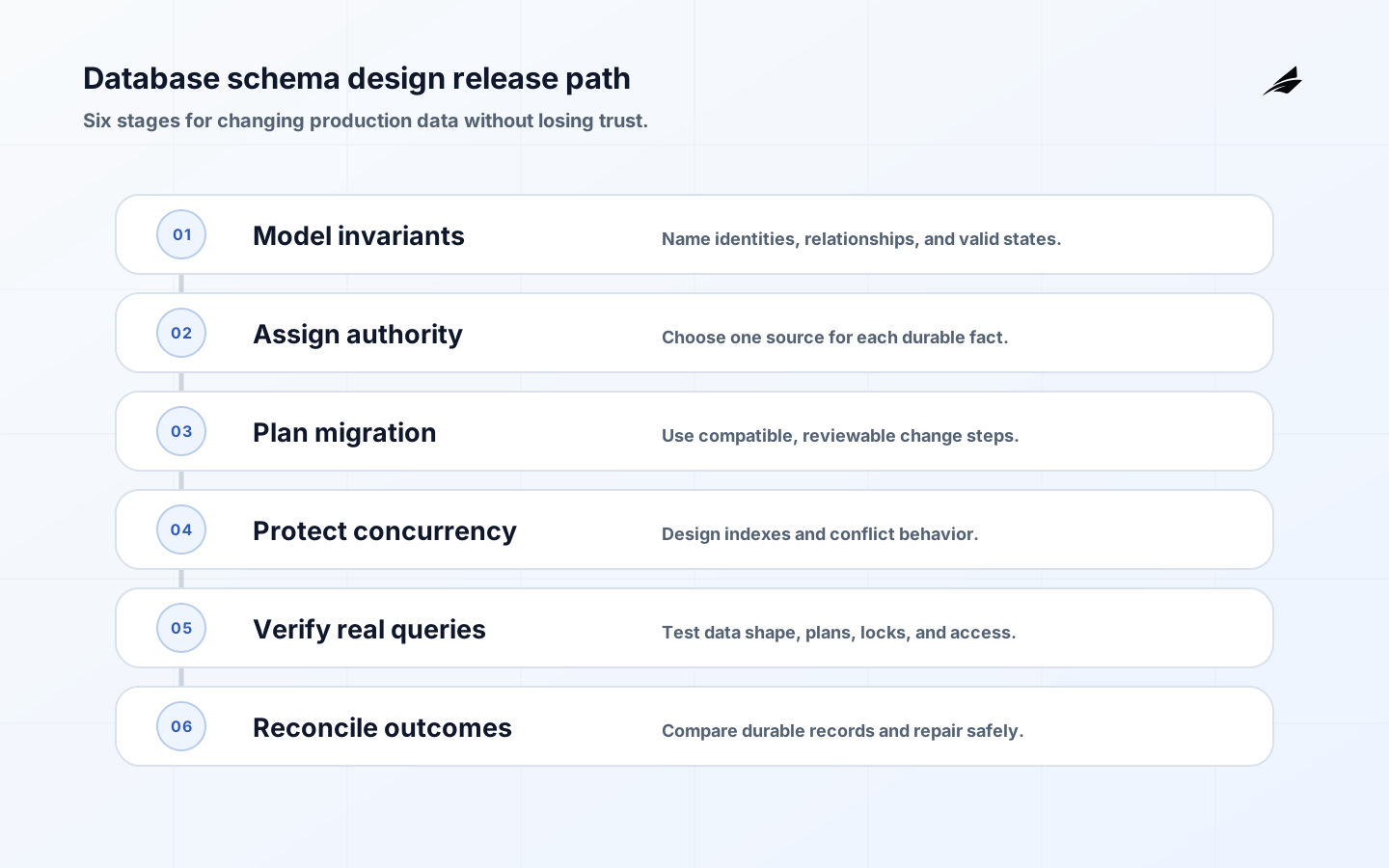
Database schema design changes character when a real product begins carrying real history. In an early prototype, a column rename or a dropped table may be a quick correction. In production, the same change can affect active sessions, reporting, integrations, backups, support investigations, and records that must remain explainable years later. The schema is not only storage structure; it is a set of invariants and compatibility promises. This guide focuses on the decisions that keep those promises intact: model ownership, encode the rules the database can enforce, migrate in observable steps, index for actual access patterns, protect query boundaries, and rehearse recovery before a change is urgent.
Treat database schema design as a production contract
Begin with the business result a record must support. An invoice needs a stable identity, an owner, money with a defined precision, a lifecycle, and a history that explains who changed it. A support ticket needs an assignment model, state transitions, timestamps, and enough context to recover after an integration failure. Do not start by copying a screen into a table. Start with the nouns, invariants, authorities, and queries that make the user task defensible. The PostgreSQL data definition documentation is a useful primary reference for constraints and schema changes, but the local contract still has to say which rule matters to the product and which team owns it.
| Schema question | Decision to record | Evidence in production |
|---|---|---|
| Identity | What makes this record unique and searchable? | Stable identifier, uniqueness rule, and support lookup. |
| Authority | Which source decides the current value? | Owner, source reference, and update history. |
| Invariant | Which states or relationships are invalid? | Constraint, validation, or explicit reconciliation rule. |
| Lifecycle | Which transitions are allowed and reversible? | Migration plan, audit event, and recovery action. |
Model ownership and invariants before adding convenience fields
A schema becomes difficult to change when several services believe they own the same fact or when a status column carries several incompatible meanings. Choose one authority for each consequential value and make derived views explicit. If an order status is computed from payments, fulfillment, and cancellation records, do not let three services write arbitrary strings into one shared column. Keep the underlying facts durable, then expose a projection or controlled transition that has a named owner. Foreign keys, unique constraints, check constraints, and not-null rules can prevent classes of corruption early. They do not replace application validation, but they make an accidental invalid state harder to persist.
Use normalized facts and deliberate read models
Normalize data when duplication would create competing truths or make updates unsafe. Denormalize when a read path has a measured performance or availability need and the refresh rule is clear. A reporting projection may copy customer and order attributes for fast filtering, but it should record the source version or update time so an operator can explain staleness. A cached summary should not become the hidden authority for a financial decision. This distinction makes a later backfill, rebuild, or reconciliation possible. Write one ordinary record, one invalid relationship, one duplicate request, and one delayed projection example before implementation; those examples reveal where a constraint belongs and where a workflow must take responsibility.
| Design choice | Protects against | Required follow-up |
|---|---|---|
| Primary or stable business key | Ambiguous support lookup and duplicate records. | Document generation, scope, and migration behavior. |
| Foreign key or explicit reference | Orphaned child data and silent relationship drift. | Enforce it or run a named reconciliation check. |
| Check or enum constraint | Impossible status, range, or category values. | Plan how future values are introduced safely. |
| Version or effective timestamp | Out-of-order updates and stale projections. | Define conflict and replay behavior. |
| Audit or history table | Unexplained consequential changes. | Restrict access and define retention. |
Plan migrations as compatibility work, not a single command
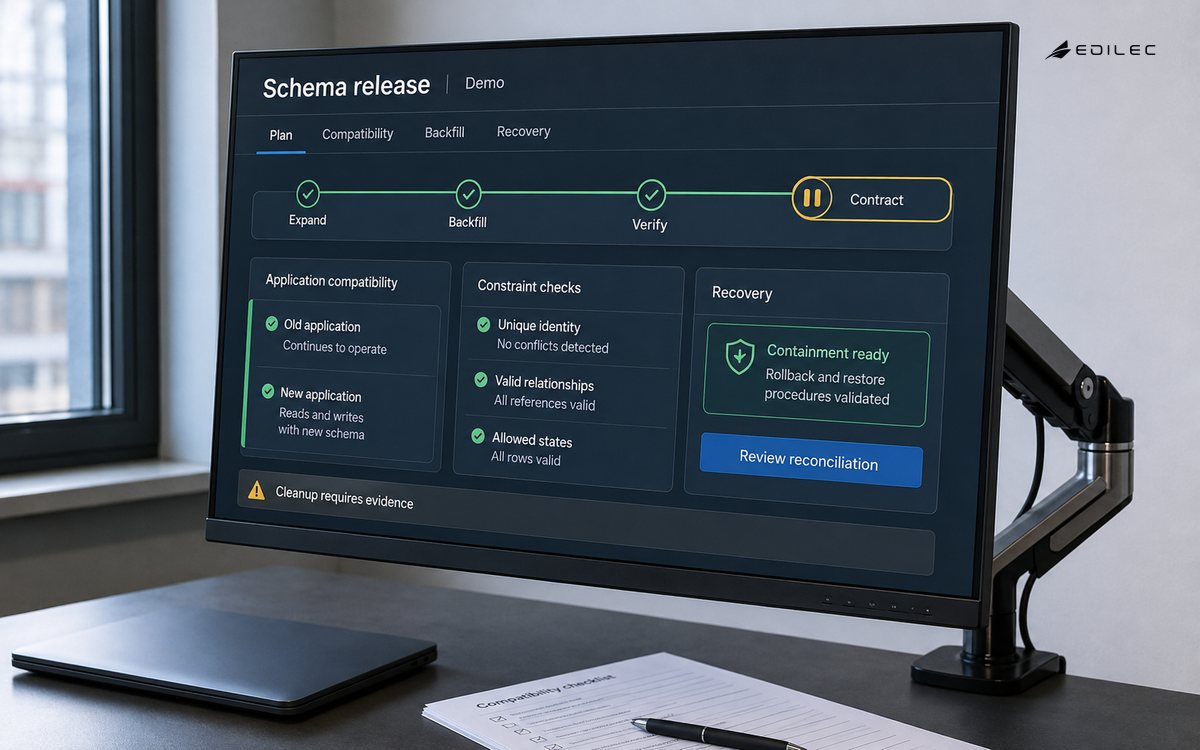
A production migration has at least three audiences: the database, the running application, and the operators who must observe or reverse the change. Prefer an expand-and-contract sequence when old and new application versions may run together. Add a nullable or optional structure, deploy code that can read both versions, backfill in bounded batches, switch reads and writes deliberately, verify the result, and remove the old structure only after usage is gone. The EF Core guidance for applying migrations recommends generating and inspecting SQL scripts for production rather than letting each application instance alter the database at startup. The principle applies beyond EF: a migration should be reviewable, state-aware, and tested against realistic data.
Name the risk of each operation. Adding an index may consume write capacity or hold a lock; changing a type may fail on one unexpected value; dropping a column may remove the only evidence needed for an audit. Capture preconditions, expected duration, lock behavior, progress signal, abort point, and post-change verification. A rollback is not always a reverse migration: after data has been transformed, the safe recovery may be restoring a snapshot, replaying an audit trail, or deploying a compensating write. The runbook should say which option is valid before the change begins.
Design for concurrent writes and real query shapes
Concurrency bugs often hide behind a schema that looks correct in a single-user test. Decide which operations must be atomic, which rows or versions need a lock, and how conflicting updates are reported. Use unique constraints for uniqueness rather than a pre-check followed by an unconstrained insert. Use transactions for a set of changes that must commit together, and use optimistic version checks when a stale edit should be rejected instead of silently overwriting a newer record. Index for the predicates, joins, sort order, and tenant boundaries that the product actually uses. The PostgreSQL indexes documentation explains that indexes can speed reads while adding write and storage cost; measure both sides and remove indexes with no meaningful workload benefit.
Tenant and privacy boundaries should appear in the access path, not only in a comment. If every query for an account must filter by tenant, make that part of the repository contract and test it with cross-tenant records. For local SQLite development, remember that foreign-key enforcement is a connection setting and must be enabled deliberately; the SQLite foreign-key documentation also calls out the indexes needed for efficient relationship checks. A test database that silently permits orphaned data can teach an application the wrong production behavior.
Keep data access safe, bounded, and explainable
The schema cannot protect a product from every unsafe query. Use parameterized statements and allow-list dynamic identifiers rather than concatenating user input into SQL. OWASP’s SQL Injection Prevention guidance makes the code-versus-data distinction explicit and also connects least privilege to containment. Give each application role only the operations it needs, separate migration credentials from request credentials, and make exports or administrative reads auditable. Add query timeouts, pagination, and row limits where a caller could otherwise turn a useful filter into an unbounded scan. For a large product, expose a stable data-access contract rather than allowing every feature to invent its own joins and authorization checks.
- Use prepared statements for values and allow-list validation for dynamic table, column, or sort choices.
- Keep migration and administrative privileges separate from the application role used for ordinary requests.
- Make tenant, role, and record authorization visible in the query boundary and verify it with negative tests.
- Record a business identifier and safe reason for consequential writes so support can find the result without raw database access.
- Monitor slow queries, lock waits, constraint failures, dead-letter writes, and reconciliation exceptions together.
Release with verification and a recovery route
Before applying a schema change, copy a representative production shape into a safe environment: large tenants, old records, missing optional values, duplicates that should be rejected, and records mid-workflow. Run the migration, the backfill, the application compatibility tests, and the rollback or containment drill. After release, compare counts, nullability, foreign-key violations, latency, lock duration, and user-visible errors with the baseline. A migration can complete successfully while the product is still wrong if a projection did not refresh, a new index changed the plan, or a report now excludes historical rows.
Make reconciliation a first-class operation. Give it a query, an owner, a safe output, and a correction procedure. When an order and its payment disagree, support should be able to identify the authoritative record, see the last applied transition, and choose a documented repair rather than editing arbitrary columns. The Database Schema Design Checklist for Reliable Digital Operations, What Changes When Caching Strategy Moves into Production, and What Changes When API Versioning Moves into Production provide useful adjacent context for data freshness, compatibility, and release verification; the schema remains the place where durable truth and constraints are defined.
Database schema design takeaways
- Model the business invariant, authority, identity, and recovery path before copying a screen into tables.
- Use constraints for relationships and impossible states, while keeping workflow policy and authorization explicit in application boundaries.
- Treat migrations as compatibility releases with generated scripts, preconditions, progress signals, and post-change verification.
- Design indexes and concurrency controls from real access patterns, tenant boundaries, and measured contention.
- Keep queries parameterized, roles least-privileged, and reconciliation searchable by business reference.
Database schema design FAQ
Should every business rule be a database constraint?
Put rules in the database when they are stable invariants that must hold regardless of which service writes the record, such as uniqueness, required relationships, or an allowed range. Keep context-dependent workflow decisions in an owned application boundary when they depend on permissions, external systems, or a time-sensitive process. The important part is to name the enforcement point and test the rule there; a rule that exists only in a UI validation is not a durable invariant.
How can a team make database migrations safer?
Generate a reviewable script, test it against realistic data, use expand-and-contract when versions overlap, bound long backfills, watch locks and query plans, and verify counts and user-visible behavior afterward. Write a containment or recovery plan before the migration starts. Do not assume that a reverse command can undo a data transformation safely.
When is denormalization justified?
Denormalize when a measured read, latency, or availability requirement justifies a second representation and the refresh, staleness, and rebuild rules are explicit. Keep the authoritative facts identifiable. A projection that cannot be rebuilt or reconciled will eventually become an unexplained second source of truth.
Conclusion: make database schema design changeable without losing trust
Production database schema design is the discipline of changing durable truth without surprising the people and systems that depend on it. Give records clear owners and identities, enforce stable invariants, migrate in compatible steps, and measure the behavior of real queries and workflows. Then make reconciliation and recovery ordinary operations rather than emergency improvisation. A schema earns trust when the team can explain what a value means, who may change it, what happens during a rollout, and how to restore a correct result when the normal path fails.