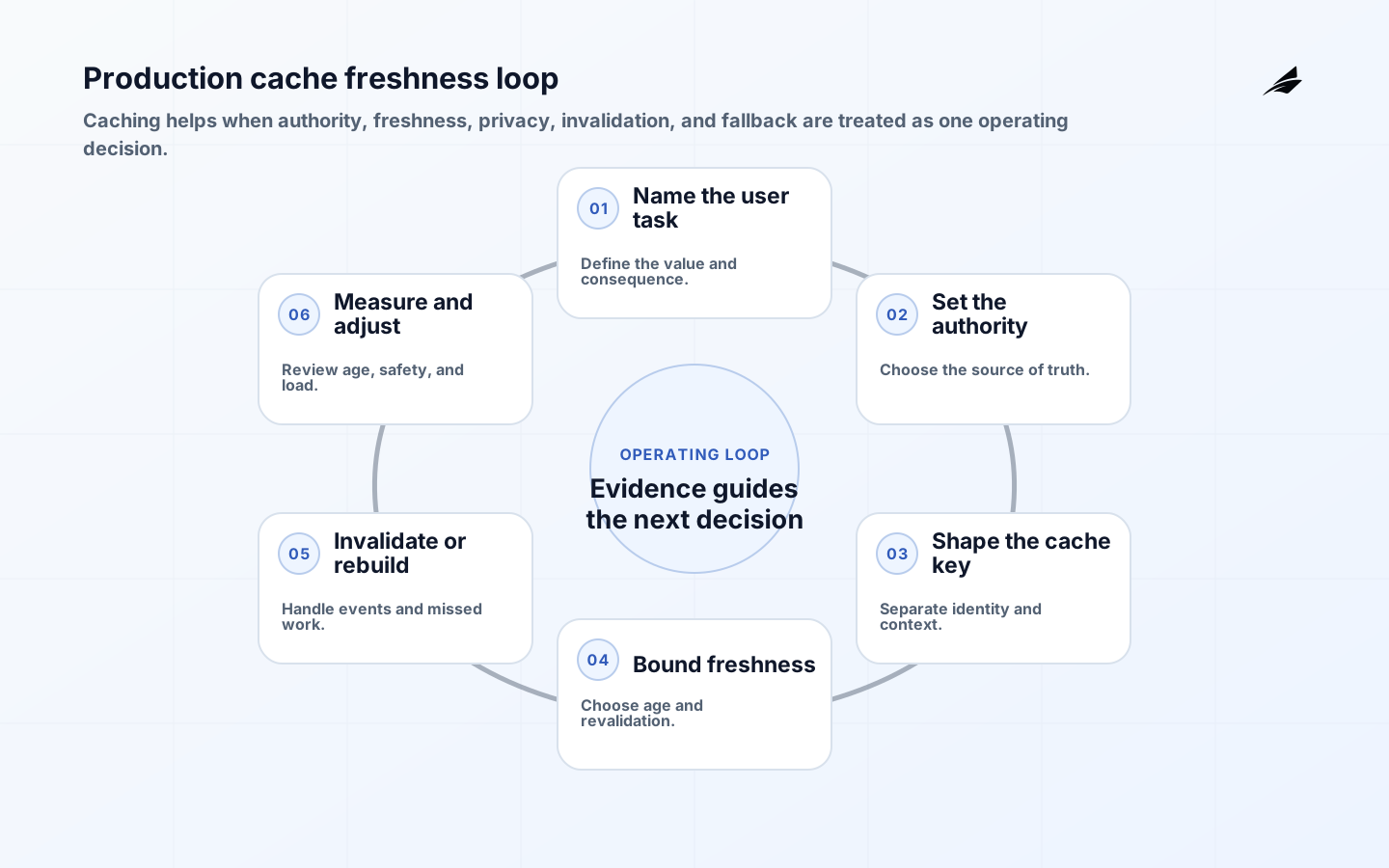
Caching becomes a production concern when a response can be served without consulting the authority that knows whether it is current, permitted, or still useful. A successful benchmark may hide the important questions: how old may this value be, who can see it, what event makes it invalid, and what should happen when the cache is unavailable? A caching strategy is therefore a correctness and security decision as well as a latency decision. This guide treats the cache as a deliberately bounded copy with an owner, a freshness contract, an invalidation path, and an observable failure mode.
Start with a user task and its authority. A public product catalogue, a personalized dashboard, a permission-sensitive account record, and a rate-limit counter do not deserve the same cache policy. For the surrounding architecture, connect this work to background jobs in production, event-driven systems in production, database schema design decisions, and error handling for founders. Each one affects when a cached value can be rebuilt, invalidated, or reconciled.
Define the production caching boundary
List the layers involved: browser cache, CDN or reverse proxy, application cache, database buffer, and any derived or materialized store. For each layer, state the cache key, value shape, authority, maximum age, privacy class, invalidation trigger, and fallback. RFC 9111 distinguishes private and shared caches and defines freshness, validation, Vary, and cache-control behavior; an application cache may add its own semantics but should not pretend the layers are interchangeable. A boundary document prevents a team from fixing an origin query while a stale edge response still shows the old outcome.

| Decision area | Question to settle | Evidence to retain |
|---|---|---|
| Authority | Which system decides the value? | Owner, source, and reconciliation rule. |
| Freshness | How old may a result be for this task? | Age budget and user consequence. |
| Key | Which identity, tenant, locale, or version separates values? | Key schema and collision tests. |
| Privacy | Can this response be shared across users or requests? | Data classification and cache directive. |
| Invalidation | Which event makes the copy unsafe or misleading? | Event, handler, and failure route. |
| Fallback | What does the user see when the cache or origin fails? | Safe response and operator action. |
Write a freshness contract that users can understand
The acceptable age is not simply a time-to-live. It is the maximum age a user or business process can accept before the result becomes misleading or unsafe. A public article may tolerate minutes, while an inventory quantity, permission, or account balance may require revalidation or no shared storage. Define whether stale-while-revalidate is acceptable, whether stale-if-error is safe, and whether a manual refresh promises an origin read. Make the age visible to monitoring and, where it changes a decision, to the user. A hidden stale response makes support and incident diagnosis much harder.
Make the cache decision observable at the same boundary that serves the response. Record a cache-status reason such as hit, miss, revalidated, bypassed, or stale-but-allowed, along with age, key class, and authority version. Keep those fields free of raw identifiers and payloads. When a policy or permission change invalidates a value, connect the event to a measured purge or version change, then sample origin responses to prove the old copy is no longer served. This turns freshness from an assumption into an operational control.
Treat cache keys as an authorization boundary
A key must include every input that changes the permitted or meaningful response: tenant, user or role where applicable, locale, feature version, resource identifier, and relevant request headers. Do not rely on the presence of a cookie to make personalized content private. MDN’s HTTP caching guidance explains why personalized content must not leak through a shared cache and why explicit directives matter. Test two users, two tenants, different roles, a changed authorization, and a request with a missing context. A hit is not healthy if it returns the wrong person’s data quickly.
Choose invalidation that matches the write path
Time-based expiry is easy to explain but can be too stale or too expensive. Event-driven invalidation can reduce staleness but introduces delivery, ordering, and replay problems. Versioned keys are often safer for immutable or deploy-generated assets, while explicit deletion is useful for a narrow administrative correction. Decide what happens when an invalidation event is lost. A durable outbox, periodic reconciliation, or read-through version check may be appropriate. Do not call a cache invalidation complete because a command returned success; retain an event or verification record that proves the relevant copy was removed or superseded.
- What exact response or computation is copied?
- Which source is authoritative when the copy conflicts?
- Which request dimensions belong in the key?
- What is the maximum safe age and how is age measured?
- Which write, policy, or deployment event invalidates it?
- Can a missed event be detected and repaired without guessing?
- What does a user see during an origin outage or rebuild?
Use expiration as a control, not a substitute for ownership
A Redis key with an expiry can prevent unbounded growth and bound the lifetime of a copy, but the timer does not know whether a business event has changed the underlying value. The Redis EXPIRE documentation is a useful implementation reference for conditional expiry and key lifetime; pair it with a domain invalidation policy. Decide what happens when a hot key expires under load, when a stampede repeats the same origin request, and when a failed rebuild leaves no value. Use request coalescing, jitter, bounded retry, or a last-known safe value only when the user consequence is understood.
Design the unhappy path before the hit path
Exercise a cold cache, expired entry, origin timeout, partial invalidation, cache outage, bad serialization, key collision, and a permission change while a response is cached. The safe result may be a direct origin read, a bounded stale response, a retryable error, or a deny. Never use stale authorization or sensitive records as a generic availability fallback. Record whether the response came from cache, revalidation, or origin so operators can see the user-visible path. A cache incident should leave enough evidence to identify affected keys or policy classes without logging private payloads.
| Risk condition | Control | Signal to watch |
|---|---|---|
| Stale public content | Age budget plus revalidation or versioned key. | Served age and revalidation rate. |
| Personalized response leak | Private or no-store policy and scoped key. | Cross-context hit tests and denied hits. |
| Invalidation loss | Durable event, retry, and reconciliation. | Event age and unresolved key count. |
| Cache stampede | Request collapse, jitter, and bounded rebuild. | Origin burst and rebuild concurrency. |
| Cache unavailable | Explicit fallback with user-safe consequence. | Fallback rate and affected route. |
Use HTTP directives precisely
Set response behavior explicitly rather than allowing a cache to infer a policy from missing headers. MDN’s Cache-Control reference explains max-age, no-cache, no-store, private, public, must-revalidate, and shared-cache directives. Remember that no-cache means revalidate before reuse, while no-store prevents storage of the response but does not erase a response already stored elsewhere. Choose directives for the data and user journey, then verify what each browser, CDN, and proxy actually does. A header copied from one route to another can turn a public asset rule into a privacy defect.
Roll out with evidence, not hit rate alone
Baseline origin latency, origin load, response age, error rate, invalidation delay, miss ratio, eviction, rebuild cost, and user-visible corrections before enabling a cache. Release one route or one key class, compare cache and origin responses for a sample, then widen only when freshness and authorization tests agree. A high hit rate can be a failure if it serves wrong or stale data. Keep a kill switch or route-level bypass with an owner and expiry. Review cache configuration as part of releases and data-policy changes, not only during performance work.
Key caching strategy takeaways
- A named authority and a user-facing freshness contract.
- A key that separates every identity, tenant, policy, and representation that matters.
- An invalidation or versioning path with replay and reconciliation evidence.
- A safe response for cache outage, origin delay, and rebuild pressure.
- Metrics for age, correctness, authorization, invalidation, and user consequence.
- A bounded rollout, bypass, and retirement plan owned by a real team.
Frequently asked questions about caching strategy
When is a caching strategy ready for production?
When the first user journey has a written authority, key, freshness budget, privacy rule, invalidation path, observable fallback, and tests for stale and cross-context responses. A benchmark alone is not readiness evidence.
Is a short TTL enough to protect sensitive data?
No. A short lifetime reduces exposure but does not prevent a wrong-context hit during that interval, nor does it account for already stored responses. Use private or no-store behavior where the data requires it and test the actual cache layers.
Which is better: TTL or event invalidation?
They solve different problems. TTL bounds age; events can shorten the period after a known write. Many systems use both, with reconciliation for missed events. The right choice follows the consequence of staleness and the reliability of the event path.
What should be measured first?
Measure served age, freshness violations, cross-context hits, invalidation delay, origin load, miss and eviction behavior, fallback rate, and corrections. Hit rate is useful only when paired with evidence that the cached answer was safe and useful.
Conclusion: make caching strategy operable
Production caching is the disciplined management of a temporary copy. Define what may be copied, for whom, for how long, and what event makes it untrustworthy. Then make invalidation, fallback, observation, and retirement part of the same design. Performance improves when correctness is explicit; otherwise the fastest response may simply be the fastest way to distribute the wrong answer.