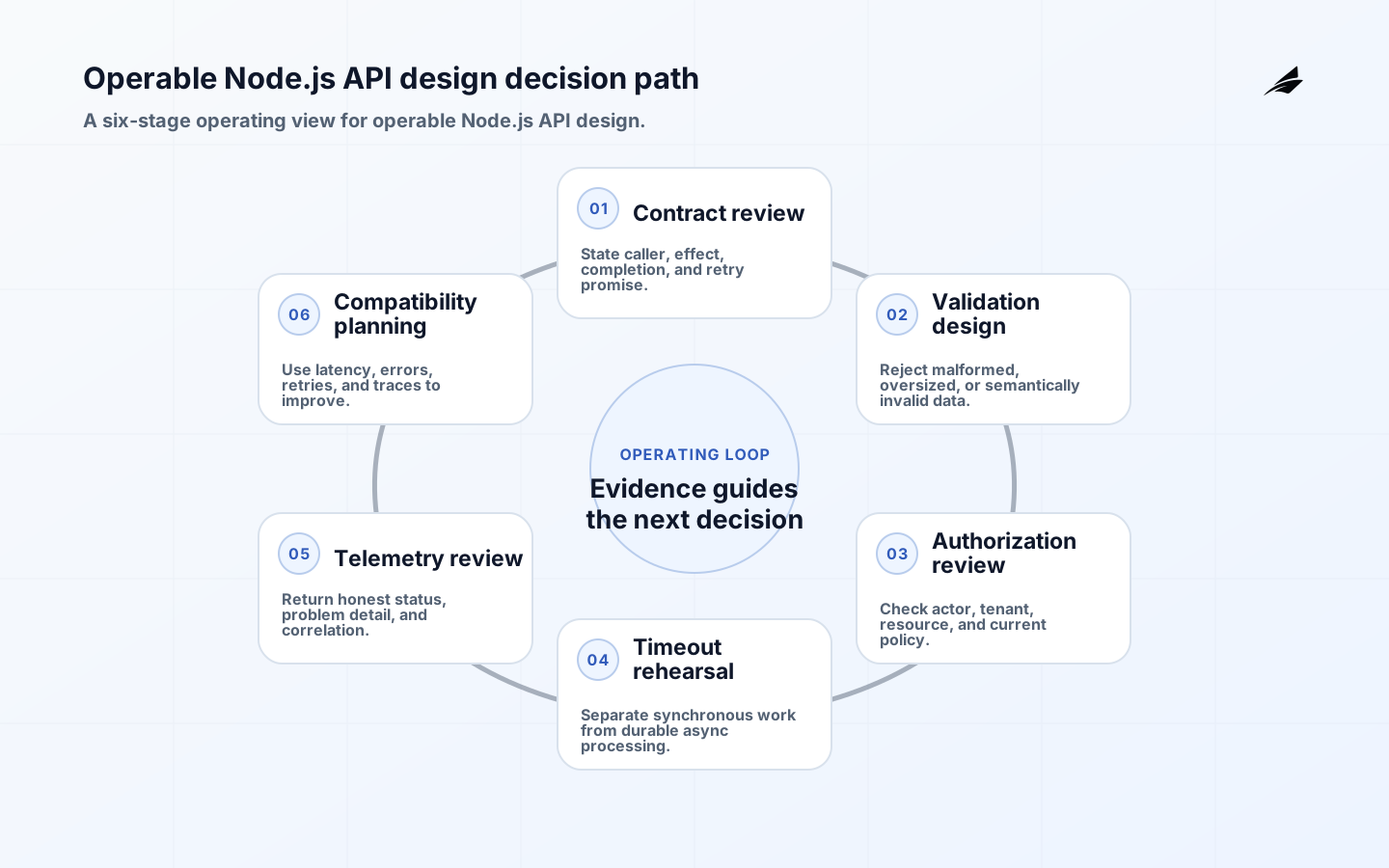
Node.js APIs are easy to start and surprisingly easy to leave underspecified. A route becomes a dependable product boundary only when its input, authority, timeout, retry, response, and support trace are explicit. This guide helps engineering teams turn Node.js HTTP handlers into contracts that can survive integration pressure, partial failure, and the next team owning the client.
Start with the operating decision for operable Node.js APIs
Node.js APIs should be planned as agreements between teams and systems, not as routes that happen to return JSON. Start with one operation and describe who calls it, which authority is required, which values are untrusted, what effect is intended, and what a caller can safely retry. That description exposes design work that a handler signature cannot: limits on body size, ownership of an idempotency key, and the difference between accepting a request and completing a long-running outcome.
| Question | Working rule | Evidence to collect |
|---|---|---|
| Outcome | Name the decision or task that must improve. | a partner integration retries a request after a timeout while the original request may already have charged a customer and queued fulfilment work |
| Authority | Identify who owns the fact and who may change it. | an API operation with a caller, authorization rule, validated request, idempotency behavior, response contract, and support trace |
| Risk | Describe the costly failure before selecting technology. | assuming that a fast controller method is reliable without defining limits, retries, error responses, and ownership of downstream work |
| Measure | Choose a signal that can change the next investment decision. | p95 and p99 latency, error class distribution, idempotency-key reuse, queue depth, dependency timeouts, and support time to locate a request |
Map boundaries and ownership for operable Node.js APIs
Validate at the boundary in layers. First reject malformed or oversized input, then validate field shape and allowed values, then check business preconditions against authoritative records. Keep error messages useful to the client without disclosing implementation detail. The OWASP input-validation guidance is a sound basis for this approach, but each operation still needs domain-specific rules such as currency precision, allowed state transitions, and tenant boundaries.
During contract review for operable Node.js API design, map the path from request to outcome with the people who operate it. Include entry points, systems of record, permissions, dependencies, handoffs, and the place where a person can correct an exception. For adjacent implementation concerns, read What Changes When Background Jobs Moves into Production, What Changes When Error Handling Moves into Production, and What Changes When Event-Driven Systems Move into Production. During contract review for operable Node.js API design, these related guides help distinguish a local implementation choice from the wider delivery practices that keep a service understandable.
| Boundary | Decision to make | Operational check |
|---|---|---|
| Input | Define identity, required fields, and validation responsibility. | Can an invalid Node.js APIs request be rejected with a useful reason? |
| Authority | State the source of truth and who can override it. | Can a reviewer explain which record or rule produced the Node.js APIs result? |
| Change | Version behavior that clients, users, or operators rely on. | Can the team deploy a compatible change and observe its effect? |
| Recovery | Give failures an owner, reference, and safe next action. | Can support resolve a disputed case without an unsafe workaround? |
Design the first observable slice for operable Node.js APIs
Idempotency is a product decision as much as a technical one. For a command that creates a payment or dispatches an order, decide what identifier represents the caller’s intent, how long it is retained, what happens when the payload changes under the same key, and which response a retry receives. Store the outcome with the key where possible. A random request identifier is useful for tracing, but it does not by itself prevent a duplicate business effect.
Make asynchronous work visible. A request may validate and enqueue a job successfully even though its final effect occurs later. Return a status that accurately describes that distinction and provide a stable resource or event for callers that need progress. Give workers the same validation, idempotency, timeout, and observability discipline as synchronous code. Otherwise the API looks healthy while the customer-facing outcome is stuck in an unowned queue.
- Write one Node.js APIs decision record with owner, boundary, and success condition.
- Collect ordinary, invalid, delayed, and contradictory examples before estimating broad scope.
- Assign an accountable operator for exceptions and a named escalation path.
- Carry a request correlation reference from the API response to the operator record.
- Test the recovery path as deliberately as the successful path.
- Review p95 and p99 latency, error class distribution, idempotency-key reuse, queue depth, dependency timeouts, and support time to locate a request after the first release before expanding the design.
Control risk without blocking work for operable Node.js APIs
Error contracts deserve versioned care. HTTP status codes carry general meaning, while RFC 9457 defines a machine-readable problem-details format for cases where callers need more context. Define stable problem types, a traceable instance identifier, and safe extension members. Do not encourage clients to parse a human description. Error responses are part of the contract that support tooling, mobile clients, and integration partners will depend on.
Use authoritative guidance with local evidence for operable Node.js APIs
During contract review for operable Node.js API design, the design choices above should be checked against primary guidance and then tested against local constraints. Useful references include Node.js HTTP documentation, Node.js debugging guide, RFC 9457: Problem Details for HTTP APIs, OWASP Input Validation Cheat Sheet. These sources explain standards and supported behavior; they do not replace the organization’s own decision about owners, legal obligations, service targets, and user impact. In this Node.js APIs context, turn the guidance into concrete configuration, review evidence, and runbooks that a team can use during a release or incident.
Measure the service and improve it for operable Node.js APIs
Node’s HTTP interface is intentionally low-level and supports streaming, so application code must make deliberate choices about timeouts, back pressure, cancellation, and resource cleanup. Give outbound calls deadlines, bound concurrency around scarce dependencies, and handle connection failures as normal operating conditions. Record dependency name and outcome in telemetry, but keep tokens, personal data, and full payloads out of routine logs.
Review APIs from the caller’s point of view after the first incident or integration delay. Can they tell whether a timeout was safe to retry? Can support find the operation from a supplied reference? Can an operator replay or compensate a failed job without direct database changes? Those answers are stronger evidence of API quality than the number of endpoints or the brevity of a controller.
Key takeaways: Node.js APIs
- Node.js APIs should begin with a real operational decision, not an abstract technology preference.
- Use an API operation with a caller, authorization rule, validated request, idempotency behavior, response contract, and support trace as the unit of planning and review.
- Make authority, change behavior, and recovery visible before scaling a design.
- During contract review for operable Node.js API design, use authoritative guidance as an input, then validate the result with representative local cases.
- Let p95 and p99 latency, error class distribution, idempotency-key reuse, queue depth, dependency timeouts, and support time to locate a request determine whether the next increment is justified.
Frequently asked questions
What is the smallest useful scope for Node.js APIs? For a Node.js API, prove one customer-facing operation with bounded records and a documented recovery path. During contract review for operable Node.js API design, the first release should prove ownership and behavior under normal and uncomfortable cases. It does not need to centralize every adjacent process.
When should a person intervene? An API owner should decide when a request crosses a financial or customer boundary, repeats with ambiguous intent, or reports a problem that automation cannot safely classify. The operator needs a trace reference and an approved compensating action.
How do we know the design is ready to expand? Add API operations after callers can retry safely, support can locate a request by reference, and dependency failures have tested ownership. Endpoint count and a green smoke test do not establish a durable contract.
Node.js API design becomes a durable advantage when the team designs the decision, authority, evidence, and recovery path together. Begin with a partner integration retries a request after a timeout while the original request may already have charged a customer and queued fulfilment work, keep the first change narrow enough to observe, and use real operating signals to guide the next investment. That is how a technical choice becomes a service people can trust.
Practical decisions for operable Node.js API design
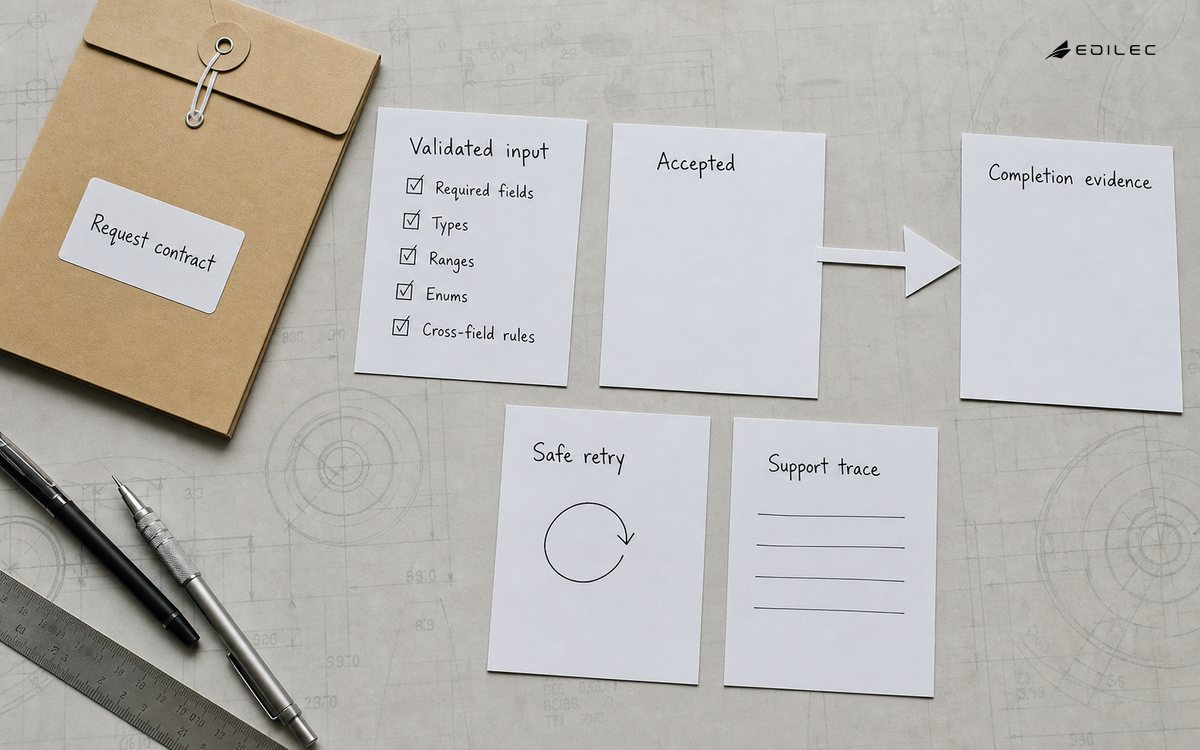
Treat one business operation as the design unit. For a shipment endpoint, specify authority, body limits, idempotency lifetime, downstream timeout, accepted asynchronous state, and the support trace. A problem-details response should give clients a stable category and safe action without exposing stack traces or credentials. Measure latency and errors by route and outcome, then watch dependency timing, rejected work, queue age, and event-loop pressure. Additive contract changes should be exercised with old clients before removal is considered.
Related reading for operable Node.js API design
Compare this guide with What Changes When Background Jobs Moves into Production, What Changes When Error Handling Moves into Production, What Changes When Event-driven Systems Move into Production. During contract review for operable Node.js API design, these adjacent articles help connect the implementation choice to ownership, delivery, and operations.
How to Design Node.js APIs Engineering Teams Can Operate FAQ
How should a Node.js API handle uncertain completion?
Use an operation identifier and queryable state when the server cannot know completion before the caller timeout; never imply that a retry is automatically safe.
What is the practical starting point?
Pick one business operation, define its caller-visible states and limits, then test duplicate, timeout, denial, and dependency-failure behavior.
When should the team scale the approach?
Broaden the API surface only after the first operation has useful traces, clear ownership, documented compatibility, and a rehearsed recovery path.
Conclusion: operable Node.js API design
An operable Node.js API is a contract between callers and the people who keep the service healthy. Define completion, validation, authorization, time budgets, and evidence together; then grow the surface only when the first operation can be diagnosed and safely changed.