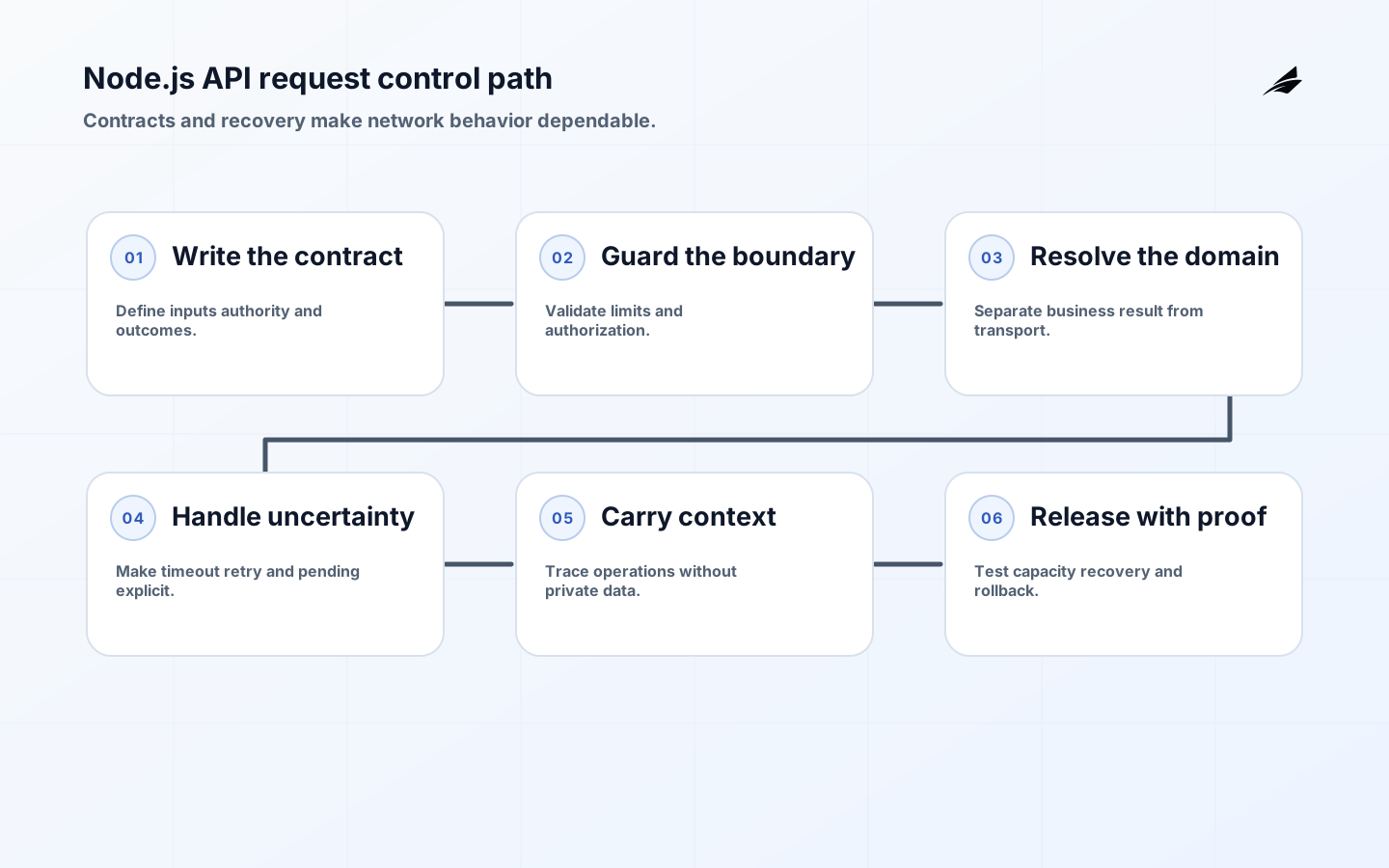
A Node.js API becomes dependable when it defines what a request means before it defines how a route is wired. Consumers need to know which inputs are accepted, who may act, what success represents, which errors are correctable, whether a retry is safe, and how an asynchronous operation is discovered. Node’s HTTP documentation describes the transport primitives, but a production service must add a business contract, trust boundary, failure model, and operating evidence. This checklist is organized around those decisions so a small endpoint can grow without making uncertainty somebody else’s incident.
Start from a contract and one critical request path
Choose one operation with real consequence: create an order, submit a claim, reserve stock, update a profile, or retrieve an authorized statement. Trace caller intent, authentication, input parsing, authorization, domain decision, persistence or provider call, response, audit, and telemetry. Write normal, validation, denied, conflict, pending, and unexpected failure examples. Do not expose a database row as the public contract simply because serializing it is convenient.

Define idempotency before consumers build retries. A network timeout does not tell the caller whether the server did nothing or completed the work. Give repeatable commands a durable idempotency key or business operation identifier and document its retention and scope. Link the contract to REST API contract mistakes and fixes when an existing service needs to make an unstable response safer without breaking every client.
| Contract concern | Question to settle | Evidence |
|---|---|---|
| Identity and scope | Who is calling, for which tenant, account, role, or resource? | Authenticated principal and scoped authorization decision |
| Input | Which types, ranges, relationships, and size limits are accepted? | Structured validation and negative tests |
| Outcome | What is complete, accepted, rejected, pending, or unknown? | Response examples, status rules, and operation lookup |
| Retry | Can a caller repeat the request without duplicating harm? | Idempotency storage or documented non-retry behavior |
| Evolution | How will consumers learn and migrate? | Versioning, deprecation, changelog, and compatibility checks |
Validate at the edge and authorize the action
Parse untrusted input before it reaches domain logic. Validate structure, content type, size, formats, ranges, cross-field relationships, and business preconditions. Reject unknown or unsafe inputs deliberately; silent coercion turns a client typo into a hidden behavior. Authentication establishes who presented credentials, while authorization decides whether that principal may perform this action on this resource now.
Keep authority close to the protected operation
Do not trust a client-provided account ID, role, status, or tenant value. Load the server-side resource in the caller’s scope and make the authorization decision at the operation boundary. The OWASP REST Security Cheat Sheet is a useful baseline for access control, input, rate limiting, and error handling; translate it into local rules for object isolation, sensitive fields, webhook signatures, and support access.
Set limits according to cost and consequence. Body size, request duration, concurrency, pagination, rate, and outbound calls should all have bounded behavior. Return a stable problem category and correlation identifier without leaking stack traces, database names, tokens, or internal topology. Make rejected input useful enough for a caller to correct while keeping private validation logic out of the response.
Keep transport outcomes separate from domain outcomes
An HTTP response code cannot carry every business state by itself. A request can be syntactically valid but refused because the order is already closed; a command can be accepted but not complete because a queue or provider must continue; a conflict can require the caller to reload or reconcile. HTTP Semantics helps ground method and status choices, while the application contract must explain the meaning users need.
| Situation | Client-facing behavior | Server and operator evidence |
|---|---|---|
| Validation failure | Identify the field or rule and do not start business work | Aggregate safe error category and request correlation |
| Known domain refusal | State the decision and a safe next action | Decision evidence linked to the operation |
| Conflict or stale write | Tell the caller which version or state must be reconciled | Conflict details and affected resource identity |
| Accepted async work | Return durable operation identity and status route | Queue, dependency, and aged-pending signals |
| Unexpected fault | Use a generic response and preserve a safe correlation ID | Cause, context, owner, and recovery runbook |
Make timeouts and retries honest
A timeout is a transport observation, not proof that the business action failed. If a provider may have completed, store an operation identity, reconcile by that identity, and only then decide whether a retry is safe. Set deadlines that propagate to downstream calls, stop work that no longer has a caller, and distinguish cancellation from a completed operation. The Node.js errors documentation is a useful reference for retaining causes and translating errors at the right boundary.
Use retry budgets and backoff for transient operations, but never retry every error. A validation failure, authorization denial, or deterministic domain refusal should not be retried. A provider outage may need a queue or circuit breaker rather than more concurrent requests. Document the response a client sees while work is pending and the human or service that resolves an aged unknown state.
Carry request context into telemetry
Logs, metrics, and traces should answer a support question. Record operation name, outcome category, latency, dependency result, retry count, queue age, and privacy-safe identifiers. Carry a correlation ID through database calls, messages, and outbound requests. Node.js asynchronous context tracking can help preserve context across asynchronous work, but test the context boundary and do not store sensitive payloads merely because they are available.
Make correlation useful to recovery
A correlation ID is valuable only if it points an operator toward the next check. Connect it to the request, domain operation, dependency call, and durable record where appropriate. Give alerts an owner and a runbook that says what status to inspect, what can be replayed, and when to escalate. A generic “500s are high” alert cannot explain whether users should retry, wait, or contact support.
Protect the event loop and dependency budget
Capacity planning starts with request cost, not a single requests-per-second target. Identify parsing, serialization, database work, remote calls, file handling, queue usage, and CPU-heavy code. Long synchronous work can delay unrelated requests in a Node process; move bounded heavy computation to an appropriate worker or service. Track event-loop delay, connection-pool wait, queue age, memory, and downstream saturation alongside latency.
Set concurrency at the narrowest dependency and make rejection or waiting visible. A fast median can hide a failing tail that causes users to retry and create duplicates. Exercise load with realistic payload sizes and slow dependencies, then record the capacity assumption in the release decision. Do not let an autoscaling policy compensate for an unbounded query or a missing timeout.
Test the contract at the boundary
Test through the actual transport for representative behavior. Include malformed input, missing credentials, unauthorized targets, duplicate commands, stale versions, dependency delays, partial failures, and an older client. Use unit tests for domain rules, integration tests for persistence and provider adapters, and a small end-to-end set for critical user promises. The test strategy operations playbook can help keep recovery evidence close to the contract.
Treat configuration and deployment as part of readiness. Fail fast on missing critical settings, keep defaults explicit, protect secrets, and verify that the deployed route exposes the expected version and health signals. Release gradually when the operation is consequential, compare outcome categories with a baseline, and keep a rollback or correction path that does not invalidate in-flight operations.
API work also connects to the client and query choices around it. The GraphQL tradeoffs guide is useful when one service is asked to support flexible composition, because resolver cost and authorization still need the same discipline. Keep the transport contract stable even when a new client shape is added, and record which errors remain safe to retry. This makes a Node.js service easier to evolve without turning every consumer into a bespoke integration.
Finally, make the contract usable by the people who operate and consume it. Publish examples that show validation, authorization, conflict, pending, and unknown outcomes; test them through the deployed transport; and link each alert to a record or status check. A GraphQL tradeoffs guide can help when a Node.js service is also a resolver backend, because the same limits and identity rules apply. Clear examples reduce support guesswork and keep retries from becoming accidental business commands.
Use the same contract in documentation, tests, telemetry, and support instructions. A consumer should see examples for validation, denied access, conflict, pending work, and an uncertain provider result; an operator should find the corresponding status or record with the correlation identifier. Review the route again when an integration, identity provider, data model, or retry policy changes. This keeps the Node.js API contract current instead of allowing a convenient success response to outlive the behavior it describes.
Node.js API checklist takeaways
- Define inputs, authority, outcomes, idempotency, and evolution before routing.
- Validate and limit untrusted work; authorize the specific object and action.
- Treat timeouts as potentially uncertain and make retries safe or explicit.
- Carry privacy-safe context through logs, metrics, traces, and recovery records.
- Test real boundaries and release only with an owner for failure and reconciliation.
Node.js API implementation questions
What belongs in the first API contract?
Describe the operation, actor and resource scope, required inputs, validation failures, authorization rule, successful and pending responses, retry and idempotency behavior, and deprecation path. Include examples that show empty, denied, conflict, and uncertain states.
Should a client retry a timeout?
Only when the operation is safe to repeat or the server supports an idempotent identity and status lookup. A timeout may mean the remote system completed the action. Reconcile before issuing a second non-idempotent command.
What does production readiness prove?
It proves the service has an explicit contract, scoped authorization, bounded work, truthful failure states, correlated signals, dependency and recovery tests, configuration checks, release criteria, and a named owner for exceptions.
Conclusion: build APIs people can safely retry
A reliable Node.js API is an agreement about identity, input, business outcome, time, and recovery. Start from one critical request path, make uncertain results visible, bound cost, carry context through operations, and test the moments when dependencies refuse to cooperate. That is how a route becomes a service consumers can build on.