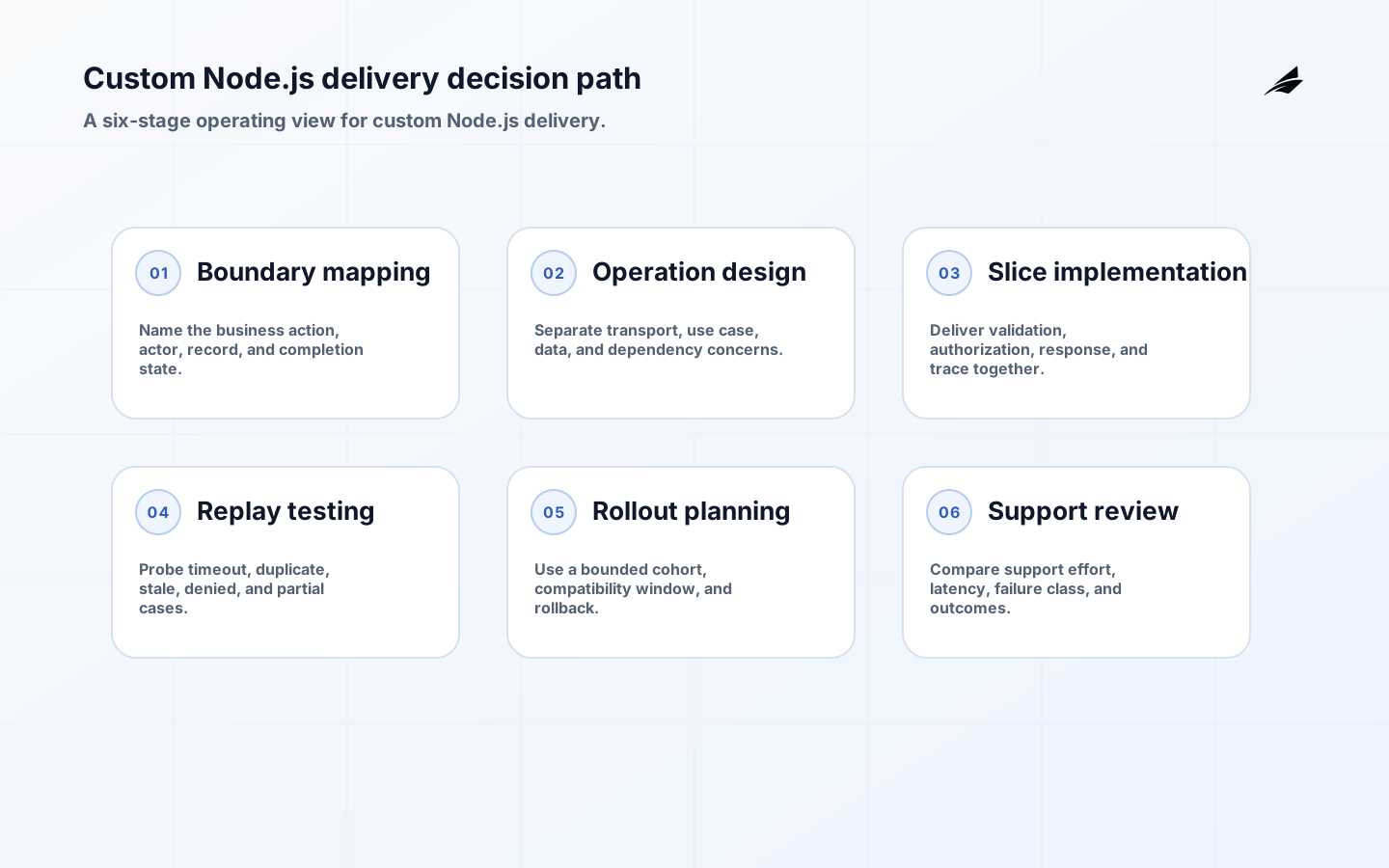
Custom software depends on APIs that make business actions understandable to both people and machines. Node.js APIs can support that work well when teams decide the boundary, validation, idempotency, authorization, and observability before implementation expands. The practical approach here is to ship one complete operation, learn from its failure modes, and make the next change cheaper.
Set the Node.js APIs boundary for custom Node.js delivery
Define the API boundary as a contract with both a caller and an operator. Validate syntax and semantics at ingress, identify the authenticated actor, authorize the particular action on the particular record, invoke a use case, and translate the outcome into a documented HTTP response. HTTP Semantics provides the baseline meaning of methods and response codes; preserving those meanings makes clients and support tools less surprising. The Node.js HTTP API documents the runtime transport surface.
| Situation | Decision to make | Evidence to keep |
|---|---|---|
| Synchronous command | Caller needs an immediate confirmed result | Complete bounded work before returning |
| Long-running task | A report or import exceeds request time | Accept durably and expose status lookup |
| Retryable write | A network retry may repeat a purchase | Use an idempotency or business-event key |
| Partner outage | A dependency is slow or unavailable | Time out, classify, and route to recovery |
Make the critical Node.js APIs decisions explicit for custom Node.js delivery
Separate request handling from business work and infrastructure adapters. A route should coordinate parsing, identity, and response mapping; it should not silently decide a pricing rule or open a database transaction whose retry semantics nobody owns. Decide early which work must finish before a response and which can be accepted durably for asynchronous processing. For the latter, return an honest status and give callers a way to discover the later outcome.
- Which user or business outcome is Node.js APIs expected to improve, and how will the team recognize success?
- For custom Node.js delivery, resolve this question during boundary mapping: Which system, module, or role owns each material decision and its authoritative data?
- For custom Node.js delivery, resolve this question during boundary mapping: What does a normal outcome, a delayed outcome, and an exception look like to a user?
- For custom Node.js delivery, resolve this question during boundary mapping: Which action must be idempotent, auditable, or subject to a higher level of review?
- For custom Node.js delivery, resolve this question during boundary mapping: What change can be released independently without weakening an existing customer path?
- For custom Node.js delivery, resolve this question during boundary mapping: Which metric and real support example will be reviewed after the release?
Deliver a small, testable Node.js APIs slice for custom Node.js delivery
Use a representative endpoint to prove the full path: schema validation, authorization tests, correlation ID propagation, structured logs, timeouts, idempotency behavior, and a failure response that callers can act on. Bound outbound calls with deadlines and cancellation, and ensure retryable writes have a durable business key. Exercise partial dependency failure in integration tests, because a fast local mock rarely reveals queue delays or connection-pool exhaustion.
| Failure pattern | Why it harms the workflow | Control to introduce |
|---|---|---|
| Route owns business rules | Rules diverge between entry points | Move decisions into a shared use case |
| Unbounded retry | Transient failure becomes duplicate work | Retry only known-safe operations with limits |
| Lost context | Support cannot join logs across services | Propagate correlation IDs |
| Generic error response | Clients cannot recover correctly | Use stable, documented error categories |
Operate Node.js APIs as a living capability for custom Node.js delivery
Node’s asynchronous execution model makes request context easy to lose unless it is carried deliberately. The AsyncLocalStorage documentation is useful for correlation context, but it does not replace an explicit event schema. Record request ID, actor or client identity where appropriate, target resource, result class, and dependency latency in logs and traces. Apply the OWASP API Security testing guidance to decide which identity and authorization facts belong in the trace.
Review risks before they become customer work for custom Node.js delivery
One tempting shortcut is a catch-all error handler that returns the same generic failure for invalid input, denied access, transient dependency trouble, and unexpected defects. That hides the response a caller should take and makes incidents harder to classify. Another is retrying every failure, which can multiply writes or overload a dependency that is already struggling.
- Use a billing or API record that exercises a valid result, a rejected input, a delayed dependency, and a conflicting update.
- Record the caller, policy or version, and resulting state so an operator can reconstruct the decision.
- Exercise retries, timeouts, stale records, and concurrent updates against the business operation.
- During boundary mapping for custom Node.js delivery, confirm that monitoring names the affected capability rather than only the infrastructure component.
- Give support a customer-safe message tied to the affected operation and an escalation owner.
- Document the rollback or correction path before traffic is expanded.
Measure whether Node.js APIs reduces friction for custom Node.js delivery
Track successful and failed requests by operation, p95 and p99 latency, timeout and retry rates, authorization denials, queue age for accepted work, and the number of requests without a searchable correlation ID. Review these per endpoint and dependency; an average across the whole service will conceal the fragile path.
Prepare a production rollout for Node.js APIs for custom Node.js delivery
For a Node.js API, the design review should walk a request from an actual client through each boundary: parsing, authentication, authorization, business execution, persistence, outgoing calls, response, and observability. Name the input and output at each step, then ask which state remains if the process stops after that step. This is particularly important for commands that cause an external effect. A request that returns after persisting intent needs an explicit worker, retry policy, and user-facing status rather than an optimistic assumption that the effect happened.
Acceptance should include controlled failure. Make a downstream dependency exceed its deadline, have a client repeat the same write, deny access to a record that exists, and inject a malformed message into asynchronous work. Confirm that the API response category is stable, the trace connects the work, and the operator can determine whether to retry, compensate, or ask for human judgment. These scenarios turn abstract resilience claims into a supportable contract.
Keep framework middleware small and explainable. Authentication, rate limiting, request parsing, and correlation can be shared, but business-specific authorization and decision logic should remain close to the capability it protects. That keeps a new endpoint from inheriting a broad permission accidentally and makes a later security review about named rules rather than the order of middleware registrations.
The API team should also publish ownership for operational decisions that are often left implicit: which team may change timeout defaults, who owns a failed outbox message, what client-facing message is safe during an incident, and when a dependency circuit is opened. These details are part of the API contract in practice. Naming them early prevents a customer-impacting outage from becoming a debate over whether the service or its caller was supposed to recover.
Key takeaways for product teams
- Node.Js APIs should be owned as a business and operational decision, not an isolated framework task.
- Define authority, failure behavior, and acceptance evidence before expanding the implementation.
- During boundary mapping for custom Node.js delivery, release one meaningful path with observability and recovery instead of several unconnected features.
- During boundary mapping for custom Node.js delivery, use standards and official documentation to guide contracts, security controls, and maintenance choices.
- During boundary mapping for custom Node.js delivery, review production evidence regularly and retire assumptions that real use has disproved.
What should the first Node.js APIs review decide? During boundary mapping for custom Node.js delivery, it should decide the valuable workflow, the authoritative owner for its critical facts, the failure that would cause real harm, and the smallest release that can prove a safer or faster result. How much design is enough? During boundary mapping for custom Node.js delivery, enough to make normal outcomes, exceptions, permissions, and rollback understandable to the people who will run the system; details can grow with evidence rather than speculation.
- When should a team revisit Node.js APIs? During boundary mapping for custom Node.js delivery, revisit it after an incident, a material workflow change, a security finding, or a metric that shows rising manual recovery.
- Should every edge case block the first release? No. During boundary mapping for custom Node.js delivery, classify it, make the safe handling visible, and provide an accountable recovery route.
- Who owns the decision? During boundary mapping for custom Node.js delivery, the business capability owner and technical owner share it; support, security, and client teams contribute the evidence that keeps the decision grounded.
Node.js API delivery becomes durable when it is tied to a real workflow, an explicit owner, and feedback from production. Start with a narrow capability, protect the behavior people already depend on, and expand only after the operating evidence is clear. During boundary mapping for custom Node.js delivery, related reading: software modernization roadmaps, quality assurance for custom systems, and software support playbooks.
Practical decisions for custom Node.js delivery
Use a business action as the design unit. A bulk reassignment API needs a maximum batch, authorization scope, partial-success rule, duplicate reporting, audit event, and operator recovery. For long work, persist an operation record and expose a bounded status vocabulary; accepted must not imply complete. Versioning includes fields, defaults, errors, timing, authentication, and rate limits. Contract-test old clients, publish deprecation dates, and measure actual usage before removing behavior. This makes the next consumer cheaper rather than preserving every accident.

Related reading for custom Node.js delivery
Compare this guide with Node. APIs: Implementation Checklist, GraphQL Tradeoffs: Security Review, REST API Contracts: Mistakes and Fixes. During boundary mapping for custom Node.js delivery, these adjacent articles help connect the implementation choice to ownership, delivery, and operations.
Node.js APIs for Custom Software: A Reliable Delivery Guide FAQ
When should a custom API become asynchronous?
Make an operation asynchronous when its work exceeds the caller time budget, involves durable retries, or needs a human-visible state before completion.
What is the practical starting point?
Start with one business action, preserve operation state, and expose validation, authorization, partial work, and correction in the same vertical slice.
When should the team scale the approach?
Extend the design after the first slice has measured outcomes, tested replay behavior, and a supportable compatibility window for callers.
Conclusion: custom Node.js delivery
Custom Node.js delivery becomes dependable when the API boundary follows the business action rather than the framework structure. Ship one observable slice, prove its recovery behavior, and let production evidence decide which abstractions deserve to spread.