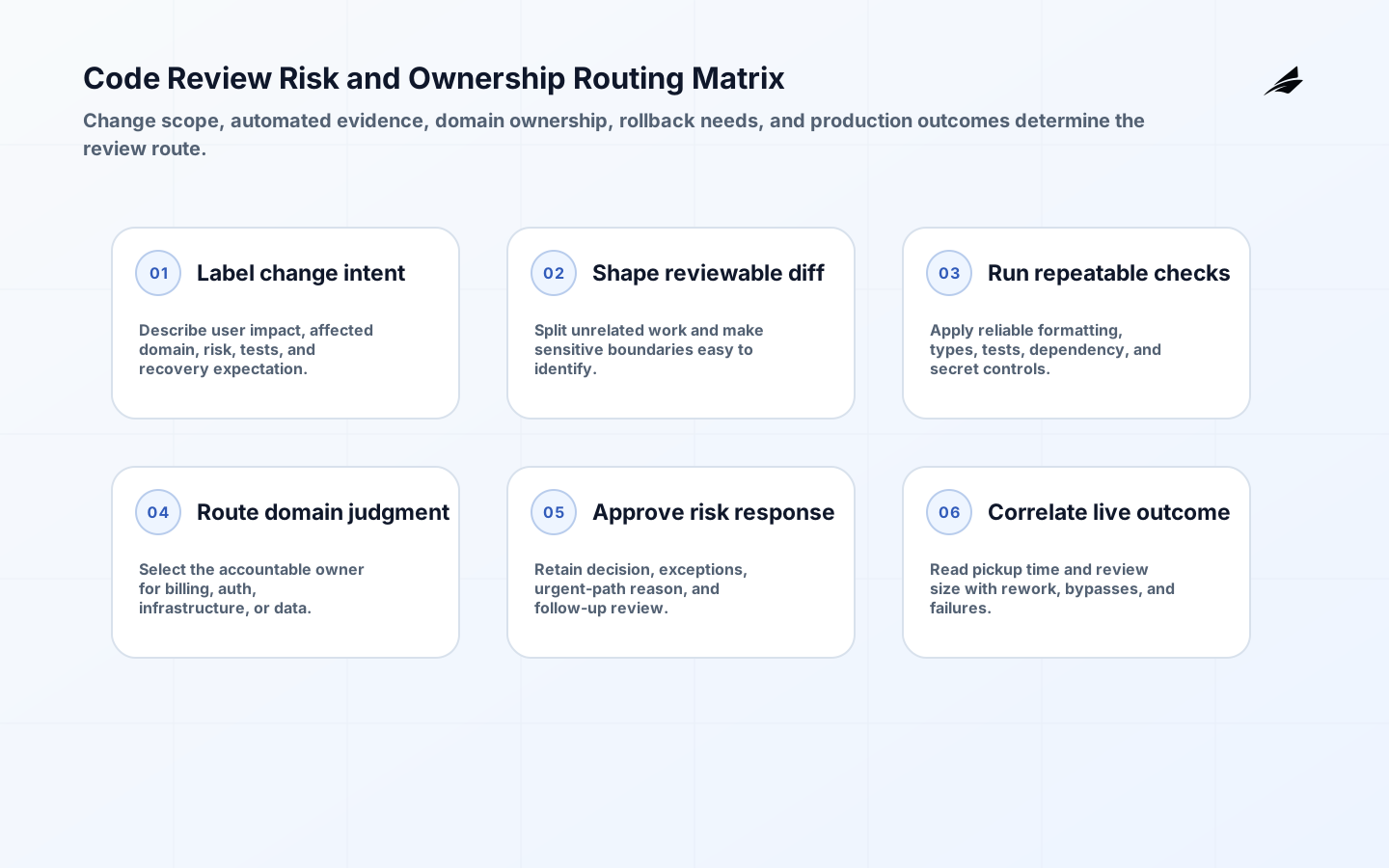
Code review systems are a social and technical control around change. The tool can show a diff, run checks, and record approval, but those features alone do not create useful review. A review system works when authors can make a change understandable, reviewers know what they own, automated checks catch routine regressions, and urgent fixes have a documented fast path. Buying or configuring a platform without those agreements simply moves an existing bottleneck into a more visible queue.
Make code review systems an explicit operating decision
Assess the workflow before the vendor. How large are ordinary changes? Who can approve code that affects billing, authentication, or infrastructure? Which checks are deterministic enough to block a merge? The Google Engineering Practices reviewer guide emphasizes reviewing for the overall code health rather than demanding perfection. That principle helps keep comments focused on correctness, maintainability, security, and user impact.
| Decision | Question to answer | Useful evidence |
|---|---|---|
| Approval model | Whose review is required for risky changes? | Code owner and branch rule |
| Automation scope | Which checks may block merge? | Reliable actionable CI result |
| Emergency route | How does urgent work proceed? | Recorded authority and follow-up |
| Retention | What evidence must be auditable? | Change, review, and check history |
Define the code review systems contract and boundaries
Set a review policy that distinguishes evidence from ceremony. Require a concise change description, test evidence, risk or rollback note when appropriate, and owners for sensitive paths. Do not require a fixed number of approvals for every file; require the accountable domain owner when a domain boundary changes. Use branch protection to enforce the policy that is real, not a collection of rules teams routinely bypass. GitHub's pull request documentation is a useful reference for the mechanics, but the policy must be local to the team's risk.
- Define who owns each domain and which changes need that owner's approval.
- Require purpose, test evidence, and risk notes in the change description.
- Automate only checks that are accurate, fast enough, and actionable.
- Create an emergency path with recorded authority and a mandatory follow-up.
- Review queue age and bypasses weekly, not only merged pull-request counts.
- Use incident findings to improve review prompts and automated checks.
Build and roll out code review systems in a bounded slice
Pilot the system with one service and measure the complete path from opening a change to operating it in production. Add formatting, type checks, tests, dependency review, and secret scanning as automation becomes reliable. Keep bots concise: a warning that cannot be acted on is review noise. Establish an urgent-change path that still records the reason, approver, and follow-up review; emergency should alter the sequence, not erase accountability.
| Failure mode | Guardrail | Signal to monitor |
|---|---|---|
| Rubber-stamp approval | Reviewers lack context or time | Small changes and owner routing |
| Noisy automation | Warnings train teams to ignore checks | Actionable threshold and bot ownership |
| Single approver bottleneck | One expert blocks all change | Documented domain ownership and backups |
| Bypass culture | Protection is routinely overridden | Exception log and incident review |
Operate code review systems with evidence
Track pickup time, time to first useful review, rework caused by late findings, change failure rate, review size, and bypasses. These are diagnostic signals, not individual performance scores. A falling merge time paired with rising incidents means the system is optimizing the wrong thing. Security review deserves special attention for authorization and input-handling changes; the OWASP Code Review Guide provides a useful checklist of areas to examine.
Make code review systems tradeoffs explicit
A centralized approval gate can give compliance evidence, but it becomes fragile when only one person understands a domain. Distributed ownership improves throughput when code owners and documentation are credible. Choose a platform for identity integration, audit retention, checks, and developer workflow, then design the human rules around it. The technical debt guide is related: review patterns often reveal the debt that makes ordinary changes too hard to reason about.
A concrete example keeps the design grounded. A pull request that changes a tax calculation, database migration, and dashboard label is difficult to review because it bundles independent reasoning. Splitting the label change lets reviewers concentrate on the accounting rule and rollback. The aim is not a smaller diff for its own sake, but a change a responsible reviewer can verify. Use the example to identify the authoritative record, expected outcome, failure that changes it, and operator who must choose the next action. That turns an architectural claim into a reviewable slice of production behavior.
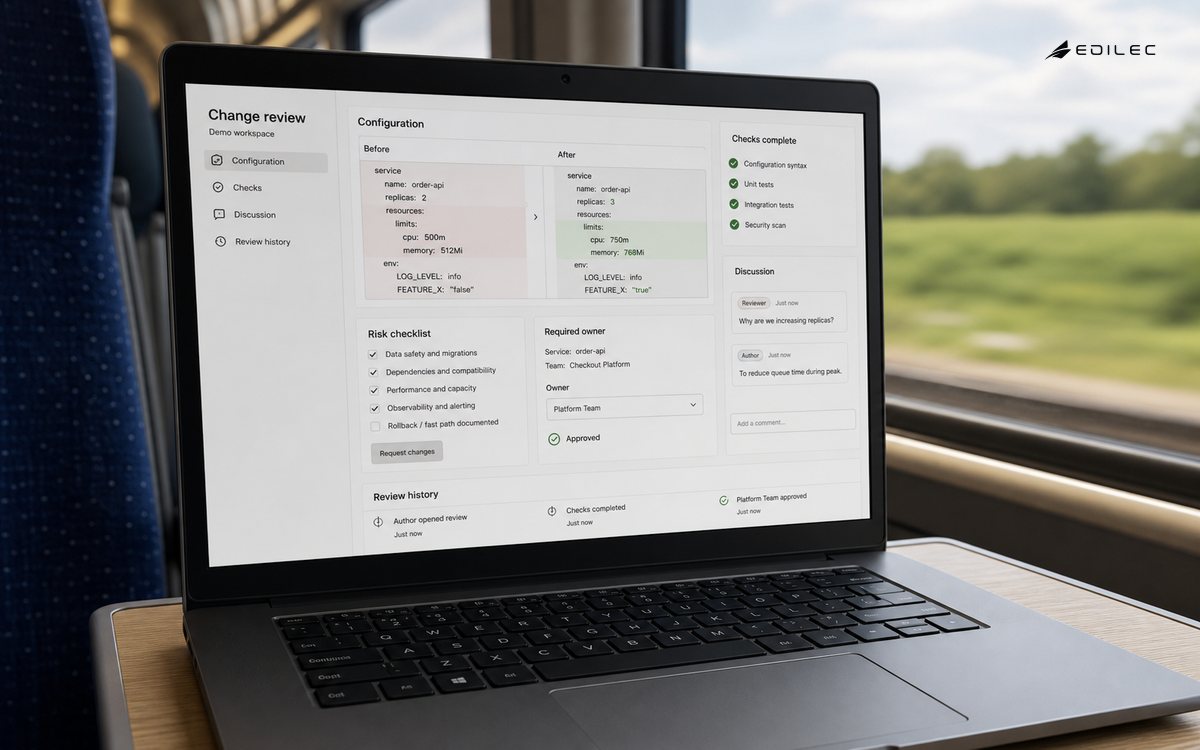
Sample completed reviews for a clear purpose, test evidence, owner involvement, actionable comments, and a link to the released outcome. For high-risk paths, test protection rules by attempting merges without an owner, with failed security checks, and through the emergency path. Keep evidence with the change: a reproducible command, expected telemetry, and a note about the failure being exercised. Checks should state the capability being protected, not merely mirror implementation details.
Engineering leadership owns policy and exceptions; domain owners review behavior in their area; platform teams own check reliability; security partners define specialist-review triggers. Reviewers need a shared standard, not an unstated expectation that they know every service. Agree on a review cadence and escalation route before the first exception arrives. The aim is a timely decision by someone with the right context, not a large committee or a static policy nobody can apply.
Pilot rule changes with a team that has enough change volume to expose queue effects. Add one required check at a time, publish what it catches and who maintains it, then remove or tune it when false positives become a material cost. Publish entry and exit criteria for each step, including the condition that stops expansion. A narrow rollout gives a better learning loop because intended and observed behavior can be compared while scope remains correctable.
Read time to first useful response alongside rework, change failure rate, reverted changes, queue age, and emergency bypasses. A service target for response can help, but should never become an excuse to skip complex review or optimize comment count. Ask what action each signal would justify. A metric without an owner, threshold, or practical response is not useful observability; a smaller trusted set is stronger during a release or incident.
Revisit code owners, protected branches, bot rules, and retention requirements as teams change. The durable artifact is not a vendor configuration but a practice that can explain why a change was accepted and how the team will learn if it was wrong. Include this in dependency review, planning, and incident follow-up so it does not depend on one person's memory. Clear notes should cover normal operation, known limits, emergency authority, and recovery evidence.
Before treating a plan as ready, turn it into a small review exercise. Use a deliberately sensitive code change to verify that owner routing, required checks, and exception logging operate as documented. The exercise should name an owner, expected evidence, and a concrete result that would cause the team to pause. It is intentionally more demanding than a demo: demonstrations often assume ideal data and a cooperative dependency, while real confidence comes from showing that the boundary responds predictably when assumptions fail. Store the result with the relevant change record so the next engineer can repeat the check rather than reconstruct its purpose from an old ticket.
Failure rehearsals are a practical way to protect operational knowledge. Ask a reviewer unfamiliar with the subsystem to identify the change purpose, risk, test evidence, and rollback route from the pull request alone. The person running the rehearsal should use ordinary documentation and permitted tools, not private memory or administrator shortcuts. Note the time needed to detect the condition, make a decision, and verify recovery. Those observations often reveal a missing identifier, unclear authority, or unsafe default before an incident turns the same omission into customer harm. Feed the learning back into tests, runbooks, and the next release rather than treating the exercise as a one-time audit.
Change needs a decision record as well as code or configuration. Record policy changes with a rationale and expiry for temporary exceptions so rules do not silently harden into unexamined process. Include the scope, assumption, approval authority, observable success condition, rollback or correction route, and date for reconsideration. This discipline keeps temporary controls from becoming invisible permanent architecture. It also gives product, operations, security, and engineering a common artifact for resolving tradeoffs, which is far more useful than asking each group to infer intent from dashboards, implementation details, or an incomplete support history.
Key code review systems takeaways
- Review quality depends on clear ownership and understandable changes.
- Automation should remove routine work, not create untriaged noise.
- Approval counts are weaker than accountable domain review.
- Emergency changes still need evidence and follow-through.
- Queue time and incident outcomes must be read together.
- A review platform cannot substitute for maintainable code boundaries.
Code review systems FAQ
Should every change have two reviewers? Not necessarily; match review depth to impact and domain ownership. Can automated tools replace review? No. They are strong at repeatable checks, while people still assess intent and operational fit. What is a healthy review size? Small enough that a reviewer can hold the change in mind; split independent work rather than using review size limits as a cosmetic target.
Conclusion: make code review systems dependable
A durable code review system makes important changes easier to understand, challenge, and recover. Treat the platform as part of a broader operating model of ownership, evidence, automation, and learning.