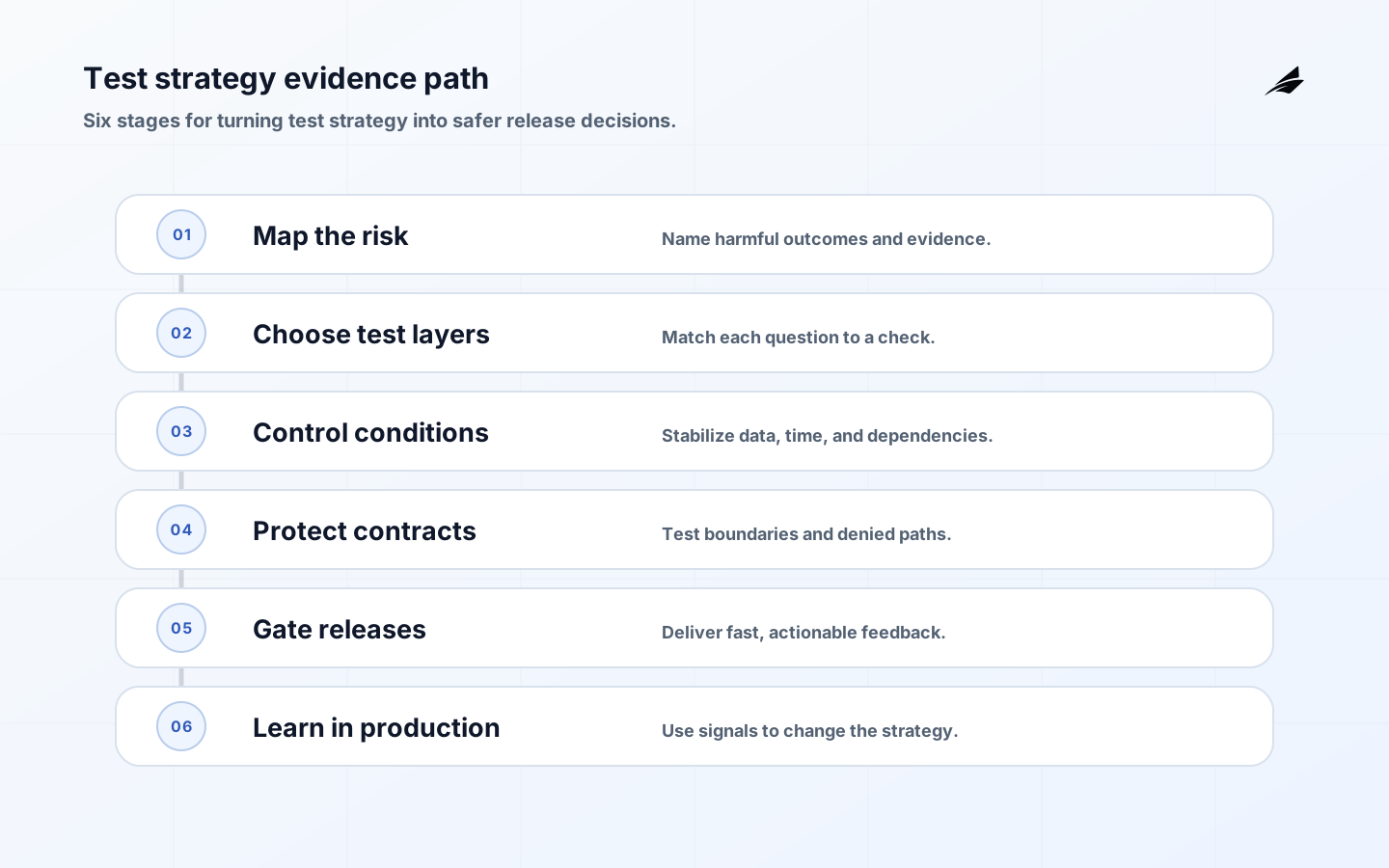
A test strategy is a decision about what confidence a team needs before changing software, where that confidence can be produced, and what happens when the evidence is incomplete. It is not a target percentage or a large collection of scripts. A payment boundary, a public API, an internal queue, and a visual detail may need different checks because their failure consequences differ. The plain-language approach is to name the harmful failure, choose the smallest reliable test that can detect it, keep data and environments under control, and connect the result to a release or recovery decision. This guide gives IT managers and delivery teams a practical structure for doing that without turning testing into a ritual.
Start with risk, not with a test-count target
List what could materially harm a user, record, contract, or operation: an unauthorized read, a duplicate payment, a lost draft, a migration that drops history, a report that silently omits a tenant, or a release that cannot be rolled back. State the expected behavior and the evidence that would prove it. A small pure function may be well protected by a focused unit test; a permission boundary needs integration and negative-path tests; a critical customer journey needs a user-visible check and production signal. The Google SRE chapter on testing for reliability treats tests as a way to reduce uncertainty about change, while also warning that a passing test alone does not prove reliability. Use that framing to prioritize investment.
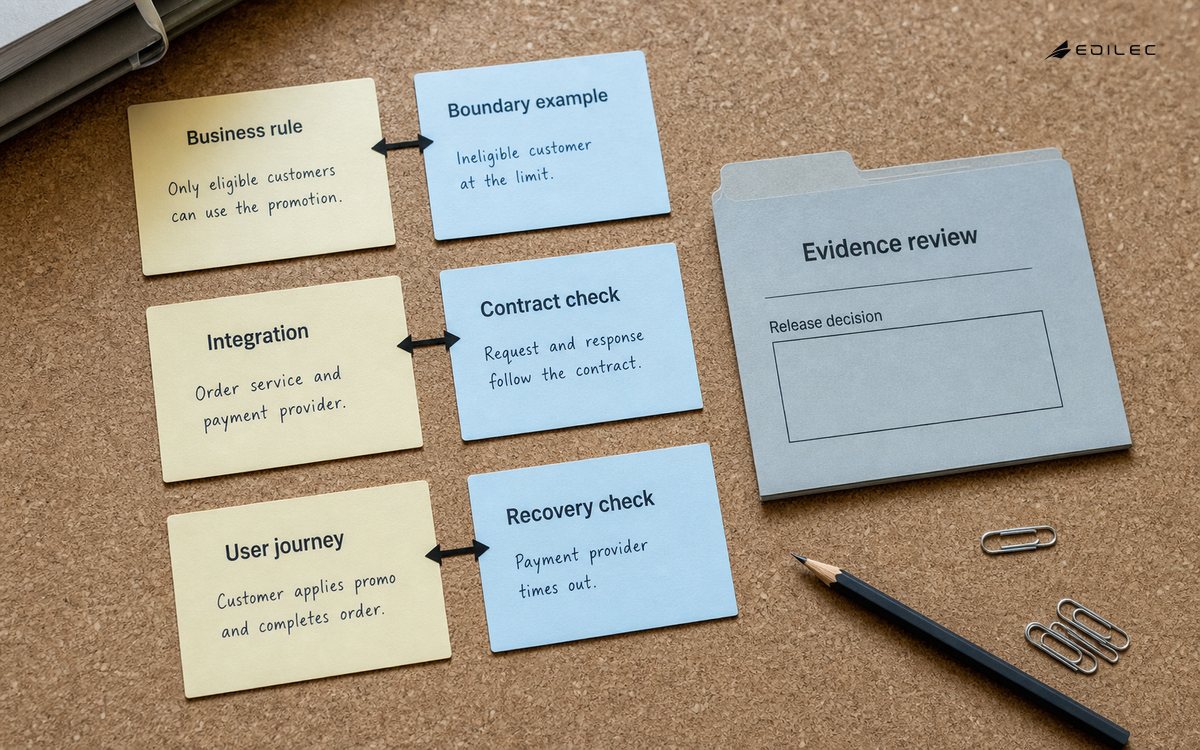
| Risk | Useful first check | Evidence that changes the release decision |
|---|---|---|
| Business rule drift | Focused unit or property example. | Expected result across ordinary and boundary inputs. |
| Integration mismatch | Contract or service integration case. | Request, response, failure, and compatibility evidence. |
| User workflow failure | User-visible journey with a recovery path. | Task completion, error, and preserved-intent behavior. |
| Production configuration | Deployment or configuration verification. | Running system matches approved assumptions. |
| Security consequence | Negative authorization and input cases. | Denied action and safe evidence without leakage. |
Choose test layers by the question they answer
Unit tests answer whether a small piece of logic behaves correctly under controlled inputs. Integration tests answer whether code, storage, queues, and external boundaries work together with the expected contract. End-to-end tests answer whether a user can complete a high-value journey through the deployed interface. Load, resilience, security, accessibility, and migration checks answer different questions again. Do not use a slow browser suite to prove every formatting branch, and do not use a unit test to claim that a deployed permission check works across the actual data boundary. Keep each layer focused enough that a failure tells the team what decision needs attention.
Make lower-level tests readable and independent
A good unit test names the behavior, controls its inputs, and fails for a reason the maintainer can understand. Avoid coupling assertions to internal implementation details when the behavior can be tested through a public interface. The Microsoft guidance on unit testing best practices emphasizes readable, resilient tests that support regression detection and design quality. Keep tests independent, deterministic, and fast enough for the feedback loop they serve. A test that passes only because another test ran first is not evidence; it is hidden state.
Control data, time, dependencies, and environments
Test data should make the case under review obvious. Use stable factories or fixtures, isolate records per test where the system permits it, and include boundary, missing, stale, duplicate, and unauthorized cases. Control clocks and random values when time or identity affects the result. Stub or virtualize external services you do not own, then reserve a smaller set of integration tests for the real contract. Playwright’s best practices recommend isolated tests, controlled data, user-facing locators, and avoiding tests that depend on third-party sites. The same principle applies to APIs and queues: a test should fail because the product behavior changed, not because a vendor banner or shared fixture changed.
| Source of instability | Control | Signal to monitor |
|---|---|---|
| Shared state | Fresh data or cleanup per test. | Order-dependent failures. |
| Time and async work | Fake clock, bounded waits, explicit polling. | Timeouts and retry frequency. |
| External dependency | Controlled stub plus a small real-contract suite. | Contract drift and external failure rate. |
| Environment drift | Pinned configuration and deployment verification. | Difference between test and release settings. |
| Browser or device variation | Defined supported matrix and stable fixtures. | Failure by browser, viewport, or device. |
Protect contracts and boundaries with negative cases
A contract test should cover what another component may rely on and how the boundary behaves when input is invalid, late, duplicated, unauthorized, or partially unavailable. For an API, check status, shape, required fields, error categories, idempotency, and authorization. For a database migration, check old and new application versions, existing records, constraints, indexes, and rollback or containment. For an event consumer, check duplicate delivery and recovery after a restart. Add security cases that align with the OWASP Application Security Verification Standard rather than treating security testing as a separate final phase. A denied action is a product behavior that should remain stable and observable.
Keep the test’s authority clear. If a fake response says the server accepted a request, the test cannot prove the database persisted it. If a UI test checks a button but not the record or status that changed, it cannot prove the workflow completed. Use a focused end-to-end case for the business result and lower-level tests to make failures easier to localize. Link the strategy to The Plain-language Guide to REST API Contracts, Code Review Systems Checklist for Reliable Digital Operations, and Frontend Performance Checklist for Reliable Digital Operations when contract evidence must travel through review and delivery.
Test what users can observe and recover
For a critical journey, assert the visible behavior rather than the component’s internal arrangement. A user should see the correct label, status, validation message, preserved draft, and next action. Playwright guidance recommends user-facing locators and web-first assertions that wait for the expected interface state. Use the same test to cover a recoverable error when it is part of the promise: a failed save should keep the entered data, a denied action should not show success, and a delayed job should expose a pending reference. Keep the journey small enough to diagnose and valuable enough to protect.
Make continuous integration a feedback system
Organize checks so that the fastest useful evidence arrives first and the release gate reflects risk. A pull request may run formatting, type checks, unit tests, contract tests, and a focused browser journey; a scheduled or pre-release job may run broader cross-browser, migration, load, resilience, and security suites. GitHub workflow documentation describes workflows as configurable automated processes triggered by repository events or schedules. Use that capability to make ownership and artifacts visible: retain logs, traces, screenshots, coverage where meaningful, and the exact version or environment used. Do not hide a flaky test behind unlimited retries; measure and fix its cause.
A red build should lead to an action. Classify failures as product regression, test defect, environment issue, dependency drift, or an accepted condition with an expiry. Set a threshold for blocking, a named owner, and a time to revisit quarantined work. If a check is too slow for every commit, decide where its evidence belongs rather than deleting it. If a check regularly fails for reasons unrelated to the product, repair the test harness or change the question. A test strategy is healthy when the team trusts the signal enough to change behavior based on it.
Connect tests to production signals and recovery
Testing ends at release only if production behavior never changes, which is not a realistic assumption. Compare release health with test evidence using error rates, latency, task completion, authorization denials, duplicate work, and support incidents. The SRE guidance links testing to monitoring and mean time to repair because a test can block a change before harm or help an operator detect the exact failure quickly. Add lightweight post-deploy checks for configuration, health, migrations, and a representative read-only journey. When an incident escapes, add or improve the check that would have reduced uncertainty, then verify that it can run at the right point in the delivery path.
- Name the harmful failure and user consequence before choosing the test type.
- Keep tests isolated, deterministic, and tied to a clear authority and expected outcome.
- Cover denied, duplicate, delayed, partial, and recovery behavior at the boundary where it matters.
- Use a small user-visible suite for high-value journeys and lower-level tests for fast diagnosis.
- Treat CI, production telemetry, and incidents as one feedback loop with owners and stop rules.
Make the test strategy tradeoffs explicit
More tests are not automatically more confidence. A large suite with slow feedback, flaky dependencies, and assertions tied to markup can discourage useful changes. A small suite that misses authorization, migrations, and recovery can create false confidence. Decide where speed matters, where realism matters, and where a human review is still necessary. Record the risk accepted by not testing a path, the trigger that would justify more coverage, and the owner who reviews the decision. This keeps the strategy proportional to product consequence instead of turning a generic testing pyramid into a permanent rule.
Test strategy takeaways
- Prioritize tests by the consequence of a wrong, missing, delayed, or unauthorized outcome.
- Use each test layer for a clear question and keep lower-level checks fast and readable.
- Control data, time, dependencies, and environment so failures identify product changes.
- Test contracts and negative paths at the boundary where permissions, persistence, and side effects become real.
- Connect release evidence to production signals, incident learning, and a visible decision about what happens next.
Test strategy FAQ
Is code coverage a good test strategy target?
Coverage can show which code was executed, but it does not show whether the important behavior, authorization boundary, failure path, or user recovery was asserted. Use it as one diagnostic signal, then pair it with a risk map and outcome-based tests. High coverage of low-consequence branches is not a substitute for a small set of strong boundary and journey checks.
How many end-to-end tests should a product have?
Enough to protect the highest-value user journeys and their most consequential recovery paths, while keeping the suite isolated and diagnosable. Use unit and integration checks for breadth and an end-to-end layer for the confidence that only a deployed path can provide. Add a test when a risk or escaped incident justifies it, not because a number feels complete.
What should a team do with a flaky test?
Measure the failure pattern, classify whether the cause is test, product, environment, or dependency, and assign an owner with an expiry for any quarantine. A retry may collect evidence, but unlimited retries hide uncertainty. Fix shared state, timing, selectors, data, or environment drift, or change the test question so its signal is reliable again.
Conclusion: make testing evidence that changes decisions
A dependable test strategy makes risk visible and turns evidence into action. Start from the harmful failure, choose a test layer that can see it, control the conditions that affect the signal, and cover denied and recovery behavior where it matters. Run the right checks at the right delivery point, connect them to production telemetry, and use incidents to improve the next decision. The result is not a perfect suite; it is a team that can change software with a clear understanding of what is protected, what is still uncertain, and how to respond when reality differs from the test.