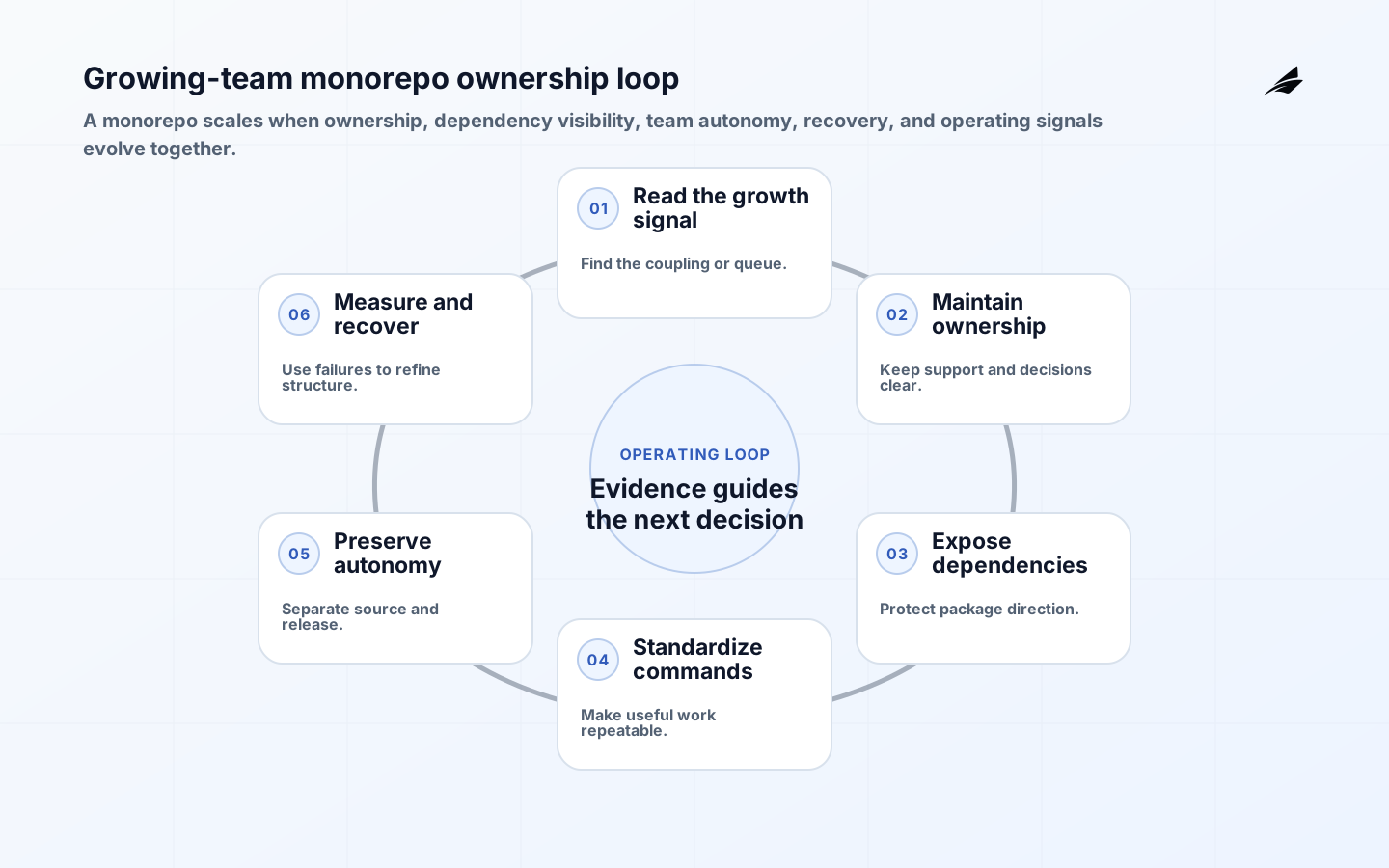
A monorepo often feels easiest when a team is small: everyone can see the same code, update a shared package, and run one familiar command. Growth changes the meaning of that convenience. More teams bring more ownership boundaries, more release schedules, more sensitive paths, and more reasons to avoid an accidental dependency. A field guide for growing teams therefore starts with relationships: which teams change which products, which packages are true shared contracts, and how a change can be proven safe without asking the entire organization to understand every directory.
Use the repository as a coordination surface, not a substitute for product ownership. Make the decision concrete with TypeScript architecture for reliable operations, database schema design for growing teams, and software modernization for growing teams. Each adjacent concern can increase or reduce coupling. The aim is a structure that lets a team make a local improvement while making cross-team impact visible early.
Define what growth is changing
At a new scale, ask which failure has appeared: review wait, full-build cost, package ownership gaps, inconsistent tooling, dependency drift, or release coordination. Do not respond to every symptom by adding a platform layer. Nx’s monorepo guidance distinguishes shared visibility and atomic changes from mere code collocation, and highlights affected execution, controlled sharing, and consistent commands. Use those ideas to name the bottleneck and choose one intervention that can be measured.
| Growth signal | Design response | Evidence to inspect |
|---|---|---|
| Reviewers are unclear | Assign package owners and review paths. | Unrouted or reassigned reviews. |
| Every change runs everything | Improve dependency and task graph accuracy. | Affected versus full-run duration. |
| Shared code has many consumers | Publish an explicit contract and compatibility rule. | Export growth and breaking changes. |
| Teams release at different speeds | Separate deploy units and version relationships. | Coordination and rollback incidents. |
| Security paths are hard to find | Inventory sensitive packages and require specialist review. | Change coverage and unresolved findings. |
Growth changes the repository when a package is no longer understood by one team, a release crosses more than one service boundary, or a dependency failure can strand several groups. Treat those changes as signals to revisit contracts, support coverage, and recovery rather than simply adding another workspace. A useful review names the team that benefits, the team that carries the operational load, the decision that now needs specialist input, and the evidence that would justify a boundary change.
Make ownership a maintained interface
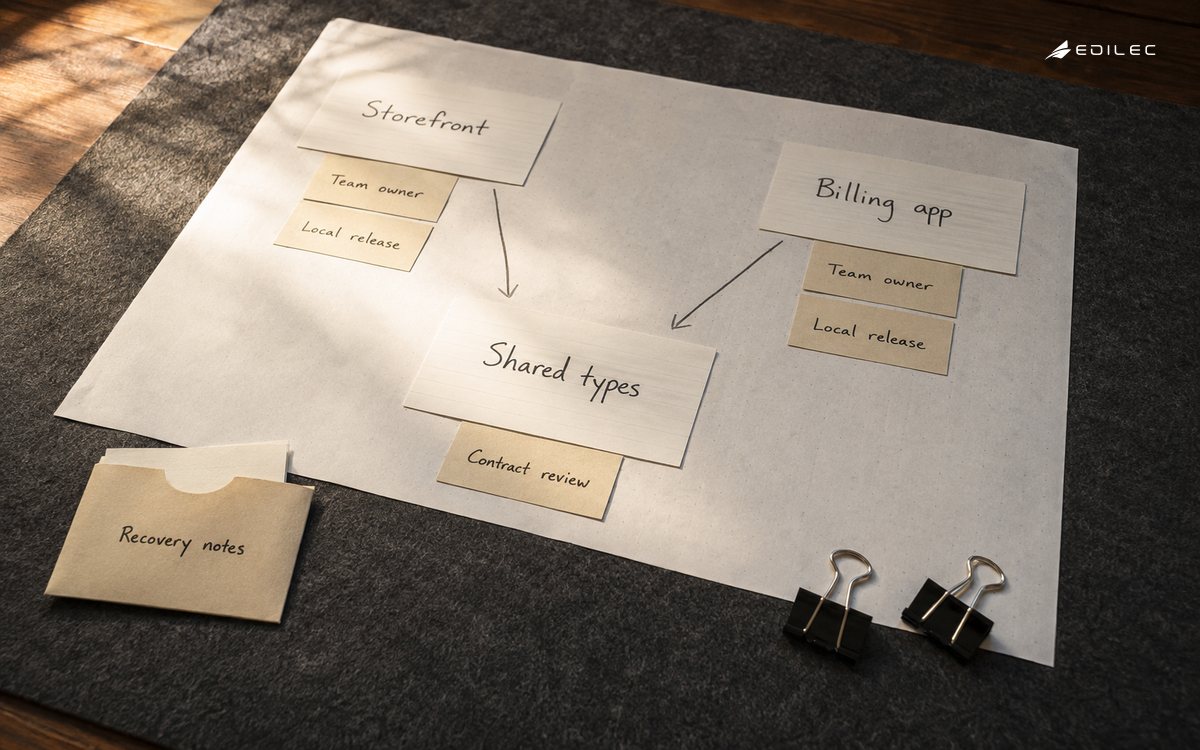
Ownership should answer three questions: who can approve a change, who supports the package when it fails, and who decides when its contract changes. A CODEOWNERS file can route review requests, but it is only useful when the named owners have time, context, and authority. GitHub’s documentation on code owners explains how path ownership can request reviews; pair it with a package catalogue that records purpose, consumers, support channel, and retirement status. Review ownership when teams reorganize, not six months after an incident.
Keep the dependency graph legible as teams multiply
Growing teams create transitive relationships quickly. A utility becomes a common import, then a domain type leaks into a UI package, then a private database client becomes a shared runtime dependency. Require direct declarations and stable public entry points. Bazel’s build reference provides a useful model for target visibility and explicit dependencies. In a Node workspace, the mechanism may be package exports, lint rules, or a graph tool, but the goal is the same: a team can remove an internal dependency without discovering an invisible consumer during release.
Standardize commands without flattening product differences
A workspace should make common actions discoverable: install, lint, type-check, test, build, and inspect affected projects. npm workspaces can provide package selection and linking, but each application may still have different runtime, fixture, or deployment needs. Define a small shared command vocabulary and let packages document their exceptions. Consistency reduces cognitive load; pretending that every product has identical checks hides real risk. Keep the command result and input versions in CI so an operator can reproduce what was verified.
- Every package has a purpose, owner, support route, and public entry point.
- Private implementation imports are blocked or reviewed as exceptions.
- Shared code changes include consumer evidence, not only its own unit tests.
- The affected graph is fast, while a clean full validation runs on a known cadence.
- Release coupling is written in compatibility and rollback terms.
- A team can deprecate or retire a package without leaving an orphaned contract.
Protect sensitive paths as repository visibility grows
A monorepo can improve review context while broadening who can read or change security-sensitive code. Inventory authentication, authorization, secrets handling, billing, personal data, deployment, and supply-chain configuration paths. Require appropriate reviewers and test changes from the neighboring application, not only the package’s own test suite. The NIST Secure Software Development Framework connects secure design and source protection to the full delivery lifecycle. Repository access, code ownership, runtime permission, and deployment permission are different controls; document all four.
Preserve team autonomy in release design
The source may be shared while deployment remains independent. Decide whether a package change is backward compatible, whether consumers can adopt it gradually, and which generated clients or schemas must move together. A shared package team should publish migration notes and a support window, not become an approval bottleneck for unrelated product work. When an atomic source change is required, make the rollout stages and rollback conditions explicit. Growth is healthy when teams can move at their own cadence while the shared contract remains visible.
Design for dependency and owner failure
Test what happens when a package owner is unavailable, a shared build is broken, a dependency is withdrawn, or a consumer has not migrated. A useful recovery path names a substitute maintainer, pins a known-good version, limits the affected release, or temporarily restores an adapter. Avoid copying private code into an application as an emergency fix without recording the new ownership and reconciliation work. Recovery should improve the graph instead of creating another hidden edge.
| Condition | Safe response | Signal for review |
|---|---|---|
| Owner unavailable | Use an assigned substitute and preserve review evidence. | Change age and ownership handoffs. |
| Shared build breaks | Stop affected releases or use a known-good artifact. | Impact scope and recovery time. |
| Dependency is removed | Use compatibility adapter or staged migration. | Consumer adoption and exception age. |
| Private import appears | Block or approve a time-bound exception. | Boundary violations by package. |
| Release rollback needed | Revert deployable unit without erasing source history. | Data or contract compatibility gaps. |
Measure whether structure is helping
Track change lead time, review response, affected-test precision, clean-build reliability, cache correctness, dependency churn, shared-package incident rate, owner coverage, and time to resolve an unowned request. Segment by team and change type so a healthy average does not hide one overloaded platform group. Use the measures to choose the next boundary or automation improvement. Do not turn them into a competition between teams; the repository is working when it makes safe change easier and unexpected coupling easier to see.
Create a cadence for structural review
A growing team should review its monorepo at a predictable moment, such as after a new product joins, a platform package becomes shared, or a release incident crosses team boundaries. Bring the package catalogue, dependency graph, ownership map, build traces, and recent exceptions. Look for changes that were easy to review but hard to support, packages whose consumer list expanded without an API decision, and checks that run often without changing a release decision. A short quarterly review can prevent years of accumulated coupling if it produces one concrete boundary or ownership improvement.
Use the review to retire as well as add. Remove unused exports, close abandoned workspaces, archive obsolete adapters, and move a package back to private ownership when its sharing story has ended. Each retirement should identify consumers, migration state, data or artifact impact, and the person who can answer a later question. A repository stays understandable when the graph reflects current relationships instead of preserving every historical shortcut forever. Make deletion a supported lifecycle state so teams do not treat growth as the only measure of platform value.
Key takeaways
- Respond to the growth symptom you can measure, not to repository fashion.
- Maintain package ownership as a support and decision interface.
- Keep dependencies direct, visible, and aligned with team and domain boundaries.
- Standardize useful commands while retaining product-specific validation.
- Separate source sharing from release coupling and runtime permissions.
- Rehearse owner, dependency, build, and rollback failure before the repository becomes critical infrastructure.
Frequently asked questions
How many owners should a shared package have?
Give it enough named maintainers to provide continuity, but keep decision accountability clear. A group can review together while one role or team owns contract, support, and retirement decisions. Revisit the list as teams change.
Can teams remain autonomous in a monorepo?
Yes, when package contracts, review scope, release units, and deployment permissions are explicit. Shared source should improve coordination, not require every team to approve unrelated implementation detail.
When should a growing team split the repository?
Consider a split when access, ownership, release cadence, or technology boundaries create more coordination cost than shared source removes. Preserve published contracts and migration evidence so the split does not become a hidden dependency rewrite.
Conclusion
A monorepo for growing teams succeeds when it makes relationships visible without turning shared visibility into shared confusion. Keep ownership current, dependency direction enforceable, builds evidence-bearing, and releases independently recoverable where possible. Growth then becomes a reason to refine the structure rather than a reason to abandon it or add another layer of ceremony.