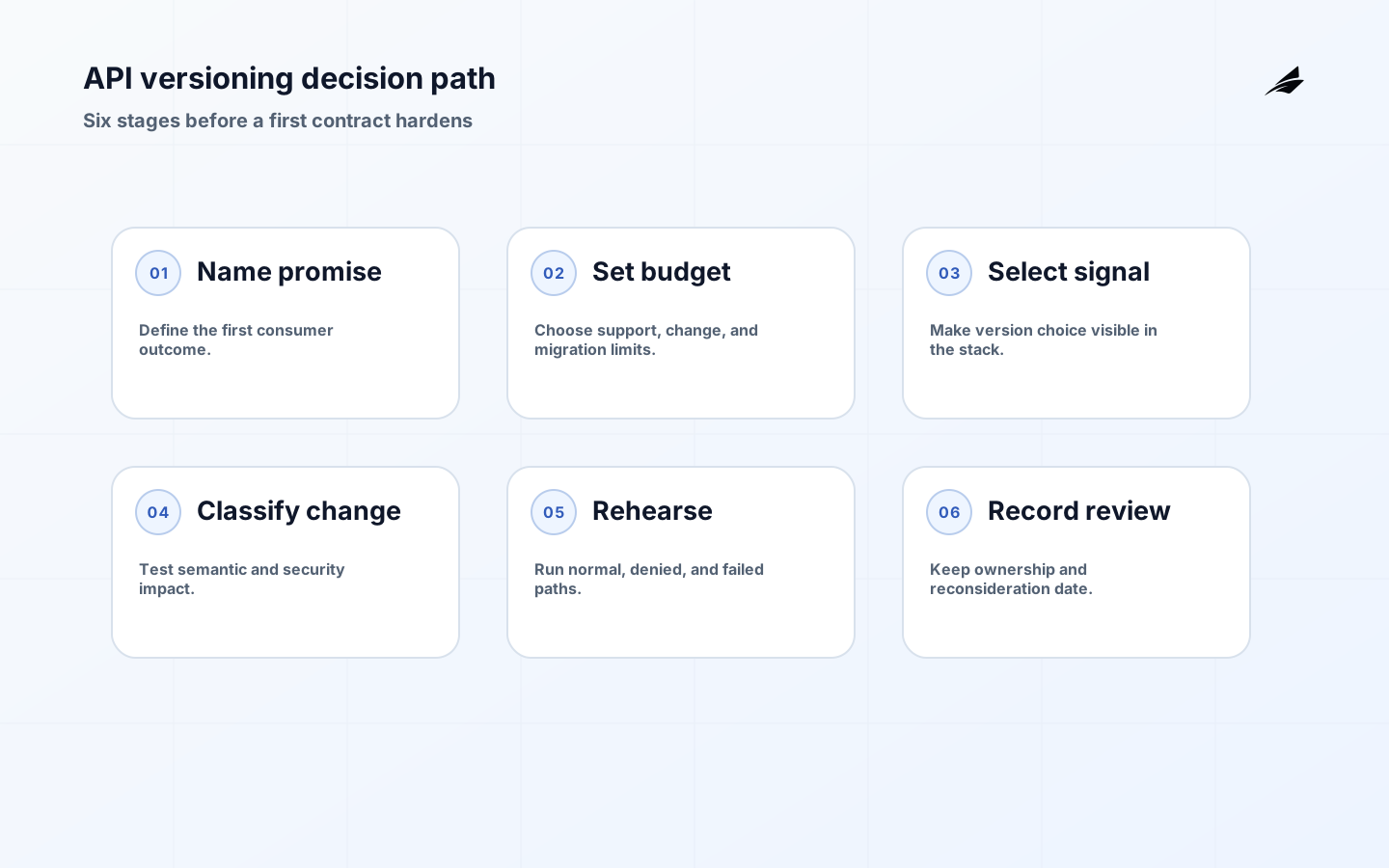
API versioning decisions are easiest to postpone when a team has one client and no production history. That is exactly when they are cheapest to make. A first route, SDK, or generated schema quietly establishes expectations about resource names, defaults, errors, authorization, and completion. Later consumers inherit those choices even if nobody wrote them down. This guide is for the design conversation before implementation: choose the boundary, state the compatibility budget, select a version mechanism, and decide how evidence will allow a safe evolution or retirement. The goal is not to predict every future feature; it is to make the first promise deliberate.
Start with the promise a client must trust
Describe one consumer journey from intent to outcome. For example, an operations console may submit a service change, receive an accepted result, poll its status, and display a completed or rejected state. Identify the actor, resource, action, source of truth, side effects, and recovery route. Then separate the stable promise from implementation detail. The name of a database table is not a contract; the meaning of an order status may be. Google API versioning is a useful reference for treating version policy as a design concern. Write the promise in language a product owner, support engineer, and client developer can all test.
| First-build question | Decision example | Why it matters later |
|---|---|---|
| Who consumes it? | Web app, mobile app, and one partner | Release cadence and support windows differ |
| What is stable? | Resource identity and terminal state meanings | Clients can migrate without reinterpretation |
| What may vary? | Optional response fields and non-breaking metadata | The team can improve without a fork |
| What is expensive to change? | Authorization, default filters, and side effects | These need explicit review or a new contract |
| Who can decide? | API owner with product and security input | Change does not become an undocumented team debate |
Set a compatibility budget
Compatibility has a cost. Keeping every old behavior forever increases test surface, documentation, security exposure, and operational confusion. Breaking all clients at once increases migration and incident risk. Choose a budget that matches the product: how many parallel representations can the team operate, how long can a client lag, what support can be offered, and which changes require a major boundary? Record the limits before the first implementation makes them hard to change. A small team might support one current contract and one previous contract for a defined period; a partner-facing product may need a longer window with explicit owner commitments.
Select behavior in a way the whole stack can observe
Decide whether callers select a version through a path, header, or media type, and state what happens when the selector is missing, conflicting, or unknown. A mechanism that works in application code but disappears in a gateway log is an incident problem. A header can be forgotten by a hand-written script and become a support problem. A path that multiplies cache and route rules can cause an operations problem. Test the choice with authentication, proxies, generated SDKs, browser clients, and request replay. The version should be visible in traces, access logs, contract documents, and support examples.
Create a change taxonomy before the first pull request
Use observable client impact as the test. Adding an optional field may be safe if clients tolerate unknown fields. Making a field required, changing a default, removing an enum member, tightening authorization, or altering the meaning of a status can be breaking. A change that keeps the same JSON shape but alters when money is captured is not harmless. HTTP Semantics provides protocol meaning for methods and responses; the product still owns the business meaning. Put the taxonomy in the review template and include before-and-after examples rather than relying on labels such as minor or major.
| Change type | Default treatment | Proof required |
|---|---|---|
| Add optional response field | Keep in the current contract | Tolerant-client test and documentation |
| Add required request field | Migrate or create a new contract | Consumer inventory and transition example |
| Change default filter | Treat as behavior change | Comparison of affected queries and owner approval |
| Change authorization | Review as a security and compatibility change | Role matrix, negative tests, and rollout plan |
| Change side effect | Use new operation or explicit version | Idempotency and business reconciliation test |
Make the first contract machine-checkable
Use an OpenAPI document or an equivalent interface description to state paths, parameters, schemas, examples, and responses. The OpenAPI Specification reduces guesswork for humans and tooling, but it does not decide whether a response means accepted or completed, or whether an action is safe to retry. Add those semantics in descriptions, examples, and tests. Keep the document reviewed with the code and generate client artifacts only after an owner has accepted the public surface. A machine-readable contract is valuable because it can fail a breaking change before the first external consumer discovers it, not because it makes design judgment unnecessary.
Plan the first release as a rehearsal
Before broad use, run a representative client through valid, invalid, unauthorized, duplicate, delayed, and unavailable-dependency cases. Capture request version, response state, error type, retry rule, and user-visible message. Keep a rollback or traffic-control action that does not destroy in-flight work. For asynchronous operations, define how the client finds the authoritative status after a timeout. For destructive operations, require an idempotency or confirmation rule. The rehearsal should include someone from support or operations because they will receive the first question when a client says the response is confusing.
Tie version policy to security ownership
An old contract can preserve old authorization assumptions, fields, and dependencies long after the new design is safer. Inventory exposed operations and data per version, apply object-level authorization consistently, and set a support end date for known vulnerable behavior. The OWASP API Security Top 10 is a useful checklist for broken object authorization, excessive data exposure, inventory, and resource consumption. Do not let a compatibility layer bypass the current security decision. If a version cannot receive a required security fix without changing semantics, make that conflict visible and escalate the retirement or migration decision.
Keep an operating record for future changes
Store the selected version strategy, compatibility rules, ownership, examples, support promise, telemetry fields, and retirement trigger with the service documentation. Include a decision log for exceptions, such as a temporary header alias or a compatibility adapter. Review version usage by client and operation, not only total traffic. A route can be quiet overall while one important scheduled job still depends on it. The related event-driven systems decisions help when the first API also emits messages; the REST API contracts guide clarifies the promise, and the growing-team versioning field guide covers ownership.
Use a decision checkpoint before implementation
Before the first route is coded, ask the team to demonstrate how a caller selects the contract, how an operator identifies it, how a breaking change is classified, and how a retired client fails. Use a small fictional request to make the discussion concrete: create a work item, receive a pending result, poll it, and handle a permission change. If the group disagrees about whether a response means accepted or complete, the version boundary is not ready. Resolve the meaning before choosing a gateway or generating an SDK.
Write the greenfield contract as a future migration
Imagine the first client only needs an order summary, while a later partner will need settlement details. Keep the first representation focused and state which fields are authoritative, optional, or deliberately absent. Define an expansion point that does not require clients to reinterpret the summary. If the future detail changes the permission or timing model, treat it as a distinct operation or representation rather than hiding it behind a field that appears immediately available. This exercise shows where an apparently flexible schema would create a hard-to-version promise.
| Checkpoint | Question | Evidence |
|---|---|---|
| Selection | Can every supported client request the intended behavior? | Examples through gateway and application |
| Meaning | Are completion, defaults, and errors unambiguous? | State transition and negative cases |
| Security | Does each version keep the right object and action policy? | Role matrix and cross-tenant tests |
| Retirement | Can the team identify the last dependent caller? | Inventory, telemetry, and owner |
The result should be a short design record with a review date. A versioning choice is not permanent architecture; it is a default that should be reconsidered when the first external consumer, high-risk data set, or slow-release client appears. Revisit the record with evidence rather than assuming the original greenfield constraints still hold.
API versioning decisions takeaways
- Define a concrete consumer promise before choosing a route or framework default.
- Spend a compatibility budget deliberately: support window, parallel versions, and migration capacity.
- Select behavior through a mechanism that clients can use and operators can observe.
- Classify changes by semantic and security impact, not by syntax alone.
- Capture lifecycle ownership and retirement evidence while the API is still small.
API versioning decisions FAQ
Can a first API simply be version zero?
A label such as v0 does not remove the promise once clients depend on it. If the team intends to break freely, state that risk, limit the audience, and provide a migration channel. Otherwise give the first public contract a clear compatibility rule.
How much should be included in one version?
Include behavior that must evolve together for a coherent consumer outcome. Avoid versioning an entire platform because one field changes, but also avoid forcing unrelated clients through a compatibility shim that changes the meaning of a shared resource.
What tests matter before the first client ships?
Test the documented normal path and the cases that expose hidden promises: invalid input, missing access, duplicate submission, dependency timeout, unknown version, and an operation that is accepted but not yet complete.
Conclusion: decide the future contract early
The first API version is a product and operating decision disguised as an implementation detail. Name the promise, limit the compatibility burden, expose the selector, test the failure paths, and keep the evidence needed to change or retire the behavior. A team that does this before coding buys itself options later without making future consumers guess what the original route meant.