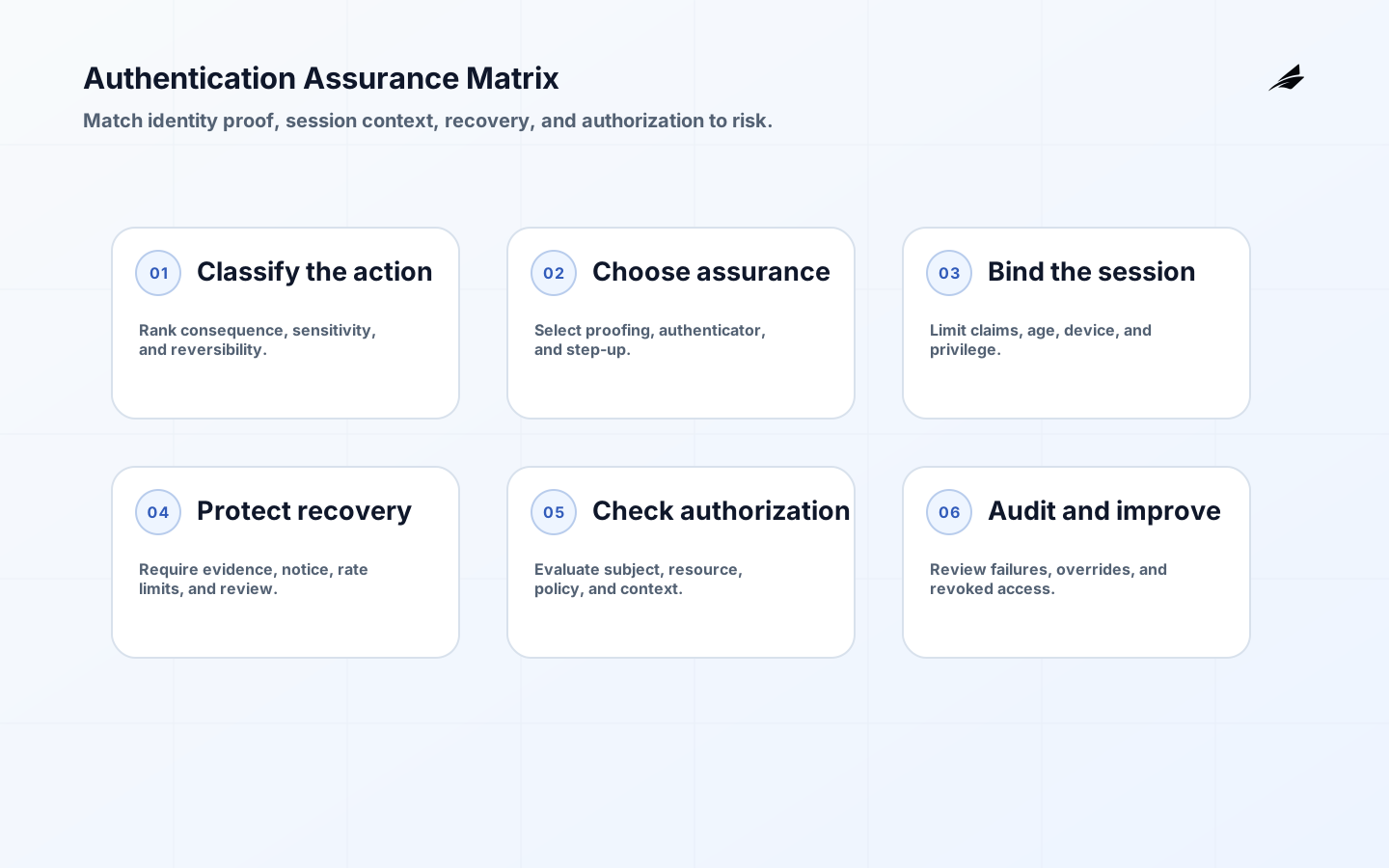
Authentication flows decisions become expensive when teams treat the topic as an implementation detail that can be cleaned up after launch. A production system has users, deadlines, operational ownership, and behavior that other systems already rely on. The practical question is therefore not which library or pattern sounds most modern. It is how to make a deliberate promise, preserve the information people need, and retain a safe way to change course. Authentication flows are safe only when a team distinguishes who a subject is, how recent confidence in that identity must be, what a session allows, and whether a specific action is authorized. That framing makes the work legible to product, security, operations, and engineering rather than leaving it as a private concern of a single codebase.
Separate identity proof, session control, and authorization
Begin with the risky actions rather than the login screen. Money movement, privilege changes, recovery, and new-device enrollment may require stronger evidence or a step-up than ordinary reading. For authentication flows, a useful discovery session follows one representative case from its trigger through the durable outcome and the support path. For authentication flows, include the normal path, a late or duplicate event, an access refusal, a dependency outage, and the person who decides when an exception is resolved. This exposes hidden coupling early. For authentication flows, it also creates a narrow first release: one outcome, one accountable owner, and evidence that the result is both correct and understandable.

| Question | Decision evidence | Failure avoided |
|---|---|---|
| What is authoritative? | Name the source, owner, update path, and correction rule. | Two components silently make different claims. |
| What changes the fact? | Record command, authorization, validation, and audit expectation. | A convenient interface bypasses business policy. |
| What can fail? | List dependency, timeout, retry, and user-visible recovery. | A transient fault becomes ambiguous manual work. |
| What proves success? | Choose behavior and operational measures before release. | A fast launch hides a declining service. |
Design authentication flows boundaries that survive change
The design choice is to select authenticators by risk, bound sessions by context and duration, make recovery as accountable as enrollment, and evaluate authorization against the target object. For authentication flows, do not make every concern global because it might be shared someday. For authentication flows, put the rule with the capability that owns its outcome, expose a small interface to its neighbors, and make translation happen at the edge. For authentication flows, this produces more useful reviews: reviewers can ask whether an operation preserves a named invariant or contract, rather than trying to infer intent from framework wiring. For authentication flows, the same boundary gives test authors a stable place to exercise failure behavior.
Evidence should shape the boundary. Look for authentication failures, session revocations, recovery attempts, privilege changes, suspicious-device signals, support overrides, and tests of every role-resource combination. For authentication flows, each signal tells a different story: an incident may reveal a missing recovery path; a delayed change may reveal broad coupling; a security finding may reveal that identity is being assumed rather than checked. Read these signals alongside product context. For authentication flows, a rare but irreversible error can deserve earlier work than a common inconvenience, while an elegant refactor without a credible consequence should wait. This is the judgment behind effective technical debt planning.
Release authentication changes behind evidence
The implementation plan should write the assurance policy, protect verifier and session material, rotate or revoke on meaningful events, rate-limit recovery, and rehearse how users regain access without bypassing controls. For authentication flows, break risky work into observable steps and decide what evidence unlocks the next step. For authentication flows, compatibility is a requirement, not a hope: clients, stored data, operators, and support tools may all depend on behavior that was never written down. For authentication flows, give every irreversible action a stop condition and an owner who can call it. For authentication flows, for cross-service work, preserve correlation identifiers and record the semantic outcome as well as the transport result so a later investigation does not depend on one ephemeral log line.
Monitor assurance and recovery signals
After release, measure successful and failed ceremony rate, recovery completion time, revoked-session use, step-up prompts, privilege escalation attempts, and support exceptions. For authentication flows, use a baseline where possible, but do not wait for perfect historical data. For authentication flows, a small dashboard and a weekly review can reveal whether the change made the intended path easier or simply moved the burden. Pair quantitative data with examples from users and on-call staff. For authentication flows, when a number moves, inspect a trace, a support case, or a representative record before assigning a cause. For authentication flows, the most reliable operating habit is to keep ownership, expected behavior, and next review date beside the metric.
| Signal | Interpretation to test | Response |
|---|---|---|
| A success metric improves but complaints rise | The metric may omit a confusing exception path. | Review real user journeys and add a quality signal. |
| Errors shift after a rollout | The change may have displaced a contract or dependency assumption. | Compare representative requests and restore a known-safe path. |
| Manual overrides increase | The workflow may be too rigid or its authority unclear. | Inspect override reasons before automating further. |
| A rare high-impact event occurs | Average performance is hiding exposure. | Run a focused incident and recovery review. |
Record identity, session, and recovery choices
An authentication decision record should be organized around events that change risk, not a single sign-in endpoint. Define enrollment, authenticator binding, regular sign-in, step-up, recovery, revocation, and support-assisted access as separate ceremonies with different evidence and controls. A convenient recovery flow that can be social-engineered can undo the strength of every primary authenticator. Decide how a user learns about a new device, how an administrator action is audited, and how a lost device is removed without leaving an attacker active. Sessions should carry only the claims and lifetime needed for their context; a change in privilege, password, tenant membership, or suspected compromise may require re-evaluation or revocation. Authorization must still check the target resource and current policy, even after successful authentication. Test ordinary and adverse cases: expired credentials, replayed recovery links, concurrent sessions, disabled accounts, delegated access, and an operator trying to exceed their own authority. The goal is a user experience that is comprehensible in the normal case and accountable when trust has to be rebuilt under pressure.
Review it with people responsible for support and fraud response, because their legitimate recovery work is where hidden usability and assurance assumptions become visible first.
Authentication delivery checks
- Write the authentication flows decision in product language, including the user or operator outcome.
- For authentication flows, map the normal case and at least three uncomfortable cases before implementation.
- For authentication flows, name the source of truth, owner, identity rule, and correction path for important data.
- Add tests for compatibility, authorization, error behavior, and the recovery path.
- Instrument the primary outcome, the failure mode, and the manual workaround.
- Schedule a review after representative production traffic has exercised the change.
Separate authentication from every adjacent decision
Authentication answers how a system establishes that a claimant controls an authenticator; it does not by itself decide what that person may do. Keep identity proofing, authentication, session management, authorization, and recovery as separate design questions. This separation makes review sharper: a strong login can still be followed by an over-broad role, a weak recovery path, or a session that remains active after a material change.
Choose assurance from consequence. A low-risk content preference may tolerate a different flow from a payroll change, administrative action, or access to regulated records. Record the asset, threat, user population, authenticator, reauthentication trigger, and recovery authority. Avoid treating a familiar provider or a passwordless label as the decision; the relevant question is whether the complete flow resists the threats that matter to the service.
Test the unhappy paths first: a lost device, changed phone number, denied consent, clock skew, expired session, disabled account, concurrent sessions, and a user who cannot complete the preferred factor. NIST Digital Identity Guidelines and the NIST assurance-level guidance help calibrate proofing and reauthentication; OWASP Authentication Cheat Sheet and OWASP Session Management cover defensive flow design. Recovery should not silently weaken the assurance required for the protected action. Give support a bounded procedure with evidence and escalation, rather than an informal override that becomes the most attractive attack path.
Log decisions without turning authentication telemetry into a new privacy problem. Keep event time, actor or subject reference, authenticator outcome, policy result, session identifier, and correlation key as appropriate, but minimize secrets and sensitive claims. Review unusual recovery, repeated failure, new device, and privilege changes with thresholds that an operator can understand and act on.
Key takeaways
- Authentication flows are a production decision with business, operational, and security consequences.
- For authentication flows, start from a bounded capability and its evidence, rather than a preferred framework or wholesale replacement.
- Keep authority, invariants, and translation boundaries explicit so change remains local.
- Treat failure and recovery as part of the contract users receive.
- For authentication flows, measure the intended result and its undesirable side effects after the release.
Authentication flows earn their place in a roadmap when they make a real capability easier to change, operate, or trust. For authentication flows, take one representative case, record its authority and failure behavior, then make the smallest change that improves the constraint without obscuring the next decision. The related guides on software modernization and database schema design can help teams carry that discipline across adjacent architecture decisions.
Frequently asked questions
What should be decided before choosing an identity provider?
Define protected assets, user populations, assurance and recovery needs, authorization boundaries, session rules, privacy constraints, and operational ownership. Provider selection should satisfy that model.
Is MFA enough for sensitive actions?
Not automatically. The factor, enrollment, recovery, session age, device context, authorization, and audit trail all contribute to the assurance of the action.
What makes account recovery safe?
A documented evidence threshold, independent signals, rate limits, user notification, support training, and escalation for exceptions. Recovery should not be easier to abuse than the normal login.
Conclusion
A dependable authentication flows decision is visible in its boundaries, examples, ownership, failure behavior, and evidence. For authentication flows, start with one complete workflow, make the hard case observable, and expand only when the people responsible for the outcome can operate and recover it. For authentication flows, that discipline keeps the implementation useful after launch, when conditions are less tidy than the first demonstration.