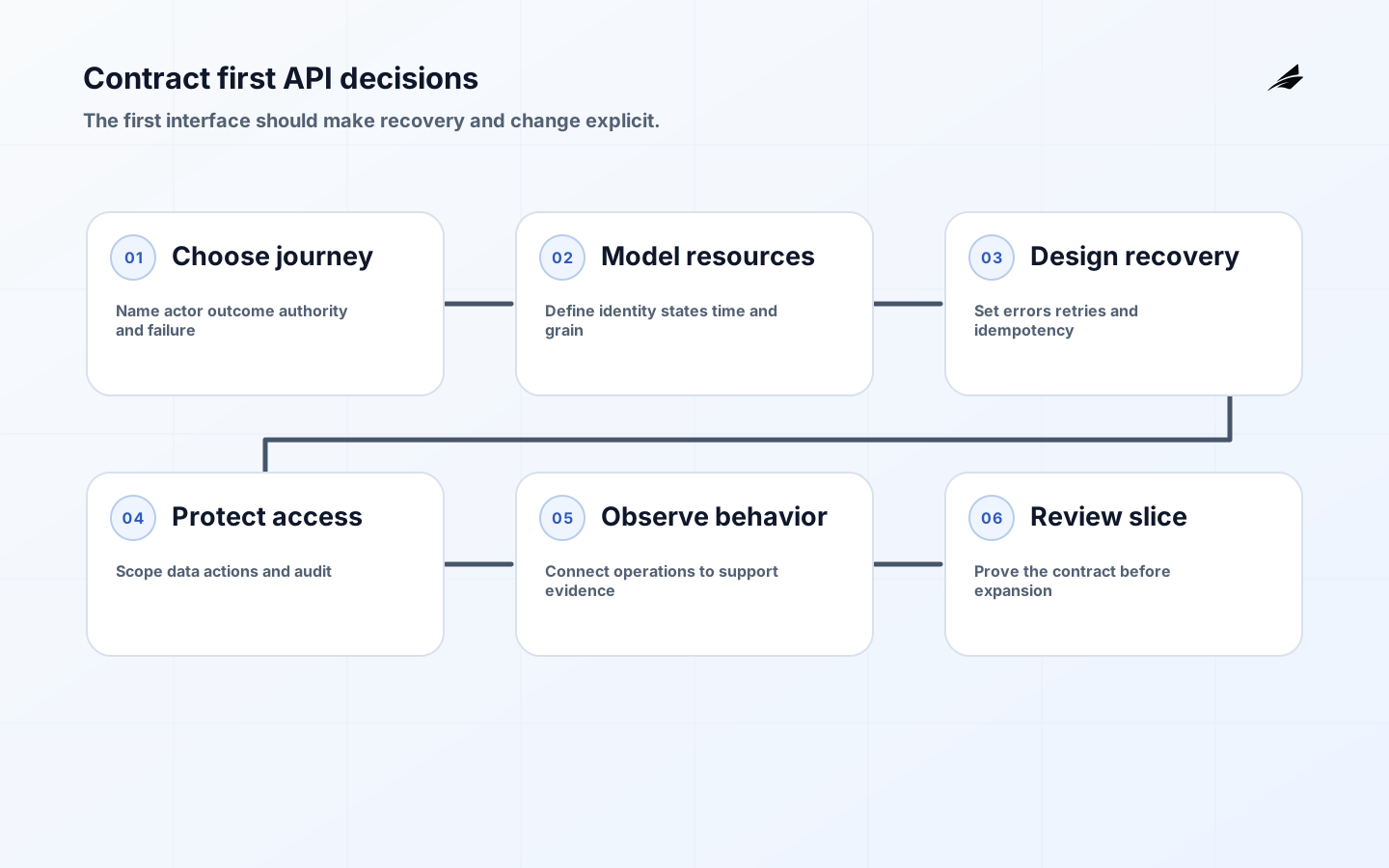
The first API contract is an architecture decision disguised as a document. REST API contracts before development should settle what a resource is, which system owns it, who can act on it, what a client may assume, and how a failed request will be recovered before a route exists. If those decisions remain implicit, implementation speed simply moves uncertainty downstream into client code, support work, and migrations. A useful contract makes the hard choices visible while they are still inexpensive to change.
Contract-first does not mean designing every future endpoint in a vacuum. It means selecting one real consumer journey, describing the request and outcome, and deciding the boundaries that protect future work. The team can then build a thin vertical slice, test the semantics with a consumer, and extend the model when evidence arrives. This keeps an early specification concrete instead of turning it into a wish list of nouns and verbs.
Pair this article with Edilec's REST API contracts guide for IT managers, Node.js API guide, and production API versioning guide. They cover the governance and evolution that should be considered before the first build, not after it.
Choose the consumer journey first
Write the smallest business task the API must support: create a shipment, approve a request, retrieve an account, or submit a document for review. Name the actor, source of truth, expected side effect, completion signal, and handoff. Include at least one failure case. A client that creates a shipment needs more than a POST path; it needs a durable shipment ID, a duplicate rule, a carrier-pending state, and a way for a support person to locate the request after a timeout.
Draw the boundary around responsibility. Which system owns customer identity, pricing, authorization, workflow state, and notifications? If the API accepts data it does not own, say whether it validates, stores, forwards, or merely references it. The Cloud API Design Guide is a useful source for resource-oriented thinking and consistent method semantics, but a local contract must still explain the business authority and timing that a generic guide cannot know.
| Decision | Example question | Why settle it early |
|---|---|---|
| Resource identity | Is an order ID stable across systems? | Prevents callers using mutable labels as keys |
| Authority | Which system owns approval state? | Avoids conflicting writes and duplicate truth |
| Side effect | What does a successful request change? | Makes retries and audit behavior testable |
| Freshness | Can a read be stale or eventually consistent? | Stops clients from treating a cache as truth |
| Support | How will an operator find the operation? | Connects API behavior to recovery |
Model resources and representations deliberately
Choose names that describe durable concepts rather than screen labels or implementation tables. Decide whether a nested path represents ownership, a query filter, or merely convenient navigation. Keep identifiers opaque when clients should not infer meaning. Define whether a representation is current state, an event, a projection, or an operation result. A field called status is not enough; document allowed values, transition authority, timing, and whether a state can move backward.
Use OpenAPI for schema, parameters, security requirements, and examples, then add prose where the schema cannot carry business meaning. Decide nullability, units, precision, timezone, ordering, and default behavior before code generators turn them into client assumptions. Keep examples valid and realistic. A response that contains only the happy-path fields will make a consumer build the wrong parser even if the schema is technically complete.
Define errors as actions a client can take
List failure categories before implementation: malformed input, missing identity, forbidden action, conflict, dependency outage, rate limit, timeout uncertainty, and internal defect. RFC 9457 gives a standard problem-details model. Extend it with stable application types, field locations, retry guidance where safe, an operation ID, and a human support route. Do not overload one response with every possible diagnostic; expose enough for the caller to decide and enough for support to investigate.
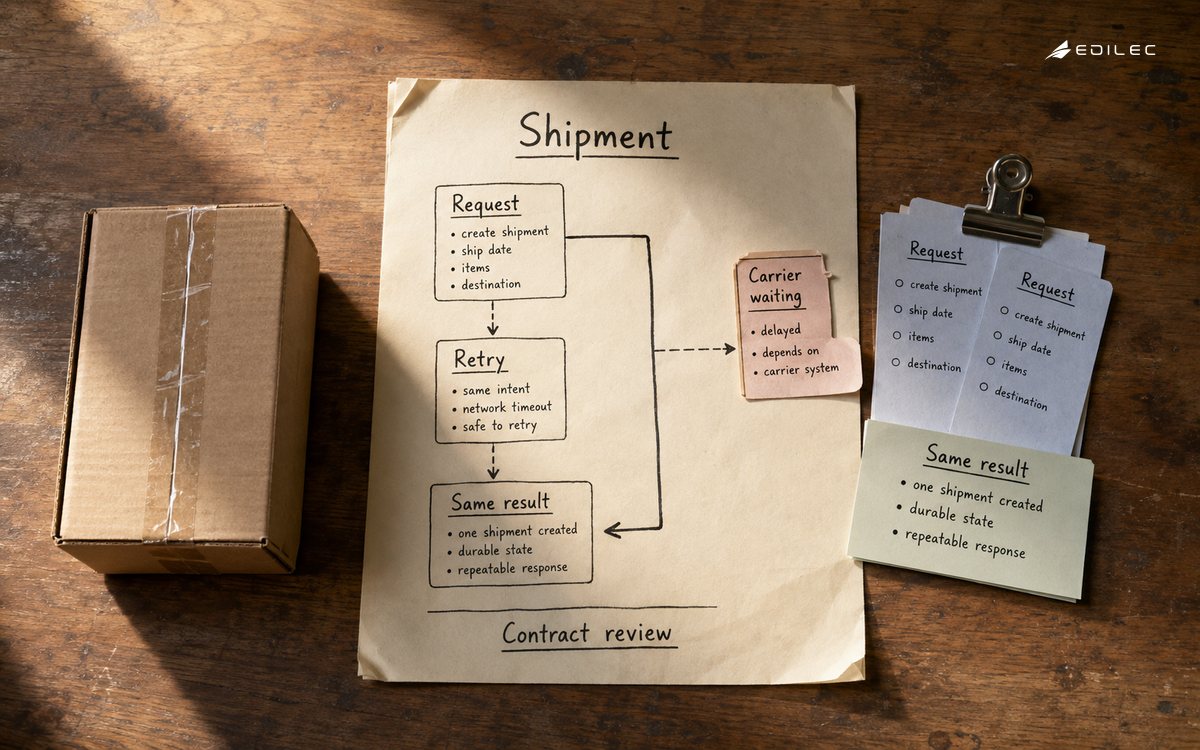
Write the retry rule next to the error rule. If a client retries after a network failure, can the server recognize the same intent? For commands, use an idempotency key or a unique business reference and define how long it remains valid. For long jobs, return an operation resource instead of keeping a request open indefinitely. For validation, make the response stable enough that a form can show the right field without parsing prose. HTTP semantics supplies the protocol vocabulary; the contract supplies the business consequence.
| Failure path | Contract decision | Test case |
|---|---|---|
| Duplicate command | Same intent returns one durable result | Replay after success and timeout |
| Stale update | Conditional write or conflict response | Two writers use the same version |
| Unavailable dependency | Pending or retryable result | Dependency fails after validation |
| Invalid field | Stable type and field location | Multiple validation errors |
| Forbidden action | Consistent denial without leakage | Valid identity with insufficient scope |
Design authorization and data exposure
Authorization must answer who may perform an action on which resource under which condition. Decide whether the contract uses user scopes, service roles, tenant membership, resource ownership, or an approval state. Show protected identifiers and returned fields separately because permission to view a record does not always mean permission to export every attribute. Include list, search, bulk, attachment, and asynchronous paths; the less visible path is often where an ownership check is forgotten.
Use the OWASP API Security risks as a review checklist for object-level authorization, broken authentication, unrestricted resource consumption, inventory, and unsafe consumption of downstream APIs. Define rate behavior, audit fields, correlation IDs, and secret handling before selecting middleware. The contract should not promise details that logs or support tools cannot safely expose. Security review is cheaper before clients depend on an unsafe representation or an over-broad scope.
Set predictable list and search behavior
Pagination is a data consistency decision. Choose cursor or offset semantics based on the write rate, ordering, and need to resume. State whether a cursor is opaque, how long it remains valid, whether items can repeat or disappear while a client walks pages, and how an empty page differs from an invalid cursor. Define maximum page size and response limits so an apparently simple search cannot exhaust a service or a client process.
Filters, sorts, and expansions need a support boundary. Publish allowed fields, comparison rules, timezone, case sensitivity, and authorization behavior. Avoid accepting arbitrary query expressions that are difficult to secure and impossible to promise. For exports, return a job reference and a retention policy rather than holding a request open. The API design is complete when a consumer can build a reliable loop over real data, not merely when a sample returns ten records.
Make the contract observable
Choose the identifiers that connect request, business operation, downstream work, and support case. Define which fields appear in logs, which are redacted, and how client version and contract selection are recorded. Track successful business effects, not only HTTP status. A 202 response may be healthy when it creates a job, but only if queue age, final outcome, and retry behavior are visible. The contract should tell support what evidence exists when a caller says the request succeeded but the expected action never appeared.
Review latency, error type, rate-limit, authorization, and data-quality signals by operation and bounded consumer group. Do not create a metric for every field. Select signals that trigger a known action: investigate a dependency, pause a rollout, contact a consumer, or repair a record. Observability is part of the contract because a client cannot safely depend on behavior the service cannot explain when it changes.
Build a change boundary before the first release
Write compatibility rules while the interface is small. State how optional fields, enums, defaults, errors, ordering, pagination, and authorization scopes may evolve. Name the service owner, consumer review route, deprecation notice, support window, and retirement authority. Google's API Versioning guidance offers practical comparison material for stable resource identity and compatibility; use it to challenge local assumptions rather than copy a rule without considering your deployment model.
Create one provider contract test and one representative consumer test before declaring the interface ready. Provider tests prove the implementation emits the promise. Consumer tests prove a known caller can complete the task. Include malformed input, missing fields, unknown enum values, duplicate replay, delayed dependency, forbidden access, pagination boundaries, and a schema change simulation. A test that only checks that both sides share a generated model can preserve a shared misunderstanding.
Run a contract review with a thin vertical slice
Review the contract using a representative request, response, error, retry, authorization denial, and support investigation. Ask a product owner whether the resource matches the business language, an engineer whether the boundary is implementable, a security reviewer whether exposure is proportionate, and a consumer whether the result is usable without hidden calls. Then build the narrow slice and compare the running behavior with the written promise before expanding the surface.
Record open questions with owners and decision dates. If a requirement depends on an external party, add a test contact and compatibility assumption. If the team cannot decide whether a response is current or eventual, expose that uncertainty instead of selecting a status that implies certainty. A contract is ready when a different team can implement a client, handle failure, and explain the support path without attending the design meeting.
| Review area | Question | Ready evidence |
|---|---|---|
| Business model | Does the resource represent a durable fact or operation? | Consumer journey and authority map |
| Failure | Can clients recover without duplicating effects? | Replay, timeout, and conflict fixtures |
| Security | Can each action be authorized and audited? | Scope matrix and denial tests |
| Lists | Can clients page through changing data safely? | Cursor, ordering, and boundary examples |
| Change | How will the first breaking need be handled? | Compatibility and deprecation policy |
| Support | Can a case be investigated after a handoff? | Operation ID, trace, and owner route |
Key takeaways before the first API build
- Choose one real consumer journey before designing a broad endpoint catalog.
- Define resource grain, authority, states, timestamps, representations, and side effects in business language.
- Design errors, retries, idempotency, and asynchronous work as one recovery model.
- Treat authorization, pagination, rate limits, logs, and support evidence as contract concerns.
- Write compatibility and deprecation rules before the first client makes hidden assumptions.
- Prove the contract with a thin vertical slice and provider plus consumer tests.
Contract-first API questions
What should be decided before the first endpoint is built?
Decide resource identity, authority, side effects, representations, errors, authorization, idempotency, pagination, observability, and the consumer task. You do not need every future endpoint, but the first vertical slice should make its important normal and failure outcomes explicit.
Is contract-first development the same as writing OpenAPI?
No. OpenAPI is a strong machine-readable description, but a useful contract also defines business meaning, recovery, security, ownership, support, and change policy. Use the document to make those decisions reviewable and testable, not to imply that a schema alone settles them.
How much detail belongs in an early contract?
Enough to make a real consumer task and its risky boundaries testable. Start narrow, include representative failures and support evidence, then grow the contract as new data states or consumers are proven. Avoid speculative endpoints that create maintenance obligations without a user or operational need.
Conclusion: build against a clear promise
The best REST API contracts are decided before implementation hardens assumptions, but they are proven through a running vertical slice rather than a large design exercise. Model the consumer task, make resources and authority precise, define failure recovery, protect access, expose list and timing behavior, and set a change boundary. That preparation saves rework because the first client is built against a promise the team has already examined from several directions.