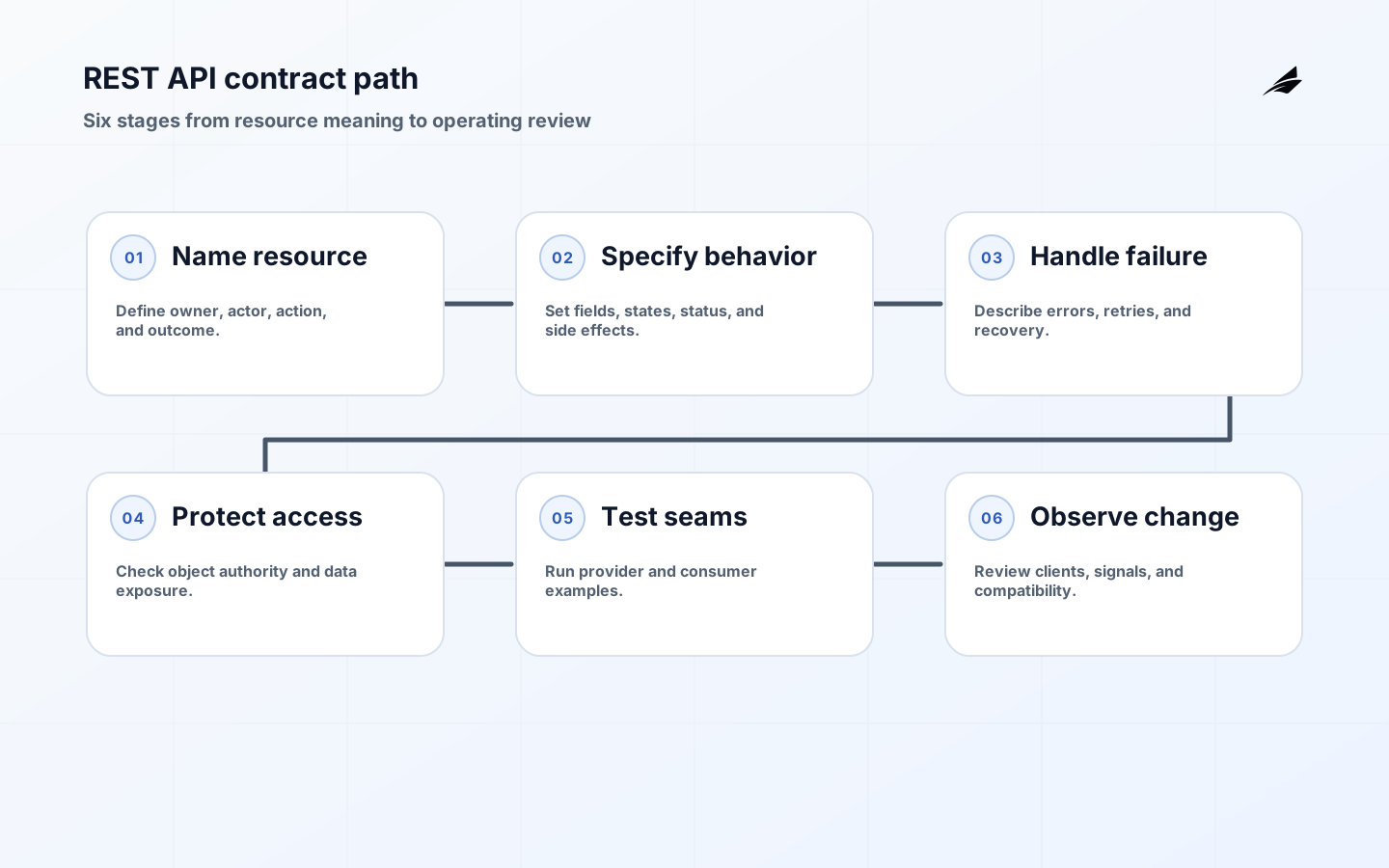
REST API contracts are the promises that let another team build without reading the server implementation. A route name is only the beginning. The real contract includes resource meaning, accepted representations, authentication and authorization, status codes, validation, ordering, retries, side effects, and the conditions under which behavior may change. The OpenAPI Specification describes a language-agnostic interface that humans and tools can inspect, while HTTP Semantics supplies the protocol meaning. Reliable custom software connects those references to a local decision record and executable examples, so a client can predict both success and failure.
Define the contract boundary before the route
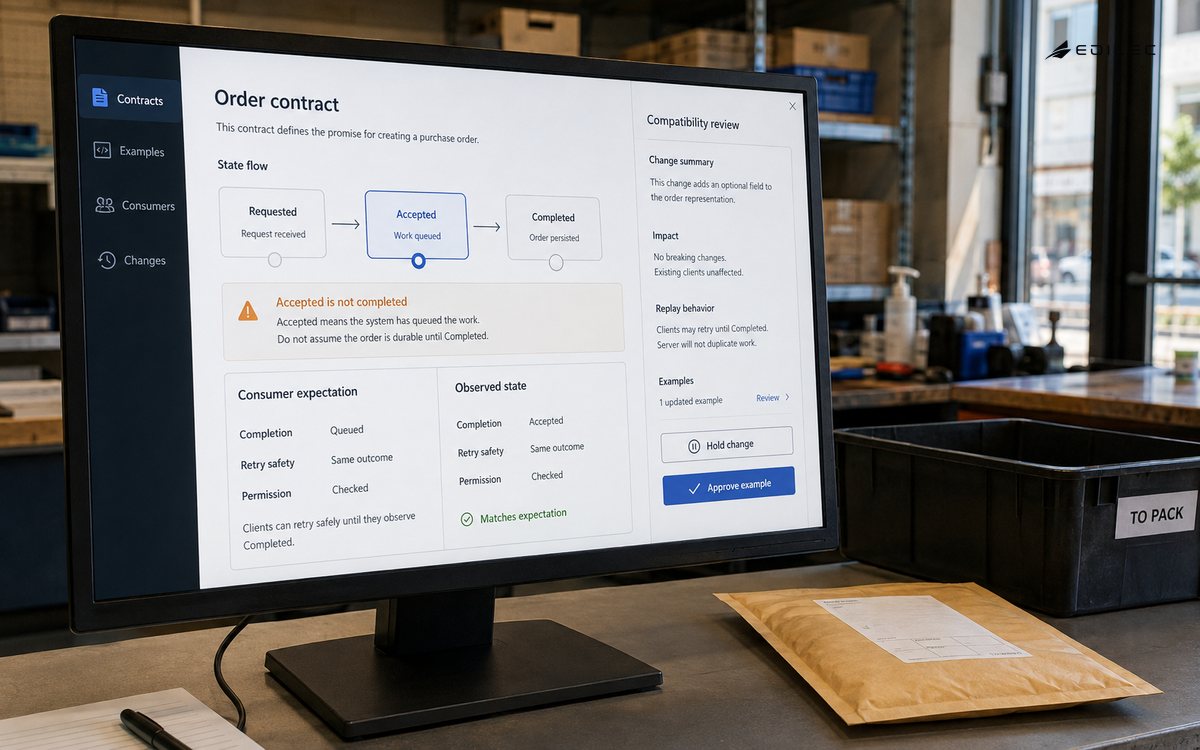
Choose one user or system outcome and write the request-to-result path in plain language. For a purchase endpoint, that might mean creating an order, reserving stock, and returning a status the caller can safely display. Name the authoritative record, accepted actor, resource identifier, state transitions, and external dependencies. Decide which behavior is promised and which is implementation detail. A generated client can enforce a field type, but it cannot know whether a successful response means committed, queued, or merely accepted for processing. Publish that distinction near the contract and make it part of the acceptance tests.
| Contract area | Decision to make | Proof a consumer can use |
|---|---|---|
| Resource | What does this object represent and who owns it? | Stable identifier, lifecycle, and authority |
| Request | Which fields are required and how are they validated? | Valid and invalid examples with status codes |
| Response | When is work complete, pending, or rejected? | State field, location, or operation reference |
| Side effect | Is a retry safe and what may happen twice? | Idempotency rule and duplicate test |
| Change | What may evolve without client work? | Compatibility policy and notice path |
Make HTTP behavior precise
Use methods and status codes for their protocol meaning rather than as decorative labels. State whether an operation is safe, idempotent, asynchronous, or conditional. A PUT that silently merges unknown fields, a DELETE that queues work, or a POST that can be retried safely needs a local explanation. Define pagination order, filter interpretation, time-zone handling, numeric precision, and empty results. When a response contains a value such as total, specify its currency, rounding, and calculation time. These details are often invisible in a happy-path example but become binding promises as soon as a second consumer appears.
Use examples as executable conversations
Keep examples for the ordinary path and the awkward paths that make integrations expensive: missing permission, unknown identifier, stale version, duplicate request, invalid state transition, rate limit, and downstream timeout. A request example should show the identity context and any idempotency or conditional headers that matter. A response example should show the fields clients may rely on and the fields they must ignore or treat as optional. Consumers should be able to run these examples in a test environment and compare the outcome, not simply paste them into documentation.
Design errors and authorization together
A client needs to distinguish invalid input, missing permission, unavailable dependency, conflict, and server defect. RFC 9457 Problem Details offers a structured pattern for HTTP errors; the product still needs to choose stable types, safe detail, and a support correlation identifier. Authorization must be checked for the requested object and action, not inferred from the fact that a caller can reach the route. Review object-level access, excessive data exposure, inventory, and resource consumption with the OWASP API Security Top 10. A generic 403 without an actionable next step is a contract gap, just as dangerous as an endpoint that returns another tenant's data.
| Observed condition | Contract response | Consumer action |
|---|---|---|
| Malformed request | Validation problem with field paths | Correct input and do not retry unchanged |
| Not allowed | Stable authorization error without sensitive detail | Hide the action or request the required role |
| Conflict | Current resource state and conflict type | Refresh, reconcile, or ask for confirmation |
| Dependency unavailable | Temporary problem with retry guidance | Back off, preserve intent, and show pending state |
| Unknown server failure | Safe problem type plus correlation ID | Stop unsafe retries and provide support context |
Set compatibility rules before consumers arrive
Compatibility is about observable client behavior, not only schema shape. Adding an optional response field may be safe for tolerant clients, while changing a default filter, enum meaning, error status, sort order, or authorization rule can be breaking without changing a JSON type. Define whether clients must ignore unknown fields, how long deprecated fields remain, and who owns a migration. Google API versioning is a useful reference for making version policy deliberate. If a change affects the meaning of a record, write an explicit transition or new representation rather than relying on consumers to infer it from a release note.
Test the contract at the seams
Combine schema validation with behavior tests. Provider tests confirm that the service returns the documented status and representation; consumer tests confirm that a real client can handle permitted variation; integration tests cover authorization, persistence, and dependency timing. Add negative cases deliberately. A test that checks only a 200 response can pass while the server returns an empty or pending result that the customer interprets as completed. Run the suite against a representative dataset and record the version of the contract, fixture, and policy so a later failure can be compared with the last known-good behavior.
Operate the promise after launch
Track latency and error rate by operation, validation failure by field, authorization denial by action, status distribution, retry volume, duplicate requests, and version or client adoption. Keep a request or business correlation identifier that lets support follow a user-visible result through the service without exposing private credentials. Review unexpected client behavior as evidence that the contract may be unclear, not automatically as a bad consumer. When a dependency fails, the API should make pending, rejected, or replayable work visible. The related error handling guide helps connect the response contract to recovery ownership.
Make change review proportional to impact
A small API change review can ask five questions: which clients call this operation, which observable behavior changes, what examples prove compatibility, how will the rollout be observed, and what is the stop or rollback condition? For a payment, identity, or data export path, add security and support owners. Keep the decision near the OpenAPI document and release notes. The REST API contracts for growing teams offers a useful adjacent view when a simple service has accumulated internal, partner, and customer consumers.
Review a contract at the release boundary
The most useful API review follows a request across the boundary instead of inspecting a schema in isolation. Pick one operation and trace the caller, authentication, authorization, validation, persistence, dependency calls, response, and support record. Mark every point where the result could be unknown or repeated. Then compare the documented behavior with the actual client assumptions: does the client treat 202 as complete, retry a mutation without a key, or expose a field that was meant to be internal? A contract is ready when these assumptions are either preserved intentionally or changed with a migration path.
Use a semantic diff, not only a schema diff
A semantic diff asks what a real user or integration will observe. Compare state transitions, authorization results, ordering, default filters, error categories, retry safety, and side effects alongside fields and types. A new optional field may be harmless, while a changed default date range can alter financial reporting. Keep one before-and-after example per affected workflow, and record which consumer owners reviewed it. This evidence makes the related API versioning guide a decision tool rather than a label added after implementation.
| Release check | Evidence | Decision if absent |
|---|---|---|
| Consumer meaning | Before-and-after workflow example | Hold the change for clarification |
| Retry safety | Duplicate and lost-response test | Add idempotency or disallow retry |
| Access boundary | Positive and negative object tests | Block release until policy is enforced |
| Support path | Correlation and runbook rehearsal | Add operator evidence before rollout |
Keep the final decision short: what changed, who is affected, what signal will show harm, who can pause the release, and when the team will review the outcome. A small record is easier to keep current than a large design document, and it gives future maintainers a way to distinguish an intentional promise from an accidental behavior that survived because nobody asked.
REST API contracts takeaways
- Define resource meaning, lifecycle, side effects, and completion state before documenting fields.
- Use HTTP semantics and structured errors so clients can classify outcomes safely.
- Treat authorization, rate behavior, retries, and data exposure as first-class contract terms.
- Test normal, invalid, forbidden, duplicate, delayed, and dependency-failure examples at provider and consumer seams.
- Observe client behavior and retire or version promises with an owned migration plan.
REST API contracts FAQ
Can an OpenAPI file be the single source of truth?
It can be the machine-readable center of the contract, but it cannot replace decisions about business state, authorization, retries, lifecycle, operational limits, or support. Keep those decisions linked to the specification and covered by tests.
How should an API describe asynchronous work?
Say whether the request accepted work or completed it, return a stable operation or resource reference, expose progress or terminal state, and document how the caller retries or reconciles. Never force clients to guess from a fast 202 or a delayed 200.
What makes a REST API change breaking?
Any change that can make a supported client fail or misread a result is breaking: required fields, removed values, changed defaults, altered status codes, new authorization requirements, different ordering, or changed side effects. Classify by consumer impact, not by whether the server compiles.
Conclusion: make the promise testable
A strong REST API contract gives another team a dependable answer to four questions: what can I ask for, what will happen, how do I recover, and what may change? Define the promise in terms of resources and outcomes, anchor it in HTTP semantics, test it across seams, and observe it in production. That discipline keeps custom software adaptable without making every consumer an accidental co-owner of the server implementation.