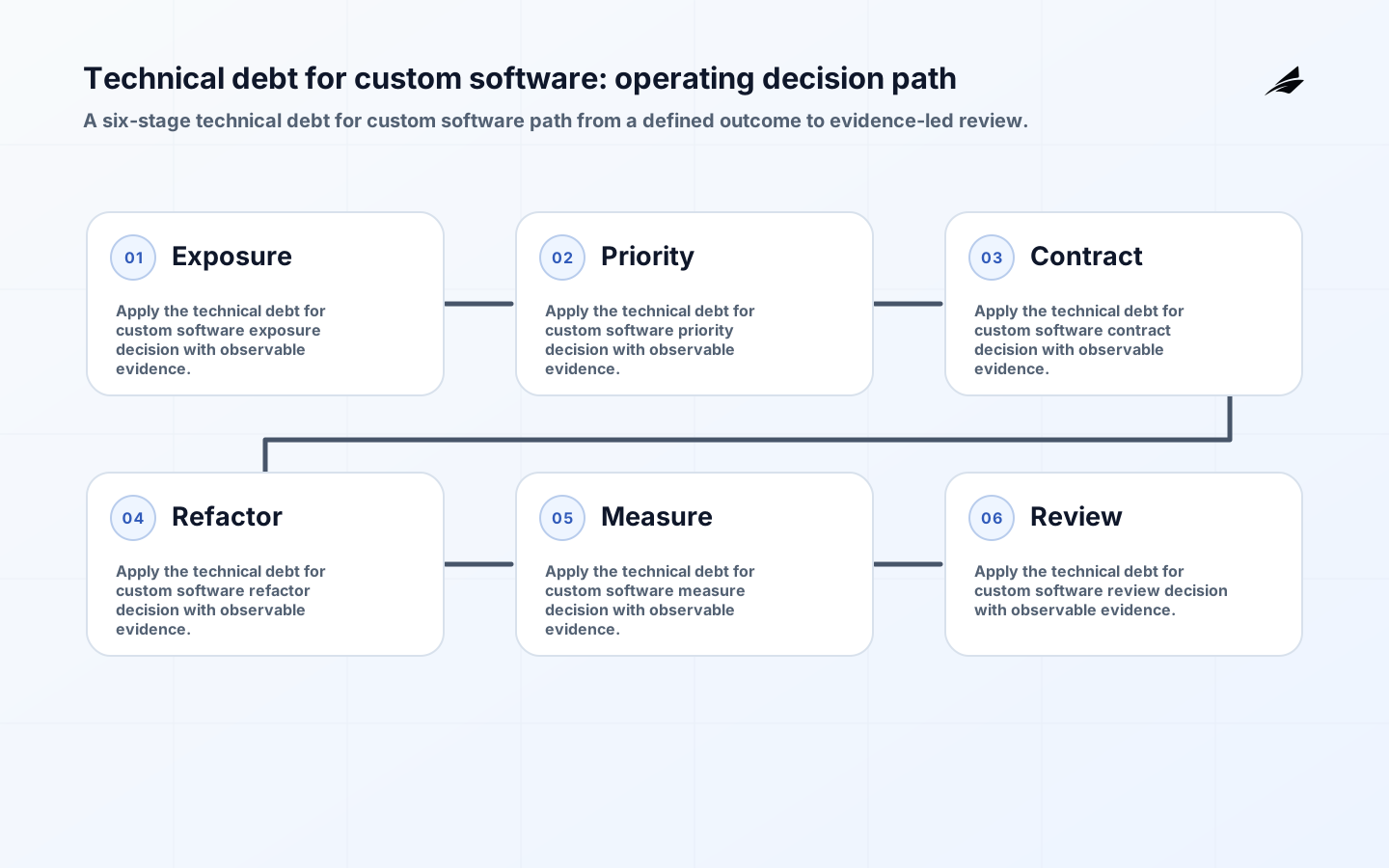
For Technical debt for custom software, Technical debt is the future cost created by a present design or delivery choice. For technical debt for custom software, It is not a synonym for old code, nor a moral judgment about the people who wrote it. For technical debt for custom software, A well-understood shortcut can be sensible when it buys time for a reversible experiment; an invisible shortcut becomes expensive when it changes the cost of every later feature, incident, or onboarding task. For technical debt for custom software, In custom software, the useful question is therefore not whether debt exists. For technical debt for custom software, It is which debts are making a customer outcome slower, less reliable, less secure, or harder to change. For technical debt for custom software, A practical technical debt practice turns that question into evidence, ownership, and a regular delivery decision rather than an infrequent cleanup campaign. For technical debt for custom software, This article uses Technical Debt Quadrant Continuous assessment and improvement Project References OWASP Application Security Verification Standard to ground the decisions in topic-specific primary guidance. For technical debt for custom software, For adjacent decisions, see software modernization, workflow contract design, support delivery checklist.
Expose the constraint behind the debt
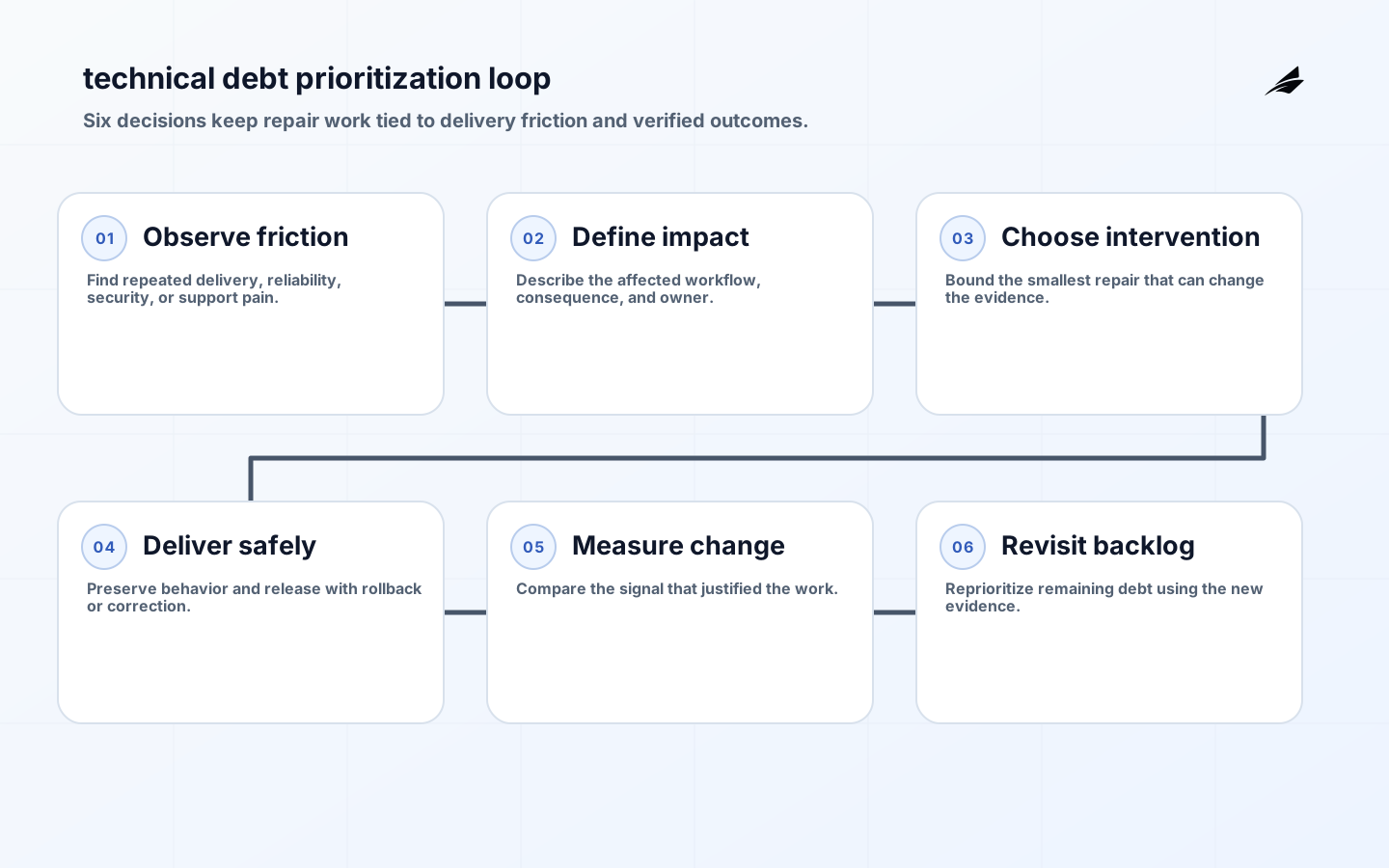
For Technical debt for custom software, Start where the system repeatedly asks people to compensate for itself. For technical debt for custom software, A release that requires private knowledge, a support queue full of corrections, a test suite nobody trusts, or a schema change that takes weeks to approve are all stronger signals than an arbitrary code-age metric. For technical debt for custom software, Capture the affected workflow, the frequency, the failure consequence, and the workaround. For technical debt for custom software, Then ask whether the cause is code structure, missing automation, an unclear interface, inadequate observability, or a business rule that was never made explicit. For technical debt for custom software, This prevents a familiar mistake: rewriting an uncomfortable module before proving that it is the constraint. For technical debt for custom software, Martin Fowler's technical debt quadrant is useful here because it distinguishes deliberate choices from reckless ones without pretending every compromise has the same risk.
| Signal | Likely underlying debt | Evidence to collect |
|---|---|---|
| Slow changes | Tight coupling or unclear module boundaries | Lead time, touched files, review rework |
| Repeat incidents | Missing failure controls or weak tests | Incident pattern and recovery steps |
| Manual corrections | Ambiguous data ownership or state | Queue age and correction frequency |
| Blocked onboarding | Undocumented design decisions | Questions a new maintainer cannot answer |
Prioritize the safest leverage point
For Technical debt for custom software, A backlog becomes useful when each item describes a decision rather than a wish to make code cleaner. For technical debt for custom software, State the affected capability, who feels the pain, the plausible consequence of leaving it alone, the smallest safe intervention, and the evidence that would show improvement. For technical debt for custom software, A fragile payment retry path, for example, deserves priority because it can create duplicate charges and expensive reconciliation; a cosmetically inconsistent helper may wait. For technical debt for custom software, Score urgency with impact, likelihood, exposure, and the cost of delay, but keep the score subordinate to a written explanation. For technical debt for custom software, Teams should also separate prerequisite work from speculative polish. For technical debt for custom software, The former unlocks a planned product change or removes an active risk; the latter needs a concrete hypothesis before it competes with customer-facing work.
- The specific workflow, service, or data boundary affected by the debt.
- A named owner who can explain the tradeoff and accept the outcome.
- A failure mode or delivery cost that is observable today, not merely predicted.
- A bounded repair that can be released, tested, and reversed independently.
- A measure such as recovery time, change lead time, or correction volume that will be reviewed afterward.
Preserve contracts during refactoring
For Technical debt for custom software, Repairs are safer when the team preserves behavior before changing structure. For technical debt for custom software, Write characterization tests around observed inputs and outputs, add telemetry where the current state is opaque, and migrate one boundary at a time. For technical debt for custom software, For a shared library, publish the replacement interface, move consumers in small groups, and remove the old path only after usage proves it is gone. For technical debt for custom software, For data changes, use an expand-and-contract sequence: add compatible structure, backfill and validate, switch readers and writers, then retire the obsolete path. For technical debt for custom software, This approach is slower than a heroic rewrite only in the narrowest sense. For technical debt for custom software, It protects delivery because rollback, diagnosis, and customer communication remain possible throughout the work.
| Repair approach | Works well when | Release guardrail |
|---|---|---|
| Characterize then refactor | Behavior is valuable but poorly documented | Keep representative regression tests |
| Strangler path | A component can be replaced at a stable boundary | Measure traffic on old and new paths |
| Expand and contract | Data or public contracts must evolve | Maintain backward compatibility during migration |
| Delete and simplify | Usage is demonstrably absent | Confirm ownership and archive decision context |
Ship a verifiable repayment slice
For Technical debt for custom software, Technical debt management works best as part of planning, architecture review, and incident follow-up. For technical debt for custom software, Reserve capacity without creating a separate class of work that is exempt from outcome scrutiny. For technical debt for custom software, A team can set a small recurring investment, but it should still explain what risk or friction that investment removes. For technical debt for custom software, Record intentional shortcuts with an owner, expiry or review date, and the condition that would make the shortcut unacceptable. For technical debt for custom software, This is particularly important after an acquisition, platform migration, or rapid launch, when temporary paths tend to become permanent by silence. Software modernization is the adjacent portfolio-level decision; technical debt gives that broader effort its evidence at the component and workflow level.
Reassess friction after release
For Technical debt for custom software, Teams often ask for a single technical debt number, but false precision can be worse than no measure. For technical debt for custom software, Estimate the cost through the work it changes: hours spent on repeated investigation, releases delayed by a dependency, correction volume, increased infrastructure spend, or an unsupported component's exposure. For technical debt for custom software, Use ranges and assumptions openly. For technical debt for custom software, A payment retry path may warrant work even if it creates few exceptions because one error can harm a customer or regulator; a noisy test may wait when it is easy to isolate. For technical debt for custom software, Compare repair options against the next credible change in the affected area. For technical debt for custom software, Sometimes an adapter or missing metric is a better first investment than a broad redesign. For technical debt for custom software, The economic view makes tradeoffs discussable across product, engineering, security, and operations. For technical debt for custom software, It should not force engineers to invent savings before they can reduce an observable operational risk.
Technical debt for custom software: operating evidence
- Bring incidents, support exceptions, delivery delays, and security findings into one view so the team can see recurring causes instead of debating isolated tickets.
- For each candidate repair, identify the business capability that will change and the customers or operators affected if the current workaround continues for another quarter.
- Check whether a planned product initiative will touch the same boundary; combining compatible work can reduce migration cost, while bundling unrelated rewrites can hide accountability.
- Ask whether the debt is local to one service, caused by an unstable contract, or rooted in an organizational ownership gap that code changes alone cannot solve.
- Confirm that the repair has a testable completion condition, an operational owner, and a way to remove temporary compatibility code after the transition is proven.
- Review completed items against their original measure and record what the team learned about estimation, sequencing, or hidden dependencies for the next planning cycle.
Technical debt for custom software: operating evidence
For Technical debt for custom software, Useful reference points include Martin Fowler's Technical Debt Quadrant, AWS guidance on continuous assessment and improvement, TypeScript's project references, and the OWASP Application Security Verification Standard. For technical debt for custom software, They do not prescribe one backlog format. For technical debt for custom software, They support a more rigorous habit: distinguish a deliberate tradeoff from unmanaged exposure, keep architectural boundaries observable, and verify security and operational claims as the system changes.
Technical debt takeaways
- Treat debt as a cost-of-change and reliability question, not an age-of-code question.
- Connect every repair to a workflow, consequence, owner, and measurable result.
- Preserve behavior and release reversibly when changing shared or persistent systems.
- Review intentional shortcuts before their assumptions disappear.
- Use modernization planning to sequence larger repairs without losing local evidence.
Technical debt FAQ
For Technical debt for custom software, Should every sprint include debt work? A recurring allocation is often sensible, but the work should compete on evidence and risk like any other investment. Is a rewrite the best solution? Only when the existing boundary cannot be safely improved and the replacement has a staged migration plan. Who owns debt? The team responsible for the capability owns the decision, while product and operations help make the customer and business consequence visible. How can leaders tell whether it helped? Compare the measure named in the debt item: fewer corrections, shorter change lead time, improved recovery, or a removed security exposure.
Conclusion: make technical debt a visible tradeoff
For Technical debt for custom software, A healthy repayment plan makes compromises legible and reversible. For technical debt for custom software, Tie the repair to a workflow, protect its contract, measure the resulting friction, and revisit the decision when evidence changes.
Test one representative repair against its compatibility contract, owner, evidence, and rollback trigger before scaling the change.
Technical debt for custom software: operating evidence
For Technical debt for custom software, For Technical Debt for Custom Software: A Practical Repayment Guide, keep the decision boundary visible in the runbook and connect each exception to an owner, evidence trail, and recovery action. For technical debt for custom software, Review the result with the people who use the workflow, then change scope only when the measured outcome supports it.
Technical debt for custom software decision 1 should name the actor, the trusted input, the observable state, and the point where a person can intervene. Case decision 1 follows the technical debt boundary and records its exception. The technical debt record for decision 1 names the evidence, owner, and correction route. Decision 1 remains bounded, inspectable, and ready to revise.
Technical debt for custom software decision 2 should name the actor, the trusted input, the observable state, and the point where a person can intervene. Case decision 2 follows the technical debt boundary and records its exception. The technical debt record for decision 2 names the evidence, owner, and correction route. Decision 2 remains bounded, inspectable, and ready to revise.
Technical debt for custom software decision 3 should name the actor, the trusted input, the observable state, and the point where a person can intervene. Case decision 3 follows the technical debt boundary and records its exception. The technical debt record for decision 3 names the evidence, owner, and correction route. Decision 3 remains bounded, inspectable, and ready to revise.
Technical debt for custom software decision 4 should name the actor, the trusted input, the observable state, and the point where a person can intervene. Case decision 4 follows the technical debt boundary and records its exception. The technical debt record for decision 4 names the evidence, owner, and correction route. Decision 4 remains bounded, inspectable, and ready to revise.
Technical debt for custom software decision 5 should name the actor, the trusted input, the observable state, and the point where a person can intervene. Case decision 5 follows the technical debt boundary and records its exception. The technical debt record for decision 5 names the evidence, owner, and correction route. Decision 5 remains bounded, inspectable, and ready to revise.
Technical debt for custom software decision 6 should name the actor, the trusted input, the observable state, and the point where a person can intervene. Case decision 6 follows the technical debt boundary and records its exception. The technical debt record for decision 6 names the evidence, owner, and correction route. Decision 6 remains bounded, inspectable, and ready to revise.
Technical debt for custom software decision 7 should name the actor, the trusted input, the observable state, and the point where a person can intervene. Case decision 7 follows the technical debt boundary and records its exception. The technical debt record for decision 7 names the evidence, owner, and correction route. Decision 7 remains bounded, inspectable, and ready to revise.
Technical debt for custom software: operating evidence