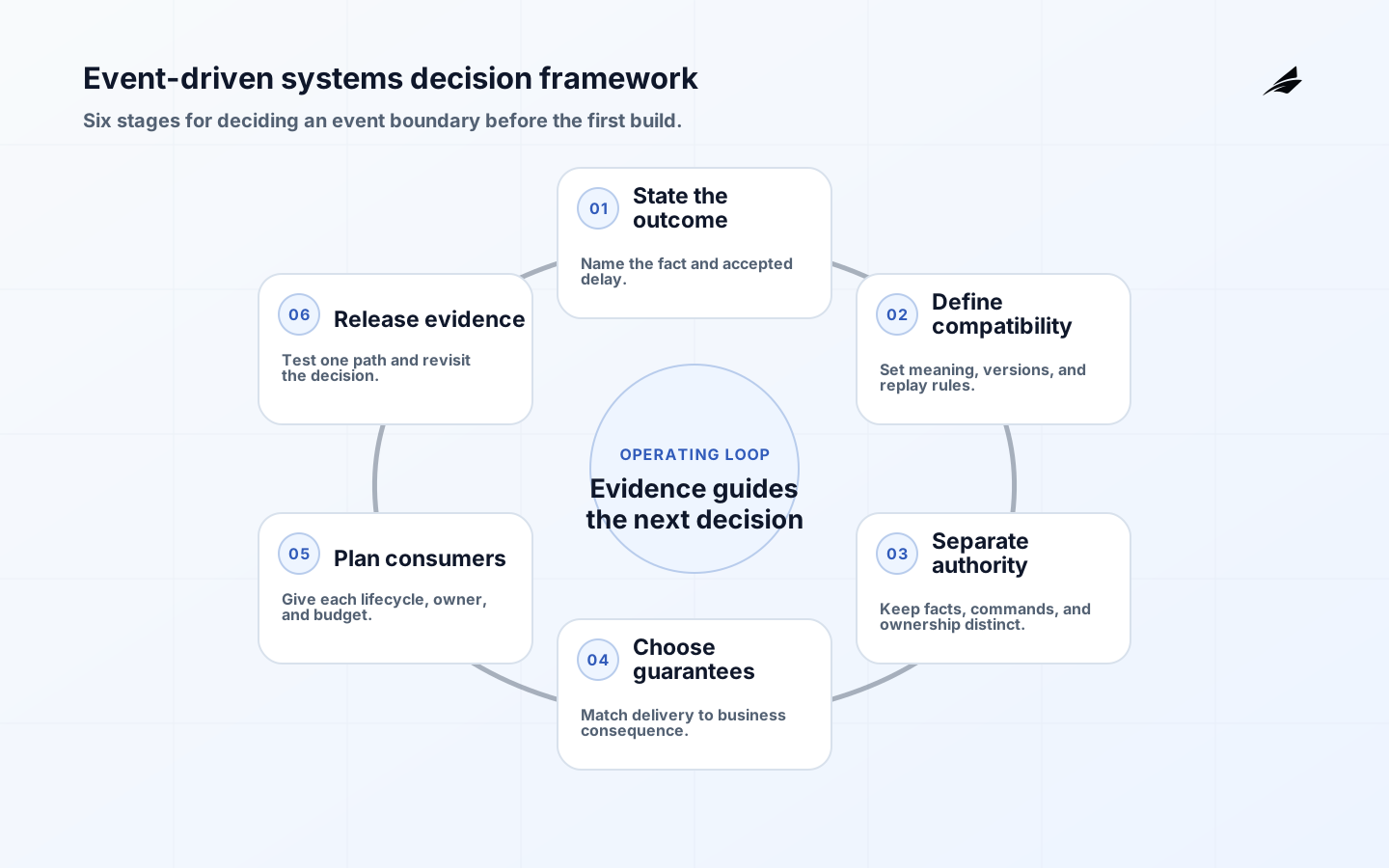
Event-driven systems decisions should be made before the first broker, topic, or consumer is created. The architectural promise is attractive: producers can publish a meaningful fact, independent consumers can react, and teams can scale or deploy parts of the product separately. The hidden work is equally real: someone must define compatibility, delivery expectations, ordering, replay, observability, permissions, and the correction path when a consumer makes a wrong decision. This framework is for product and engineering teams deciding whether the approach fits a first build. It turns enthusiasm into a short decision record that can be tested, challenged, and revisited as the workload becomes better understood.
Write the event-driven systems decision in business terms
State the fact that must travel, the user or system outcome it enables, and the time window in which a consumer may act. “Publish order updated” is not enough. Say whether the goal is to reserve inventory, refresh a search index, notify a customer, or build an audit history. Name the authoritative record and the person accountable for the outcome. Then write what is outside scope: a consumer may update its own view but may not change the order’s source status; analytics may be delayed; a customer-facing email must not be sent twice. The Google Cloud event-driven architecture guidance distinguishes events as immutable facts from the logic consumers apply, which is a useful boundary for this decision.
| Question | Decision to record | Proof before build |
|---|---|---|
| Outcome | Which user, operator, or system result depends on the fact? | Representative journey and success measure. |
| Authority | Which record or service is allowed to decide the current value? | Owner and source identifier. |
| Delay | How stale can a consumer’s view be? | Accepted window and user-facing state. |
| Recovery | Who repairs a bad, missing, or repeated reaction? | Runbook and correction example. |
Define compatibility as a promise, not a version suffix
An event contract should tell a consumer which fields are stable, which may be absent, how schema versions are introduced, and what a consumer should do with an unknown field or event type. Include a durable event identity, source, subject, occurrence time, correlation identifier, and a versioning rule that does not rely on tribal knowledge. Decide whether consumers can replay old events after a deployment and whether the producer retains enough information to do so safely. A version number alone cannot tell a consumer whether an old value is still authoritative or whether it needs a migration. Write examples for current, missing, duplicate, delayed, and future payloads.
Keep event data, commands, and ownership separate
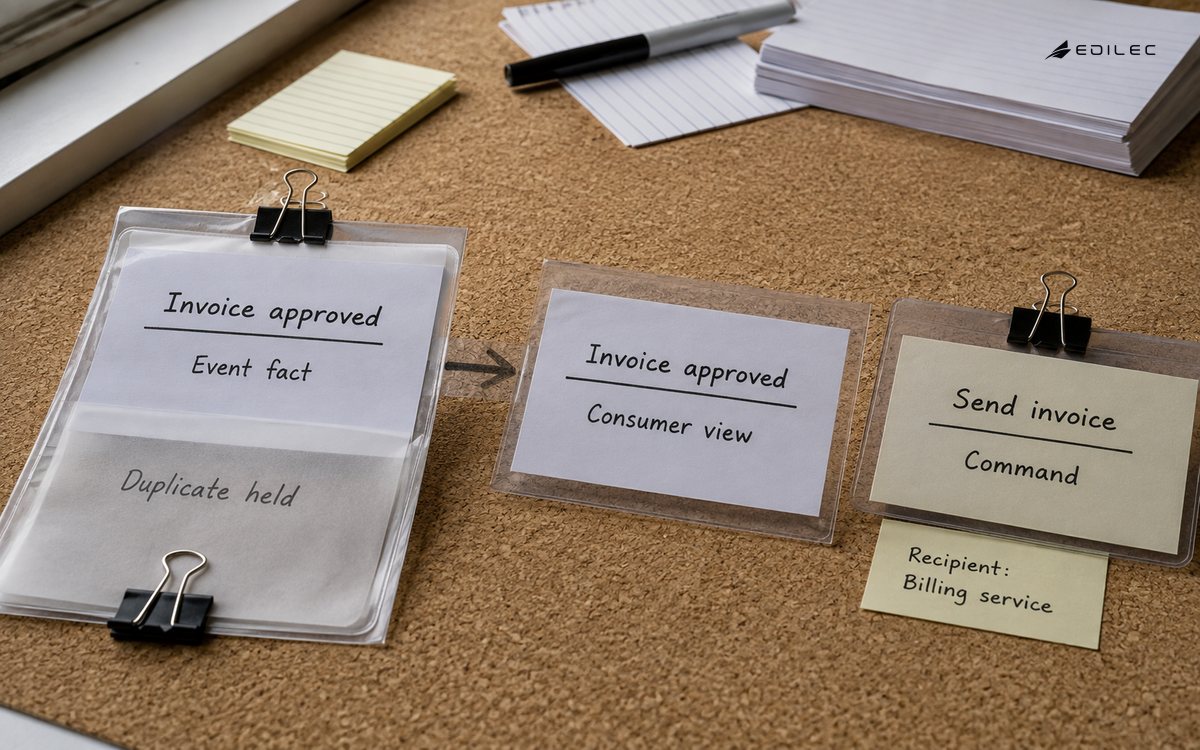
The first-build review should challenge any event that sounds like an instruction. A fact such as InvoiceApproved can be consumed by many capabilities; a command such as SendInvoice has a named recipient and a completion expectation. Mixing the two makes retries and authority confusing. Decide which service owns each state transition and which consumers may create their own derived state. If a consumer needs a correction, give it a command or workflow that returns to the authority rather than allowing it to emit a competing “fixed” fact. This boundary is especially important when several services are built by different teams or use different release schedules.
Choose delivery guarantees that match consequence
Do not ask whether a system supports exactly-once before asking what happens if a message is repeated or lost. For an analytics update, at-least-once delivery with a deduplicated consumer may be adequate. For an entitlement change, the business may require a durable outbox, a unique transition, and a reconciliation report. For an audit trail, retention and immutability may matter more than low latency. Write the guarantee as an end-to-end claim: what does the producer commit, what does the channel retain, what does the consumer acknowledge, and what proves the external side effect? The AWS event sourcing pattern is relevant only when a durable history of state changes is a real requirement, not merely because events are available.
| Consequence | Starting guarantee | Required control |
|---|---|---|
| Informational refresh | At-least-once with idempotent projection. | Stable key, replay rule, and freshness signal. |
| Customer notification | At-least-once with deduplication or send ledger. | Recipient reference, send status, and correction path. |
| Permission or entitlement | Durable transition with reconciliation. | One authority, unique intent, and approval evidence. |
| Compliance history | Immutable retained record with controlled access. | Retention, audit trail, and reconstruction test. |
Plan the consumer lifecycle before the first subscription
A consumer is a product component with a lifecycle: onboarding, catch-up, normal processing, pause, deploy, replay, retirement, and deletion. Decide how a new consumer obtains the history it needs, how it handles events produced by an older schema, and how it stops without leaving a silent gap. If a stream is replayable, define the starting position and whether the consumer can safely rebuild its projection. If the channel is ephemeral, define the backfill or source query that replaces missing history. Give the consumer a team, a budget, a data-access policy, and a dashboard. Without those decisions, adding a subscription creates a permanent operational obligation with no accountable owner.
Keep the event path observable from the beginning. OpenTelemetry messaging conventions provide a vocabulary for spans, metrics, and exceptions across producers and consumers. Record event age, publish-to-consume latency, consumer lag, processing duration, retry count, dead-letter age, and outcome correlation. The most important signal is often not “message delivered” but “authoritative business result reconciled.” Define the join key before implementation so a support person can move from a user reference to the event, consumer attempt, and durable outcome.
Govern change across producers and consumers
A producer should not remove a field or change its meaning because its own tests still pass. Maintain a consumer inventory, deprecation window, contract examples, and a rule for incompatible changes. Require a review when a new consumer handles sensitive data, creates a side effect, or changes the consistency expectation. Architecture styles are constraints, not brand labels; the Azure architecture styles guidance recommends choosing constraints from workload drivers and measuring whether they produce the intended properties. Use the same discipline here: record why the event boundary exists and what evidence would cause the team to simplify or replace it.
A repository and release boundary can reduce coordination cost only when the contract is visible. Add compatibility tests to the producer and consumer pipelines, keep fixtures that represent old versions, and document the owner who approves a breaking change. Link the decision to Monorepo Structure Decisions That Matter before the First Build, A Field Guide to API Versioning for Growing Teams, and Event-Driven Systems for Custom Software when code ownership, event contract ownership, or synchronous APIs overlap.
Make the first release small, observable, and reversible
The first build should prove one meaningful path, not establish a universal messaging platform. Choose one producer, one consumer, one contract, and one business result. Test duplicate delivery, out-of-order input, missing fields, dependency timeout, permission denial, consumer restart, and a replay or reconciliation action. Release to a bounded cohort or internal workflow, then compare the actual delay, failure categories, support load, and correction time with the assumptions in the decision record. If the result is not better than a direct call, that is useful evidence. Stop, simplify, or change the boundary before more consumers make the choice expensive.
Record the decision in a form a new engineer can challenge: the chosen boundary, alternatives considered, accepted consistency window, delivery guarantee, data classification, owner, and review date. Include the evidence that would justify expanding the event path and the evidence that would justify returning to a synchronous design. This turns the first build into a learning instrument rather than an irreversible architectural commitment.
- Write the user outcome and accepted delay before selecting a broker or stream.
- Name the authoritative fact, the command owner, and the consumer’s derived state separately.
- Define event identity, compatibility, retention, replay, and data-access boundaries in examples.
- Choose delivery guarantees from the consequence of loss, delay, or repetition.
- Instrument end-to-end outcome and give an operator a safe correction or retirement path.
Decision framework takeaways
- An event-driven decision is justified by a concrete outcome, not by a preference for asynchronous technology.
- Compatibility includes meaning, ownership, replay, retention, and security, not only a version field.
- Delivery guarantees must be stated end to end and matched to business consequence.
- Every consumer needs a lifecycle, owner, budget, observability, and retirement plan.
- A small reversible slice creates better evidence than a broad first release with hidden operational cost.
Event-driven systems decision FAQ
What should be decided first for event-driven systems?
Name the business outcome, authoritative record, producer, consumer, accepted delay, consequence of duplicate or lost delivery, and recovery owner. Those decisions tell you whether an event, command, stream, queue, or synchronous call is appropriate before a tool choice narrows the conversation.
How should a team state a delivery guarantee?
Describe the complete path from producer commit through channel retention, consumer acknowledgement, and external side effect. Say how repetition, loss, delay, and replay are handled. “Exactly once” is not useful unless the team can identify the boundary where the guarantee ends and the reconciliation control that covers the rest.
Should the first build create a shared event platform?
Usually no. Prove one measurable producer-consumer path first, then extract shared tooling when repeated needs are clear. A platform that arrives before a contract, owner, and operating evidence can make every team inherit the same complexity without proving a product benefit.
Conclusion: decide the boundary before the broker
Event-driven systems can create real independence, but only when their facts, owners, guarantees, and recovery paths are explicit. Before the first build, write the outcome, authority, accepted delay, consumer lifecycle, and evidence that would change the decision. Then release a small path that can be observed and reversed. The strongest architecture is the one that gives a team useful flexibility while preserving a clear answer to what happened, who owns the result, and how to make it right.