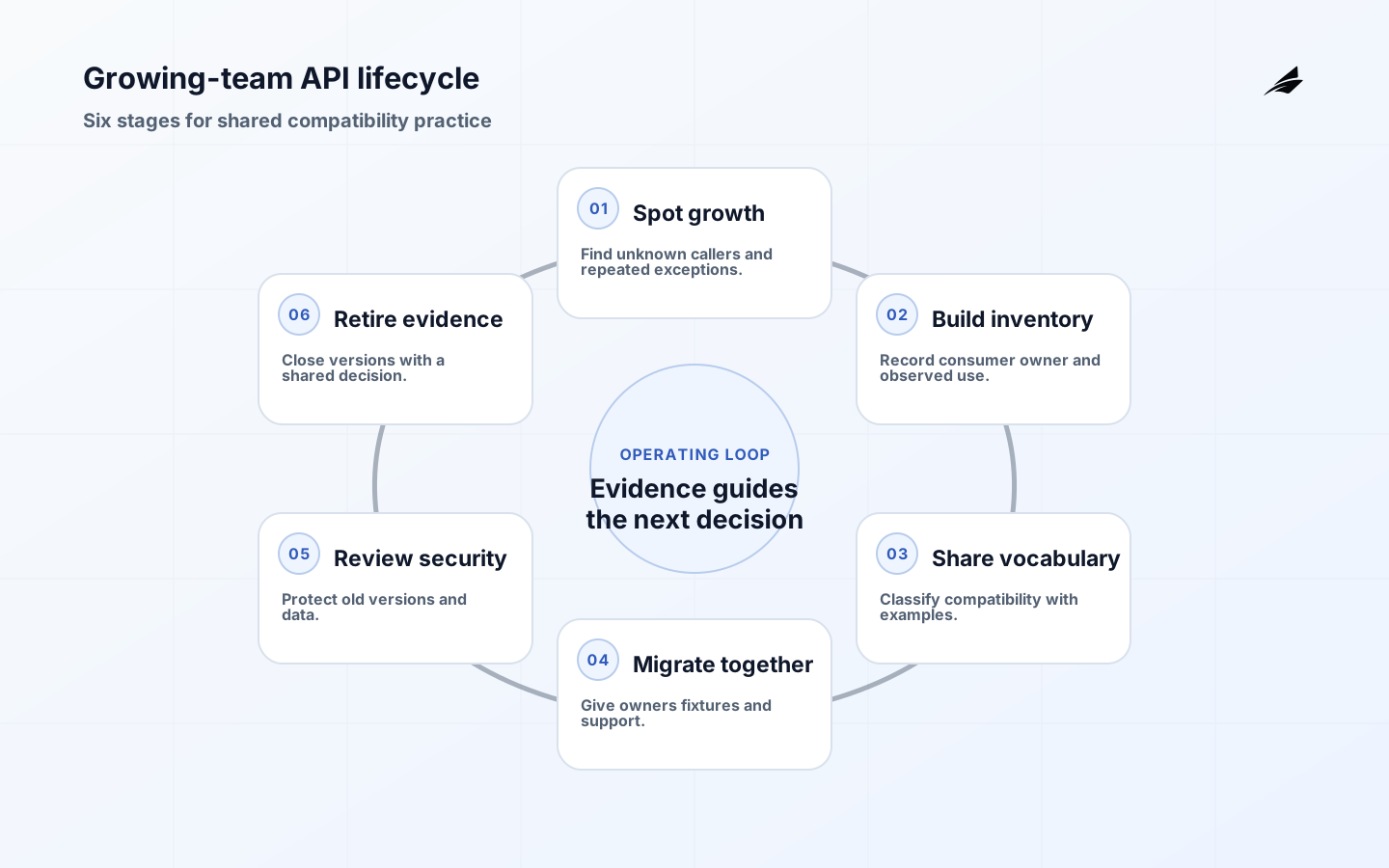
API versioning for growing teams is less about choosing a clever selector and more about making compatibility a shared operating practice. The first builders may remember why a field exists, which partner lags, or which gateway rewrites a header. A larger team cannot rely on that memory. New consumers arrive, ownership shifts, and a harmless-looking default can become a customer incident. This field guide gives teams a workable system: recognize the growth signal, catalogue consumers, classify change, migrate with evidence, include security in the lifecycle, and keep a cadence that fits the risk instead of every change becoming a meeting.
Recognize the growth signal
A versioning program becomes necessary when the team can no longer answer basic questions quickly. Which clients use this operation? Which version do they request? Who can approve a breaking change? What does a deprecated field cost to keep? Which security fix must reach old consumers? Look for duplicated adapters, undocumented route aliases, release notes that say “minor” while support calls it breaking, and traffic that uses shared credentials. These are not just documentation gaps; they show that the product has more contracts than the team can hold in working memory. Start with one service whose consumer population is visible enough to learn from.

| Growth pressure | Small-team habit that fails | Shared practice to add |
|---|---|---|
| More consumers | Ask the original developer who uses the route | Consumer and operation inventory |
| Different release cadence | Announce one date to everyone | Owner-specific migration windows |
| More teams | Treat schema diff as impact proof | Observable change taxonomy |
| Partner exposure | Remove an old route when usage looks low | Inventory confidence and support plan |
| Security maintenance | Patch only the current version | Versioned security and retirement policy |
Build an inventory people can use
An inventory should answer who calls what, with which version, for which business purpose, and under whose authority. Combine specification files, gateway logs, client repositories, SDK releases, partner agreements, scheduled jobs, and support knowledge. Mark confidence: an explicit client registration is stronger than an inferred user-agent string. Record last observed use, release cadence, data sensitivity, and migration difficulty. Keep the inventory close to the service documentation so an API change review can query it. OpenAPI 3.1 provides a useful contract surface, but it must be connected to real callers rather than treated as proof that the file is complete.
Separate internal and external expectations
Internal consumers often share release coordination, but that does not make them free of compatibility obligations. A data pipeline may deploy weekly while a mobile client updates monthly; a partner may need formal notice; a browser may be cached beyond the team's plan. Classify audience and control the blast radius accordingly. Use adapters or an API gateway only when ownership and removal conditions are clear. A translation layer that hides a breaking change can be useful during migration, but an unowned permanent adapter becomes another version nobody can retire.
Give the team one compatibility vocabulary
Define compatible, conditionally compatible, and breaking with examples. Adding an optional response field may be compatible; changing a default filter is conditionally compatible; removing an enum value or requiring a new request field is breaking. Include authorization, rate limits, ordering, timestamps, and side effects in the vocabulary. HTTP Semantics helps keep protocol terms precise, while the local examples make the impact understandable to product and support. Put the classification in pull requests and change notes so a reviewer can challenge the decision with evidence instead of preference.
Run migrations as partnerships
A migration is successful when the consumer's business outcome remains correct, not merely when requests reach the new route. Give each owner a before-and-after example, a test fixture, a deadline, a support contact, and a way to verify completion. Track use of old and new versions by operation, then reconcile it with the owner list because shared credentials can hide stragglers. Let a consumer decline or pause a rollout when evidence is incomplete. The related API versioning mistakes and fixes is useful for reviewing failure patterns; pair it with the REST API contracts guide and the pre-build versioning decisions when the change affects several teams.
Make security part of the lifecycle
Old versions can retain fields or authorization rules that the current design has removed. Include security review when a version exposes sensitive data, adds an action, changes object ownership, or introduces a compatibility adapter. The NIST Secure Software Development Framework encourages secure design, review, verification, and vulnerability response as normal development activities. The OWASP API Security Project provides a focused cross-check for broken object authorization, inventory, and exposure. A version policy should say how a critical security change reaches lagging consumers and when support ends if they cannot move.
Keep a lightweight operating cadence
Review the inventory and version usage on a predictable schedule. For each active version, inspect adoption, error and validation patterns, latency, support demand, security exceptions, and remaining migration work. Review proposed changes asynchronously with a short evidence pack: consumer impact, examples, selected version behavior, rollout observation, rollback or adapter plan, and retirement effect. Escalate only when impact or ambiguity requires a decision. This cadence keeps the API program responsive without turning every additive field into a governance event.
Use incidents to improve the contract system
When a version-related incident occurs, ask which promise was missing or unobservable. Did the client select an unexpected version? Did a gateway strip a header? Was a deprecation message absent? Did the response preserve syntax but change meaning? Did logs omit the consumer identity? Fix the system that allowed the surprise: improve inventory, add a contract test, make the version visible, revise the classification, or shorten a security exception. Keep the lesson specific so it changes a review rule rather than producing a vague request for more documentation.
Give each active version a small scorecard
A scorecard helps a growing team see lifecycle risk without turning the program into a spreadsheet exercise. For each version, record active consumers, last observed use, unresolved exceptions, security findings, error and validation trends, support demand, migration work, and the next decision date. The scorecard should lead to action: investigate a hidden caller, provide a migration fixture, review a stale adapter, or approve retirement. Keep the evidence linked to the service and make the owner visible so the scorecard does not become a status artifact that no one can change.
| Scorecard signal | Healthy reading | Action when unhealthy |
|---|---|---|
| Consumer ownership | Every material caller has a named team | Find and confirm unknown ownership |
| Migration progress | Old traffic declines with tested outcomes | Offer support or change cohort order |
| Security posture | Current fixes reach supported versions | Escalate exception or shorten support |
| Operational clarity | Version and caller appear in traces | Fix gateway and telemetry fields |
| Retirement readiness | Remaining use is understood and bounded | Set a final notice or preserve deliberately |
Review one difficult consumer each cycle
Do not review only the easiest client. Choose a mobile release, partner, scheduled job, or shared credential whose migration is slow or ambiguous. Trace its workflow, data sensitivity, version selector, failure response, and support route. The team learns where the lifecycle process is weakest when it investigates a consumer with a different constraint from the platform team. Record the specific improvement—an SDK example, a deprecation header, a new owner field, or a security exception expiry—then check its effect at the next review.
Make the review artifact useful to a new maintainer. Include the endpoint owner, consumer owner, last observed request, contract revision, known exception, security contact, and the exact condition that changes the next decision. This small amount of context prevents a future engineer from re-opening the same discovery work or assuming that a quiet version is safe to delete. It also makes handoff possible when the original service team changes.
A scorecard also protects against premature removal. Low traffic can mean a quiet but consequential workflow, a client hidden behind a proxy, or a job that runs monthly. Combine telemetry with owner confirmation and business context. If evidence remains incomplete, state the uncertainty and choose a safer notice or adapter rather than presenting an assumption as a fact.
API versioning for growing teams takeaways
- Treat unknown consumers and undocumented exceptions as growth signals, not isolated annoyances.
- Keep an inventory with ownership, purpose, cadence, sensitivity, and observed use.
- Use one change vocabulary that includes semantics, authorization, ordering, and side effects.
- Give consumer owners evidence and support for migration, then reconcile logs with declared inventory.
- Review security and retirement as part of the same lifecycle, with an explicit end condition.
API versioning for growing teams FAQ
Should a platform team own every API version?
A platform or API enablement team can own the lifecycle process and tooling, but the service owner remains accountable for business meaning and compatibility. Consumer owners must accept migrations and security implications for their use.
What if the consumer inventory is incomplete?
Mark confidence and use traffic, credentials, code search, partner records, and scheduled-job reviews to close gaps. If a version may have unknown consumers, choose a safer migration or notice period instead of treating low observed traffic as proof of no dependency.
When is a compatibility adapter worthwhile?
Use one when it reduces a bounded migration risk and has an owner, observability, security review, and removal condition. Do not create an adapter simply to avoid classifying a breaking semantic change.
Conclusion: make compatibility a team habit
Growing teams do not need a heavy API bureaucracy; they need shared facts. Inventory consumers, describe change by impact, migrate with evidence, include security, and review versions on a cadence. That small operating system preserves the speed of a young service while giving every new consumer a fair answer about what the API promises and when it may change.