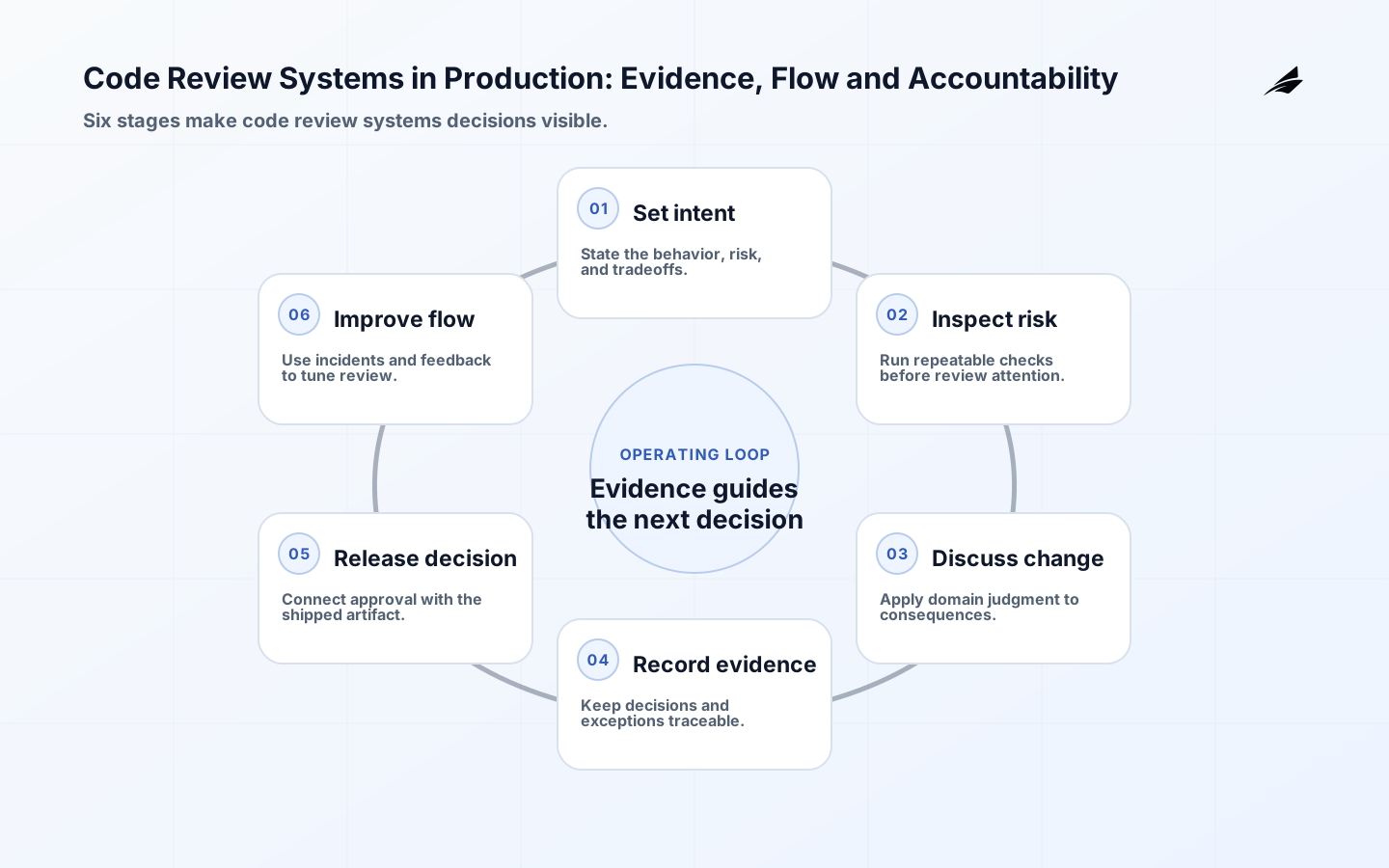
A production review system should make the reviewer’s job specific. “Looks good” is weak evidence; “the authorization check is preserved, the migration is backward compatible, and the failure path is covered” gives the author a decision they can act on. Templates can prompt for risk, test evidence, rollout behavior, and observability, but they should not turn every small documentation change into a ceremony. Calibrate required reviewers and checks to the consequence of the change.
Make change intent reviewable
A reviewer needs a concise statement of the problem, intended behavior, notable trade-offs, and evidence already gathered. Include links to the issue, design decision, incident, or customer case when that context changes the review. Keep the diff narrow enough that a human can hold the relevant behavior in mind; split mechanical formatting or unrelated refactoring from a risky functional change. Google's engineering practices for review are a useful reference for timely, constructive review. The important local convention is to make the author’s reasoning inspectable: what is deliberately unchanged, which failure path was considered, and how can a reviewer reproduce the claimed result?

| Change characteristic | Review focus | Evidence expected |
|---|---|---|
| Localized behavior | Correctness and tests around the changed rule. | Focused automated check and readable example. |
| Public contract | Compatibility and consumer impact. | Schema or contract tests and migration note. |
| Security-sensitive path | Authorization, input handling, and secret exposure. | Threat-aware review and relevant scanning. |
| Infrastructure or release rule | Blast radius and rollback behavior. | Plan, owner, and deployment evidence. |
Let automation carry repeatable evidence
Automation should remove mechanical uncertainty before a person spends attention on design and consequence. Run formatting, type checking, tests, dependency checks, static analysis, and policy checks appropriate to the changed surface. Make results visible and stable; a noisy check that is routinely ignored teaches the team to ignore valuable failures too. NIST's Secure Software Development Framework supports integrating secure practices throughout development rather than reserving them for a final gate. Do not treat a green pipeline as proof of correctness. Automated checks establish bounded facts, such as a test passed against a fixture. Human review must still question whether the fixture, control, and user outcome are the right ones.
Review automation itself needs ownership. Version the rules, explain failures in terms of an action the author can take, and create an expiry path for temporary exceptions. A repository may need a required status check, but the responsible group also needs a way to fix flaky infrastructure without blocking unrelated work indefinitely. Capture the distinction between a failed product test, a failed environment, and an unrun check. That clarity supports trustworthy merge controls and helps leaders see whether delays come from review capacity, poor change boundaries, or unreliable automation.
Use human review for judgment and shared understanding
Assign reviewers according to ownership and risk, not availability alone. A domain owner may know the policy implication of a field change; a platform owner may know whether an integration violates a runtime boundary. Avoid routing every change to the same senior person, which creates queues and makes learning fragile. Comments should identify the concern, evidence, and desired outcome rather than merely state preference. Ask whether a name, test, or smaller change would make the decision more obvious to the next maintainer. GitHub's pull request review documentation describes the workflow features, but no tool can replace a respectful agreement on what approval means.
| Review signal | Interpret with | Improvement response |
|---|---|---|
| Long time to first review | Change size, ownership coverage, and reviewer load. | Improve routing or split large changes. |
| Many late defects | Defect class and escaped review evidence. | Add the missing test, checklist, or domain review. |
| Repeated comment type | Whether guidance is discoverable before review. | Automate, document, or improve templates. |
| High rework rate | Clarity of intent and early design alignment. | Discuss the decision before implementation grows. |
Escalate evidence for high-consequence change
A review system should make it harder to merge an unexamined high-risk change, not make all work equally slow. Define triggers for additional review: customer data access, payment or entitlement rules, authentication, irreversible migrations, externally visible contracts, and changes to deployment authority. OWASP's Code Review Guide is a useful starting point for security-oriented inspection. For each trigger, state the extra evidence and the person or team who can make the decision. A second approval without a specific responsibility is theater; a targeted review of an authorization rule or migration plan is a real control.
Close the loop from review to release
Connect the merged revision to the artifact and deployment that carry it, then revisit notable incidents and rollbacks without blame. Ask what evidence would have made the issue visible earlier: a clearer contract, a representative test, a better owner rule, or a smaller release. Update the system rather than relying on memory. Code review systems buyer and CTO guide and code review systems for custom software offer useful adjacent planning guidance. The best review culture is not one with the most comments; it is one that steadily improves the team’s ability to make safe, understandable changes. For the broader operating context, compare this production system with code review systems for CTOs.
- Describe the user or operational outcome before asking for approval.
- Keep changes focused and separate mechanical churn from behavior.
- Automate repeatable checks and maintain the checks as production tooling.
- Route review by accountable ownership and stated risk.
- Require specific extra evidence for security, data, and release-sensitive changes.
- Use escaped defects and review delays to improve the system, not to assign blame.
Keep the review interface focused on decision-making evidence. A useful template can ask for user impact, risk class, test evidence, data or migration implications, rollback approach, and follow-up work without forcing a long narrative for every small fix. Encourage authors to respond to substantive comments with the decision made, not only a code change, so the final discussion remains legible later. For urgent fixes, preserve a short retrospective review rather than bypassing the system permanently. The retrospective should establish what was changed under pressure, what evidence was unavailable, and whether a test, ownership rule, or release control should be improved. That balance lets a team respond quickly without normalizing unreviewable change.
Set review-service expectations by risk class and measure them honestly. A routine change may need a same-day acknowledgement; a data migration may need planned review from a specialist. When the expectation is missed, inspect workload, unclear ownership, and change size before blaming individuals. Review capacity is an engineering concern that leaders can improve through staffing, automation, and better boundaries.
Review ownership should have a failure mode. If the designated reviewer is unavailable, define who may act, what evidence is required, and how the owner is informed afterward. For critical fixes, that route should include a short decision record and a follow-up review of the change under normal conditions. This prevents urgency from turning into a permanent bypass while ensuring that production recovery does not wait for one individual. It also reveals where a domain has only one effective steward and needs deliberate knowledge sharing.
For changes with a customer deadline, record the decision deadline separately from the merge deadline. That small distinction gives reviewers time to challenge risk while letting release owners decide whether a partial capability, a feature hold, or a controlled rollback is the appropriate response.
Key takeaways
- Code review is a system of intent, evidence, judgment, and traceability.
- Automation should establish repeatable facts before humans review the hard questions.
- Risk-based escalation protects consequential changes without slowing every task.
- Review outcomes become more valuable when connected to release and incident learning.
Frequently asked questions (FAQ)
Review data can improve the system without becoming a productivity scoreboard. Watch time to first useful review, reopen rate, recurring defect themes, and changes that bypass normal evidence. A rising review queue may indicate ownership or batch-size problems rather than reviewer laziness. Use the signals to improve boundaries and feedback, and retain a clear emergency path that records why normal review was shortened. What is the right size for a code review?
The right size is one that lets a reviewer understand the intended behavior and its evidence without losing context. Size varies by domain, but separating unrelated edits and discussing major decisions early nearly always improves review quality.
Can tests replace human review?
No. Tests can establish that specified cases behave as expected. Human review checks whether the cases, interfaces, risks, and operational consequences are appropriate, and it shares knowledge of the resulting design.
Review policies work best when they describe decisions rather than ceremonies. A small copy change may need a quick owner check, while a permission change needs evidence from tests, policy owners, and a rollback plan. Make that difference visible in the review template and repository rules, then revisit it after incidents or repeated rework. Authors should know what context to provide before opening a change, and reviewers should know when a question is advisory versus a release gate. Clear expectations reduce waiting without lowering the quality of judgment on consequential work.
A useful review record should preserve the question that prompted the change, the evidence available at decision time, and the uncertainty that remains. That record helps a later incident review distinguish a missed test from an unclear requirement or an unavailable owner. It also gives new reviewers a compact path into the domain without requiring them to reconstruct every conversation. Keep the record proportionate: a few precise facts and an explicit decision are more valuable than a long checklist that nobody reads.
Conclusion
A production code review system turns change into accountable evidence. Clear intent, reliable automation, focused human judgment, and a release feedback loop help a team deliver quickly without asking reviewers to guess what matters.