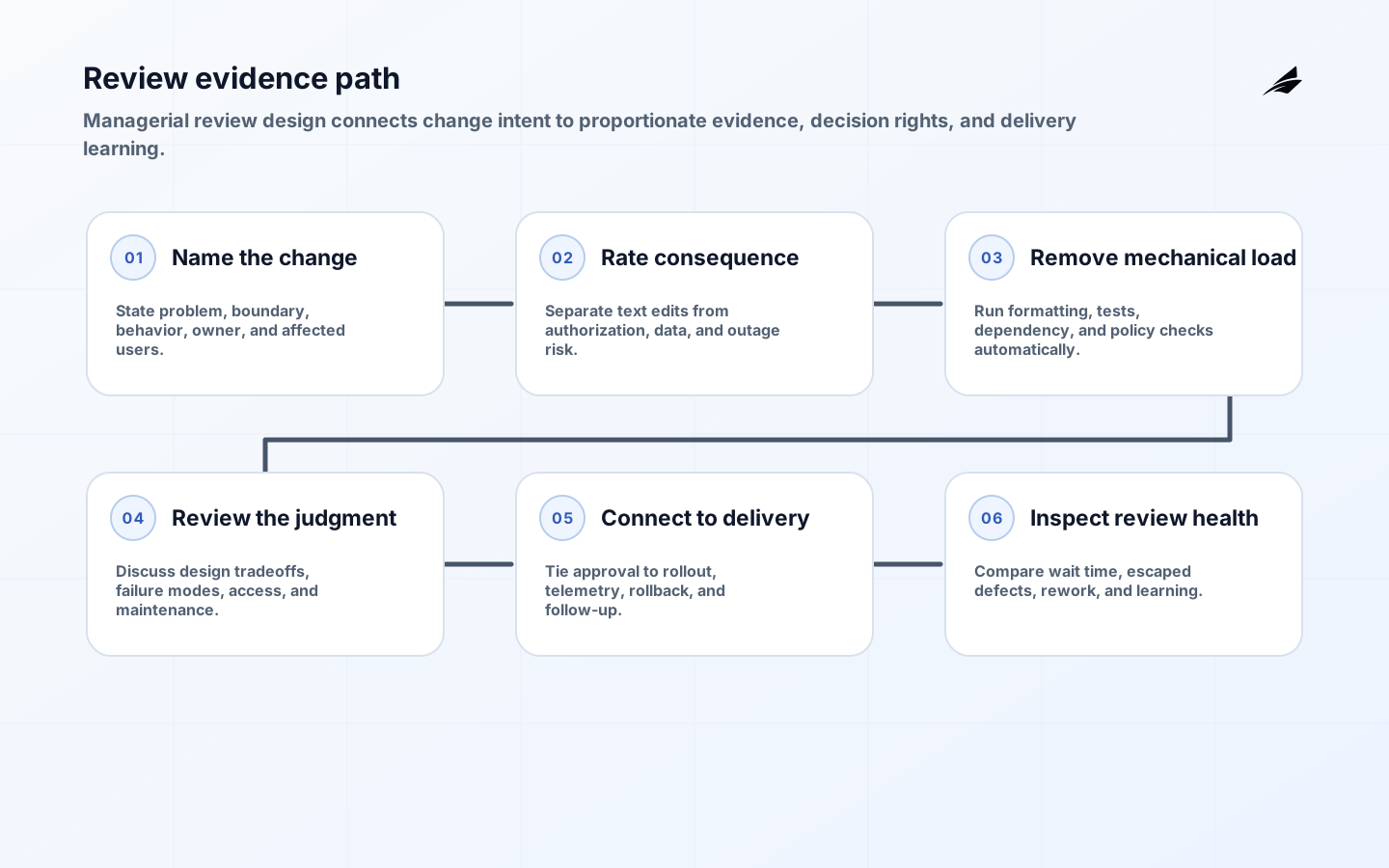
A code review system is the set of habits, tools, policies, and evidence that lets a team change software safely at a sustainable pace. IT managers should evaluate it as a delivery system, not as a count of approvals. A review can catch a security boundary, clarify an operational assumption, or teach a design principle; it can also become a queue that delays small fixes and encourages rubber-stamping. Google’s review guidance emphasizes useful comments and sustainable speed; GitHub’s review documentation clarifies approval and requested-change states. The management decision is to create enough signal for risk without making every change carry the same ceremony.
Make the code review outcome explicit
Define what review must establish: the change solves the stated problem, preserves important behavior, respects security and privacy boundaries, is operable, and has tests proportionate to risk. Separate questions that belong to automated checks from questions that require judgment. A formatter should not consume reviewer attention; a migration, authorization change, or failure-policy change should not pass because the build is green. NIST’s secure-development framework and SLSA levels add concrete security and provenance questions. Write the policy in terms of evidence and decision rights, including who may approve high-risk changes and who can block or request a safer sequence.

| Change type | Useful evidence | Human attention |
|---|---|---|
| Docs or formatting | Automated validation | Lightweight or self-review |
| Business rule | Tests, examples, edge cases | Owner and peer review |
| Identity or data access | Threat analysis and negative tests | Security-aware reviewer |
| Migration or release path | Rollback, reconciliation, monitoring | Owner plus operations review |
Make changes small enough to understand
Small, coherent changes improve review quality because the reviewer can hold the intent and evidence in mind. They also reduce merge conflicts, shorten feedback loops, and make rollback more targeted. Do not split a change so aggressively that the intermediate commits are misleading; instead separate mechanical movement, behavior change, and cleanup where each stage remains buildable. Set a service expectation for first response, but do not reward shallow approvals. The useful metric is time to a confident, integrated change, not time from request to any button click.
Turn review into a clear contract
A pull request should explain the problem, boundary, expected behavior, test evidence, operational impact, and rollback or follow-up. Templates help only when they ask questions people can answer. Reviewers should comment on correctness, maintainability, security, observability, and user impact, then distinguish blocking defects from suggestions. GitHub’s review model supports approvals, requested changes, and comments; the team still needs a local rule for stale approvals, new commits, ownership, and emergency changes. Make the path for disagreement respectful and visible so people do not move important decisions into private messages.
| Signal | What it may show | Caution |
|---|---|---|
| First-response time | Queue pressure or unclear ownership | A fast response can still be shallow |
| Change size | Reviewability and coupling | Averages hide risky outliers |
| Rework after review | Useful discovery or late requirements | Interpret with change type |
| Post-release defects | Missed evidence or weak tests | Do not blame review alone |
Automate checks for review friction
Run formatting, compilation, unit tests, dependency checks, secret detection, static analysis, and policy checks before a reviewer spends time. Make failures actionable: name the rule, affected file, reproduction, and safe path. Security automation should inform a human risk decision rather than create an unreviewed wall of warnings. For supply-chain confidence, retain provenance and build evidence appropriate to the system; SLSA describes levels of increasing assurance. Keep checks fast for normal changes and move expensive suites to a controlled stage when their signal justifies the wait.
Review operational consequences
A code change can be correct in isolation and unsafe in operation. Ask whether it changes capacity, alerts, permissions, data retention, migration order, rollback, or customer communication. Include dashboards and runbook updates in the change’s evidence, not as a promise after merge. For a service that handles retries or asynchronous work, review idempotency, duplicate messages, poison records, and recovery. For a UI, review accessibility and error states. The review system should make the relevant operational owner easy to find rather than assuming the author knows every downstream dependency.
Govern without making review ceremonial
Set ownership rules for sensitive paths, maintain a small reviewer pool, and rotate expertise so one person does not become a permanent bottleneck. Review the queue by age and risk, not only by count. Sample merged changes for the quality of reasoning, including approvals that found nothing, and use blameless retrospectives when defects escape. Change the policy when evidence shows it is missing a risk or creating work with no benefit. A manager’s job is to improve the system’s learning rate and confidence, not to maximize the number of comments per change.
- State the review outcome and decision rights before choosing tooling.
- Keep mechanical checks automatic and human attention focused on judgment.
- Prefer coherent, reviewable changes with visible intent and rollback.
- Measure queue age, rework, defects, and outcome quality together.
- Include security, accessibility, data, and operational consequences where relevant.
- Use escaped defects to improve evidence and design, not to assign blame.
Code review systems takeaways
A strong code review system is a risk-based conversation surrounded by reliable automation. Make intent visible, keep changes understandable, require evidence proportionate to consequence, and make ownership explicit. Then measure whether software reaches users with fewer surprises and less waiting. Those outcomes matter more than a perfect approval statistic.
A manager’s review scenario
For a change that alters a customer-facing workflow, ask the author to state the outcome, risk, evidence, rollout, monitoring, and rollback in one place. Let automation cover mechanical checks, then ask a domain reviewer about business behavior, a security reviewer about access and data, and an operations owner about failure and support. Release to a small cohort and compare defects, rework, and customer effort. If the process is slow, reduce change size or clarify ownership before reducing evidence. If an incident escapes, improve the missing check or contract rather than adding an indiscriminate approval rule.
Managerial review signals
A review policy is useful when it provides a repeatable way to reason about consequence. A text change may need automated checks and a content owner. An authorization change needs negative tests, an access-model reviewer, and a release note naming affected roles. A migration needs lock and backfill estimates, reconciliation, rollback or forward-only reasoning, and an operations owner. An emergency fix can move quickly but needs a follow-up review while context is fresh. Managers should inspect whether comments are actionable, whether authors receive a response within the agreed window, and whether approval remains meaningful after new commits. A monthly sample can compare review depth with escaped defects and rework. Fix noisy checks and add targeted evidence for recurring defects. This creates learning instead of ceremony.
Frequently asked questions about code review systems
What belongs in the first review policy?
Define change ownership, minimum automated checks, risk categories, reviewer expectations, response time, emergency handling, stale approvals, and the evidence required for release or migration changes. Keep the initial policy short enough to follow.
Should every change need two approvals?
Not necessarily. Approval count is a proxy. Require the people who can evaluate the actual risk, and use stronger review for access, data, release, and safety-sensitive changes than for a contained documentation correction.
How can a team improve review speed?
Reduce change size, clarify ownership, keep checks fast, use reviewer rotation, and remove low-signal ceremony. Track time to a confident decision and verify that faster review does not increase escaped defects or rework.
A manager’s review system example
Take a change that adds a refund workflow. The pull request states the customer outcome, allowed roles, idempotency key, ledger effect, notification behavior, alert, and rollback. Automated checks cover formatting, unit rules, authorization negatives, API contract, dependency scanning, and migration rehearsal. A reviewer with payment context checks duplicate requests, partial failure, reconciliation, and the wording shown to an operator. The operations owner verifies the dashboard and runbook before approval. The change is released to an internal cohort, then a small customer cohort, with a decision record linking evidence to the rollout. If the review takes two days, the manager examines whether the change is too broad or ownership unclear; if a defect escapes, the team asks which evidence was missing rather than adding a blanket approval rule. This system makes the important work visible while keeping low-risk changes fast.
Review the queue as a service
Inspect age by risk, first response, review rounds, change size, rework, and escaped defects. Speak with authors about unclear comments and with reviewers about noisy checks. Retire a rule that produces warnings nobody acts on, and add a targeted check when a recurring defect has a stable signal. Maintain reviewer ownership for sensitive paths but rotate ordinary work to spread knowledge. The system improves when people can disagree in the review itself and when the final decision, accepted risk, and follow-up are easy to find later.
Conclusion
IT managers can make code review a competitive delivery capability by treating it as a system of evidence, judgment, and learning. Risk-based policy, small changes, automated checks, respectful feedback, and operational ownership give teams confidence without turning every pull request into a meeting.
A manager can make this policy practical by publishing a short risk matrix and reviewing it after incidents. The matrix should connect change type to reviewer expertise, automated evidence, rollout, and rollback. Track review age, rework, escaped defects, and customer impact together so speed does not hide weak decisions. Retire rules that create noise and add targeted evidence when a real defect reveals a gap.
For a high-consequence change, the review record should connect intent, evidence, owner, rollout, rollback, and support impact. A manager can sample these records after release and improve the process from observed rework rather than adding blanket ceremony.