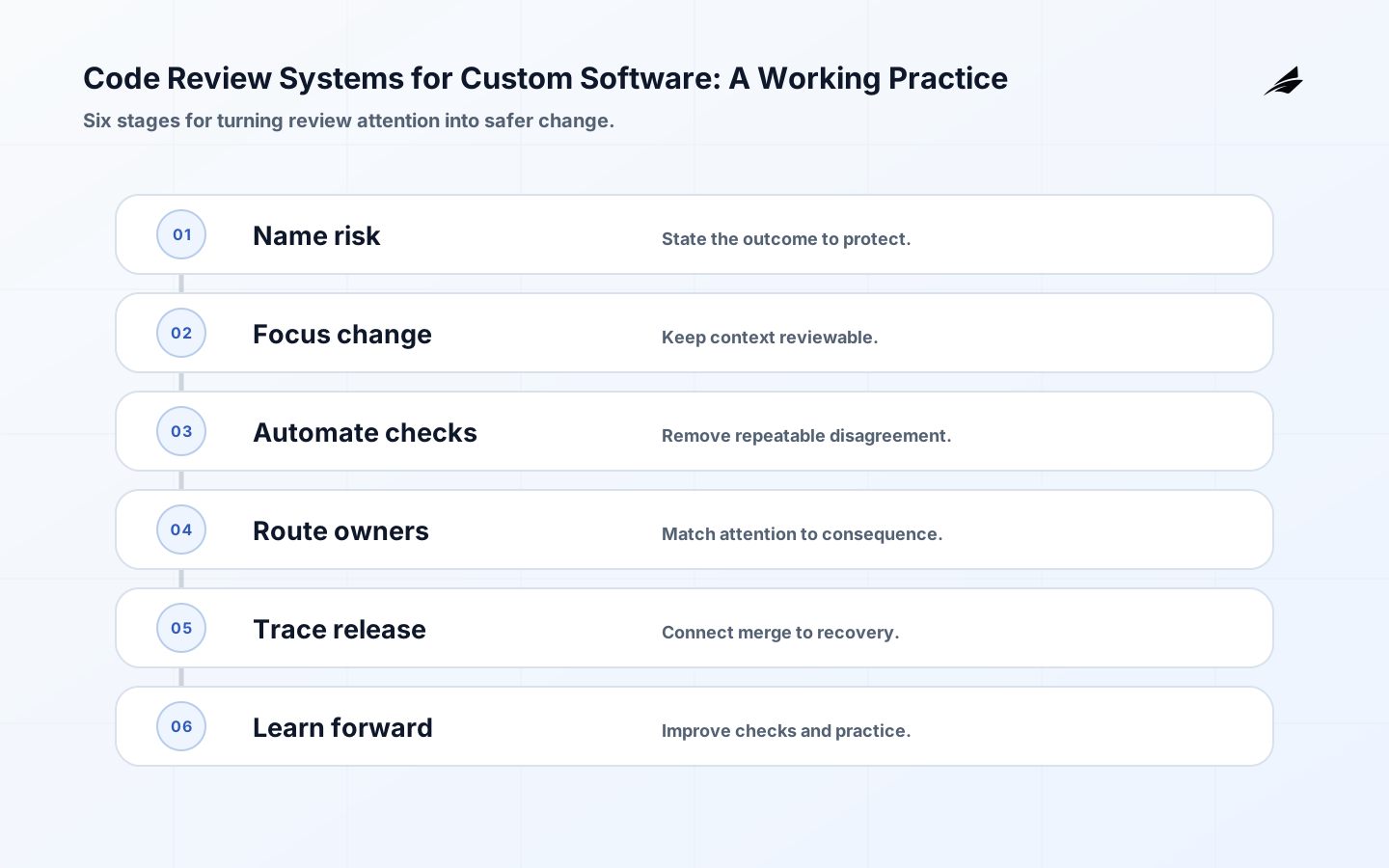
Code review systems are the way a custom-software team turns another person's attention into a release decision. The tool may be a pull request, merge request, change list, or a Gerrit review, but the durable practice is broader: an author explains the intended behavior, automation supplies repeatable evidence, a reviewer examines risk and context, and the team records what happened after the change. A review process that only counts approvals can feel orderly while still missing an authorization mistake, an untested migration, or a recovery path no operator can use.
Define what the review must protect
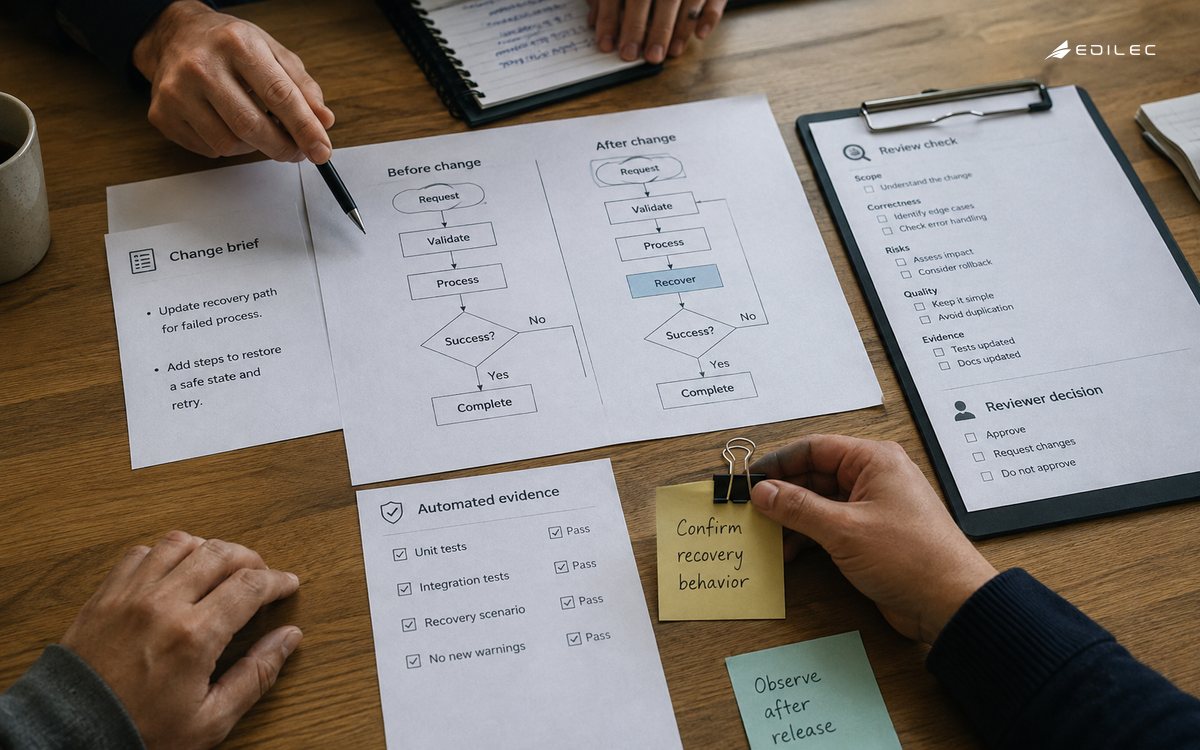
Begin with the consequence of a wrong change. For a custom product, review may need to protect customer-visible behavior, data integrity, access control, performance, supportability, or future maintainability. Those goals should be visible in the change description so the reviewer knows which questions matter. Google’s standard for code review frames the primary purpose as improving overall code health while balancing progress and the absence of a mythical perfect change. That is a stronger basis than asking reviewers to apply personal taste.
| Review concern | Author provides | Reviewer verifies |
|---|---|---|
| Behavior | User outcome, affected states, and examples. | The implementation matches the promised behavior. |
| Risk | Data, access, dependency, and rollback impact. | The dangerous boundary has a control and a test. |
| Evidence | Relevant tests, traces, screenshots, or migration checks. | Evidence would fail if the change were broken. |
| Ownership | Responsible team and support route. | The owner can observe and recover the change. |
| Scope | A focused, independently understandable unit. | The change can be reviewed without reconstructing a project. |
Make the unit of review small enough to understand
A review is a reasoning task, so context has a finite capacity. Split a large feature into changes that each preserve a coherent behavior: add a schema field, introduce a compatibility reader, backfill a bounded set, then switch a cohort. A 2,000-line pull request may contain less total work than five small changes, but it gives reviewers fewer chances to isolate a bad assumption. The Google small change guidance emphasizes self-contained portions that authors can explain and reviewers can process while work continues.
Small does not mean trivial or artificially fragmented. A security-sensitive change may need its migration and tests in one review so the reviewer can see the complete control. Use the change description to show the intended order, the out-of-scope work, and the condition that would make the design unsafe. If reviewers cannot tell whether a file is functional logic, generated output, or an unrelated cleanup, ask the author to separate the concerns before discussing style.
Let automation remove predictable disagreement
Formatters, linters, type checks, dependency scans, unit tests, contract tests, and deployment previews should catch mechanical issues before human review. Human attention is better spent on business behavior, invariants, failure modes, data ownership, and the consequences of a partial rollout. The Gerrit overview describes review as a way to find mistakes before customers see them while tests confirm intended behavior. The two forms of evidence complement each other; neither is a substitute for the other.
- A check must have a clear failure meaning and an owner who can repair it.
- A flaky check should be visible as a reliability problem, not silently retried forever.
- Tests should fail when the behavior is broken, not merely execute the changed lines.
- Generated evidence should link back to the source change and relevant business case.
- Required checks should not block an urgent recovery without an explicit, auditable exception.
Route attention by consequence and ownership
The right reviewer is not always the most senior person or the author’s closest teammate. Route changes to people who understand the affected domain, security boundary, operational path, or data contract. GitHub’s code-owner documentation explains how owned paths can automatically request the responsible people and, where configured, make their approval a merge condition. Treat that as a routing control, not proof of understanding: an owner still needs enough context and time to review.
Use tiers that reflect consequence. A low-risk text or test adjustment may need one ordinary review. An authorization policy, payment state transition, or destructive migration may need a domain owner, an operational reviewer, and explicit evidence of rollback or reconciliation. Avoid a permanent approval bottleneck for routine work; it will teach authors to wait, bypass, or split review context in unsafe ways. Rotate reviewers and record decisions so knowledge does not remain with one person.
Make feedback specific, kind, and decisive
A useful review comment names the behavior at risk, the evidence behind the concern, and the smallest change that would make it safe. Label a blocking issue clearly and mark optional polish as optional. Personal preference should not masquerade as a production requirement. The Google review guidance distinguishes technical facts and style authority from personal taste and encourages reviewers to notice what is already good. That tone protects both quality and the willingness to improve the codebase.
| Comment type | Example intent | Expected next step |
|---|---|---|
| Blocking defect | This path can expose another tenant’s record. | Author adds a control and a negative test. |
| Design question | Which record is authoritative after a retry? | Author explains or records the decision. |
| Evidence request | What proves the migration is complete? | Attach a check, trace, or verification result. |
| Optional polish | This name could be clearer for future readers. | Author accepts or consciously leaves it. |
| Out-of-scope issue | A broader cleanup is needed but not here. | Create a linked follow-up with an owner. |
When a thread turns into a design disagreement, move the conversation to the smallest group that can decide and write the result back into the review. Do not let an unresolved comment become an invisible veto. The review system should show which concerns are closed, which are accepted risks, and which belong to another change. That record helps a future maintainer understand why a seemingly unusual choice exists.
Connect review to rollout and recovery
A review is not complete at merge if the change creates production risk. Require a rollout note for migrations, flags, permission changes, and dependency updates: exposure order, observation window, stop condition, rollback or correction action, and owner. A change that is safe at one percent traffic may be unsafe at one hundred percent because its data volume or user mix changes. Keep the review linked to the deployment and any reconciliation run so the team can trace intent to outcome.
The GitHub pull request review model provides useful primitives such as approve, comment, request changes, and resolved conversations. Use those primitives to represent a local decision rather than turning them into a ceremony. When an emergency exception is necessary, capture who accepted it, why normal evidence was unavailable, and when the change receives the fuller review that the emergency displaced.
Measure whether the system improves change quality
Track first-response time, time to merge, review rework, change size, escaped defects, rollbacks, flaky checks, and the age of open blocking threads. Break the signals down by change class and team, because a low median can hide a queue of high-consequence work. Also measure whether reviewers are concentrated in a way that creates a single point of failure. A shorter review time is useful only if it does not arrive with more escaped defects or painful recovery.
Sample completed reviews for learning rather than blame. When a bug escapes, ask which evidence was absent, hard to find, or discounted; whether the change was too large; and whether an automated check could express the invariant. When a review is unusually smooth, preserve the useful pattern. Feed the result into templates, tests, ownership maps, or reviewer training. A code review system should get better at making important questions easy to ask.
Avoid approval theater and permanent queues
Approval counts are easy to report and easy to game. They do not show whether the reviewer had domain context, read the tests, or understood the consequence. A required owner who is always unavailable can create a rubber stamp or a shadow bypass. A template with twenty unanswered questions can make authors add prose without adding evidence. Keep the process proportional, inspect the actual failure modes, and remove controls whose only effect is delay.
The opposite trap is treating every issue as a blocking emergency. If reviewers cannot distinguish correctness, safety, and polish, authors stop trusting the process. Establish an escalation path, set reasonable response expectations, and permit an accountable decision when multiple designs are sound. The goal is a codebase that improves while people can still deliver and learn.
Review friction often points to a neighboring design problem. A repeated migration question belongs beside the technical debt guide; a costly client composition may need the GraphQL production guide; and weak regression evidence should be addressed with the test strategy guide. Cross-links like these keep review from becoming a catch-all meeting for unresolved architecture.
Key takeaways
- Define the risks and outcomes that review must protect before choosing approval rules.
- Keep each change focused, understandable, and paired with the evidence a reviewer needs.
- Automate repeatable checks so human attention can address behavior, ownership, and tradeoffs.
- Route consequential changes to accountable domain and operational owners.
- Connect review decisions to rollout, recovery, and learning after merge.
Frequently asked questions
What should code review systems optimize for?
They should improve code health and protect users without making delivery impossible. That means small, context-rich changes; objective checks; timely, specific feedback; and a way to learn from defects that escape the review.
Should every change have the same number of approvals?
No. Review depth should follow consequence, uncertainty, ownership, and the ability to recover. A documentation change and an authorization change deserve different scrutiny, but each should have enough evidence for its promise.
How can reviews remain respectful and decisive?
Separate blocking issues from optional polish, explain the reason for a request, acknowledge sound work, and provide an escalation route. Write decisions back into the review so disagreement does not become an unbounded queue.
Conclusion: make code review systems useful
Good code review systems turn attention into shared engineering judgment. They give authors a clear target, reviewers the context to make a decision, automation a meaningful role, and operators evidence after release. Keep the path proportional to consequence, protect the dignity of the people in it, and use production learning to strengthen the next change.