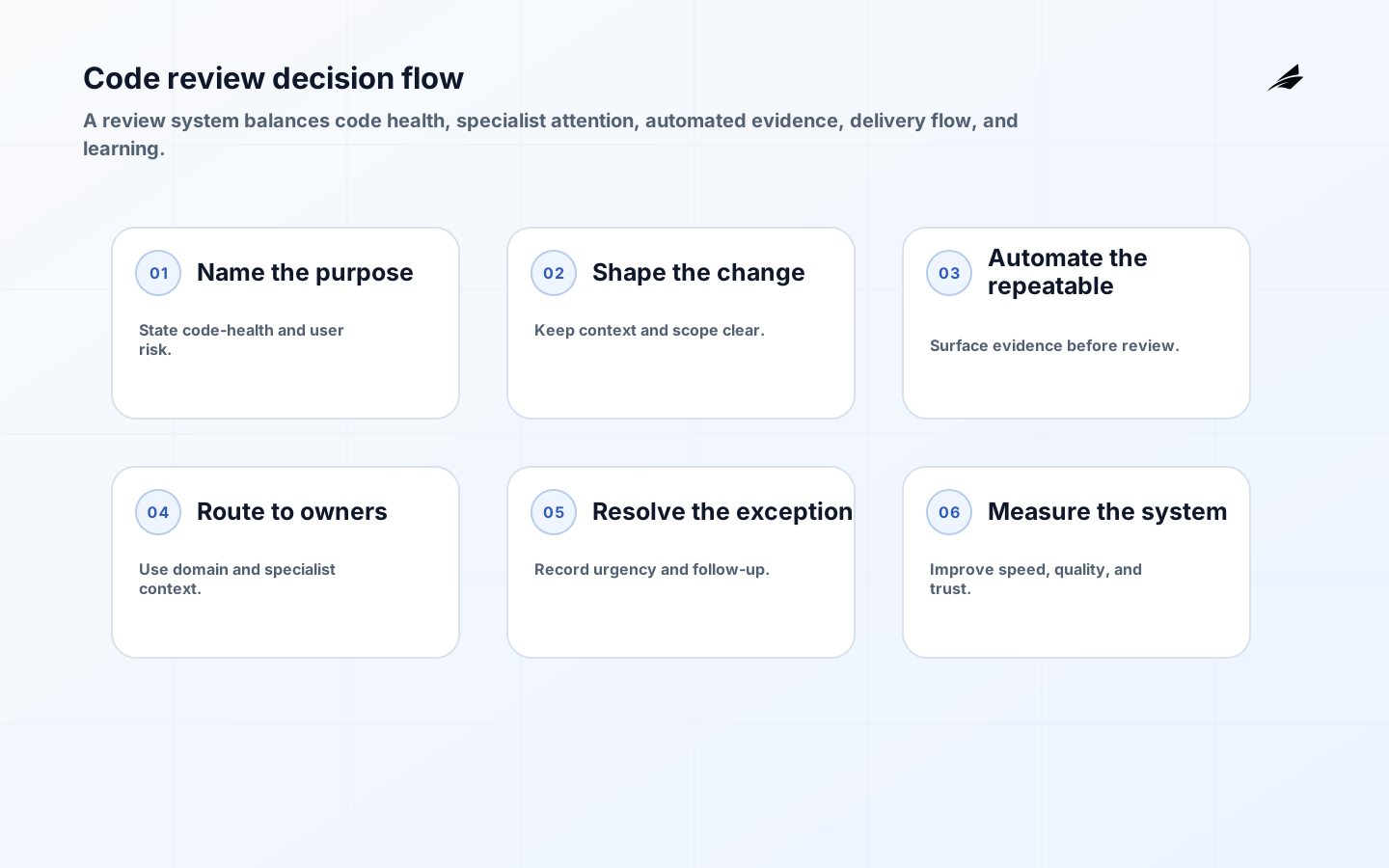
A code review system is the set of people, change boundaries, automated checks, approval rules, and feedback habits that decide whether a change is ready to merge. It is not the same as a pull request tool. A team can have required approvals and still miss a dangerous design, overload its reviewers, or teach authors to bypass the process. The useful goal is continuous code health: changes become easier to understand, defects are caught near their source, and the record explains why a consequential decision was accepted.
Make the review record useful after the merge as well as before it. Capture the risk that shaped the review, the evidence that reduced uncertainty, the exception that was accepted, and the owner who should revisit the decision if production signals change. This is especially important for shared libraries, authorization code, migrations, and emergency fixes, where a later maintainer may not have the original conversation. A short rationale linked to a test or rollout condition is more durable than a ceremonial approval.
Start with the change risks your team actually carries. A routine UI copy edit, a shared library export, an authorization rule, and a data migration should not require identical review. Use test strategy for reliable operations, technical debt controls, quality assurance for custom systems, and error handling implementation to see how review connects to validation, maintainability, and recovery.
Make each review a decision about code health
Define what reviewers are expected to examine: design fit, behavior, tests, complexity, security, observability, documentation, and compatibility. Google’s Engineering Practices describes code review as a way to maintain code and product quality, with attention to design, functionality, tests, clarity, and documentation. Turn that broad standard into a small local rubric. A review should state the change’s purpose and risk, show how it was tested, and make it possible for a reviewer to focus on the decision rather than reverse-engineering the entire repository.
| Review shape | Best use | Risk to manage |
|---|---|---|
| Author plus peer | Routine changes inside an owned product area. | Shared blind spot or missing domain context. |
| Code-owner review | Shared libraries, infrastructure, or sensitive contracts. | Overbroad ownership creates a queue. |
| Security or privacy review | Credentials, personal data, authorization, or exposure changes. | Late specialist gate with no design context. |
| Pair or synchronous review | Complex logic, urgent diagnosis, or onboarding. | Rationale disappears unless written down. |
| Automated checks | Formatting, types, tests, dependency and policy checks. | False confidence when coverage is narrow. |
Give reviewers the change context they need
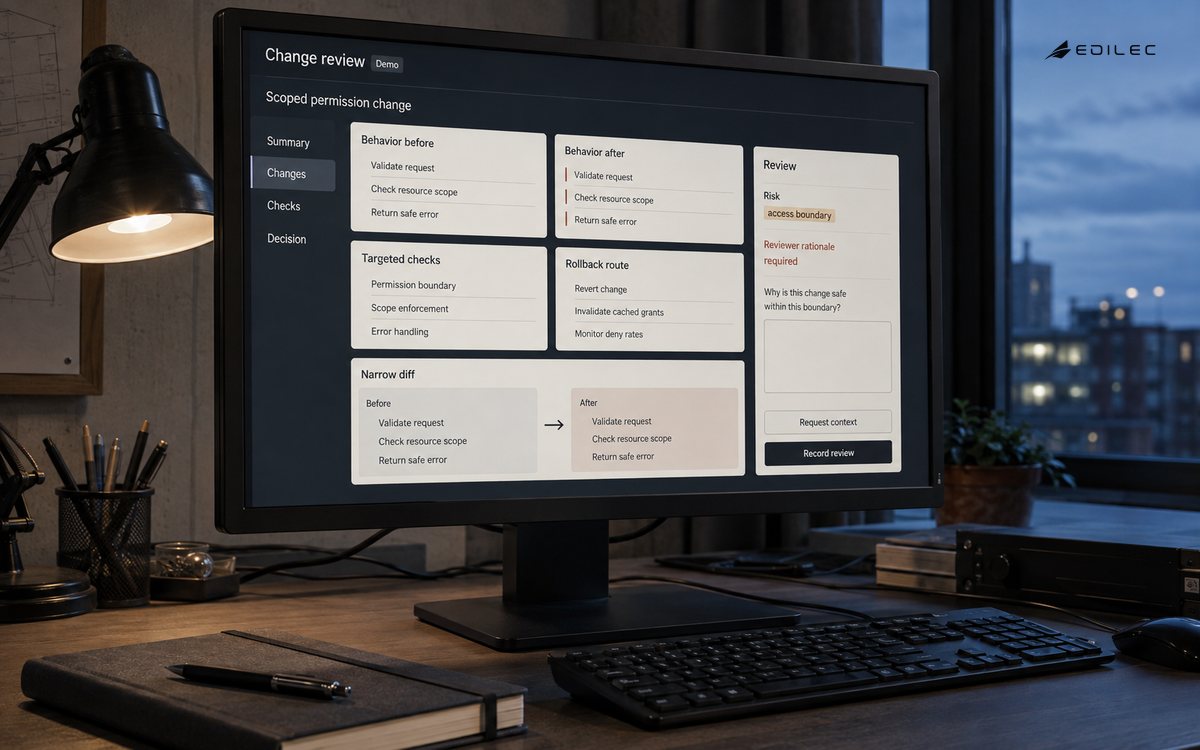
A good change description names the problem, affected users or systems, behavior before and after, rollout, rollback, tests, and unresolved questions. Keep the diff narrow enough that a reviewer can inspect it in one sitting, or split it into design and implementation changes. Avoid combining a functional change with a formatting sweep; it makes defects and review history harder to see. Use templates to ask for evidence, not to create a long form that authors fill with generic sentences. Context is a review control because it lets a reviewer challenge assumptions before they become code.
Automate repeatable checks and protect human attention
Run format, lint, type, unit, contract, dependency, secret, and policy checks where they provide reliable signal. Static analysis can catch patterns across a repository, while a human reviewer should reason about domain behavior, authorization, failure, migration, and usability. GitHub’s code scanning documentation is a useful reference for treating scanning as an integrated workflow. Make automated results actionable: show the changed path, rule, confidence, suppression reason, and owner. A noisy check teaches teams to click through the gate.
- Does the check run before a reviewer spends time on a basic defect?
- Can the result identify the changed code and a repair path?
- Which failures block merge and which create a tracked follow-up?
- Is suppression scoped, explained, approved, and time-bounded?
- Do checks cover generated files, migrations, dependencies, and deployment configuration?
- Can an operator reproduce the exact version and inputs that produced the result?
Route decisions to the right owner
Reviewers need enough context and authority to approve the risk they are seeing. Assign product or domain owners for behavior, maintainers for shared contracts, and specialists for security, privacy, data, or operations changes. GitHub’s pull request review model supports comments, approvals, requested changes, required reviews, and code-owner routing, but local rules must say which approvals matter and when an emergency path is allowed. Separate an advisory comment from a blocking issue so authors do not treat every preference as a release gate.
Manage review flow as a service level
Measure first response, time to merge, change size, rework, review rounds, abandoned changes, post-release defects, emergency bypasses, and reviewer load. Google’s guidance on review speed focuses on team throughput rather than making one author wait for a perfect response. Use the data to improve ownership, slicing, pairing, templates, or check quality. Do not respond to slow reviews by adding more mandatory approvers without finding the queue’s cause. A shorter review is healthy when it preserves the decision evidence, not when it hides discussion.
Review security and quality where they enter the change
Security review should be early enough to influence design. Use the OWASP Code Review Guide PDF for a structured look at authentication, authorization, injection, session handling, logging, and information leakage. Apply the NIST Secure Software Development Framework as a lifecycle frame: protect source and dependencies, review security requirements, verify releases, and learn from defects. Ask reviewers to inspect how the change fails, what it logs, what it exposes, and how it is reversed. A green scanner does not prove that the product rule is correct.
| Signal | Healthy interpretation | Action when it deteriorates |
|---|---|---|
| First response | Review capacity matches normal delivery cadence. | Adjust rotation, ownership, or interrupt load. |
| Change size and rework | Feedback arrives while the change is understandable. | Improve slicing, pairing, or design notes. |
| Post-release defects | Important risks are caught before deployment. | Inspect missed context, tests, and release controls. |
| Override rate | Emergency paths are rare and reviewed afterward. | Fix the bottleneck or clarify policy. |
| Specialist queue | Sensitive changes receive timely context-aware help. | Engage specialists earlier or narrow the gate. |
Make feedback precise, kind, and durable
A useful comment identifies the observed risk, why it matters, and a feasible next step. Distinguish required changes from suggestions and explain the reasoning behind a security or design request. Google’s guidance on review comments emphasizes courtesy, reasoning, and comments that improve the code rather than judging the developer. When a decision is significant, move the rationale into code, documentation, or an architecture record so it remains after the pull request is closed. Resolve threads only when the risk is addressed or a named owner accepts it.
Handle urgency without normalizing bypasses
An emergency path may be necessary for an incident, but it should preserve the smallest useful record: reason, scope, approver, test or verification, deployment window, and follow-up review. Do not use urgency to skip a security owner on a sensitive change when a safer containment is available. After the incident, inspect why the normal path could not meet the need and improve the system. An override that remains undocumented becomes a second workflow with weaker controls.
Run a preflight review of the review system
Choose three recent changes: one routine product edit, one shared contract change, and one security or data-sensitive change. Reconstruct how each was described, which checks ran, who reviewed it, what feedback was blocking, and what evidence remained after merge. Then choose a change that bypassed the normal path and ask whether the exception was necessary or merely easier. This exercise shows whether the system routes attention by risk or treats every pull request as the same object. It also reveals where the tool’s status is being mistaken for a team decision.
Use the result to revise one template, one check, one owner rule, and one emergency procedure. Avoid a wholesale process rewrite that creates a new learning gap. If review latency is high, identify the first response bottleneck; if defects escape, inspect missed context and test design; if security reviews queue, involve specialists earlier. Publish the change with an example so authors know what good evidence looks like. A review system improves through small, observable adjustments that make the next change easier to reason about.
Code review systems takeaways
- Define the review purpose as improving code health and product behavior.
- Match review shape and specialist involvement to the change’s risk and context.
- Automate repeatable checks, but keep human attention on design, domain, failure, and security decisions.
- Route ownership clearly and keep blocking rules smaller than the full set of useful feedback.
- Measure review speed, load, rework, defects, and bypasses as system signals.
- Preserve rationale and review exceptions so the organization can improve its next change.
Code review systems FAQ
How many approvals should a change need?
Use the smallest number that provides the necessary context and accountability. A routine owned change may need one capable peer; a sensitive shared contract may need a maintainer or specialist. More approvals are not automatically more assurance.
Can automated checks replace code review?
No. Automation is excellent for repeatable patterns and regressions, while reviewers reason about intent, trade-offs, user impact, authorization, failure, and maintainability. Use both with clear responsibilities.
How can a team make reviews faster?
Reduce change size, expose context, route to available owners, improve noisy checks, pair on complex work, and review the queue by first-response time. Adding a new approval gate should be the last response to a slow process.
Conclusion
A good code review system turns change into a visible, proportionate decision. Give reviewers context, automate mechanical evidence, route risk to owners, protect the flow from queues, and preserve the reasoning that future maintainers will need. The result is not slower delivery; it is a codebase that can keep improving without making urgency or individual memory the primary control.