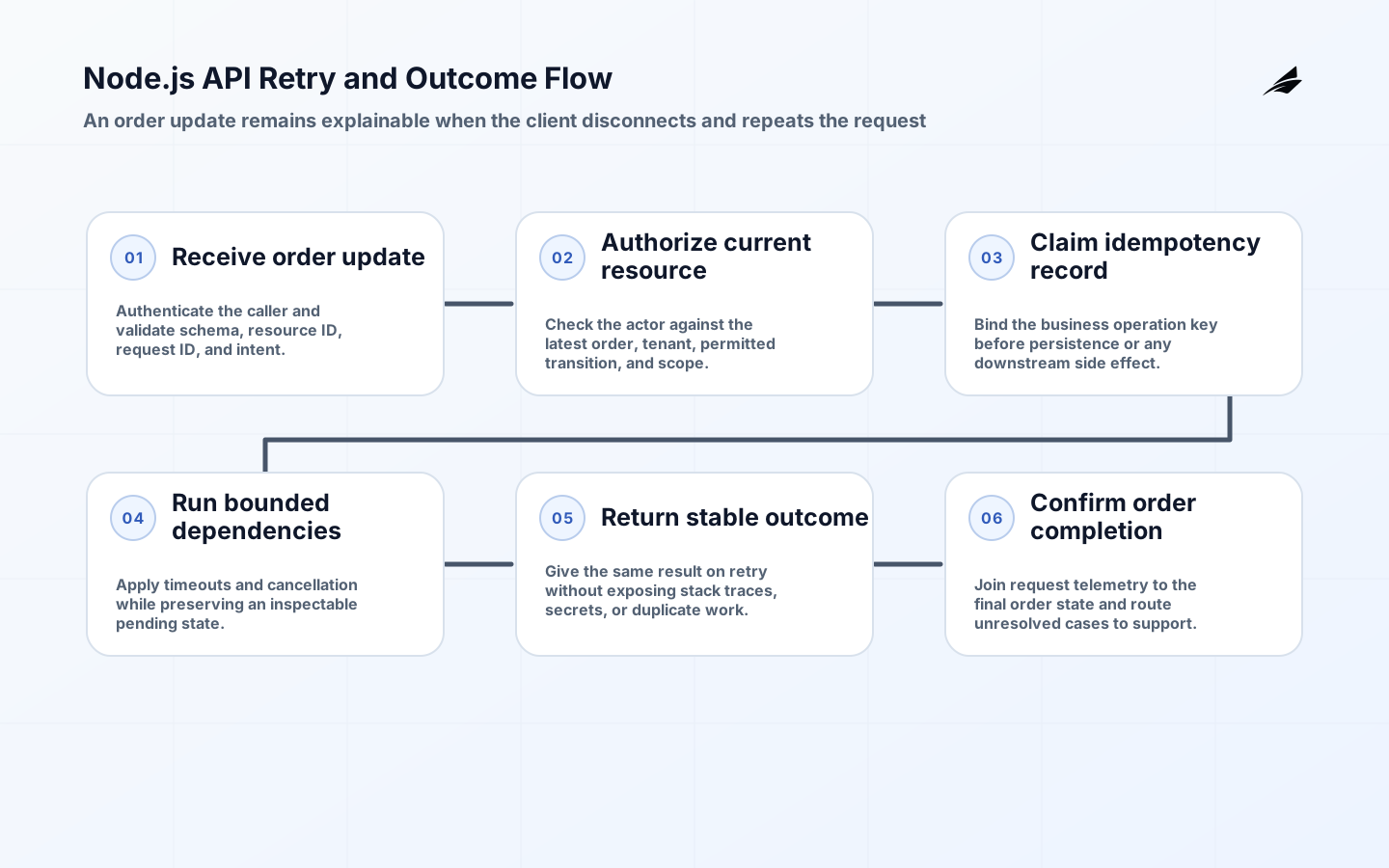
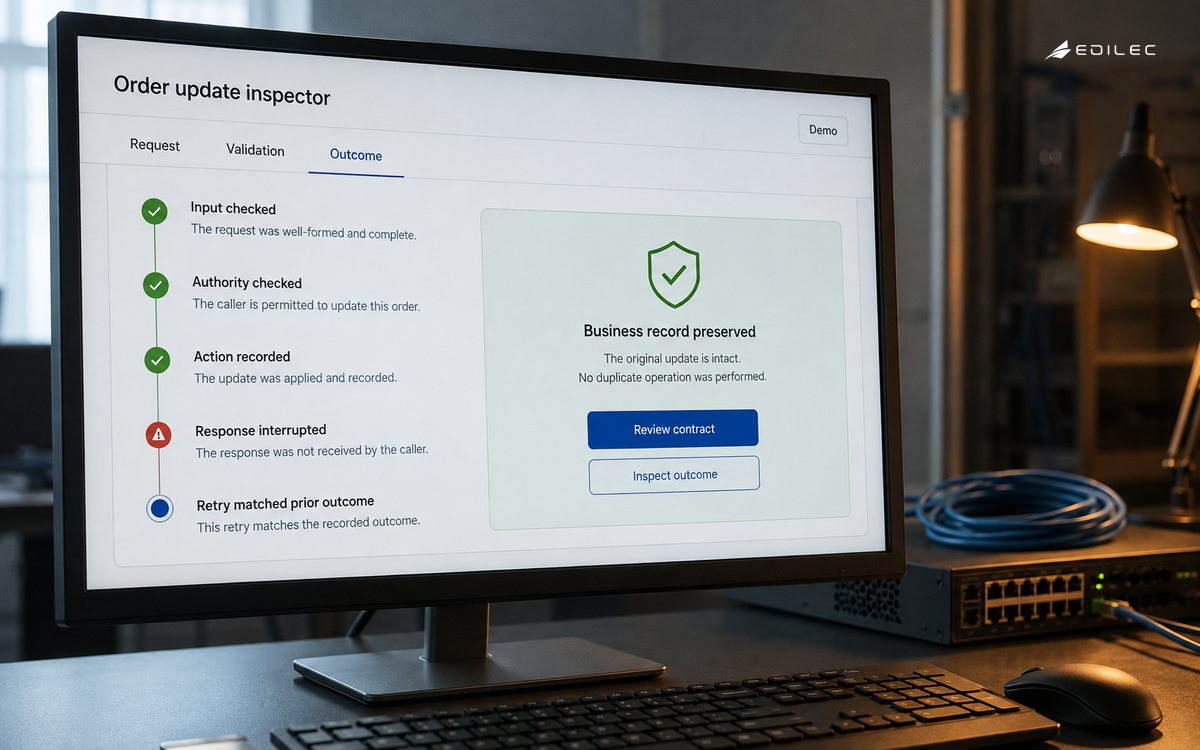
Node.js APIs is an operating decision, not a technology label. A client submits an order update, loses its connection before the response, and retries. The server must decide whether the same action is safe to repeat, how to validate current permissions, and what evidence lets support explain the outcome. A Node.js service can be small and still need disciplined contracts, timeouts, and error handling because every consumer experiences the behavior as a promise. This guide helps custom software teams turn node.js apis into a clear promise, a delivery path, and a reviewable operating practice. The aim is not to remove every trade-off. It is to make the trade-off explicit enough that a team can change the system without guessing who depends on it or how failure should be handled.
Start node.js apis with an outcome and a boundary
Begin with the user or operational outcome that node.js apis must improve. Name the decision-maker, the data or behavior that is authoritative, the expected time boundary, and the consequence of a wrong result. Define routes around business capabilities, not database tables, and give every operation a clear request contract, response representation, authorization decision, failure type, and ownership. HTTP Semantics distinguishes method properties such as safety and idempotency, but the application must state how a duplicate order, payment, or approval is handled. Put the interface description next to realistic examples and tests. The useful test is whether a new engineer and a support owner can explain what the system promises without reading implementation details.
| Decision area | Question to settle | Evidence to retain |
|---|---|---|
| Outcome | Which user or business result must improve? | A concrete scenario and success measure. |
| Boundary | What belongs inside this capability and what remains external? | Owner, interface, and dependency map. |
| Failure | What can safely retry, wait, or require review? | Recovery rule and escalation route. |
| Change | Who approves a behavior change and how is impact checked? | Decision record, test evidence, and rollout plan. |
Define the node.js apis promise
A promise turns a broad engineering intention into behavior a team can verify. State the inputs, permitted transitions, output, permissions, timing, and recovery rule in language that product, support, and engineering can all use. Avoid a promise such as “reliable” or “scalable” without a context. Instead, say what happens when data is delayed, a caller retries, a worker is unavailable, or an operator needs to correct a record. This is also where Node.js API design becomes concrete rather than decorative.
- What real decision or workflow makes node.js apis worth maintaining?
- Which actor owns the authoritative change, and which actors only observe it?
- What invalid, delayed, duplicate, or denied case must the design handle?
- Which contract, state, or dependency can a reasonable consumer rely on?
- What evidence will show that the intended outcome occurred?
- Who can pause, repair, or roll back the behavior during an incident?
Build node.js apis in small, testable slices
Do not begin by standardising every adjacent system. Validate input at the boundary, authenticate before domain work, authorise the requested action against the current resource, then translate trusted values into a use case. Keep external calls bounded by a timeout and propagate cancellation where the dependency supports it. The Node.js HTTP documentation describes the platform primitives; an application should add request IDs, structured logs, limits, and a deliberate shutdown path around those primitives. Keep the first slice narrow enough that its normal and failure paths can be exercised before its assumptions spread. REST API contracts provides useful adjacent context when the work crosses an existing service or workflow boundary.
Use examples as design material: one ordinary case, one boundary case, one invalid request or state, one delayed dependency, and one correction. Review the examples with the people who will operate the result. A technically valid implementation can still be wrong if it leaves a support owner unable to explain a disputed outcome or a user unable to recover from a predictable interruption. For Node.js APIs for Custom Software: A Practical Guide, make those examples part of the review record so later changes preserve the same decision.
| Stage | Practical choice | Check before progressing |
|---|---|---|
| Discover | Map users, owners, data, and dependencies. | The team agrees on the problem and scope. |
| Design | Write behavior and recovery examples. | Important states and permissions are explicit. |
| Deliver | Release one bounded path with instrumentation. | Normal and adverse cases have been tested. |
| Operate | Review outcome and exception signals. | An owner can diagnose and improve the path. |
Operate node.js apis with evidence
Measure request rate, latency by route and dependency, validation failures, authorization denials, timeouts, saturation, and business completion. Return stable problem categories without exposing stack traces or credentials. The OWASP API Security Project is a useful checklist for common API risks, especially broken object-level authorization; use it alongside threat modelling for the specific data and actions in the service. Use a small set of measures that connects implementation behavior to the intended workflow. For example, separate a technical signal such as timeout rate from a business signal such as completed corrections. Review the measures at a regular cadence and include the people who handle exceptions; they often see the first mismatch between a documented promise and an actual customer journey.
Avoid common node.js apis failure modes
The common failure is putting all behavior in route handlers until validation, retries, logging, and persistence cannot be reasoned about separately. Another is assuming a successful HTTP status proves the user goal completed. Make asynchronous outcomes queryable, preserve correlation, and test the unhappy path with a real dependency timeout or duplicate request. Treat these as design signals, not reasons to abandon the approach. The corrective move is usually modest: name the owner, constrain the interface, add one realistic test, preserve a correlation record, or delay retirement until the relevant users have moved. background jobs is a useful companion when the issue is a broader change or reliability concern.
- No one can name the consumer, owner, or support route for a behavior.
- A successful technical response is mistaken for a completed business outcome.
- Recovery depends on an undocumented manual step or a single person’s memory.
- Metrics show volume but not correctness, delay, or user impact.
- A migration or shared abstraction has no retirement condition.
- Production evidence contradicts a design assumption but the documentation is unchanged.
Use a node.js apis implementation checklist
Use this checklist as a conversation before release, not as a ceremonial sign-off. Each answer should point to a test, a visible behavior, an owner, or an operational record. For deeper delivery confidence, pair the work with error handling and revisit the plan when the first production evidence arrives. In this KM-SW-0043 implementation, the checklist should be reviewed by the people accountable for node.js apis.
- Write the node.js apis outcome, owner, boundary, and failure consequences in plain language.
- Capture normal, boundary, denied, delayed, duplicate, and correction examples.
- Define an interface or state model that makes the permitted behavior inspectable.
- Protect access and sensitive data at the service boundary, not only in the user interface.
- Release behind a controllable rollout or cohort when the blast radius warrants it.
- Instrument technical health and the business outcome separately.
- Document a bounded recovery, rollback, or repair action before dependency failure forces an invention.
- Set a review date and a criterion for expanding, changing, or retiring the first slice.
Key takeaways
- Node.js APIs should begin with a valuable outcome and a named operational boundary.
- A clear promise includes failure, recovery, ownership, and evidence, not only happy-path behavior.
- Small releases with realistic examples reveal risk earlier than broad standardisation.
- Operational measures must distinguish a healthy component from a completed user outcome.
- A documented retirement or improvement decision keeps temporary work from becoming permanent uncertainty.
Frequently asked questions
When should a team invest in node.js apis? Invest when a recurring workflow, reliability risk, or delivery constraint has a clear cost and a team can name the behavior it needs to improve. How much design is enough? Enough to describe ownership, ordinary and adverse cases, access, recovery, and a measurable outcome before the first release. Should every related system use the same pattern? No. Share a pattern when it preserves a genuine contract or reduces meaningful risk; keep an exception when its constraints differ and record why. What is the first operational metric to add? Add the signal that tells an owner whether the intended user or business result happened, then pair it with the technical signal most likely to explain a failure.
Conclusion
Well-run node.js apis gives a team a way to make change legible. Start with an outcome, make the promise testable, release one controllable slice, and learn from production evidence. The authoritative references used here, including HTTP Semantics (RFC 9110) and OWASP API Security Project, are useful for the underlying standards and platform details. Apply them to the actual workflow, people, and recovery decisions in front of the team; that is where an engineering practice earns its value. Over the next month, take one Node.js API operation and exercise malformed input, an unauthorized resource, a dependency timeout, and a retried request. Review the response, log correlation, and final business record with support. This focused drill shows whether Node.js APIs are truly recoverable for callers and maintainers, not simply reachable over HTTP. Repeat the drill after a dependency or schema change, because a dependable API is maintained through continued evidence rather than established once by an initial set of route tests.