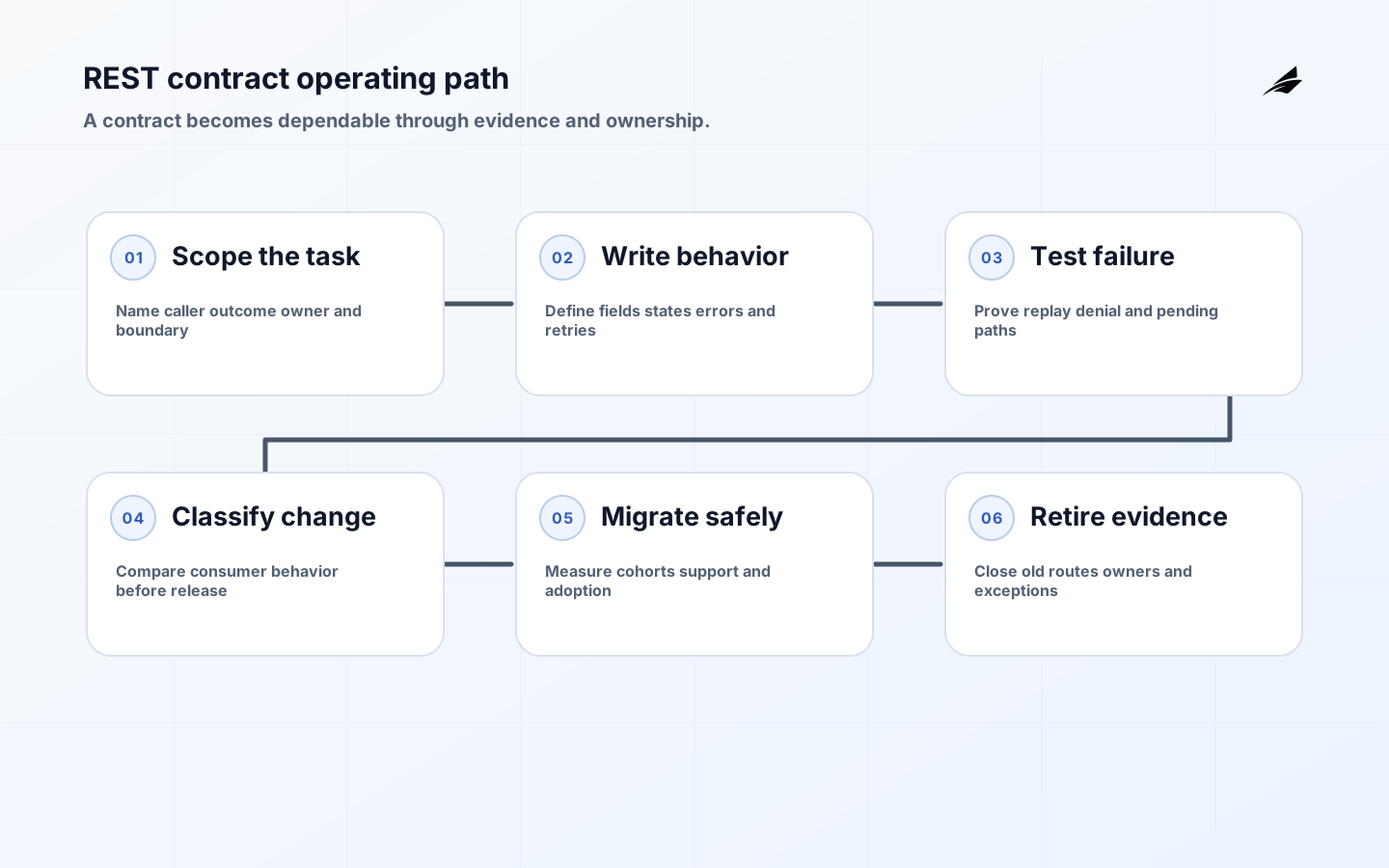
A REST API contract is the agreement that lets one team change a service without surprising every client attached to it. It covers more than paths and JSON shapes: callers need to know which fields are required, what an empty result means, how pagination is ordered, which errors are safe to retry, how authorization fails, and how long an old behavior will remain available. For an IT manager, the contract is a portfolio control. It makes supplier dependencies, business-critical integrations, and ownership gaps visible before a release turns them into an overnight incident.
The useful management question is not whether an endpoint is documented. It is whether a named consumer can complete a real task under normal and abnormal conditions, and whether the organization can prove that behavior after the original developer has moved teams. This guide treats the contract as a living operating artifact: define it from a consumer journey, test its semantics, classify change, communicate migration, and retire old behavior with evidence.
For adjacent implementation context, compare this approach with Edilec's Node.js APIs for custom software, error handling guide, and API versioning in production. Those articles cover the service boundary, failure behavior, and production transition that a contract must connect.
Start with the business task and boundary
Begin with a task such as creating a shipment, importing a customer, or checking an entitlement. Write the actor, the authoritative record, the expected side effect, and the point at which the caller can safely continue. This prevents an endpoint catalog from becoming a substitute for a promise. A shipment creation contract should say whether the request is idempotent, how a duplicate is identified, what state is returned when a carrier is pending, and which identifier support can use to trace the operation.
Keep protocol semantics separate from business semantics. RFC 9110 defines HTTP methods, representations, status codes, caching, and conditional requests, but it cannot decide whether a second POST would create another invoice or return the first one. State that rule in the contract and test it. Also record the data classification, caller identity, scope, rate expectations, and downstream systems so security and operations can review the surface rather than only the schema.
| Contract concern | Decision to record | Evidence a manager can request |
|---|---|---|
| Business effect | What state changes and who owns it? | Before and after examples with a business identifier |
| Representation | Which fields, nulls, units, and defaults are stable? | Versioned schema plus realistic payload fixtures |
| Failure | Which outcomes are retryable, final, or pending? | Problem responses and retry exercise |
| Identity | Which caller and end user are authorized? | Scope matrix, denial cases, and audit fields |
| Support window | How long is old behavior promised? | Published policy, owner, and retirement gate |
Make the written contract executable
Use an interface description that can be reviewed, linted, and turned into test fixtures. The OpenAPI Specification is useful for paths, parameters, schemas, security requirements, and responses. It is not a complete business contract by itself. Add descriptions for state transitions, invariants, ordering, idempotency, ownership, and examples that include empty, invalid, delayed, and partial cases. A schema that says a field is a string still leaves the consumer guessing whether it is a currency, a user-facing label, or an opaque identifier.
Treat generated clients as evidence, not authority. A code generator may make an optional field appear required, collapse two error states into one exception, or reject an enum value added by the server. Review generated behavior for each important consumer language and keep a strict consumer fixture in the contract test suite. Require examples to compile or validate in CI, but also have a human read them as a support engineer would. If an example omits the field that explains a pending state, it is not useful documentation.
Design errors, retries, and idempotency together
Callers need enough information to choose a safe next action without parsing prose or guessing from a status code. RFC 9457 provides a standard shape for problem details; use it as a foundation, then define stable application types, field-level validation information, a correlation identifier, and a link to an action or support route. Avoid returning a generic 500 for a known business rejection. Avoid exposing stack traces or sensitive record details in an error that crosses a trust boundary.
Document retry behavior at the operation level. A timeout after a create request is an uncertainty about the result, not proof that the server did nothing. Use an idempotency key or a business uniqueness rule where replay could duplicate an effect. For reads, specify cache and freshness expectations; for updates, state whether clients may safely repeat the request; for asynchronous work, return a durable operation reference that can be polled or followed. This is where the contract meets distributed tracing guidance: support should be able to connect the caller's request to downstream work.
| Observed situation | Contract response | Client action |
|---|---|---|
| Malformed input | Stable validation type with field details | Correct input without retrying |
| Known business rule | Explicit conflict or rejection type | Show a useful decision to the user |
| Timeout after side effect | Idempotent lookup or operation status | Recover the result before replay |
| Dependency unavailable | Retryable failure with bounded guidance | Back off and preserve intent |
| Permission denied | Consistent authorization response | Stop and request the right access |
Classify compatibility from consumer behavior
A change is compatible only relative to the clients and promises that matter. Adding a response field may be safe for a tolerant JavaScript client and breaking for a generated model configured to reject unknown properties. Changing a default, narrowing an enum, changing sort order, altering decimal precision, or converting a nullable value to an empty string can break workflows without changing the route. Ask a representative consumer owner to review every proposed change and explain the before-and-after task, not only the diff.
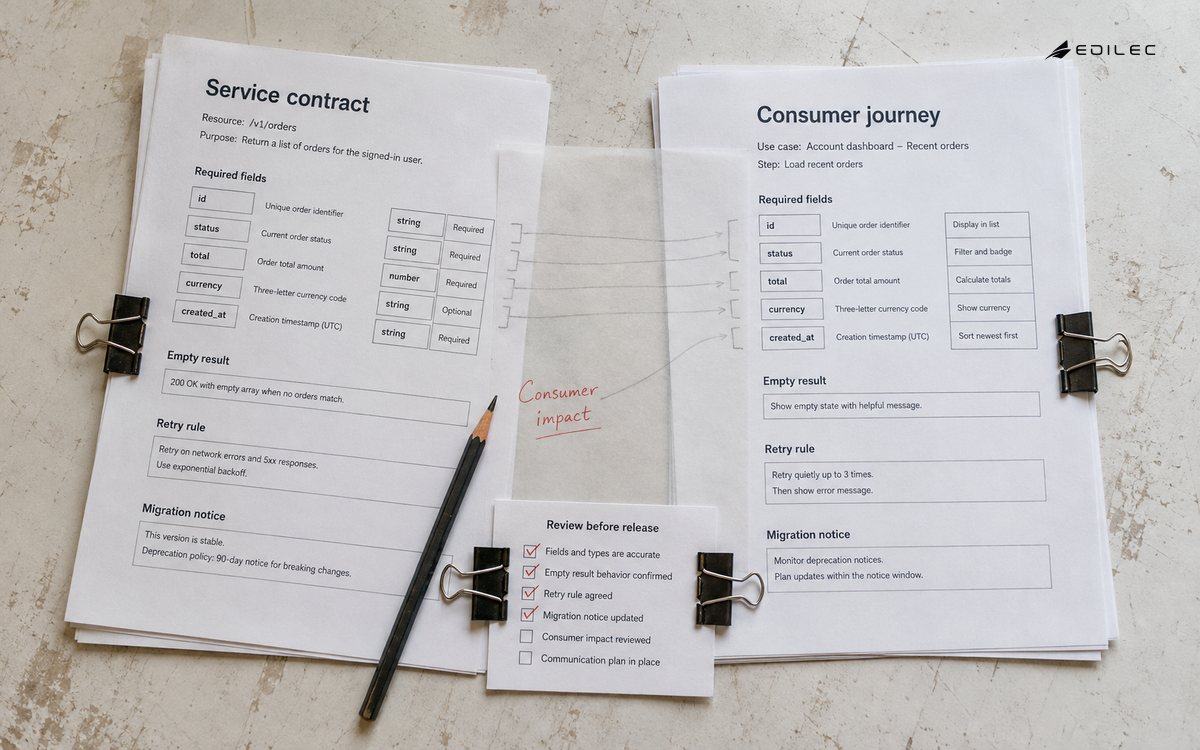
Use a small change record with a compatibility class, affected consumers, test fixtures, rollout sequence, communication owner, and stop condition. The record should also say whether a new field is informational or authoritative. When an old field and a replacement coexist, define which one wins if they disagree and log the disagreement. That avoids a migration in which one client writes the new representation while another silently overwrites it with a stale legacy value.
Govern the contract across teams and suppliers
A contract review needs an accountable service owner, at least one consumer representative, support, and security when protected data or privileged actions are involved. Set a review threshold: routine additive changes can follow a lightweight path, while a changed meaning, authorization model, retention rule, or retry effect needs architecture and operational review. Google's API Design Guide and the Microsoft REST API Guidelines are useful comparison points for naming, resource modeling, compatibility, and errors, but local business commitments still determine the support promise.
For suppliers, add contract obligations to procurement and service reviews. Request a versioning policy, deprecation notices, test credentials, rate-limit behavior, incident contact, security notification route, and evidence of backward compatibility. Do not assume a vendor's documentation covers the integration you built. Preserve your own fixtures and an adapter boundary so an external change is isolated. If a supplier has a shorter support window than your release cycle, treat that mismatch as a commercial and architectural risk, not as a documentation inconvenience.
Roll out change with adoption evidence
Publish a replacement before asking consumers to leave the old behavior. Give them a sandbox or deterministic fixtures that include the new fields, error types, ordering, and delayed cases. Instrument traffic by client, version, and operation where privacy policy permits, and identify unknown callers before announcing a final date. A request that carries a new header is not proof that the consumer completed its business task on the replacement. Measure the workflow outcome or a stronger proxy such as successful operation completion and absence of fallback errors.
Use stages: announce, enable in parallel, canary selected consumers, set a warning period, enforce the new path for a controlled cohort, and retire only after the gate is met. Record exceptions with an owner and expiry. A rollback should restore a compatible service behavior without reopening a security defect that motivated the change. The OWASP API Security risks are a reminder that deprecated endpoints still need authorization, inventory, patching, and abuse monitoring while they remain reachable.
Operate the promise after release
Give support a contract-aware diagnostic path: request ID, operation name, client version, response type, release version, authorization result, and relevant business identifier with sensitive values masked. Monitor successful business operations, validation failures, unexpected status distributions, retries, latency tails, rate-limit responses, authorization denials, and old-version traffic. The dashboard needs named actions and thresholds. A metric that nobody can interpret or act on is not evidence of contract health.
Review the contract when incidents, client questions, or recurring exceptions expose an undocumented assumption. Keep the schema, examples, test fixtures, migration decision, and support notes together in version control. Once a route is retired, remove credentials, policy exceptions, documentation, and monitoring that would otherwise make the path look supported. The aim is a smaller surface that remains explainable, not an archive of promises that no longer reflect deployed behavior.
Use a manager's release review
A useful review ends with a decision rather than a list of comments. Confirm the consumer inventory, compatibility class, security impact, error and retry behavior, test evidence, migration communication, adoption gate, support owner, and rollback boundary. For a critical integration, require a tabletop exercise: simulate a timeout, an invalid payload, a partial rollout, a supplier outage, and a caller that missed the notice. The result should identify unresolved risk and the person authorized to pause the release.
| Checkpoint | Question | Approval evidence |
|---|---|---|
| Consumer map | Who depends on the old behavior? | Named owners and usage evidence |
| Semantic diff | What meaning changes for a reasonable caller? | Before and after examples |
| Failure proof | Can callers distinguish retry from rejection? | Automated fixtures and observed traces |
| Migration | Can consumers adopt independently? | Parallel path and support message |
| Retirement | What proves the old path can close? | Traffic threshold, date, and authority |
Key takeaways for REST API contracts
- Define a REST API contract from a business task and its failure paths, not from routes alone.
- Use OpenAPI and examples as executable review artifacts, while documenting business semantics separately.
- Treat error shape, idempotency, retries, authorization, and traceability as part of the interface.
- Classify changes from real consumer behavior and measure adoption before retiring old behavior.
- Keep service, consumer, support, security, and supplier owners visible for the entire contract lifecycle.
REST API contract questions
Does every REST API need URL versioning?
No. A URL version, media type, or header can select a contract. Choose the mechanism that your gateways, caches, documentation, SDKs, monitoring, and consumers can apply consistently. The important controls are an explicit compatibility policy, a migration path, and a measured retirement decision.
Is adding a response field always backward compatible?
No. It is usually low risk only when clients tolerate unknown fields, generated models are configured accordingly, and the field does not change an existing default or meaning. Verify strict parsers, schema registries, exports, and downstream data stores before classifying it as additive.
Who should own an API contract?
The service owner is accountable for implementation and availability. A consumer owner validates practical compatibility, product owns customer commitments, support owns communication and diagnosis, and security reviews exposure. One person should still be named as the decision coordinator so responsibility does not disappear between teams.
Conclusion: governing the REST API promise
REST API contracts let an organization change software without turning every integration into an emergency project. Start from a real consumer task, write the semantic promise, test retries and errors, classify compatibility from observed clients, and make migration evidence visible. The result is a service boundary that remains dependable when ownership changes, suppliers evolve, and the original implementers are no longer available to explain what the API was supposed to mean.