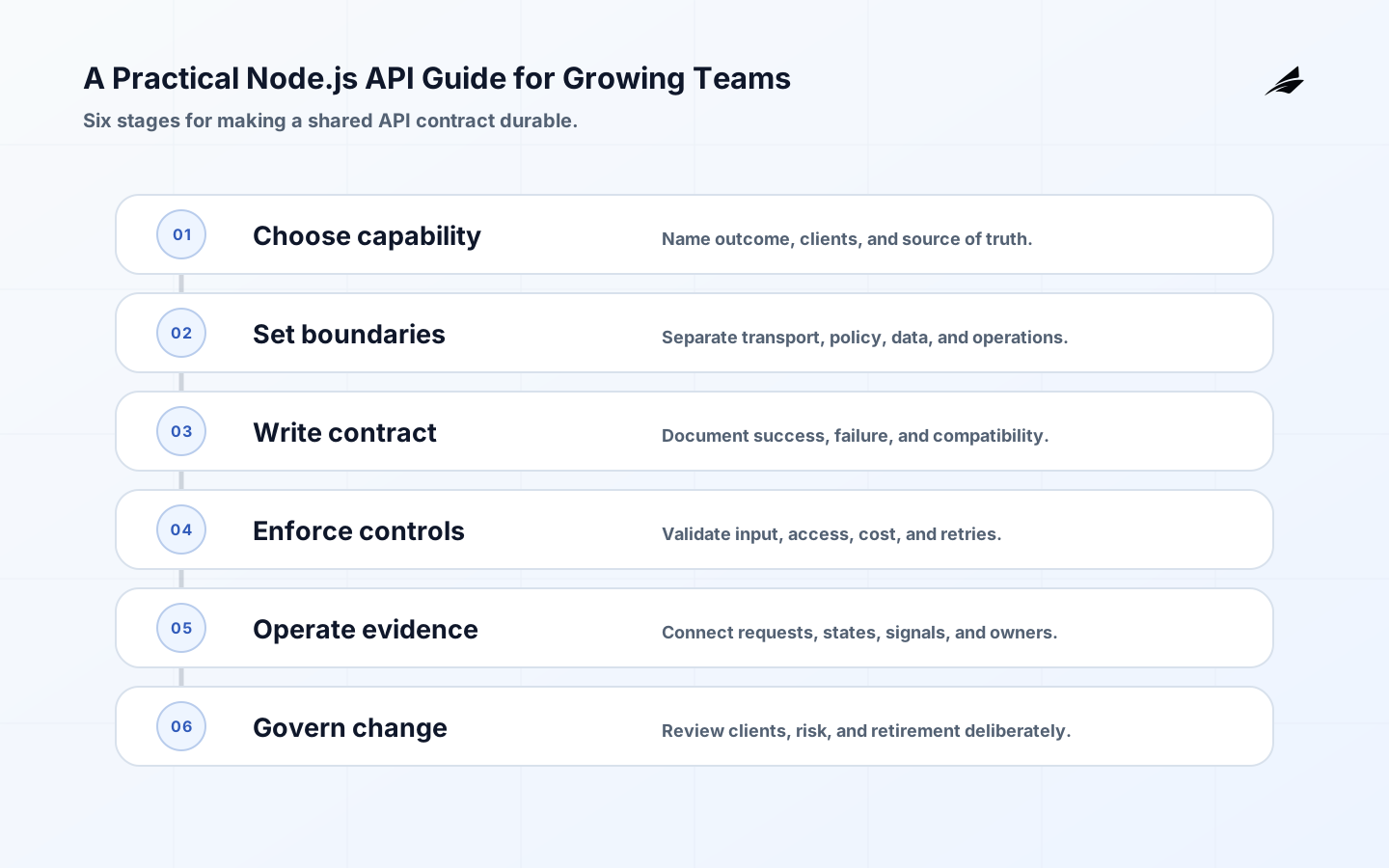
Growing teams often reach for Node.js APIs because the language, runtime, and ecosystem let a small group deliver quickly. The difficult part arrives later: more clients depend on the response shape, more roles share a tenant, more integrations time out, and a change that was local becomes an operational event. A field guide should therefore start with decisions, not libraries. The team needs a visible contract, a clear owner for each state, a bounded request path, safe authorization, and evidence that helps a new engineer understand what the API did. Those choices make speed sustainable.
Use the OpenAPI Specification to make paths, schemas, responses, and security requirements inspectable; use the Node.js HTTP documentation for connection and cancellation behavior; and use HTTP semantics to keep methods and status codes meaningful. Check the OWASP API security risks at object and function boundaries, then use Node.js error guidance and OpenTelemetry HTTP conventions to shape the evidence path. These sources inform the implementation; the product team still owns the local contract.
Make the Node.js APIs decision explicit
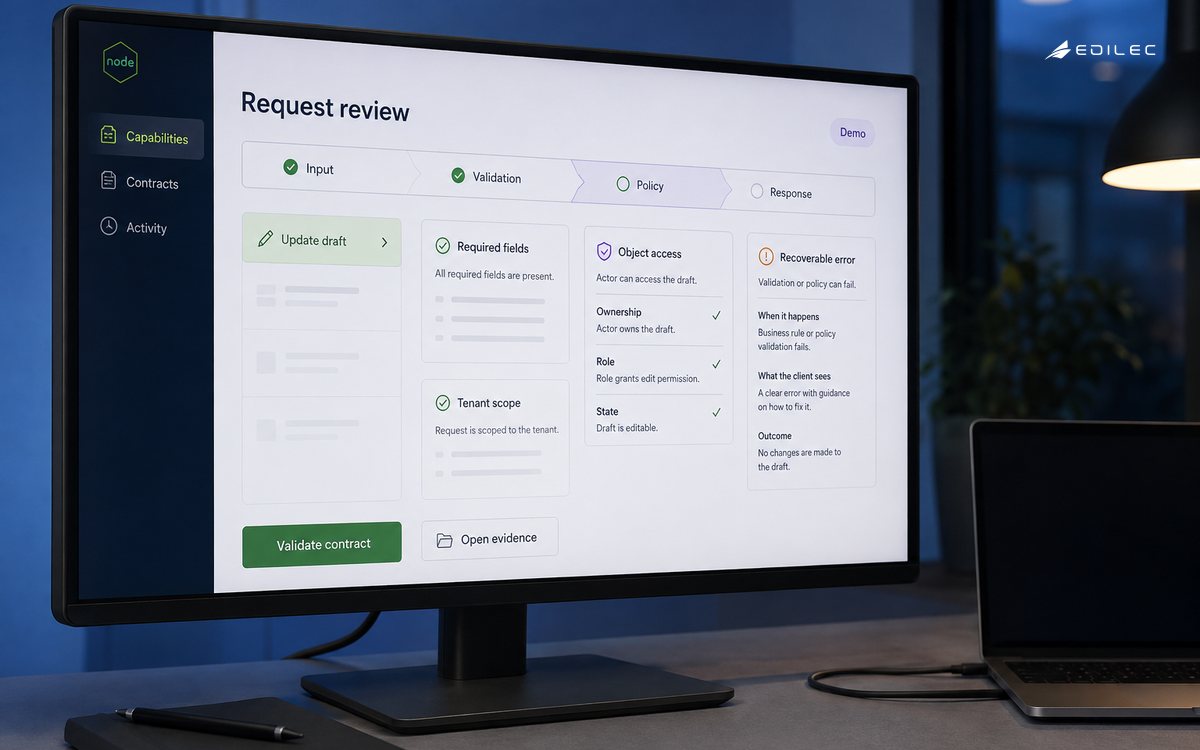
Write down the capability the API must make possible and the clients that will depend on it. Distinguish browser requests, internal workers, partner integrations, and administrative tools because their authentication, latency, and failure expectations differ. Identify the system of record and the operations that may change it. OpenAPI provides a language-independent interface description, but the team still needs to decide whether a route is a resource read, a command, or an asynchronous operation. A concise decision record should include outcome, owner, clients, risk, compatibility, and the evidence that justifies expansion.
| Decision area | Question | Evidence |
|---|---|---|
| Capability | What user or business outcome does the API enable? | Named journey and success event |
| Ownership | Which system is authoritative for each state? | Domain and data map |
| Clients | Who calls it and under which trust model? | Client inventory and roles |
| Change | What can evolve without breaking callers? | Version and compatibility rule |
Set boundaries before implementation
Set boundaries at business capabilities and trust transitions. A Node.js API should not expose a database table merely because the table is convenient. Name the resource, permitted operations, tenant boundary, field visibility, pagination, query cost, and lifecycle state. Keep authentication separate from authorization: a valid token identifies a principal, but it does not grant access to every object or property. OWASP's API risks make object-level authorization a specific concern because identifiers supplied by callers create a broad attack surface. Check authority at the operation and object boundary.
Also set technical boundaries. Give each request a deadline, body limit, concurrency budget, dependency budget, and cancellation rule. Decide which work can stop when the client disconnects and which mutations require reconciliation. A gateway can enforce coarse limits, but the service must protect itself when called by a trusted internal client. Keep the public error vocabulary small and meaningful. A caller should know whether to correct, authenticate, request access, retry, poll, or contact support without learning framework internals.
Build Node.js APIs for inspection and change
Design request and response examples for success, empty data, invalid input, denied access, missing resource, rate limiting, timeout, and asynchronous acceptance. Validate untrusted input at runtime; TypeScript types disappear at the network boundary. Use stable identifiers and explicit dates, money, pagination, and null semantics. Keep commands idempotent when a client may safely retry, and give long-running operations an operation ID and status endpoint. Document which response fields are safe to cache and which are user- or tenant-specific. The related REST API contract guide gives a useful companion model for these client promises.
Make the code easy to inspect at the boundaries: parse, authenticate, authorize, validate, call the domain operation, map the result, and record evidence. Avoid mixing response formatting with database queries or hiding policy in a generic helper that nobody can audit. Node's HTTP APIs expose connection and abort signals that can help cancel downstream work. Use them deliberately, with a distinction between abandoning a read and undoing a committed write. Consistent structure reduces the cost of reviewing a change and tracing a failure.
Operate the Node.js APIs path as a product
Operate the route as a product surface with an owner, support path, health definition, and deprecation policy. Track latency and status by operation, client, dependency, and release. Add signals for validation failures, authorization denials, cancellations, retries, queue age, event-loop delay, and resource saturation. OpenTelemetry semantic conventions help align cross-service telemetry, but domain fields must answer the local question: did the requested outcome happen, and what should happen next? Redact tokens, credentials, full payloads, and unnecessary personal data before logs and traces become shared evidence.
| Signal | What it can reveal | Decision |
|---|---|---|
| P95 latency | Slow path or dependency | Profile, cache, or reduce work |
| Denied object access | Policy gap or attack pattern | Review authorization and alert |
| Event-loop delay | CPU or synchronous work | Split, defer, or bound processing |
| Pending age | Async work not resolving | Reconcile, retry, or escalate |
Release in evidence-bearing slices
Release a capability in a slice that can be tested with real clients and real data shapes. Use contract tests, authorization tests, malformed input, dependency failure, cancellation, and load cases before broad exposure. Keep old and new schemas compatible during deployment, especially when a worker or database migration crosses versions. A canary or feature gate limits blast radius, but it must not become a substitute for a rollback or data correction plan. Record which version accepted a mutation and which policy was in force so support can explain the result.
Apply practical controls to Node.js APIs
Validate input before capability work
Runtime validation should turn unknown network input into a known request model before business logic or dependency work begins. Check required fields, length, shape, tenant scope, and cost. Return a stable correction response and keep the raw payload out of logs. A typed client can improve developer feedback, but it cannot make an untrusted request safe once it reaches the service.
A practical control set includes runtime schemas, object and function authorization, request limits, timeouts, retry bounds, idempotency, safe problem details, structured logs, trace propagation, dependency health, graceful shutdown, and a current client inventory. Review each control through a failure case. For example, a rate limit needs a response clients can interpret, a queue needs an owner for terminal work, and graceful shutdown needs a drain timeout that does not leave a deployment hanging forever. Controls should be small enough to test and visible enough to review.
Give dependency limits their own budget
Give each outbound call its own deadline, retry rule, and concurrency budget. A single global timeout hides which dependency consumed the request's time; separate budgets make saturation and cancellation visible to the operator. Record the dependency and attempt safely, then decide whether the caller should receive a correction, a pending state, or an explicit failure. This keeps a slow provider from silently consuming the capacity intended for every other route.
Create a working agreement for Node.js APIs
Write a working agreement that explains naming, versioning, status semantics, authorization review, error shape, logging redaction, test evidence, and release ownership. Keep it short and update it from a real decision. A working agreement is valuable when it helps a new contributor answer why a route is shaped this way and how to change it safely. Link to the contract, examples, runbook, and dashboards. Do not make a tool or framework the only source of meaning.
Use evidence to govern Node.js APIs
Review evidence in a sequence: contract compatibility, security findings, request cost, user outcome, recovery age, and support burden. A higher request rate is not automatically success if denials, latency, or corrections rise. Set thresholds that cause concrete actions such as pause, narrow, rollback, re-authorize, or document an accepted tradeoff. The related test strategy guide helps choose evidence before the build begins. Keep a record of the decision and revisit it when clients, data, or dependencies change.
Choose the next Node.js APIs improvement
Choose the next improvement from the most consequential unresolved risk, not from the loudest technology trend. If callers cannot tell pending from failure, improve the contract. If the service is slow under a known workload, reduce synchronous work or make the cost visible. If authorization is hard to explain, narrow the resource boundary and add policy tests. If support cannot reconcile a timeout, add an operation status and durable identifiers. Each next step should have an owner, a measurable change, and a date for review.
When cache behavior affects a response's meaning, pair the API review with caching strategy in production. Decide what can be reused, how tenant and authorization context is isolated, how invalidation works after a mutation, and what an operator does when the cache and source disagree.
Make team guardrails executable
A growing team needs more than a style guide. Turn the important guardrails into checks that run against a real boundary: reject unvalidated input, deny cross-tenant access, cap expensive queries, preserve a request identity, and document how a mutation is reconciled after a timeout. Keep the check close to the contract and name the owner who reviews a failure. When the team adds a new client or service, extend the client inventory and contract tests before changing the shared helper.
Review a few production cases with someone who did not build the route. Ask them to find the request, interpret the response, locate the authoritative state, and explain the next safe action. If they need a private dashboard, an undocumented query, or a developer's memory, that is a design gap. Use the Node.js memory guidance when resource pressure is part of the case, and update the runbook when a new limit or recovery step is introduced.
- A new contributor can find the contract and failure examples.
- Authorization tests cover objects, properties, operations, and tenant boundaries.
- The request path has explicit body, time, concurrency, and retry limits.
- A client disconnect or process restart has a documented state and recovery action.
- The owner and evidence for a contract or runtime change are visible.
Node.js API field guide takeaways
- Choose a capability, owner, client set, and source of truth before adding routes.
- Treat authorization, runtime validation, cancellation, and cost limits as API behaviour.
- Make pending, error, retry, idempotency, and compatibility semantics visible.
- Connect telemetry to user outcome, resource cost, and an accountable response.
- Use small releases and evidence-bearing contracts to make change safer.
Node.js API questions from growing teams
A small team should start with one valuable capability and a contract that includes unhappy paths. OpenAPI helps make the interface inspectable, but it does not decide ownership or recovery. TypeScript improves implementation feedback, but runtime validation is still required at the network boundary. A Node.js API should be designed to drain during deployment, bound expensive work, and preserve enough evidence to reconcile a client disconnect or dependency timeout.
Conclusion: grow the API with evidence
Growing teams do not need a perfect API platform before they can operate well. They need explicit contracts, clear boundaries, safe authorization, bounded work, evidence, and a shared working agreement. Build those around a real capability, release in slices, and let production signals choose the next improvement. That is how Node.js APIs remain a useful advantage as the team and its clients grow.