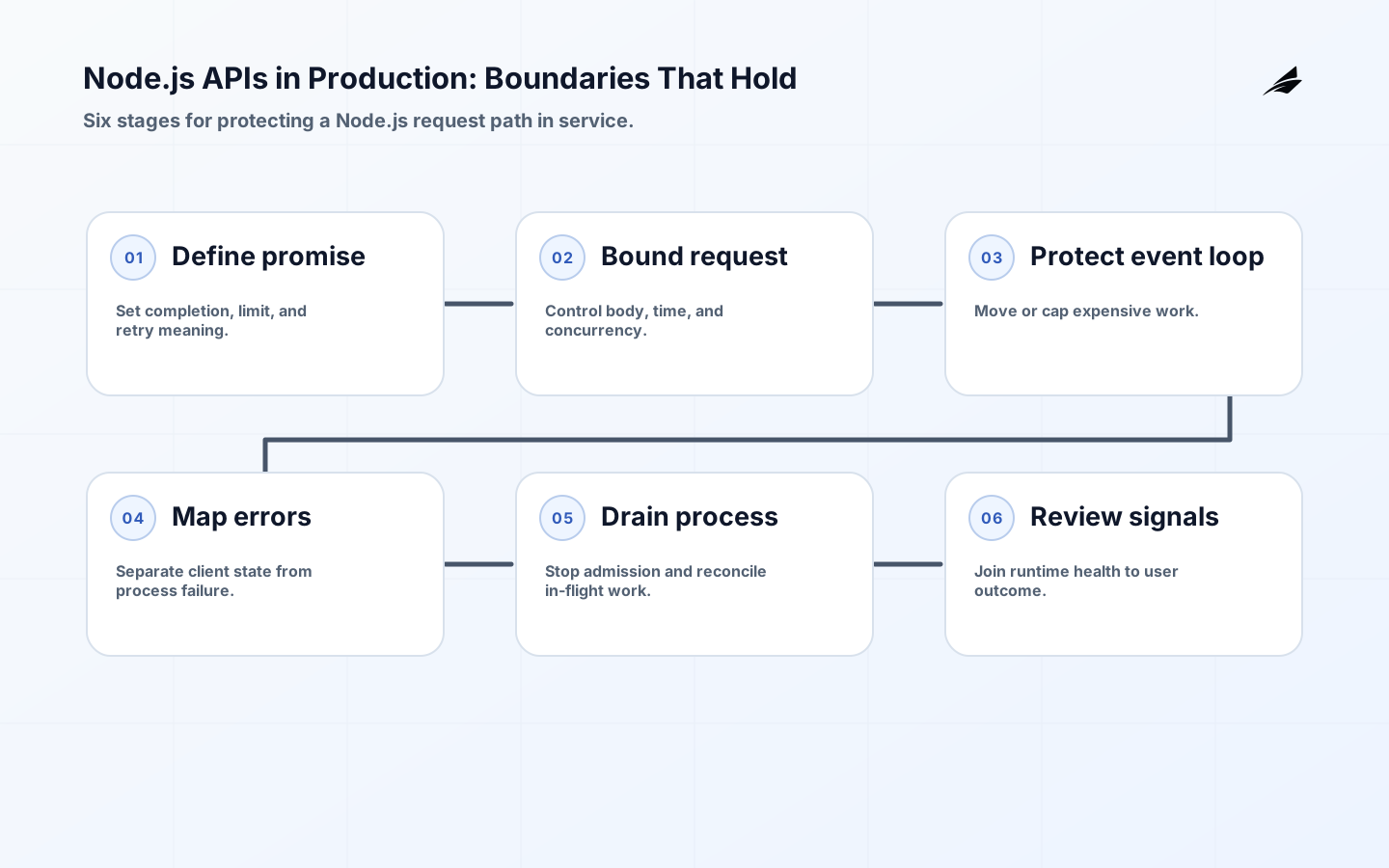
Node.js APIs change character when they move into production. In a local test, a route can appear to work with small payloads, fast dependencies, and one request at a time. In service, the same process must protect a shared event loop, make authorization and input limits explicit, survive slow providers, and tell operators whether a request completed before a deployment or shutdown interrupted it. Production readiness is therefore a boundary exercise: define the promise, constrain the work, separate client outcomes from process failures, drain deliberately, and carry enough context to diagnose one request without collecting everything.

Define what a Node.js API promises under load
Write the request promise in terms a caller and an operator can verify. State acceptable payload size, authentication and authorization behavior, timeout, rate or concurrency expectations, response semantics, idempotency for writes, and what happens during dependency or process failure. A route that accepts an unbounded body or waits forever has already made an availability decision. A route that returns success before a durable write is confirmed has made a data-consistency decision. Keep these choices close to the use case and expose them in tests and a contract, rather than leaving them as framework defaults.
Keep request boundaries legible
A dependable request path has recognizable stages: parse, authenticate, authorize, validate, execute the use case, persist the outcome, format the response, and record safe evidence. Keep framework and transport code at the edge so the business decision can be tested without a live server. Put authorization next to the operation that needs it, not only in a middleware assumption. Validate before expensive work and before external calls. The Node.js HTTP documentation is an implementation reference; it does not decide the business contract, so write that local contract explicitly.
| Boundary | Decision to make | Signal when it is wrong |
|---|---|---|
| Request body | Maximum size, parsing, and schema | Rejected payloads or memory growth |
| Authentication | Accepted identity and session lifetime | Unexpected anonymous or stale requests |
| Authorization | Resource and action policy | Cross-tenant or privilege failures |
| Dependency | Timeout, retry, and concurrency limit | Latency cascade or socket exhaustion |
| Response | Status, shape, and completion meaning | Clients retrying or misreading state |
Protect event-loop capacity
Node.js can handle substantial concurrent I/O, but a process still has finite CPU, memory, sockets, and event-loop time. Avoid synchronous file or crypto work in a request path unless its cost is bounded and accepted. Limit body parsing, pagination, regular-expression complexity, fan-out, and queued work. An unsettled promise still occupies resources, even if the code looks asynchronous. Watch event-loop delay, heap pressure, open handles, dependency latency, and rejected requests together. If a computation is large, move it to a worker or a bounded job and make the request state explicit.
Async does not mean unbounded
Set a concurrency budget for calls to each provider and for work admitted by each route. Use an abort or timeout signal and release resources when a client disconnects. Do not turn every upstream error into an immediate retry; coordinated backoff and a terminal state protect both systems. A queue can absorb a burst only if its age, size, and consumer capacity are visible. Test a slow provider with realistic parallel requests, not only a single delayed unit test.
Separate client errors from process failures
Use the public contract to distinguish invalid input, denied action, conflict, dependency unavailability, and unexpected failure. The Node.js Errors reference explains the runtime error model, but an exception name should not leak directly into an API response. Map known failures to stable codes and safe detail; let unexpected failures reach a protected handler that records the release, request, and correlation context. If a write may have completed before an error surfaced, enter a reconciliation state instead of pretending the operation failed cleanly.
Drain and restart deliberately
A deployment or platform event can stop a process while requests and background tasks are active. On a termination signal, stop admitting new work, allow bounded in-flight requests to finish, close server connections, and persist or requeue durable jobs. The Node.js Process documentation is the right place to check signal and lifecycle behavior. Define what happens when the grace period expires; killing a process without a recovery plan creates ambiguous writes. Exercise the sequence in a production-like environment and include readiness behavior so a load balancer stops sending traffic before the process exits.
Carry correlation through asynchronous work
A request identifier should connect the incoming request, use case, provider call, database change, queue message, and final response. Node.js asynchronous context tracking can carry contextual data across callbacks, but it does not replace authorization, durable state, or explicit propagation to another process. Keep identifiers non-sensitive, control their retention, and record the outcome rather than every payload. A useful investigation can answer which release handled the request, where time was spent, whether a side effect occurred, and who owns the next action.
Prove the path with production-shaped tests
Release one operation with real authentication, a representative database, realistic payloads, an actual dependency boundary, and the observability the on-call team will use. Test malformed input, denied access, slow and failing dependencies, duplicate writes, client disconnect, process restart, schema migration, and shutdown during an in-flight request. Keep the API description executable where practical; the OpenAPI Specification can hold request, response, and error examples that clients and tests share. The related REST API contracts article is a useful comparison for contract drift.
| Test | Expected evidence | Stop condition |
|---|---|---|
| Slow dependency | Timeout, bounded resources, and clear state | Requests pile up without an owner |
| Duplicate write | One effect and a repeatable result | Second effect or ambiguous support case |
| Process termination | Drain, requeue, or reconciliation | Lost work without visible state |
| Large payload | Early rejection and stable memory | Event-loop or heap pressure |
| Denied request | Safe response and audit context | Protected resource details leak |
Manage dependency budgets explicitly
For each dependency, write the maximum time, concurrency, payload, and retry work the service can afford. Tie the budget to the user or job deadline and decide what happens when it is exhausted. A provider that has already accepted a command needs reconciliation; a read that exceeded its deadline may be canceled; a background job may be rescheduled with an age limit. Keep the budget visible in configuration and telemetry so an operator can distinguish a provider problem from local saturation.
Prove restart behavior before the first incident
Stop a process during a request that is reading, writing, and waiting on an external service. Confirm which work is canceled, which work is durable, which job is requeued, and what the caller sees after reconnecting. Run the same rehearsal during a schema change and a rolling deployment. The evidence should include request or operation identity, state before and after, and the action an operator takes when the graceful window expires.
For adjacent decisions, compare test strategy in production when failure tests need release evidence, and caching strategy when response freshness and invalidation affect completion meaning. These boundaries should be reviewed with the same request identity and user outcome as the API itself.
Review runtime signals as one story
Dashboard the full request story: rate, latency, event-loop delay, memory, open connections, dependency timeouts, response classes, queue age, and reconciliation cases. Use a release marker and a route or operation name that has stable meaning. A low error rate can coexist with a serious problem if requests are pending, timing out at the client, or producing incorrect business state. Give each alert an initial query, an owner, and a safe first action. When a signal changes, compare it with a real request trace and a customer outcome before deciding whether to roll back, reduce traffic, or repair data.
Review resource pressure alongside correctness. A service can return technically valid responses while memory growth, open sockets, or event-loop delay makes the next request unsafe. Set a capacity signal for each expensive operation and define the user-facing behavior when the budget is reached: reject early, queue, reduce optional work, or ask the caller to narrow the request. This makes capacity a visible part of the API promise instead of an incident surprise.
Keep readiness and liveness separate. A process may still be alive while it cannot safely accept more traffic because a dependency, migration, or memory budget is unhealthy. Let readiness reflect the work the instance can honestly perform, and let liveness remain narrow enough to avoid restart loops. During a release, make the transition visible in the request and deployment evidence so an operator can tell whether a drop in traffic is planned draining or an unobserved outage.
Node.js API production decisions worth retaining
- Define request limits, completion semantics, and dependency behavior before traffic arrives.
- Keep parsing, identity, authorization, validation, business work, and evidence distinct enough to test.
- Protect event-loop capacity with bounded payloads, concurrency, CPU work, and timeouts.
- Treat shutdown and ambiguous writes as correctness paths, not platform details.
- Join runtime signals to the request outcome an operator or customer actually cares about.
Questions teams ask about Node.js APIs in production
What is the most common production mistake with the event loop?
Assuming asynchronous syntax makes work cheap or bounded. Synchronous CPU, oversized payloads, unbounded fan-out, and promises waiting on slow providers can still consume the process. Set budgets and test them under parallel load.
How should a Node.js API behave during deployment?
Stop admitting new work, drain bounded in-flight requests, close connections, and requeue or reconcile durable operations. The service should become unready before termination, and the team should know what happens when the grace period expires.
Can async context tracking replace a request log?
No. It can help carry a correlation value in one process, but the team still needs explicit propagation, durable state, controlled logging, and a contract for work that crosses a queue or service boundary.
Conclusion: make Node.js APIs resilient at the edges
A production Node.js API is dependable when its limits, failure states, shutdown behavior, and evidence are designed as deliberately as its route handlers. Keep the request path legible, protect the event loop, reconcile uncertain writes, and release against realistic signals. The result is a service that can change without asking operators to guess what happened.