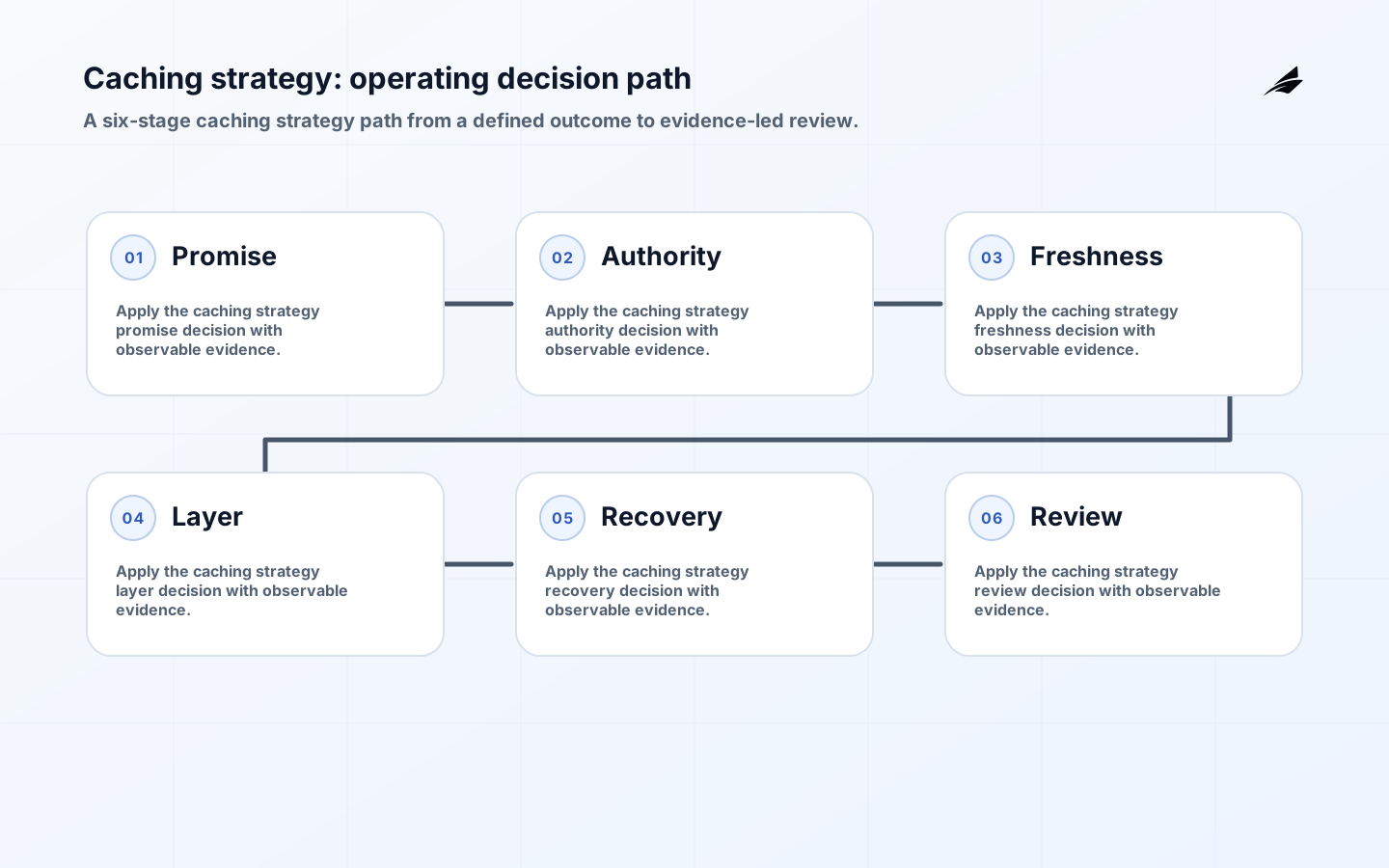
For Caching strategy, A caching strategy is a set of promises about which data can be reused, by whom, for how long, and how the system corrects or avoids a stale result. For caching strategy, Its purpose is not to add a fast key-value store. For caching strategy, It is to reduce unnecessary work or latency while preserving correctness, privacy, and recovery. For caching strategy, The HTTP Caching specification provides shared semantics for cache directives and validation, but each product each product must define its freshness policy for a price, inventory count, profile, dashboard total, or permission. For caching strategy, Begin with a user decision and its tolerance for stale information. For caching strategy, That framing prevents a performance fix from silently turning into a data-integrity or authorization problem. For caching strategy, This article uses HTTP Caching HTTP Caching Redis eviction Cascading Failures to ground the decisions in topic-specific primary guidance. For caching strategy, For adjacent decisions, see database schema design, workflow contract design, support delivery checklist.
Choose the data promise before the cache
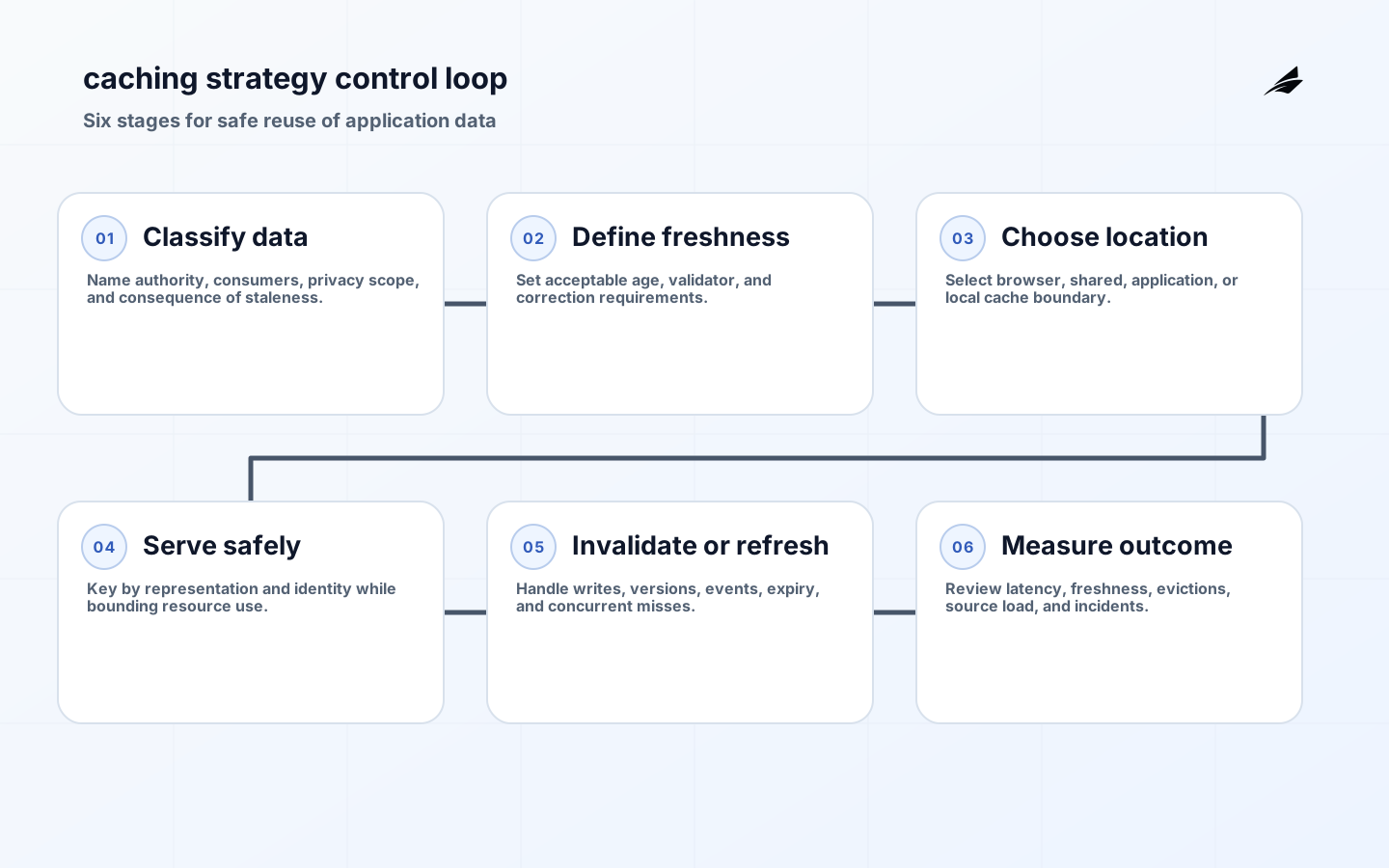
For Caching strategy, Classify a value before choosing a cache location. For caching strategy, Some values are public and slow-changing, such as versioned documentation. For caching strategy, Some are private but read often, such as a user's preferences. For caching strategy, Some are derived and expensive, such as a dashboard aggregate. For caching strategy, Some are volatile or safety-critical, such as a payment status, inventory reservation, or current permission. For caching strategy, For each, record the authoritative source, consumers, maximum acceptable age, invalidation trigger, privacy scope, and fallback when the cache is unavailable. For caching strategy, A cache should never become an accidental source of truth because a database query was expensive. For caching strategy, That source-of-truth statement connects directly to database schema design and makes later corrections traceable.

| Data class | Typical cache choice | Non-negotiable rule |
|---|---|---|
| Public immutable asset | Browser and CDN cache with a content-hashed URL. | A changed asset gets a new identifier; never rely on users clearing cache. |
| Public changing representation | Shared HTTP cache with validators and explicit freshness. | Responses vary correctly by representation and do not mix personalized content. |
| Private user view | Server-side or private client cache scoped to identity and tenant. | A cache key must include the authorization context that affects the result. |
| Derived aggregate | Application cache or materialized projection with refresh policy. | Show or record freshness and provide a correction route. |
| Critical mutable state | Often no read cache, or a tightly bounded one with validation. | Staleness must not grant access, duplicate an action, or mislead a commitment. |
Pair freshness with correction
For Caching strategy, A time-to-live is a policy choice, not a universal solution. For caching strategy, It bounds how long a value may remain without revalidation, but it does not tell you what happens immediately after a material change. For caching strategy, Choose among expiration, explicit invalidation on writes, event-driven refresh, versioned keys, revalidation with validators, or a combination. For caching strategy, The MDN HTTP caching guide explains concepts such as freshness and validation that are useful beyond browsers. For caching strategy, Document race behavior: if an invalidation arrives before a write commits, or a refresh finishes after a newer value exists, which version wins? For caching strategy, For derived views, define whether users see stale data with a label, wait for fresh data, or receive an unavailable outcome.
- Put the authority, identity scope, and representation version into the cache-key design review.
- Use event or version information to reject a refresh result that is older than a known source change.
- Set a bounded TTL even for explicitly invalidated values when a missed event is possible.
- Avoid caching authorization decisions longer than policy, membership, or risk signals allow.
- Give support a way to inspect freshness and request a safe refresh without deleting arbitrary shared keys.
Select a layer that preserves context
For Caching strategy, Browser, CDN, gateway, application, database, and in-process caches each solve different problems. For caching strategy, A browser cache avoids a network request; a CDN can absorb public traffic close to users; an application cache can avoid repeated computation or remote calls; a local process cache is fast but becomes inconsistent across instances. For caching strategy, Select the earliest layer that can safely serve the representation, then preserve the security context it needs. For caching strategy, Do not use an in-process map for distributed session state unless inconsistency is acceptable. For caching strategy, Do not send personalized responses to a shared cache without correct cache-control and variation. For caching strategy, Caching should simplify a measured bottleneck, not conceal an unbounded query, missing index, or unstable upstream service.
| Layer | Good fit | Common failure |
|---|---|---|
| Browser/CDN | Public assets and representations with clear HTTP semantics. | Serving an old or personalized response because headers and variation were incomplete. |
| Gateway | Repeated authenticated reads with centralized policy and observability. | Keying only by URL when tenant, locale, or authorization changes content. |
| Application cache | Expensive derived data or controlled third-party reads. | Storing mutable objects without an invalidation and memory-pressure plan. |
| In-process cache | Small, disposable data with a short lifetime per instance. | Assuming a local eviction or refresh reaches all replicas. |
| Database projection | Read models that need transactional or rebuildable semantics. | Letting projection lag become invisible to users and operators. |
Design for misses and memory pressure
For Caching strategy, The hardest cache failures happen during load spikes or partial outages: many requests miss together, a dependency recovers slowly, or an eviction policy discards the working set. For caching strategy, The Redis eviction documentation shows that memory pressure is an explicit operational behavior, not an exceptional surprise. For caching strategy, Plan cache admission, maximum memory, TTL distribution, request coalescing, stale-while-revalidate behavior, and fallbacks. For caching strategy, Protect against stampedes by letting one request refresh a key while others use a safe stale value or wait within a deadline. For caching strategy, Scope keys and logs to identity and tenant. For caching strategy, Never cache secrets, credentials, or responses whose privacy boundaries cannot be represented safely.
For Caching strategy, Buying or operating a cache also means choosing accountability. For caching strategy, Clarify who owns availability, capacity, upgrades, backup requirements if any, network controls, incident response, and cost allocation. For caching strategy, A managed cache can reduce infrastructure work but does not determine key design or invalidation correctness; a self-managed cluster can offer control but adds failover and patching duties. For caching strategy, Make an exit plan for a cache tier that becomes unavailable or too expensive: the application may bypass it for low-volume paths, use a stale bounded representation, shed nonessential work, or return a clear unavailable result. For caching strategy, Those choices should be tested before they are needed, not invented during an outage.
Measure truth, latency, and source relief
For Caching strategy, A high hit rate can coexist with stale dashboards, privacy leaks, or an overloaded source caused by a small set of hot misses. For caching strategy, Measure end-to-end latency, source load avoided, cache age, refresh errors, eviction rate, memory use, stampede suppression, and correctness incidents. For caching strategy, Segment by operation and data class; one aggregate number cannot guide policy. Google's analysis of cascading failures is relevant because caches can either isolate a failing dependency or amplify it through retries and synchronized expiry. For caching strategy, Run failure drills with the cache disabled, partially stale, and under memory pressure. For caching strategy, A product should continue to state the truth even when it cannot state it instantly.
- Set service objectives for user-visible latency and freshness, not only cache hit rate.
- Alert on refresh failure, eviction anomalies, cache-key cardinality growth, and source fallback load.
- Test a permission change, source correction, and tenant switch for cross-user or stale-data exposure.
- Review cache invalidation whenever the underlying schema, event contract, or authorization policy changes.
- Budget cache operating cost, including memory, network, monitoring, and incident response, alongside compute savings.
Key takeaways
- A caching strategy starts with the data decision, authority, acceptable age, and correction path.
- Freshness and invalidation must be designed together; a TTL is only one control.
- Choose the earliest cache layer that can safely preserve representation and privacy semantics.
- Plan for eviction, synchronized misses, and dependency failure as normal operating conditions.
- Judge caching by latency, source protection, freshness, and correctness, not hit rate alone.
Caching strategy FAQ
For Caching strategy, What should never be cached? For caching strategy, Credentials, secrets, and any response whose privacy or freshness requirements cannot be expressed safely should not be cached. For caching strategy, Is a shorter TTL always safer? For caching strategy, It reduces some staleness but can increase source load and synchronized misses; choose it with invalidation and capacity behavior in mind. For caching strategy, Should we cache database queries? For caching strategy, Cache the representation or derived result with a clear authority and invalidation policy, not an opaque object merely because the query is slow. For caching strategy, How do we clear a cache? For caching strategy, Prefer scoped, versioned, or event-driven invalidation over broad flushes that create uncontrolled load.
Conclusion
For Caching strategy, A cache is a controlled copy of a fact, and every copy needs a reason, boundary, and correction route. For caching strategy, Design those rules before selecting technology, then test how they behave when the source, cache, or network is under stress. For caching strategy, The result is faster software that stays honest about what it knows.
Apply this caching strategy rule to a representative case and record its owner, evidence, and recovery action.
Caching strategy: operating evidence
For Caching strategy, For Caching Strategy: Buyer and CTO Guide for Correctness at Scale, keep the decision boundary visible in the runbook and connect each exception to an owner, evidence trail, and recovery action. For caching strategy, Review the result with the people who use the workflow, then change scope only when the measured outcome supports it.
Caching strategy decision 1 should name the actor, the trusted input, the observable state, and the point where a person can intervene. Case decision 1 follows the caching strategy boundary and records its exception. The caching strategy record for decision 1 names the evidence, owner, and correction route. Decision 1 remains bounded, inspectable, and ready to revise.
Caching strategy decision 2 should name the actor, the trusted input, the observable state, and the point where a person can intervene. Case decision 2 follows the caching strategy boundary and records its exception. The caching strategy record for decision 2 names the evidence, owner, and correction route. Decision 2 remains bounded, inspectable, and ready to revise.
Caching strategy decision 3 should name the actor, the trusted input, the observable state, and the point where a person can intervene. Case decision 3 follows the caching strategy boundary and records its exception. The caching strategy record for decision 3 names the evidence, owner, and correction route. Decision 3 remains bounded, inspectable, and ready to revise.
Caching strategy decision 4 should name the actor, the trusted input, the observable state, and the point where a person can intervene. Case decision 4 follows the caching strategy boundary and records its exception. The caching strategy record for decision 4 names the evidence, owner, and correction route. Decision 4 remains bounded, inspectable, and ready to revise.
Caching strategy decision 5 should name the actor, the trusted input, the observable state, and the point where a person can intervene. Case decision 5 follows the caching strategy boundary and records its exception. The caching strategy record for decision 5 names the evidence, owner, and correction route. Decision 5 remains bounded, inspectable, and ready to revise.
Caching strategy decision 6 should name the actor, the trusted input, the observable state, and the point where a person can intervene. Case decision 6 follows the caching strategy boundary and records its exception. The caching strategy record for decision 6 names the evidence, owner, and correction route. Decision 6 remains bounded, inspectable, and ready to revise.
Caching strategy decision 7 should name the actor, the trusted input, the observable state, and the point where a person can intervene. Case decision 7 follows the caching strategy boundary and records its exception. The caching strategy record for decision 7 names the evidence, owner, and correction route. Decision 7 remains bounded, inspectable, and ready to revise.
Caching strategy decision 8 should name the actor, the trusted input, the observable state, and the point where a person can intervene. Case decision 8 follows the caching strategy boundary and records its exception. The caching strategy record for decision 8 names the evidence, owner, and correction route. Decision 8 remains bounded, inspectable, and ready to revise.
Caching strategy decision 9 should name the actor, the trusted input, the observable state, and the point where a person can intervene. Case decision 9 follows the caching strategy boundary and records its exception. The caching strategy record for decision 9 names the evidence, owner, and correction route. Decision 9 remains bounded, inspectable, and ready to revise.
Caching strategy decision 10 should name the actor, the trusted input, the observable state, and the point where a person can intervene. Case decision 10 follows the caching strategy boundary and records its exception. The caching strategy record for decision 10 names the evidence, owner, and correction route. Decision 10 remains bounded, inspectable, and ready to revise.
Caching strategy: operating evidence