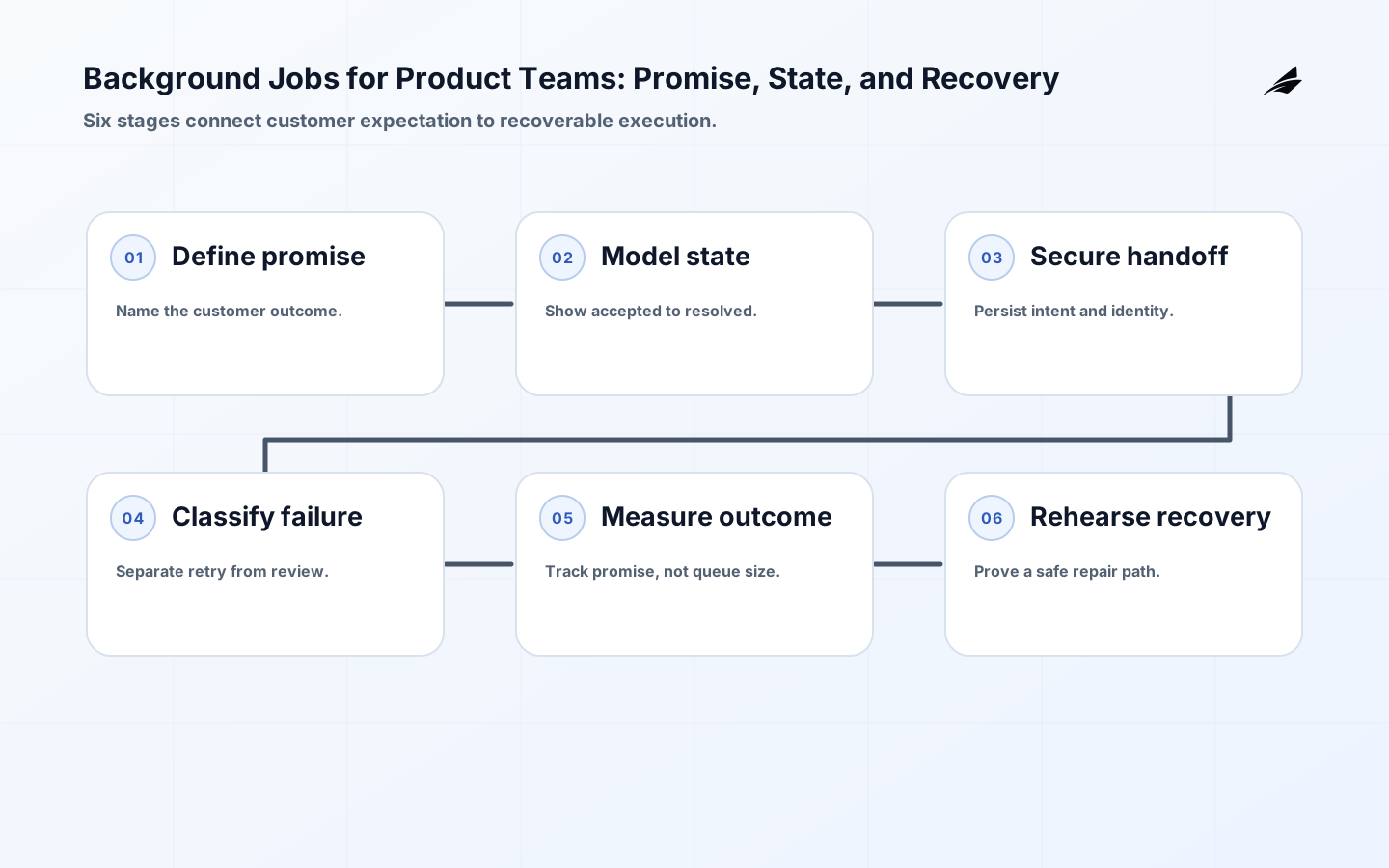
Background jobs are product behavior with a delayed clock. When a user starts an export, import, notification, reconciliation, or media conversion, the system cannot simply say that a request was accepted and leave the rest to infrastructure. It must explain what was accepted, what will happen next, how long the outcome may take, and where a person can go when the work stops. A queue can move execution away from a request, but the product still owns the promise. The strongest background job designs begin with a customer outcome and then choose delivery mechanics that preserve that outcome under retries, crashes, and changing dependencies.
Start with one journey that the team already understands. A monthly report is a useful example: the request creates a durable report record, captures the requester and filters, returns a report status, and schedules work against that record. The error handling guide helps make the failure vocabulary consistent, while event-driven systems explains why an event or queue does not remove the need for ownership. This article focuses on the product decisions that make background jobs dependable after the first successful demo.
Define the product promise before choosing a queue
Move work off the request path when duration is variable, a dependency may be slow, the user can continue without the result, or the action is deliberately scheduled for later. Keep the synchronous part responsible for authentication, validation, durable intent, and a truthful response. Do not enqueue a message before the record that gives the work meaning is committed. Otherwise a transaction can fail after the message is published, leaving a worker with an identifier that the product never accepted. The queue is a delivery detail; the accepted business intent is the record that support and the user can understand.
Write the promise in observable terms. “The report will be ready soon” is not a useful contract. “The report request will appear as preparing, the user can leave the page, the system will notify them when a download is available, and a failed request will show a reason and retry action” gives product, design, engineering, and support something to test. If a result can be partial, say what partial means. If the work may be cancelled, name which side effects are reversible and which are not. These choices prevent a status label from becoming a substitute for a state model.
| Decision | Product question | Implementation evidence |
|---|---|---|
| Why defer? | What benefit comes from not waiting? | Measured request budget and user journey |
| Accepted record | What durable object represents intent? | ID, requester, scope, authorization, and state |
| Completion | What counts as done for the user? | Final effect, retrieval path, and notification |
| Failure | Which problem needs a correction or a person? | Reason code, owner, retry or review action |
| Cancellation | What can stop safely after acceptance? | Transition rules and audited side effects |
Model accepted, running, and recoverable states

A status is useful only when it corresponds to a transition the system can prove. A practical state set might include accepted, queued, running, waiting, succeeded, failed, cancelled, and needs-review. Each state needs an entry event, an owner, an expiry or next action, and a safe response if the next dependency cannot be reached. “Running” should not remain visible forever because a process crashed; the design needs a lease, heartbeat, timeout, or reconciliation rule that moves stale work into a state a human can investigate.
Show only progress that the system can measure. An import can report validated rows and committed rows when those counts are durable; it should not show 63 percent merely because a timer predicts a finish. For a report, the user may need a stable download link, the filter set used, and the time of the last attempt more than a moving percentage. A support agent may need the job ID, state transition history, dependency response, and whether a retry can create a duplicate. The product surface and operator record should describe the same state, at different levels of detail.
For the report example, a user request creates report R-1842 with state accepted. A scheduler publishes work for R-1842, the worker claims it, writes a temporary artifact, records the result, and then changes the report to ready. If the worker loses its lease after producing the artifact, the next attempt must recognize the existing artifact or replace it safely. A state model makes that unusual sequence part of design rather than an incident discovered by a customer.
| State | Meaning | Required next action |
|---|---|---|
| Accepted | The product recorded intent and scope. | Publish or schedule work with a traceable ID. |
| Running | A lease or heartbeat identifies active execution. | Renew, complete, or expire the lease. |
| Waiting | A known dependency or time window blocks progress. | Record the dependency and revisit time. |
| Failed | The current attempt cannot produce the promised result. | Classify as retryable, terminal, or review. |
| Ready | The user can retrieve or use the completed outcome. | Keep the artifact and access policy consistent. |
Make duplicate delivery harmless to the customer
Assume a job can run more than once. RabbitMQ reliability guidance treats acknowledgements as a transfer of responsibility, while Amazon SQS delivery guidance documents redelivery for standard queues. Do not hope that a broker will deliver exactly once. Give the business effect a stable idempotency key, record the effect, and make the worker safe when the key already exists. For an email reminder, the key might combine invoice ID, reminder type, and scheduled date. For an export, it might identify the report request and output version.
Separate the idempotency decision from the transport identifier. A message ID helps trace a delivery, but a business key protects the effect when a producer publishes the same intent twice or a worker retries after a timeout. If the job calls an external system, pass the provider’s idempotency key when supported and store the provider reference. If the effect cannot be made atomic, record a pending outcome and reconcile it later. The user should never be told that a payment, email, or file was completed solely because a worker reached an acknowledgement line.
- Persist the business intent before publishing work.
- Use a stable key for each customer-visible side effect.
- Keep queue payloads small and re-read authoritative records at execution time.
- Record completion and provider references before acknowledging the delivery.
- Test a crash after the side effect but before the success record.
- Make replay permissioned, bounded, and visible to support staff.
Classify failures before setting a retry policy
A retry is a product decision about whether another attempt can improve the outcome. Temporary throttling, a network timeout, or a short database outage may be retryable. A malformed file, revoked authorization, missing record, or unsupported provider response usually needs a terminal state or corrected input. Temporal retry policies distinguish transient and permanent failures, while Cloud Tasks retry configuration exposes attempts, duration, backoff, and rate limits. Those knobs are useful only after the application has named which responses merit another attempt.
Use backoff and jitter to prevent every job from returning to a failing dependency at once. Cap total elapsed time as well as attempts, because a job that retries once every hour can still violate a user promise. Preserve the reason for every retry and the response that caused it. When work reaches a dead-letter or review path, retain enough context to fix the cause without copying secrets or unnecessary personal data into an operator queue. A failed state that says only “worker error” is not a recovery plan.
| Failure class | Typical example | Product action |
|---|---|---|
| Transient | Connection reset or brief provider outage. | Retry with bounded backoff and show waiting. |
| Rate-limited | Provider returns 429 with a retry hint. | Respect delay, cap attempts, and monitor age. |
| Terminal input | Invalid file format or missing required field. | Fail with a correction the user can make. |
| Authorization | Permission revoked after request acceptance. | Stop safely and explain the changed authority. |
| Unknown effect | Timeout after an external side effect. | Reconcile before retrying a customer-visible action. |
Observe the business outcome, not only queue depth
Queue depth is an infrastructure signal, not proof that customers are receiving outcomes. A shallow queue can hide one report that has been stuck for six hours, while a deep queue can be acceptable during a known batch window. Track accepted-to-start latency, execution duration, oldest eligible work, retry rate, terminal failure rate, time to customer-visible completion, and the number of records whose state disagrees with the queue. Link these metrics with a stable job or business record ID so a support question can move from the interface to the worker and back again.
Define thresholds with the product promise. If a notification is useful within ten minutes, alert on the age of unprocessed notifications and the proportion that exceed the window. If an overnight reconciliation may take several hours, alert on missing completion rather than every long-running attempt. Keep dashboards separate for normal volume, dependency health, and recovery backlog. The test strategy guide is useful when turning these signals into acceptance cases: a metric is stronger when a repeatable test can cause it to change in an expected way.
Give support a safe path to explain and repair
An asynchronous feature is not complete until someone can answer a delayed-outcome question without reading source code. Provide a support view that shows the business record, current state, last transition, attempt count, safe next action, and the policy that governs replay or cancellation. Hide secrets and sensitive payloads; use references or redacted summaries rather than copying a full request into an admin screen. Every intervention should have an actor, reason, scope, and result. A retry button without those controls turns an operational shortcut into a second source of duplicate work.
Make ownership explicit at three levels: the product owner defines the promise, the service team owns the execution path, and an operations or support role owns the recovery queue. These roles can be held by one small team, but they should not be implied. If a provider changes its limits, if a queue is paused, or if a user asks for a reversal, the escalation route should be documented. A caching strategy guide illustrates a related principle: derived state needs a clear invalidation and repair owner. Background job state is no different.
Release one job type and rehearse the ugly path
Choose one job with a contained side effect and a clear user benefit. Before general release, exercise duplicate delivery, worker crash after an external call, malformed input, dependency timeout, exhausted retries, cancellation during execution, and a stale lease. Run the same cases through the user surface and the operator surface. If a recovery action can change a financial, permission, or notification outcome, test its authorization and audit trail with the same care as the happy path.
Roll out with a bounded cohort or feature flag, and compare the observed completion window with the promise written in the product requirement. Keep the old synchronous or manual path available only as a deliberate fallback with a named sunset condition. When the job is stable, add the next job type only after the queue, status, dashboards, and support workflow remain understandable. This is how a team grows background processing without creating a hidden second application made of retries and exceptions.
- Name the first job type and the user outcome it protects.
- Capture the durable record, idempotency key, and state transitions.
- Define retryable, terminal, and operator-review failures.
- Set a completion window and alert on age, not just volume.
- Run crash, duplicate, cancellation, and dependency-failure rehearsals.
- Review the evidence with product, support, engineering, and operations.
Takeaways for product-owned background jobs
- Treat the durable business record as the anchor for asynchronous work.
- Show states that correspond to evidence, not invented progress.
- Assume duplicate delivery and protect side effects with business idempotency keys.
- Classify failures before choosing retry counts, delays, or dead-letter behavior.
- Measure customer-visible completion and work age alongside queue health.
- Give support an audited, permissioned recovery path before launch.
Common questions about product-facing background jobs
When should work stay in the request path?
Keep it synchronous when the user needs the result to make the next decision, the work fits the response budget, and failure can be reported immediately. Move only the variable or slow portion when a durable handoff and later status are clearer for the user.
Is a message ID enough to make a job idempotent?
No. A message ID traces one delivery, while a business idempotency key protects the customer-visible effect across duplicate intent, republishing, and a worker crash after the side effect. Store the key and the resulting effect together where possible.
What should a user see when a job exhausts retries?
Show a stable failed or needs-review state, a plain-language reason, whether the user can correct anything, and how to get help. Do not expose internal stack traces or imply that another retry will fix a terminal input problem.
Conclusion: make delayed work accountable
Background jobs improve responsiveness when they preserve a clear promise after the request ends. Define the accepted record, model the states, make effects safe to repeat, classify failure, measure the customer outcome, and rehearse recovery before adding volume. A queue can then remain an implementation component while the product stays understandable, supportable, and trustworthy.