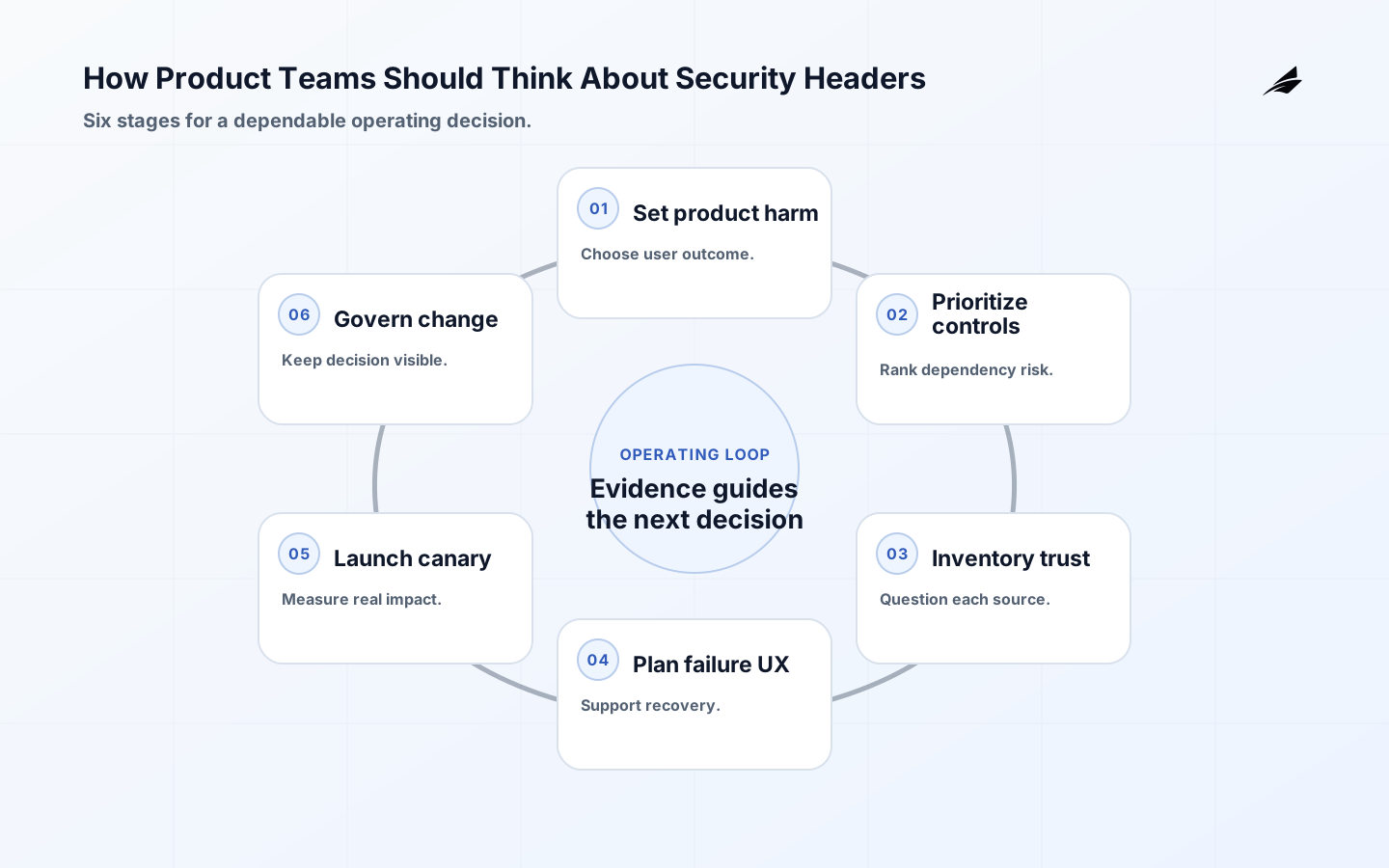
Security headers are HTTP response instructions that let a browser enforce important boundaries around transport, content, embedding, and certain cross-origin behavior. Product teams should not treat them as a checklist pasted into a reverse proxy. Headers can prevent classes of browser-side abuse, but an aggressive policy can also break payment flows, analytics, support widgets, or legitimate embedded content. The product task is to decide which browser protections match the application’s real pages, then ship and monitor them like any other behavior change.
Product decisions should also account for cross-site scripting guidance, CORS guidance, CSP implementation guidance, and CSRF prevention guidance. These references connect browser controls to the user journeys and dependencies that product teams own.
Set the security headers scope
Begin with an inventory of response types and third-party dependencies. Marketing pages, authenticated dashboards, administrator consoles, file downloads, embedded reports, and callback pages have different risks and compatibility needs. Content Security Policy deserves special care because it can limit which scripts, styles, frames, and network destinations a page may use, yet a broad wildcard or unsafe exception can erase much of its value. The right policy is built from observed page behavior, not guessed from a generic configuration.
| Decision area | Question to answer | Accountable evidence |
|---|---|---|
| Header area | Product decision | Validation |
| HSTS | Which domains are HTTPS-ready? | Redirect and subdomain test |
| Content Security Policy | Which origins may execute or receive data? | Browser console and violation reports |
| Frame control | Who may embed this page? | Embedding test on allowed and untrusted origins |
Prioritize controls by user journey and blast radius
Set a transport baseline first: HTTPS everywhere and a considered HSTS policy once redirects and subdomains are understood. Use frame-ancestors in CSP to govern embedding, a restrictive referrer policy where it suits the product, and content-type protections for responses that should not be interpreted as another format. Prefer CSP directives that are precise and progressively deployed. A report-only period can reveal violations, but reports need ownership and triage; otherwise they become an ignored stream of blocked resources.
Exercise blocked journeys before release
Release headers by page class and environment. Test a fresh browser profile, mobile web view, authenticated flow, password reset, file upload, error page, and third-party payment or support route. Inspect both response headers and browser console behavior. Developers should avoid loosening the entire policy for one integration; isolate the needed origin or nonce pattern instead. Product managers can help by deciding whether a blocked third-party feature is valuable enough to justify the additional trust boundary.
| Scenario | Expected response | Review evidence |
|---|---|---|
| Page type | Common concern | Release check |
| Account settings | Script and form integrity | Reset and MFA flows work |
| Payment callback | Third-party destination | Return and error states work |
| Admin console | Embedding and sensitive data | Frame denial and fresh-login test |
Give policy changes an operating owner
Keep the policy close to the application configuration and review changes with the teams that own front-end dependencies. Treat a new script host, frame destination, or data endpoint as a product and security decision. Related guides on OAuth security and OpenID Connect matter here because browser callback pages and identity-provider embeds often reveal undocumented dependencies.
Translate external guidance into product choices
Use primary guidance to anchor technical choices: NIST Cybersecurity Framework 2.0 describes a governance-oriented risk framework; Cross-Origin-Opener-Policy guidance supplies practical baseline outcomes; the API Gateway service limits offers implementation-oriented guidance; and RFC 9700 records current OAuth security practice. These references inform the controls here, but the accountable owner must still apply them to security headers in the organization’s actual architecture and threat model.
Measure compatibility and protection together
Monitor CSP violation reports after deduplication, blocked-resource rates on critical journeys, header coverage across response classes, and regressions caused by policy deployments. A high report count may mean an attack attempt, a page defect, or a stale integration; context is essential. The operational goal is a policy that protects rendered pages while remaining explainable when a product change needs a new browser capability.
Account for browser dependencies and blast radius
Content Security Policy is most effective when it reduces the number of implicit browser trust decisions. Nonce- or hash-based script authorization can be stronger than allowing broad script origins, but it requires the rendering path to generate and propagate values correctly. Avoid adding unsafe inline execution just to make a legacy page work; isolate the legacy route, schedule the refactor, or use a targeted integration boundary. A policy that is slightly narrower and understood by the team is more durable than a complex policy copied from another application.
Header configuration should be tested at the edge that actually serves users. A framework middleware setting can be overridden by a CDN, load balancer, error handler, or an alternate host. Include redirects, cached responses, download endpoints, and error pages in automated checks. A missing header on an administrative subdomain or an old callback route may matter more than a polished policy on the main landing page. Maintain a small test inventory of domains and response classes as the product grows.
Keep policy changes traceable
Product decisions sometimes create legitimate pressure to broaden browser permissions, especially when embedding analytics, payment, video, or customer-support tools. Make that tradeoff visible. Record what data the third party can receive, whether it executes on authenticated pages, which pages need it, and how it can be removed. Security headers cannot decide whether an integration is appropriate, but they provide a precise place to document and enforce the resulting browser boundary.
Make governance usable in delivery
Security headers also benefit from a clear ownership boundary between product code and platform configuration. Central platform teams can enforce a baseline for transport and obvious unsafe response types, while application teams own the more specific content and embedding rules that reflect their pages. This split prevents a global change from breaking a legitimate integration without review, but it also prevents every product from silently weakening core protections. Keep a tested rollback method that removes a newly introduced restrictive directive without discarding the entire header set. When a violation report points to an unexpected host, verify whether it is an authorized dependency, an implementation defect, or an attempted injection before adding it to policy. Browser behavior changes over time, so revisit policy when updating front-end frameworks, adopting a new CDN, or changing how pages are rendered. A header deployment is successful when it is represented in infrastructure and application tests, understood by the people shipping front-end changes, and narrow enough that future exceptions are visible rather than absorbed into a permissive global rule.
Review a real customer journey
Before enforcement, put a product owner and a front-end engineer in front of the response matrix for a critical page. They should be able to name the permitted script, frame, and connection origins, and explain why each exists. Unknown entries deserve investigation, not automatic inclusion. This compact review catches dependency sprawl early and turns a technical header file into a maintained product boundary. Repeat it after a major integration or rendering change.
Place verification beside the release
Do not overlook response consistency. A hardened main application page is weakened if its error handler, alternate domain, or cached response silently omits the intended protection. Automated checks should cover representative URLs after infrastructure changes, and failures should reach the owner who can correct the serving layer rather than only the front-end team.
Include a browser compatibility check in the release record. The target is not every historical client; it is a conscious decision about supported clients and the security behavior they receive.
When a policy is intentionally broadened, record the exact route, dependency, owner, and review date. That small record prevents a one-off compatibility decision from silently becoming a global browser trust rule.
Key takeaways
- Define security headers around a real high-consequence workflow, not a generic tool setting.
- Give every exception an owner, compensating control, and expiry date.
- Use measurement to remove operational blockers and revise the control deliberately.
Frequently asked questions
Can security headers stop every web attack? No. They complement secure server-side authorization, input handling, and session controls. Is report-only mode enough? No. It is a learning phase; enforcement is the protection. Why not apply one CSP to every route? Different page types and trusted integrations often require different, documented policies.
Conclusion
Good security headers make browser trust boundaries deliberate rather than accidental. Inventory real page behavior, deploy in stages, and keep policy exceptions narrow and visible. That gives product teams security that survives normal feature work.
Choose the user harm you are reducing
Product teams should not begin with a list of header names. Begin with the harm: injected script reading a session, a page framed for deceptive interaction, a browser using HTTP after an HTTPS visit, an unnecessary camera or microphone permission, or a resource interpreted as the wrong type. Then decide which browser contract addresses that harm and what product behavior must remain available. CSP, HSTS, framing policy, MIME sniffing protection, and Permissions-Policy have different coverage. Record the owner of each policy and the evidence that will show it works. This also gives design and support a role: when a policy blocks legitimate use, the team can explain the tradeoff and choose a bounded fix.

| Decision | Practical test | Evidence |
|---|---|---|
| Boundary | Name the protected resource and owner | Scope record |
| Failure | Rehearse denial, retry, and recovery | Observed result |
| Change | Version the policy and expiry | Review decision |
Prioritize controls by dependency and blast radius
A small product can usually start by confirming HTTPS on all relevant hosts, setting a sensible referrer policy, preventing MIME sniffing, and protecting framing. CSP deserves deeper inventory because it touches every script, style, image, font, connection, and frame. Treat third-party services as product dependencies with a reason, owner, and removal review. Use report-only mode to discover violations, then enforce a tested policy. Do not copy a policy from another product: its analytics, payment, upload, and embedded support dependencies may be different. A short inventory workshop with engineering and design often reveals more than a security checklist.
Plan the customer experience for a policy failure
A browser block can look like a blank page, a broken login, a missing image, or an unavailable embedded tool. Add monitoring that maps a violation to a route and release, and prepare a support explanation that asks for the browser, page, time, and action without requesting secrets. If HSTS or a certificate policy causes a connection failure, the remedy may be infrastructure, not a client-side workaround. Include a representative set of devices and browsers in acceptance testing. Product managers should make the go/no-go decision with evidence of both security benefit and user impact, not treat policy rollout as a hidden technical detail.
Keep policy decisions visible over time
Version policies with releases and review exceptions when dependencies change. An exception needs a reason, owner, scope, expiry, and replacement plan. Review CSP reports, blocked-resource support cases, missing headers on alternate routes, and the inventory of third-party domains. Ask whether the policy still matches the product’s actual data flows. MDN documents important browser behavior such as HSTS taking effect from secure responses and CSP Report-Only being useful for discovery; use those mechanics to set expectations, but keep the final product decision grounded in your own traffic and dependencies.
Key takeaways
- Define the boundary and the owner before choosing implementation details.
- Test denial, delay, duplication, and recovery as first-class paths.
- Measure the customer or operator outcome, not only the control signal.
- Keep exceptions narrow, time-bound, and easy to investigate.
- Review the policy when dependencies, traffic, or business rules change.
Frequently asked questions
How should product teams prioritize headers? Start with the user harm and the dependency surface, not a copied list of names. What is a product failure? A policy that quietly breaks login, checkout, embeds, or support without an owned recovery path. When should the decision be revisited? When a vendor, domain, script bundle, browser target, or authentication flow changes.
Conclusion
How Product Teams Should Think About Security Headers becomes dependable when the rule is understandable, the failure path is rehearsed, and the evidence survives a busy day.
For adjacent decisions, compare Production API rate limiting, Production security headers, Billing workflows.