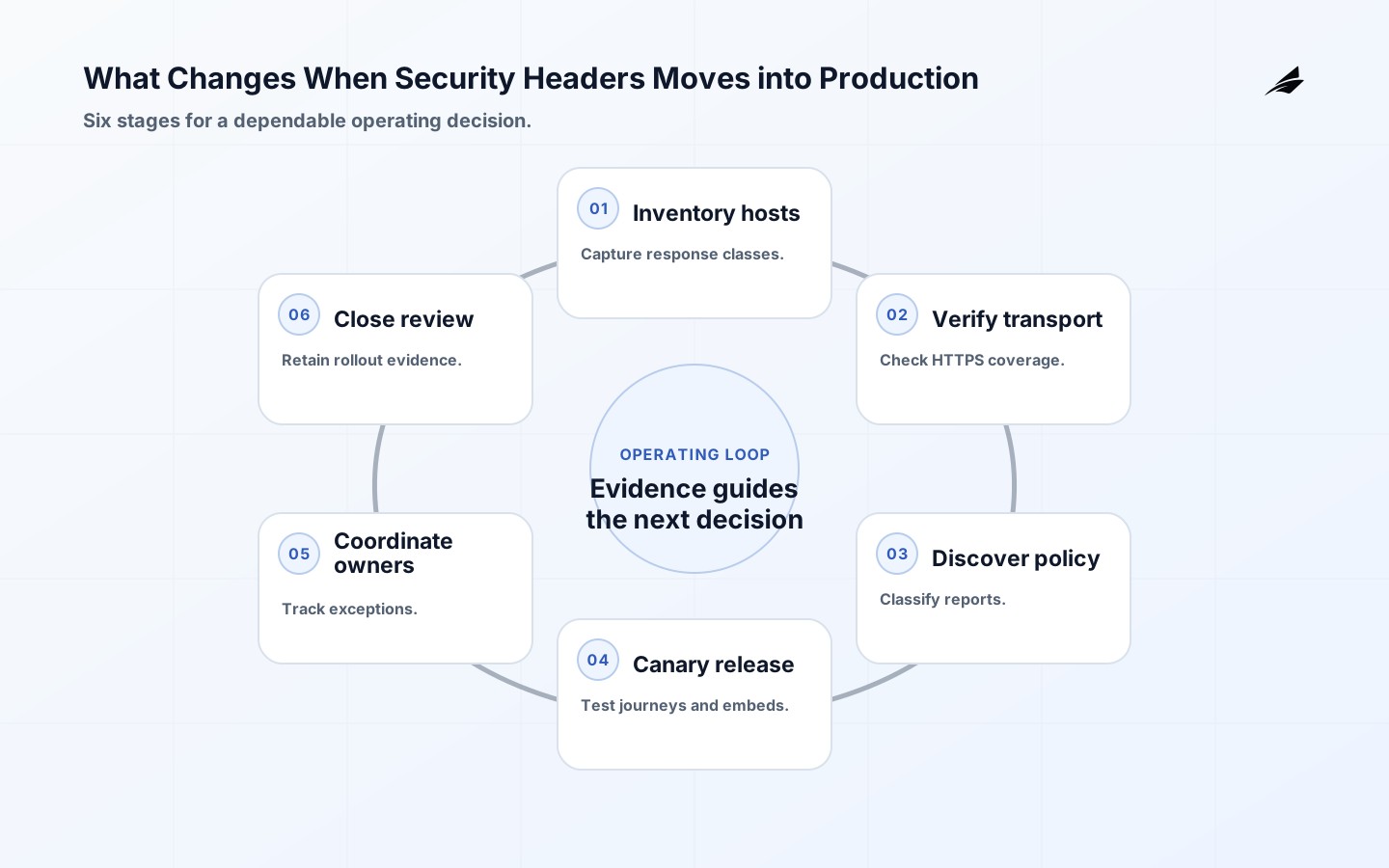
What Changes When Security Headers Moves into Production becomes consequential when a team has to operate security headers through ordinary releases, outages, support requests, and investigations. The protected thing is the browser response policy, not a checkbox in a platform console. A header copied globally without route knowledge can either leave a sensitive browser behavior unprotected or break a payment, embed, or login journey This guide treats security headers as a production capability: a set of bounded decisions, enforcement points, records, and review routines that keep the intended control true after launch.
Set the security headers boundary
Start with application routes, cookies, caching, frames, scripts, form submissions, downloads, and each third-party origin a browser is allowed to contact.
The boundary should join adjacent practices without blending their ownership. Keep the question narrow: which normal and exceptional paths can affect the browser response policy, and what stops the wrong path from doing so?
Design a production security headers architecture
For this topic, an edge or application response layer applies route-aware transport, content, framing, cookie, and caching rules while reports expose unexpected browser behavior.
| Decision area | Production rule | Why it matters |
|---|---|---|
| Transport | Set HSTS only after HTTPS behavior and subdomain scope are understood. | A browser will remember the instruction, so rollback needs care. |
| Content policy | Allow only necessary script, style, frame, and connection origins. | Constrains injection impact and unplanned browser trust relationships. |
| Framing | Use frame-ancestors or equivalent framing controls. | Reduces clickjacking exposure on sensitive pages. |
| Cookies | Apply Secure, HttpOnly, and an intentional SameSite setting. | Makes session transport and cross-site behavior explicit. |
Make security headers decisions reviewable
Write down which route needs which policy, permitted third-party origins, report ownership, cookie attributes, rollout mode, and exception expiry. The detailed guidance in web.dev security headers is a strong technical baseline, but production teams must still decide how its controls apply to their own routes, assets, customers, and failure modes.
- Classify routes by the consequence of a browser compromise rather than applying one visual template to every page.
- Record why every third-party origin is allowed and who owns its removal.
- Prefer nonces or hashes for code that must be inline instead of broad script exceptions.
- Keep a small response-header regression suite next to application release checks.
- Use browser reports as operational evidence, with a named queue and response expectation.
Implement security headers without losing the operating model
Use a staged release that exposes assumptions early. Inventory high-value routes, deploy report-only content policy where appropriate, inspect violations, then enforce a tested route group with a rollback signal. This is also the right point to align engineering work with the more general practices in web.dev COOP and COEP, rather than treating a security control as a detached compliance activity.
| Observed condition | Likely meaning | Practical response |
|---|---|---|
| Policy breaks checkout | An external dependency or inline pattern was omitted. | Use reports and route tests to identify the necessary narrowly scoped allowance. |
| Unexpected third-party call | A script or tag introduced a new destination. | Treat it as a trust-change review, not an automatic allow-list entry. |
| Header absent on one route | Proxy or application path bypassed the standard response. | Compare automated route snapshots with the declared baseline. |
| Report volume spikes | A release changed browser behavior. | Triage by route, directive, and release before switching to enforcement. |
Operate and measure security headers
Retain response-header snapshots, content-policy reports, blocked-resource triage, deployment diffs, and route-level functional tests. The primary guidance in MDN Origin-Agent-Cluster and MDN Permissions Policy can help test whether local choices still align with current, authoritative practice.
Key security headers takeaways
- Protect the browser response policy by defining the decision boundary before selecting or expanding tooling.
- Use accountable, time-bounded rules for which route needs which policy, permitted third-party origins, report ownership, cookie attributes, rollout mode, and exception expiry.
Security headers FAQ
Can security headers replace secure application code? No. They are browser-facing guardrails and do not fix authorization mistakes, server-side injection, or unsafe dependency behavior. Should every route share one content security policy? Usually not. A coherent baseline is useful, but login, administration, public content, and embedded workflows can have different legitimate dependencies.
Prepare browser-policy recovery and escalation
A browser policy rollout must distinguish a real production dependency from a violation caused by legacy or unneeded code. Give reports enough route and release context to make that judgment quickly. If a sensitive route breaks, use a narrow rollback that preserves unrelated headers and document the reason. Avoid turning a report-only policy into permanent observation: set a decision date, assign triage ownership, and remove exceptions that no longer represent a legitimate browser relationship.
Header ownership belongs in the same change process as scripts, tags, and embedded vendors. A team that can explain every new browser origin before release will have fewer late-stage policy surprises and a clearer route to remove obsolete dependencies.
Test headers from the public edge and from the application route, including error responses and redirects. Policy often differs between those paths. Recording a small expected header set per route class gives engineers a quick regression signal and prevents an infrastructure migration from silently dropping protections that users and browsers had previously received.
A production header review should include the paths that ordinary browser tests miss. Check redirects, error templates, cached responses, alternate hostnames, downloads, embedded frames, and authenticated pages from the public edge. Capture the response class, policy version, route owner, and expected browser effect without recording tokens or customer payloads. When a violation appears, compare it with the release that introduced the dependency and decide whether to remove the dependency, narrow the policy, or restore the known-good response. A rollback should preserve unrelated protections and should leave a dated follow-up for the underlying compatibility issue. Ownership also matters across teams: the app team may control CSP, the platform team may control HSTS, and a partner may control a frame or script. The review closes when each open exception has a reason, scope, expiry, and responder, and when a colleague can reproduce both the intended response and the safe failure behavior. That makes headers an operable production control rather than a static checklist.
Conclusion: keep security headers operable
Security headers are strongest when their daily decisions remain narrow, explainable, and testable. That discipline makes the browser response policy easier to operate during routine change and far easier to defend when conditions become urgent.
Production turns header configuration into a compatibility contract
A header that looks correct in a single response may fail on a redirect, error page, alternate hostname, CDN path, or embedded application. Inventory the response classes and hosts that customers actually use. For each, capture the policy, browser behavior it is intended to trigger, required dependencies, and owner. Verify HTTPS coverage before expanding HSTS; MDN notes that the policy changes future browser handling only after it is received over a secure connection. For CSP, compare the declared sources with the bundles and third-party services in the production release. This is a release boundary, not an infrastructure checkbox.

| Decision | Practical test | Evidence |
|---|---|---|
| Boundary | Name the protected resource and owner | Scope record |
| Failure | Rehearse denial, retry, and recovery | Observed result |
| Change | Version the policy and expiry | Review decision |
Use report volume to stage enforcement
Start with report-only discovery where the policy is new, then classify reports by route, release, and dependency. A large number of reports can reflect one bad script, one obsolete page, or a browser extension; do not widen the policy blindly. Fix or remove required dependencies, add the narrowest justified source, and test again. Enforce with a canary that includes login, checkout, uploads, downloads, embeds, and error recovery. Watch browser errors, conversion, authentication completion, and support contacts. Keep both the current and known-good policy available so rollback preserves a deliberate baseline.
Coordinate certificates, proxies, and application owners
Security headers often cross ownership boundaries. The web app team may own CSP, the platform team may own HSTS and redirects, and a partner team may own an embedded frame. Define who can approve a source, who responds to a blocked resource, and how a certificate or proxy change is verified. Test that headers survive caching and that stale policies are not served to the wrong host. A production exception should be narrow, time-bound, and visible in the release record. Never solve a rollout issue by removing all headers; identify the failing contract and restore the smallest safe behavior.
Close the rollout with evidence and a review date
At the end of the rollout, retain sampled headers, report summaries, browser and route coverage, open exceptions, and the owner for each follow-up. Revisit the policy when a vendor, domain, script bundle, frame, or authentication flow changes. Review whether the controls still address the original harm and whether any browser feature is now unsupported or unnecessary. MDN’s guidance distinguishes CSP, HSTS, and Permissions-Policy mechanics; the product’s own evidence determines the right scope. A policy is production-ready when it is enforced on the intended surface, monitored when it fails, and understandable to the people who must recover it.
Key takeaways
- Define the boundary and the owner before choosing implementation details.
- Test denial, delay, duplication, and recovery as first-class paths.
- Measure the customer or operator outcome, not only the control signal.
- Keep exceptions narrow, time-bound, and easy to investigate.
- Review the policy when dependencies, traffic, or business rules change.
Frequently asked questions
What does production add to security-header work? Alternate hosts, redirects, caches, error pages, embeds, certificates, and ownership boundaries. How should enforcement be staged? Discover violations, classify required dependencies, canary the policy, and compare browser and business outcomes. What closes the review? Sampled responses, report summaries, open exceptions, owners, and a date to revisit the policy.
Conclusion
What Changes When Security Headers Moves into Production becomes dependable when the rule is understandable, the failure path is rehearsed, and the evidence survives a busy day.
For adjacent decisions, compare Billing workflows, RBAC for growing teams, API rate limiting checklist.