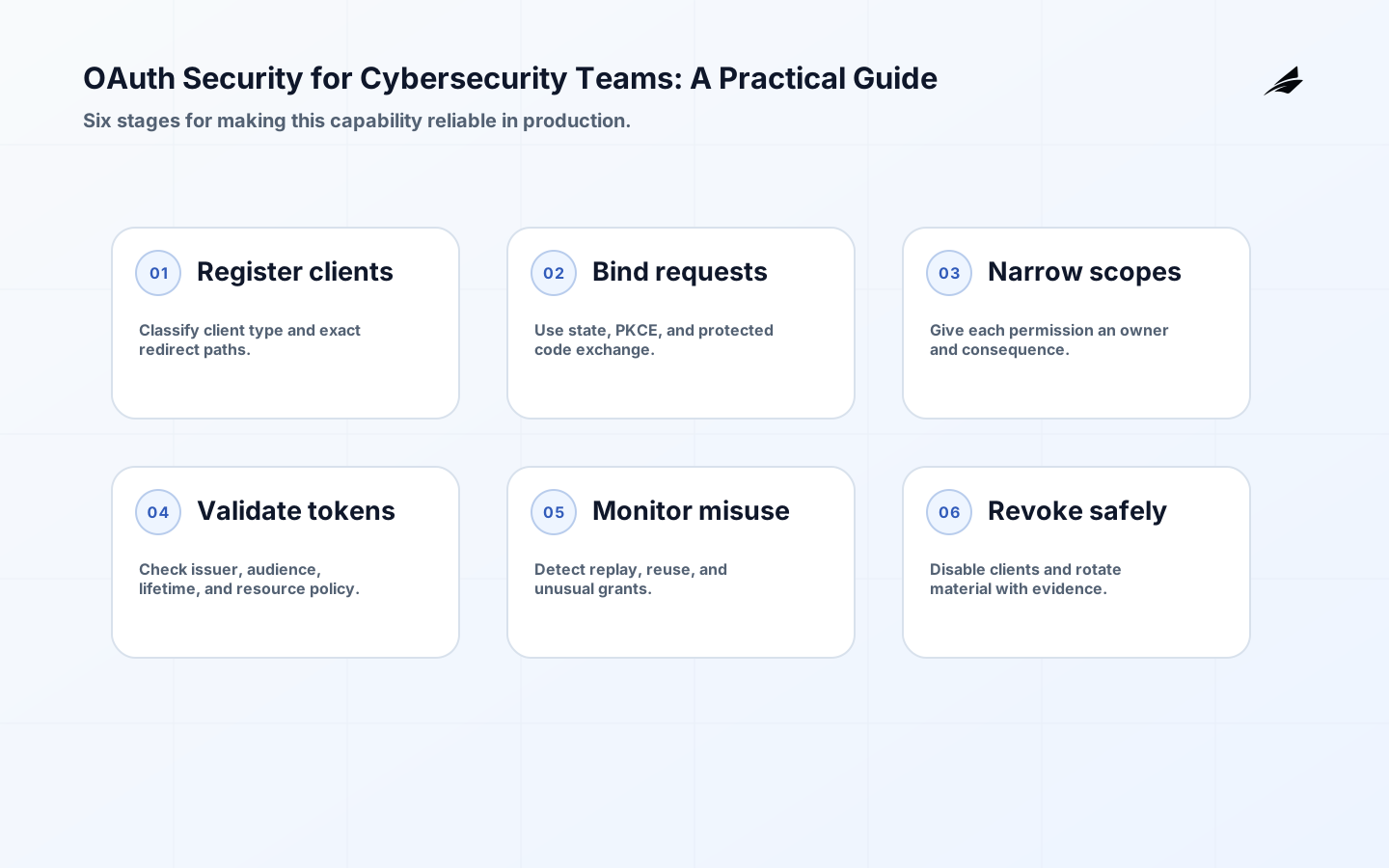
OAuthCyber: oAuth security is the practice of safely delegating access to APIs and resources without treating an access token as a password-shaped convenience. OAuthCyber: operations leaders need a clear model of the parties involved: the resource owner, client application, authorization server, resource server, redirect endpoint, and the people who operate each of them. OAuthCyber: most severe failures arise in the connections between those responsibilities: loose redirect URI handling, confused client identity, excessively broad scopes, token leakage, or weak operational response when credentials are exposed.
Set the OAuth security scope — cybersecurity OAuth review
OAuthCyber: use the authorization code flow with PKCE for public clients and carefully register exact redirect URIs. OAuthCyber: rFC 9700, the OAuth 2.0 Security Best Current Practice, updates earlier security advice and deprecates patterns considered insecure. OAuthCyber: that makes current protocol choices important: do not inherit an old flow simply because a library still offers it. OAuthCyber: the authorization server must distinguish clients, the client must validate state and redirects appropriately, and the resource server must verify the token’s intended audience and authorization before serving data.

| OAuthCyber: decision area | OAuthCyber: question to answer | OAuthCyber: accountable evidence |
|---|---|---|
| OAuthCyber: component | OAuthCyber: security responsibility | OAuthCyber: review question |
| OAuthCyber: client | OAuthCyber: initiates request and protects callback state | OAuthCyber: are redirect URIs exact and owned? |
| OAuthCyber: authorization server | OAuthCyber: authenticates and issues grants | OAuthCyber: are client and consent policies current? |
| OAuthCyber: resource server | OAuthCyber: validates token and authorizes action | OAuthCyber: is audience and scope checked per request? |
Design controls that fit the workflow — cybersecurity OAuth review
OAuthCyber: model scopes as user-understandable capabilities, not vague labels such as full access. OAuthCyber: a reporting application might receive read-only access to a named API; a payment integration may need a much narrower action with explicit consent. OAuthCyber: bind tokens to an expected audience, keep lifetimes suitable for the use case, rotate client credentials, and avoid placing bearer tokens in URLs, logs, browser storage, or support tickets. OAuthCyber: where higher assurance is needed, consider sender-constrained approaches supported by the ecosystem rather than assuming bearer-token theft is impossible.
Build and test the failure paths — cybersecurity OAuth review
OAuthCyber: test the protocol at the boundaries. OAuthCyber: attempt an altered redirect, a callback with mismatched state, a token presented to the wrong resource server, an expired token, a revoked consent grant, and a client secret rotation. OAuthCyber: exercise the operational path for a reported token leak: who can revoke grants, rotate client authentication, identify affected calls, and notify the right owners? OAuthCyber: these tests are more informative than a successful demo login because they show whether the system rejects the failures attackers exploit.
| OAuthCyber: scenario | OAuthCyber: expected response | OAuthCyber: review evidence |
|---|---|---|
| OAuthCyber: failure test | OAuthCyber: expected result | OAuthCyber: evidence |
| OAuthCyber: redirect URI alteration | OAuthCyber: authorization request rejected | OAuthCyber: validation event |
| OAuthCyber: wrong audience token | OAuthCyber: resource request denied | OAuthCyber: aPI authorization log |
| OAuthCyber: credential rotation | OAuthCyber: old client credential stops working | OAuthCyber: rotation and owner record |
Make operations accountable — cybersecurity OAuth review
OAuthCyber: maintain an inventory of OAuth clients, owners, redirect URIs, scopes, environments, and credential expiry. OAuthCyber: require review for a new broad scope or redirect URI, and remove integrations that are no longer used. OAuthCyber: this is closely linked to OpenID Connect when authentication is layered on OAuth, and session security when browser state bridges a user login and an authorization request.
Use authoritative guidance with local evidence — cybersecurity OAuth review
OAuthCyber: the supporting protocol references are RFC 8414 for authorization-server metadata, RFC 9728 for protected resource metadata, RFC 9126 for pushed authorization requests, and RFC 7009 for revocation; use each to test the corresponding integration boundary.
OAuthCyber: use primary guidance to anchor technical choices: NIST Cybersecurity Framework 2.0 describes a governance-oriented risk framework; CISA Cybersecurity Performance Goals supplies practical baseline outcomes; the OWASP OAuth 2.0 Cheat Sheet offers implementation-oriented guidance; and RFC 9700 records current OAuth security practice. OAuthCyber: these references inform the controls here, but the accountable owner must still apply them to OAuth security in the organization’s actual architecture and threat model.
Measure the operating outcome — cybersecurity OAuth review
OAuthCyber: measure active client inventory coverage, percentage of clients using approved current flows, scope breadth, redirect URI changes, token-revocation time, and failed callback validation. OAuthCyber: treat sudden consent spikes, client credential use from unexpected environments, or tokens presented to invalid audiences as investigation signals. OAuthCyber: the goal is a delegation system whose authority is narrow enough to understand and whose operators can revoke it quickly.
Address architecture and dependency tradeoffs — cybersecurity OAuth review
OAuthCyber: client registration is an asset-management problem. OAuthCyber: every client should have a named owner, environment, redirect URIs, granted scopes, credential type, last-use evidence, and retirement date. OAuthCyber: prevent unowned applications from retaining access just because their original developer left. For machine-to-machine cases, avoid borrowing an end-user grant model; use a grant appropriate to the workload and constrain it to the resource actions required. OAuthCyber: this clarity makes incident response faster because revocation can target one integration without disabling unrelated clients.
OAuthCyber: redirect handling deserves careful product testing. OAuthCyber: exact matching is safer than prefix or wildcard patterns, and an authorization response should be bound to the browser journey that initiated it. OAuthCyber: mobile and native applications need platform-appropriate redirect protections rather than improvised URL handlers. OAuthCyber: avoid exposing authorization codes or tokens in referrer headers, browser history, screenshots, or server logs. OAuthCyber: when a callback fails, give the user a clear recovery route while preserving enough diagnostic correlation for operators to investigate safely.
Review change without losing the operating model — cybersecurity OAuth review
OAuthCyber: authorization should remain at the resource server even when a token was issued by a trusted server. OAuthCyber: validate the token using the issuer’s published keys and expected claims, then enforce application-specific authorization for the requested object and action. OAuthCyber: a broadly scoped token should not let a user access another tenant’s object just because the endpoint accepts it. OAuthCyber: exercise key rotation and issuer metadata changes before they happen unexpectedly; operational failures around trust material are a common way otherwise sound protocol designs become unavailable.
Turn the design into durable governance — cybersecurity OAuth review
OAuthCyber: operations teams need a contained recovery plan for the ecosystem around OAuth, not only the application code. OAuthCyber: maintain contact paths for identity-provider support, client owners, API owners, and security responders. OAuthCyber: keep certificate and client-secret rotation schedules visible, and test a rotation on a low-risk client before an urgent event forces it. OAuthCyber: consent and authorization records may be important evidence during an investigation, but store them with the same care as other security logs because they reveal integration relationships. OAuthCyber: where a client is decommissioned, revoke grants, remove redirect registrations, rotate associated credentials, and verify that no scheduled job still depends on the access. OAuthCyber: in multi-tenant systems, ensure tenant context is enforced by the resource server rather than trusted from a client-supplied label. OAuthCyber: this is where protocol compliance meets product authorization: a valid token proves a defined delegation, while the API must still protect each customer object and action. OAuthCyber: a well-run program makes that boundary visible to both developers and support staff.
Run a practical review — cybersecurity OAuth review
OAuthCyber: when reviewing an integration, trace a single authorization from the user’s consent screen to the API action that uses it. OAuthCyber: confirm the client identity, redirect, granted scope, token audience, tenant context, and resource authorization at each step. OAuthCyber: this exposes where an assumption crosses a protocol boundary. OAuthCyber: a concise trace is also valuable for support and incident response, because it identifies which party can revoke access and which service can prove what the token was used to do.
Keep verification close to the work — cybersecurity OAuth review
OAuthCyber: use provider and library updates as review triggers. OAuthCyber: protocol recommendations, supported algorithms, and SDK defaults evolve. OAuthCyber: track the components that validate tokens and construct authorization requests, test updates in a representative environment, and retire deprecated behavior before an external change forces a rushed migration.
OAuthCyber: place integration ownership in the client record and test the deprovisioning path. OAuthCyber: an OAuth client with no accountable owner should be treated as a retirement candidate, not a harmless legacy entry.
For high-impact integrations, practice revocation with the client owner and API owner present. OAuthCyber: the exercise proves both the technical command and the communication route required to stop delegated access quickly.
Build a security review that follows the token — cybersecurity OAuth review
OAuthCyber: review OAuth as a chain: client registration, authorization request, user interaction, code exchange, token storage, resource validation, downstream authorization, logging, and revocation. OAuthCyber: mark trust boundaries and classify public and confidential clients differently. OAuthCyber: public clients cannot keep shipped secrets, so use PKCE; confidential clients still need rotation and compromise response. OAuthCyber: reject open redirects and weak URI matching. OAuthCyber: treat codes, access tokens, refresh tokens, assertions, and signing keys as credential classes with different lifetimes. OAuthCyber: rFC 9700, the OAuth Best Current Practice, is the primary baseline. OAuthCyber: validate issuer, signature, audience, expiry, not-before, and scope, then enforce current business policy; a read scope should not cross tenants or bypass approval. OAuthCyber: the OWASP OAuth Cheat Sheet turns attack paths into tests. OAuthCyber: monitor replay, refresh reuse, issuer changes, signing failures, and abnormal grants without collecting credentials. OAuthCyber: tabletop provider outage and compromised-client response, deciding whether to fail closed, offer read-only mode, or queue work. OAuthCyber: connect findings to NIST CSF, CISA Goals, and Audit Logs Architecture.
Key takeaways
- OAuthCyber: define OAuth security around a real high-consequence workflow, not a generic tool setting.
- OAuthCyber: give every exception an owner, compensating control, and expiry date.
- OAuthCyber: test the denial, change, recovery, and evidence paths before calling the control complete.
- OAuthCyber: use measurement to remove operational blockers and revise the control deliberately.
Frequently asked questions
OAuthCyber: is OAuth an authentication protocol? OAuthCyber: not by itself. OAuthCyber: oAuth is designed for delegated authorization; OpenID Connect adds an identity layer. OAuthCyber: are access tokens safe in a browser? OAuthCyber: they require careful flow, storage, and exposure decisions; avoid designs that leak them to URLs or logs. OAuthCyber: why is PKCE important? OAuthCyber: it protects the authorization-code exchange for public clients against interception and is part of modern recommended practice.
OAuthCyber: turn findings into adversarial tests owned by the team that can fix them. OAuthCyber: include open-redirect attempts, code interception, refresh-token reuse, issuer confusion, scope escalation, cross-tenant access, and logging redaction. OAuthCyber: preserve safe evidence for each test and record the expected operator action. OAuthCyber: re-run the suite after provider upgrades, client-library changes, key rotation, or a new resource server. OAuthCyber: the practical measure is not how many checks exist but whether a failed check stops unsafe release or reaches the right responder quickly.
For the security team, make adversarial tests release gates when the affected action is high impact. OAuthCyber: preserve expected failures and responder actions as test evidence. OAuthCyber: use a named owner, a dated review, and a measurable stop condition. OAuthCyber: check both the normal path and the adverse path, then record the evidence where the next operator can find it. OAuthCyber: review dependencies, permissions, configuration, data handling, and recovery together because a locally correct component can still create an unsafe system when its assumptions do not match its neighbors. OAuthCyber: keep the first release narrow enough to inspect. OAuthCyber: when the evidence exposes a gap, change the control, test, alert, runbook, or ownership record explicitly; do not hide the gap in a broad exception. OAuthCyber: a useful review ends with a decision, an owner, and the next verification date.
Conclusion
For cybersecurity OAuth review, consult OAuth 2.0 Authorization Server Metadata, OAuth 2.0 Protected Resource Metadata, OAuth 2.0 Pushed Authorization Requests, OAuth 2.0 Token Revocation when checking the stated boundary, test, and operating evidence.
OAuthCyber: related decisions for cybersecurity OAuth review: How AI Agents Work in Business Workflows: Architecture, Controls and Rollout, RAG for Company Knowledge and Support: Architecture, Controls and Rollout, Internal tools that scale with operations.
OAuthCyber: oAuth security is strongest when every client, redirect, scope, token audience, and revocation path is intentional. OAuthCyber: use current flows, test the failure cases, and operate an inventory that makes delegated authority visible. OAuthCyber: protocol correctness and operational readiness belong together.