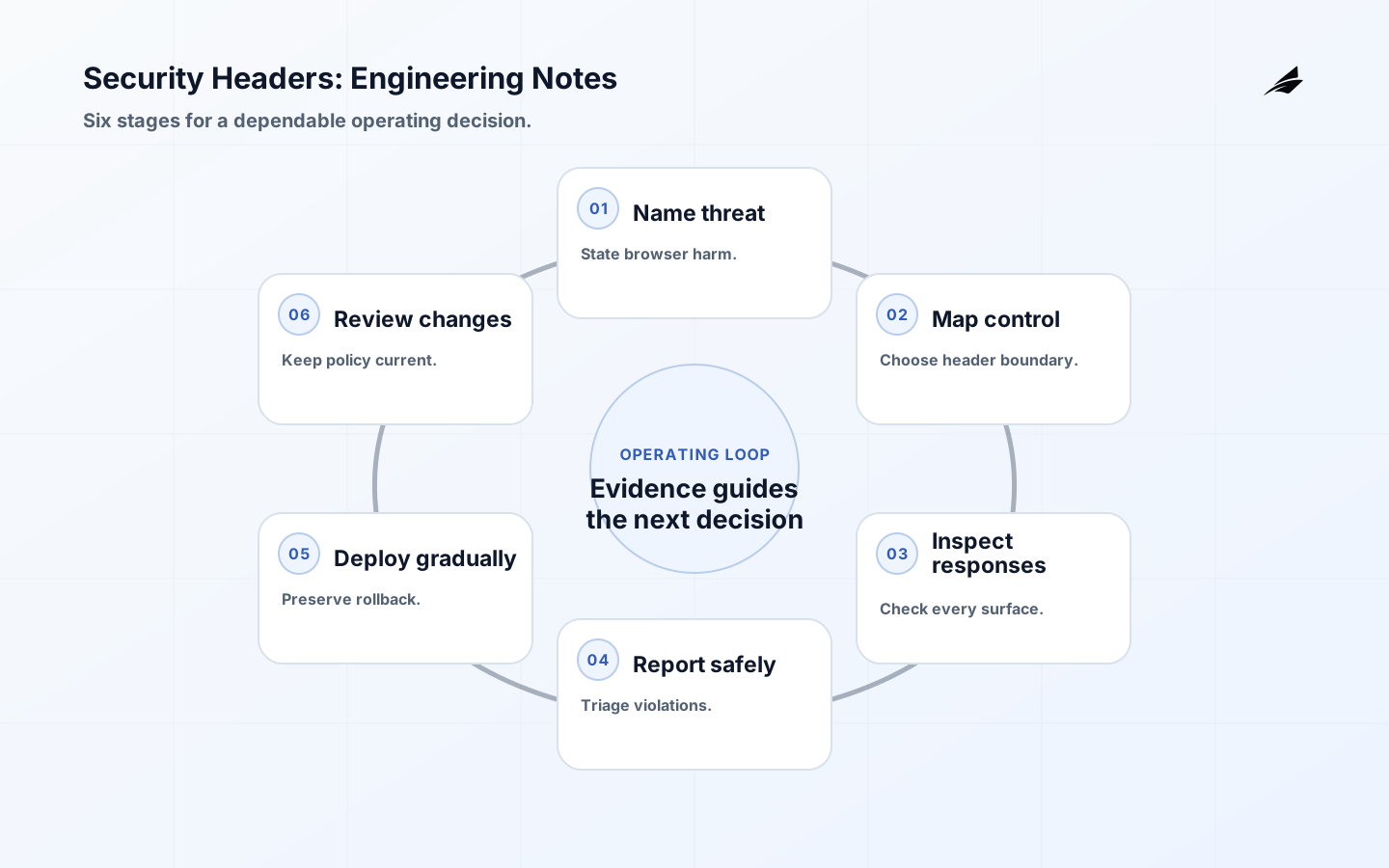
Security headers are an operating decision, not a product label or a one-time audit. The central question is which browser behavior a route may permit and which protection it requires. The systems inside that question are browser documents, APIs, downloads, redirects, static assets, and CDNs. Start with the consequence of getting the decision wrong: a copied policy breaks a journey or leaves content exposed. The goal is not to promise that failure is impossible.
The engineering baseline also includes Content Security Policy Level 3, MDN’s CSP guide, Reporting-Endpoints guidance, and web.dev’s CSP guidance. These references help separate browser capability from deployment sequencing and reporting operations.
Define the security headers decision
Write the decision in language a product owner and an operator can test: which browser behavior a route may permit and which protection it requires. For this topic, the scope includes browser documents, APIs, downloads, redirects, static assets, and CDNs. Separate policy from mechanism. That distinction prevents a configuration setting from becoming unexamined proof.
| Question | Decision | Evidence |
|---|---|---|
| Purpose | State the protected outcome for security headers. | Named owner and representative journey. |
| Authority | Separate policy, implementation, and exception approval. | Role record and change history. |
| Scope | Identify browser documents, APIs, downloads, redirects, static assets, and CDNs. | Current inventory and exclusions. |
| Expiry | Choose a review point for stale state or exceptions. | Scheduled review and closure evidence. |
Map the security headers boundary
Trace one consequential journey end to end. Include every component that can create, change, accept, copy, cache, or invalidate relevant state across browser documents, APIs, downloads, redirects, static assets, and CDNs. Follow an unhappy path in detail: a copied policy breaks a journey or leaves content exposed.
5, API Gateway service limits, Cross-Origin-Opener-Policy guidance. Those conditions need local decisions and testing. Related reading in this collection includes Vulnerability Management for Buyers and CTOs, Incident Playbooks: Hands-on Planning and Exercise Guide, Data Retention Operations: A Playbook for Deletion, Holds and Restore.
Build testable security headers controls
| Area | Implementation | Test |
|---|---|---|
| Prevention | Use route-aware CSP, framing rules, secure transport, nosniff, and deliberate caching. | Attempt an unauthorized or out-of-context action. |
| Detection | Capture the actor, action, decision, configuration version, time, and result. | Generate a representative adverse event and verify attribution. |
| Change | Version policy and maintain rollback. | Deploy a controlled change and prove reversal. |
| Recovery | Plan for a copied policy breaks a journey or leaves content exposed. | Exercise containment and restoration criteria. |
Controls should fit the path rather than accumulate around it. For security headers, a practical set is route-aware CSP, framing rules, secure transport, nosniff, and deliberate caching. Each control needs a reason, owner, release method, and expected result.
Operate security headers as a service
Operating security headers requires current inventories, named owners, exception handling, release checks, and a review cadence. Treat these as service obligations rather than project close-out artifacts.
Compare security headers choices by operating fit
Compare alternatives by how they enforce which browser behavior a route may permit and which protection it requires, how they fail, who operates them, and how evidence is retrieved. The longest feature list does not automatically produce the best control.
| Lens | Question | Proof |
|---|---|---|
| Coverage | Which security headers paths are actually controlled? | Inventory and explicit exclusions. |
| Assurance | What is independently verified? | Test evidence and review history. |
| Operability | Who responds to degradation or denial? | On-call owner and exercised runbook. |
| Change | How is behavior updated safely? | Staged release and rollback proof. |
Security headers takeaways
- Begin with the concrete decision: which browser behavior a route may permit and which protection it requires.
- Map material components across browser documents, APIs, downloads, redirects, static assets, and CDNs.
- Make a copied policy breaks a journey or leaves content exposed a rehearsed failure case.
- Use controls suited to the path: route-aware CSP, framing rules, secure transport, nosniff, and deliberate caching.
- Preserve decision evidence with policy context.
- Review exceptions, changes, and recurring signals.
Frequently asked questions about security headers
What should a team do first with security headers? Is a tool enough for security headers? When should security headers be reviewed?
Implementation notes for security headers
Implementation becomes credible when security headers are exercised against an actual operating path rather than a diagram alone. Use a representative request, release, record, or response and identify the exact point at which the organization decides The central question is which browser behavior a route may permit and which protection it requires The review should include normal activity and a change that removes trust: a role change, credential reset, dependency failure, configuration rollback, data hold, or suspicious signal. The practical outcome is a security headers practice that supports real work while producing enough evidence to explain a difficult decision months later.
Header rollout also needs a compatibility ledger. List every browser-facing dependency, the response directive it relies on, the route classes it touches, and the team that can remove or replace it. A report-only phase is useful only when reports enter a queue with a release owner and a decision date. Group violations by root cause rather than approving each URL as it appears; one outdated bundle can create thousands of reports. For cross-origin isolation, verify both the opener and embedded-resource relationships, including error responses and redirects. For transport policy, confirm certificate coverage, hostname redirects, and recovery behavior before increasing duration or scope. Keep a known-good header set beside the proposed set and test both from the public edge and the application origin. This ledger gives product teams a practical way to weigh browser compatibility against the harm the control is intended to prevent. It also gives responders an accountable path when a vendor, script bundle, or proxy change creates a new violation.
Do not let a report volume dashboard become the policy owner. Assign each violation class to a team that can inspect the route, release, dependency, and intended browser behavior. A small regression suite should cover the response on success, redirect, error, cached, and authenticated paths. Review the suite when a vendor or bundle changes, and retain the prior policy long enough to compare impact. This makes rollout evidence useful to product and platform teams, not just to the person who edited the header configuration.
Conclusion: make security headers evidence-led
A strong security headers practice makes the decision, boundary, controls, and evidence legible.
Understand what each header can and cannot enforce
A response header changes browser behavior for the response or future requests; it does not grant a user permission to read a database row. CSP constrains resource loading, HSTS upgrades future browser requests after a secure response, and X-Content-Type-Options prevents MIME sniffing. Framing controls address whether a page can be embedded, while Permissions-Policy scopes browser features. Keep these boundaries explicit so teams do not claim that a header fixes an authorization defect. MDN’s header reference is useful precisely because it distinguishes response semantics, browser support, and directives. Write the intended threat and the expected observable effect beside each configured header.
| Decision | Practical test | Evidence |
|---|---|---|
| Boundary | Name the protected resource and owner | Scope record |
| Failure | Rehearse denial, retry, and recovery | Observed result |
| Change | Version the policy and expiry | Review decision |
Use browser reports as change evidence
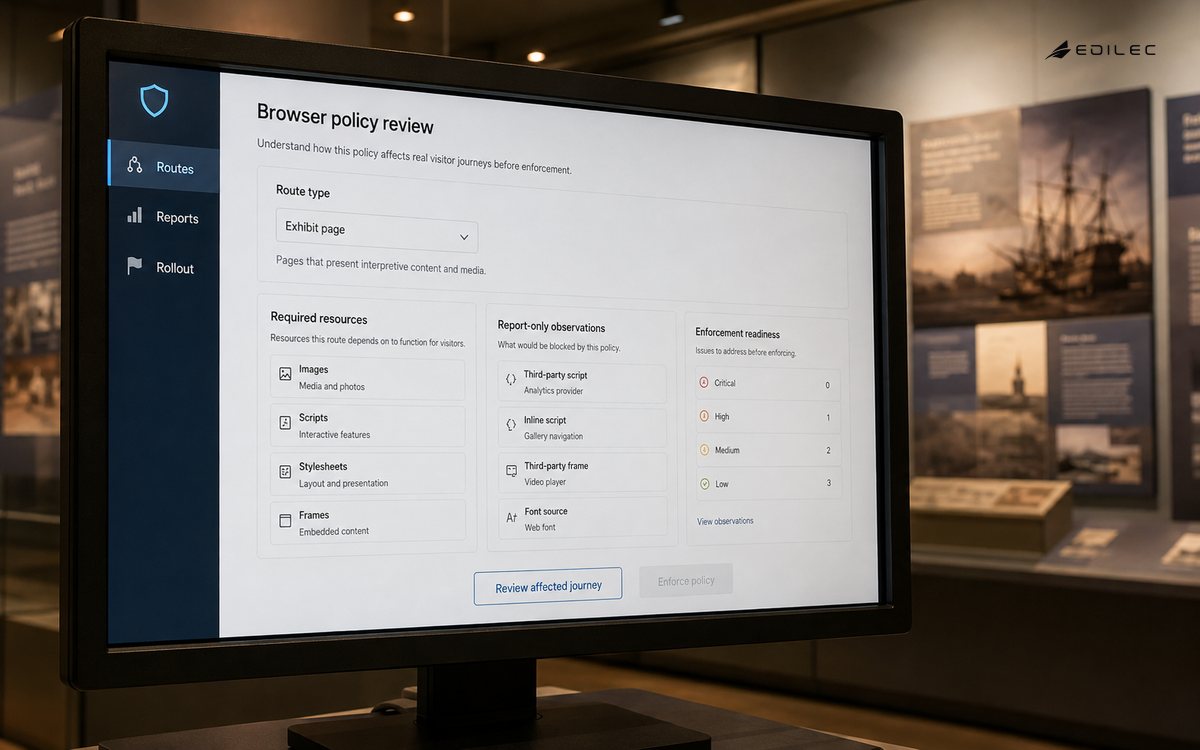
Report-Only CSP can reveal dependencies before enforcement, but reports need triage. Group them by policy version, route, user agent, and source rather than counting every violation equally. A report from a deprecated page is different from a blocked payment script. Protect the reporting endpoint from volume abuse and avoid retaining unnecessary sensitive data. For an infrastructure change, capture a before-and-after sample of headers on HTML, API, redirect, error, and asset responses. This catches a common failure: the application emits the right policy while a CDN, redirect, or alternate hostname omits it.
Make deployment order part of the security design
Verify certificate coverage and HTTPS redirects before increasing HSTS scope. Verify that every required script and connection is represented before enforcing CSP. Validate framing and feature policies against embedded partners and authenticated flows. Roll out in a canary, watch browser errors and support feedback, then widen deliberately. Keep a known-good policy and a documented rollback condition. If a policy must be relaxed, record the narrower alternative, owner, and expiry rather than adding a permanent wildcard. Browser controls are operational controls: their value depends on current inventory, observability, and a team able to respond when the contract changes.
Review the policy as application architecture changes
New analytics, payment, chat, identity, or document vendors can widen the browser trust boundary. At each dependency change, ask whether the resource can be self-hosted, whether it needs a nonce or hash, whether it should run on every page, and whether the policy needs a report. Remove old sources and subdomains. Recheck browser support for Permissions-Policy directives before treating absence as protection. The engineering record should contain the policy, the domains in scope, sampled response evidence, open exceptions, and the date for the next review. That record makes headers maintainable instead of a mysterious block of server configuration.
Key takeaways
- Define the boundary and the owner before choosing implementation details.
- Test denial, delay, duplication, and recovery as first-class paths.
- Measure the customer or operator outcome, not only the control signal.
- Keep exceptions narrow, time-bound, and easy to investigate.
- Review the policy when dependencies, traffic, or business rules change.
Frequently asked questions
Can a security header replace authorization? No; browser policy and server-side access control address different boundaries. How should reports be used? Group violations by route, release, and dependency, then fix or remove the narrowest source. What makes rollout safe? Verified transport coverage, tested dependencies, a canary, and a known-good policy for rollback.
Conclusion
Security Headers: Engineering Notes becomes dependable when the rule is understandable, the failure path is rehearsed, and the evidence survives a busy day.
For adjacent decisions, compare Product teams and security headers, Production API rate limiting, Production security headers.