API rate limiting changes in production because it must withstand ordinary operations, staff changes, dependency failures, and deliberate misuse. The goal is not to collect a control label; it is to make decisions about credential stuffing, brute-force attempts, expensive queries, bulk extraction, and noisy tenants exhausting shared capacity explicit and repeatable. API Gateway throttling guide provides an authoritative baseline, while the local design must specify ownership, implementation boundaries, testing, and review.
Production capacity decisions benefit from Cloudflare rate limiting best practices, API Gateway service limits, and Google API quota design. These references make provider ceilings, workload cost, and client-facing budgets concrete before a rollout reaches real traffic.
Choose the capacity that must remain available
For API rate limiting, the relevant facts include authenticated principal, tenant, endpoint cost, request size, burst history, and retry horizon. Those paths often carry the same authority but receive less scrutiny.
OWASP Top 10: Broken Access Control and GitHub REST API rate-limit documentation support explicit, protected access decisions; the organization still has to choose its risk boundary. Capture those examples before writing configuration or code.
| Design decision | Question to settle | Release evidence |
|---|---|---|
| Scope | Which credential stuffing need protection first? | Named resource, action, and accountable owner |
| Trusted facts | Where do authenticated principal and tenant originate? | Issuer, freshness, and failure behavior |
| Enforcement | Which component can actually stop the operation? | Server-side decision and negative test |
| Exception | When may normal control be narrowed temporarily? | Approver, expiry, and post-use review |
Set budgets around cost and fairness
Design API rate limiting so that the component closest to the protected action can reject an unsafe request. AWS Well-Architected service limits is useful for the operating principle: make the decision observable and avoid implicit trust.
- Inventory credential stuffing, brute-force attempts, expensive queries, bulk extraction, and noisy tenants exhausting shared capacity before choosing a product setting or default policy.
- Keep the final API rate limiting decision on the server or service that owns the sensitive operation.
Canary with representative clients
The result should be an evidence set that tells an operator whether API rate limiting is protecting the real action rather than merely returning an attractive status.
| Test | Unsafe outcome prevented | Signal to monitor |
|---|---|---|
| Unauthorized request | A hidden or alternate path bypasses the control | Denied operations by action and caller |
| Boundary mismatch | A valid identity reaches the wrong resource | Cross-scope denials and investigation result |
| Dependency failure | Missing decision facts silently become allow | Failure mode, retry, and escalation volume |
| Change or revocation | Old state remains powerful after an update | Propagation time and stale decision count |
Protect recovery without hidden bypasses
Production health comes from review, not from a launch checklist. Monitor 429 responses by principal, queue depth, endpoint cost changes, bypasses, and tenant concentration, then distinguish attack signals from workflow defects.
Set budgets from service cost
Rate limits should reflect the cost a request imposes, not only the number of HTTP calls. A search endpoint that fans out to several systems, an export that reads thousands of rows, and a password-reset endpoint have different failure modes. Measure safe concurrency, fan-out, payload size, and downstream dependency limits before selecting a fixed number. Then separate a short burst allowance from a sustained budget so normal interactive use is not mistaken for abuse. Apply an additional constraint to expensive query shapes and pagination. A single generous per-key limit can still allow a tenant or attacker to exhaust a shared database if the key is easy to create or the request cost varies widely.
- Rate-limit authentication and recovery attempts separately from ordinary application traffic.
- Set tenant and global ceilings as well as per-principal limits for shared services.
- Return consistent retry information without disclosing sensitive account state.
- Load-test limits with downstream dependencies enabled, not with a stubbed cheap handler.
Use outcome data to retune limits
Create a regular evidence review for API rate limiting with the service owner, operational lead, and security reviewer.
Key takeaways
- API rate limiting should protect a named business action, not an abstract compliance category.
- Enforcement belongs at the protected service, including APIs and background paths.
- Exceptions need a narrow scope, owner, expiry, and review trail.
Frequently asked questions
Where should a team start? Choose one workflow involving credential stuffing and document its action, owner, inputs, outcome, and evidence. How much logging is enough? When is an exception acceptable?
Production rate limiting should be reviewed as a capacity allocation decision. Separate ordinary demand from bursts, retries, batch work, health checks, and operator recovery, then assign each class a budget that matches its consequence. A canary should include clients with different connection behavior, tenant sizes, authentication states, and downstream call patterns. Compare the observed result with a baseline that includes latency, rejected work, queue age, saturation, support contacts, and successful completion. If a limit protects the edge but starves a legitimate workflow, the remedy may be a cost model or queue design rather than a higher ceiling. If a bypass is necessary during an incident, record the exact cohort, expiry, approver, and evidence that normal enforcement returned. Review the oldest exceptions after the canary, not only aggregate rates. This keeps production policy tied to a customer promise and gives the service owner enough detail to decide whether to expand, pause, or redesign the control.
The production owner should define a stop condition before the first canary. Examples include a rise in failed checkout, authentication completion, queue age, downstream saturation, or support contacts beyond the reviewed baseline. Segment results by tenant size and client behavior so a healthy aggregate does not hide a blocked customer group. After the canary, record the decision, unresolved exceptions, and the next review date. A rate-limit policy is ready to expand only when the service can explain both legitimate rejection and safe recovery.
Keep the canary decision reversible at the policy boundary. If clients retry aggressively, protect the queue and downstream service before raising a ceiling. If legitimate work is blocked, identify the exact budget and workflow instead of granting a broad bypass. The evidence should show who changed the rule, which cohort was affected, and when normal enforcement returned.
Conclusion
API rate limiting becomes dependable when teams can explain the protected work, the facts that influence a decision, the component that enforces it, and the evidence available after failure.
Production rate limiting changes the question from “does it work?” to “who gets capacity?”
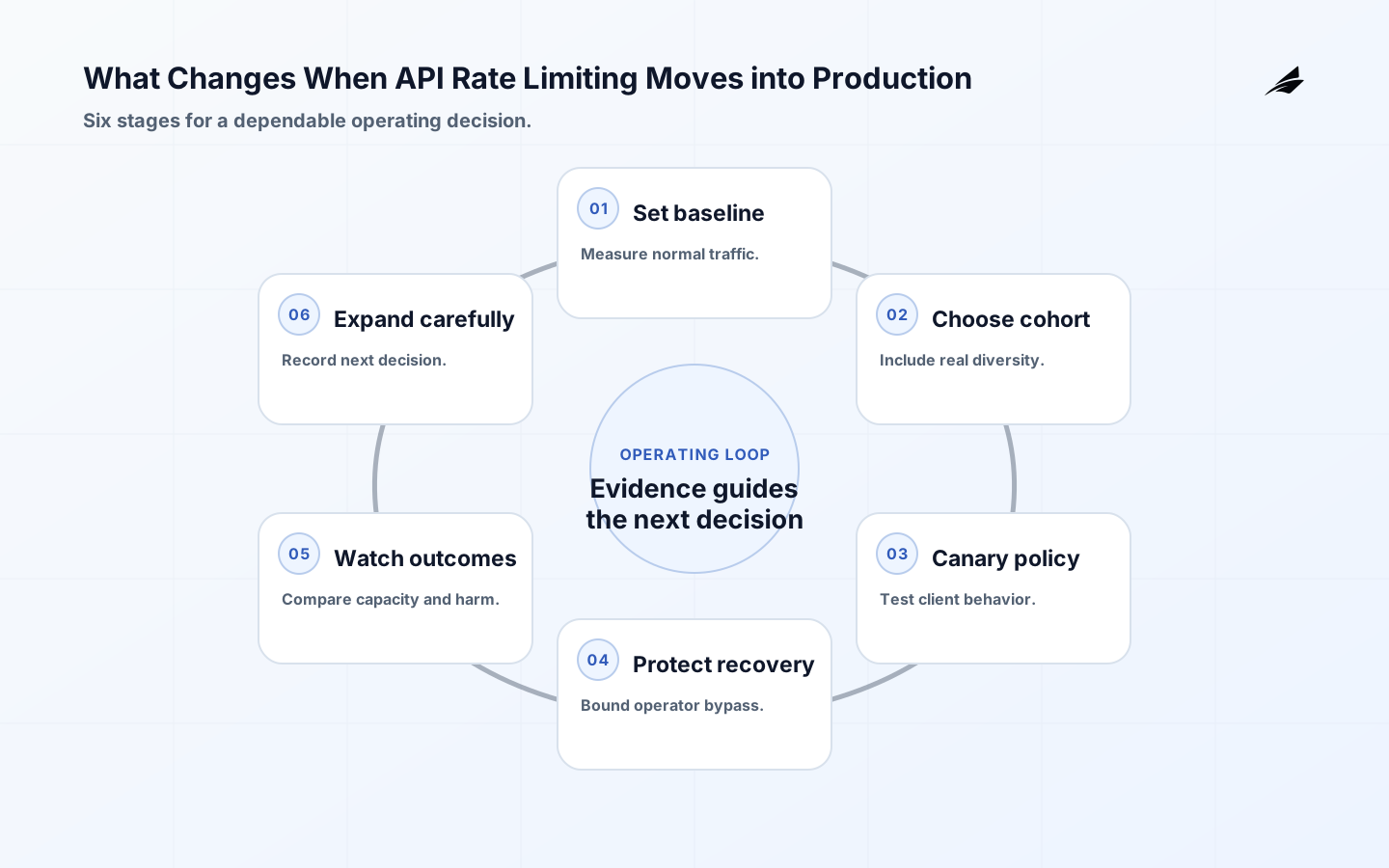
A local test with one client can prove that a counter increments, but production adds tenants, retries, gateways, background jobs, vendor quotas, and support pressure. Set a baseline for normal traffic by route and tenant before tightening limits. Identify the first scarce resource for each expensive path and the customer-visible outcome when it is exhausted. Use separate budgets for interactive requests, batch work, and operational recovery where their priorities differ. OWASP recommends combining request limits with bounds on payloads, pages, memory, and execution time; a production plan that controls only request count is incomplete.

| Decision | Practical test | Evidence |
|---|---|---|
| Boundary | Name the protected resource and owner | Scope record |
| Failure | Rehearse denial, retry, and recovery | Observed result |
| Change | Version the policy and expiry | Review decision |
Canary with real client diversity and real failures
Choose a cohort that includes different plans, regions, SDK versions, and traffic shapes. Replay representative bursts, slow downstream responses, duplicate submissions, and retries after a 429. Verify Retry-After and error bodies in every client library, not only through a curl example. Watch rejection rate, latency, queue age, successful completion, and support contacts. If the limiter is backed by a shared store, test a partial outage and rolling deployment. A canary is successful when the team can explain both admitted and rejected work and knows which threshold would pause expansion.
Protect recovery and avoid an invisible bypass
Incidents often create the temptation to disable limits globally. Define a narrow operator path with strong authentication, audit logging, and an expiry instead. Keep health checks and critical callbacks on a reserved budget, but measure them so the reservation cannot become an unbounded channel. If the limiter fails, follow the documented mode: conservative local protection, bounded queue, or denial of an expensive operation. Record the change and return to the normal policy after the dependency is healthy. The rollback plan should protect the service and preserve enough evidence to explain what happened to affected tenants.
Review the policy from outcome data
After rollout, compare the production baseline with the design assumptions. A high rejection rate may mean abuse, a new client bug, or a legitimate workload that was not modeled. Examine the noisiest tenant and the most frequently rejected route, then inspect a sample of successful requests to see whether the limit is protecting the intended resource. Review quota increases as policy changes, not support-only exceptions. Keep a decision record with owner, policy version, measured effect, unresolved risk, and next review date. That record helps the next release build on evidence instead of resetting the conversation.
Key takeaways
- Define the boundary and the owner before choosing implementation details.
- Test denial, delay, duplication, and recovery as first-class paths.
- Measure the customer or operator outcome, not only the control signal.
- Keep exceptions narrow, time-bound, and easy to investigate.
- Review the policy when dependencies, traffic, or business rules change.
Frequently asked questions
What changes when rate limiting reaches production? Capacity must be allocated across tenants, clients, retries, jobs, and recovery traffic. What belongs in a canary? Real SDKs, burst shapes, slow dependencies, duplicate submissions, and a limiter-store failure. When should rollout pause? When rejection, latency, queue age, or support impact contradicts the reviewed baseline.
Conclusion
What Changes When API Rate Limiting Moves into Production becomes dependable when the rule is understandable, the failure path is rehearsed, and the evidence survives a busy day.
For adjacent decisions, compare Production security headers, Billing workflows, RBAC for growing teams.