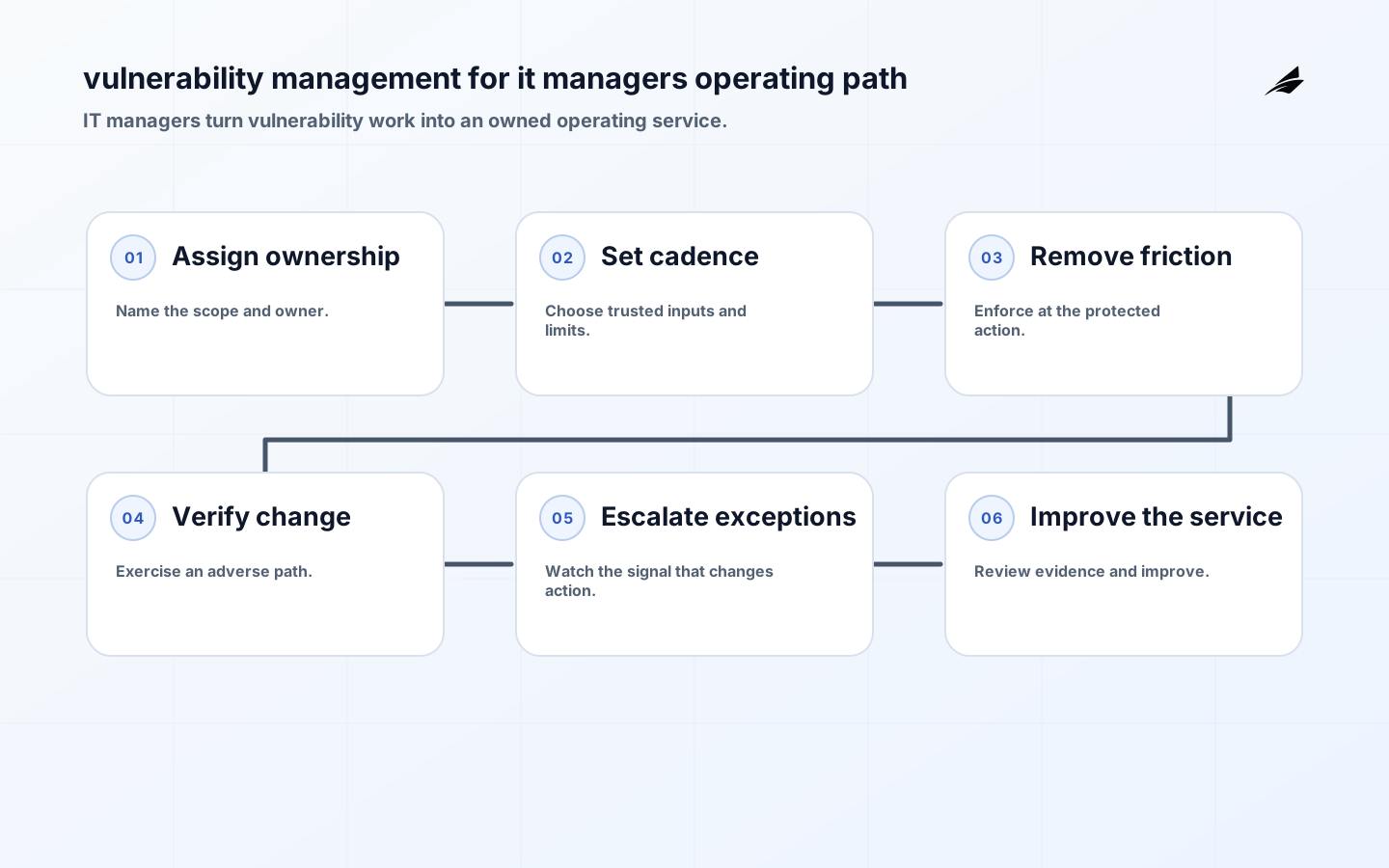
Vulnerability management is the continuing practice of finding weaknesses, deciding which ones matter in a particular environment, reducing exposure, and proving the result. An IT manager needs more than a scanner dashboard. Asset discovery, patch capability, compensating controls, business ownership, and verification all determine whether a reported issue becomes a managed risk. The important question is not whether the organization has a list of CVEs; it is whether it can identify an exposed, high-consequence system and move it to a safer state within an agreed window.
Set the vulnerability management scope — IT-manager vulnerability management
Establish a trustworthy asset picture before debating severity scores. Include endpoints, servers, cloud accounts, containers, network appliances, internet-facing applications, and software that may be present through images or dependencies. Then combine vulnerability intelligence with exposure, exploitability, privilege, business criticality, and available mitigation. A critical score on an isolated test image is different from a remotely reachable flaw on an identity service. CISA performance goals are useful as a baseline, while local risk decisions must still be explicit.
| Decision area | Question to answer | Accountable evidence |
|---|---|---|
| Input | Question | Owner |
| Asset inventory | Is the system in scope and reachable? | Service owner |
| Scanner result | What condition was observed? | Security operations |
| Business context | What happens if this system is compromised? | Product or IT owner |
Fit vulnerability work to operator reality — IT-manager vulnerability management
Define remediation classes that the service owners can act on: emergency containment, accelerated patch, scheduled patch, accepted exception, or false positive. Each class should have a target response, an accountable owner, and a verification method. Do not make a scanner the source of truth for every condition; reconcile its output with configuration management, cloud inventory, and application owners. When patching is unsafe, document a compensating control such as network restriction, disabled feature, workload isolation, or enhanced monitoring, along with an expiry date.
Test queues, dependencies, and escalation — IT-manager vulnerability management
Start with a small set of high-value assets and run the full workflow end to end. Validate credentialed scanning or equivalent coverage, test the patch in a representative environment, deploy it through change control, then rescan or use version evidence to confirm remediation. During an active exploit campaign, the first action may be exposure reduction rather than perfect patch deployment. An effective runbook makes that distinction clear and identifies who can decide on service interruption.
| Scenario | Expected response | Review evidence |
|---|---|---|
| Disposition | When to use | Proof of completion |
| Emergency containment | Active or likely exploitation | Exposure removed or access blocked |
| Accelerated patch | High-consequence reachable weakness | Version or rescan evidence |
| Time-bound exception | Patch cannot safely proceed | Compensating control and expiry |
Assign service ownership and cadence — IT-manager vulnerability management
Avoid sending owners an undifferentiated queue. Provide a concise view of why their asset is prioritized, what action is expected, the deadline, and where to record a justified exception. Connect the process with incident playbooks for suspected exploitation and security headers when browser-side mitigations can reduce exposure while a permanent repair is prepared.
Use authoritative guidance with local evidence — IT-manager vulnerability management
Use primary guidance to anchor technical choices: NIST Cybersecurity Framework 2.0 describes a governance-oriented risk framework; CISA Cybersecurity Performance Goals supplies practical baseline outcomes; the OWASP Cheat Sheet Series offers implementation-oriented guidance; and RFC 9700 records current OAuth security practice. These references inform the controls here, but the accountable owner must still apply them to vulnerability management in the organization’s actual architecture and threat model for this IT-manager review.
Measure exposure reduction and recovery — IT-manager vulnerability management
Measure coverage of in-scope assets, age of vulnerabilities by risk class, percentage verified after remediation, exception age, and time from credible exploitation notice to containment. Median closure time can hide a long tail of neglected systems, so review the oldest and most exposed items separately. Metrics should help leaders remove blockers such as unsupported software, missing maintenance windows, or unclear ownership.
Address architecture and dependency tradeoffs — IT-manager vulnerability management
Exposure assessment should include what sits in front of a vulnerable component. A vulnerable service behind a strong authentication boundary, network restriction, and monitoring may warrant a different immediate response than the same service directly exposed to the internet. That is not a reason to ignore the finding. It is a reason to state the compensating controls and their confidence level while a permanent repair is scheduled. If an assumed boundary cannot be verified, treat it as weaker than the spreadsheet suggests.
Patch governance works best when service owners can plan around it. Publish maintenance expectations, dependency windows, rollback methods, and who can approve an emergency change. For managed services, collect the provider evidence that a fix is deployed and identify customer configuration that remains vulnerable. For end-user devices, combine technical deployment success with signals that devices are checking in and receiving updates. A patch marked complete in a ticket but absent from an exposed system is not a completed remediation.
Review change without losing the operating model — IT-manager vulnerability management
An exception register should make risk visible rather than normalize delay. Include the affected asset, vulnerability condition, business reason, compensating control, owner, approval, expiry, and the next review date. Escalate expired exceptions and revisit them when an exploit becomes public or the asset’s role changes. This gives leadership a clear decision trail and encourages teams to remove root causes such as unsupported operating systems, unmanaged cloud accounts, or applications without a practical maintenance path.
Turn the design into durable governance — IT-manager vulnerability management
A mature program distinguishes technical severity from remediation urgency without denying either. An exploit may be highly severe but not reachable in the deployed configuration; another issue may have a lower published score but affect a public administrative portal with weak compensating controls. Record the reasoning in a form that can be challenged later, including what evidence established reachability and what condition would change the priority. Threat intelligence can accelerate a decision, but it should not replace asset knowledge or become an unverified feed that drives disruptive changes. Coordinate with change managers so planned maintenance, emergency windows, and rollback decisions are available before an advisory lands. When a fix fails, retain the failed-attempt evidence and escalate the operational blocker rather than repeatedly closing and reopening the same ticket. Over time, remediation patterns reveal investment needs: end-of-life platforms, services without owners, incomplete asset discovery, or environments that cannot be patched safely. Those are management problems worth solving, not just unpleasant exceptions on a security dashboard.
Run a practical review — IT-manager vulnerability management
Use the weekly risk review to look at a small sample of overdue items in detail. Confirm that the asset is real, the owner is current, the exposure assessment is still accurate, and the exception or patch plan has evidence. This prevents the program from being governed by ticket status alone. When the same blocker appears repeatedly, assign a remediation project for the underlying lifecycle gap instead of accepting the same explanation across every patch cycle.
Keep verification close to the work — IT-manager vulnerability management
Communicate priority changes clearly. When new evidence moves a finding from scheduled work to urgent containment, explain the exposure and expected action in the owner’s terms. Timely, specific context produces better operational decisions than forwarding a raw advisory or a high severity label without a path to act.
Report unresolved exposure in business terms as well as technical terms. Leaders can remove a maintenance-window or funding blocker only when they understand what service and customer consequence the delay creates.
Make remediation verification independent where risk warrants it. A second scan, configuration query, or owner confirmation can catch a failed deployment before the item is removed from the queue.
Vulnerability Management for IT Managers: make the decision record useful — IT-manager vulnerability management
A concrete decision example — IT-manager vulnerability management
For an IT manager, make one vulnerability decision reviewable: name the asset, exposed condition, trusted severity signal, failure state, owner, and evidence that proves risk was reduced. Keep the case small enough to verify in tooling and specific enough to guide support when remediation stalls In the IT-manager vulnerability management workflow, the owner records that result.
IT managers turn security findings into feasible work by making ownership, safe change, deadlines, exceptions, and verification explicit. Start with an asset register that answers who can authorize a patch or containment action and whether the asset is exposed.
Review movement rather than ticket counts: new high-risk findings, overdue work, expiring exceptions, reopens, and orphaned assets. Repeated findings usually indicate drift in images, dependencies, inventory, or deployment. Remove that source instead of repeatedly closing the symptom.
| Decision point | Minimum record | Proof |
|---|---|---|
| Scope | Protected action and owner | Named boundary |
| Failure | Safe fallback and escalation | Adverse-path test |
| Change | Review trigger and expiry | Versioned evidence |
| Outcome | Signal and next action | Owner review |
Make the review meeting useful to the teams doing the work. Bring a short list of findings that need a decision, not a dump of every scanner result. For each item, ask whether the owner needs access, a maintenance window, a test environment, a vendor response, or a risk acceptance. Track the request and its due date. Managers should also protect time for verification, because an engineer who is measured only on deployment speed may skip the rescan or focused test that proves the exposure changed. Over several cycles, recurring blockers become management work: improve the base image, retire an unsupported service, repair inventory ownership, or change the release process so security maintenance is routine.
Key takeaways
- Define vulnerability management around a real high-consequence workflow, not a generic tool setting.
- Give every exception an owner, compensating control, and expiry date.
- Test the denial, change, recovery, and evidence paths before calling the control complete In the IT-manager vulnerability management workflow, the owner records that result.
- Use measurement to remove operational blockers and revise the control deliberately.
Frequently asked questions
For implementation context, consult NIST systems security engineering guidance, NICE workforce guidance, Google Cloud’s security framework, and NIST IoT cybersecurity guidance. Use them to set ownership, cadence, escalation, verification, and service-improvement measures.
Should teams patch every finding immediately? No. They should rapidly contain serious exposure and use risk, asset context, and operational safety to set the repair sequence. Is CVSS enough to prioritize? No. It is an input, not a replacement for exposure and business context. How are false positives handled? Record evidence, preserve the decision, and revisit it after tool or asset changes.
Conclusion
Vulnerability management earns trust when it turns technical findings into accountable decisions and verified outcomes. Build reliable coverage, prioritize with context, and make exceptions temporary. A smaller queue with clear action is safer than a large dashboard nobody can operate.
For adjacent implementation context, see related Edilec guide 1, related Edilec guide 2, related Edilec guide 3 In the IT-manager vulnerability management workflow, the owner records that result.
The operating model should make it easy to ask for help without hiding the risk. An owner who cannot patch safely needs a route to platform, security, vendor, or leadership support, along with a documented interim control. Managers can then distinguish a technical blocker from an unwillingness to act. Review the oldest exceptions and the most frequently reopened findings first. Those cases reveal where the organization needs better images, ownership, deployment automation, or service retirement rather than another dashboard.