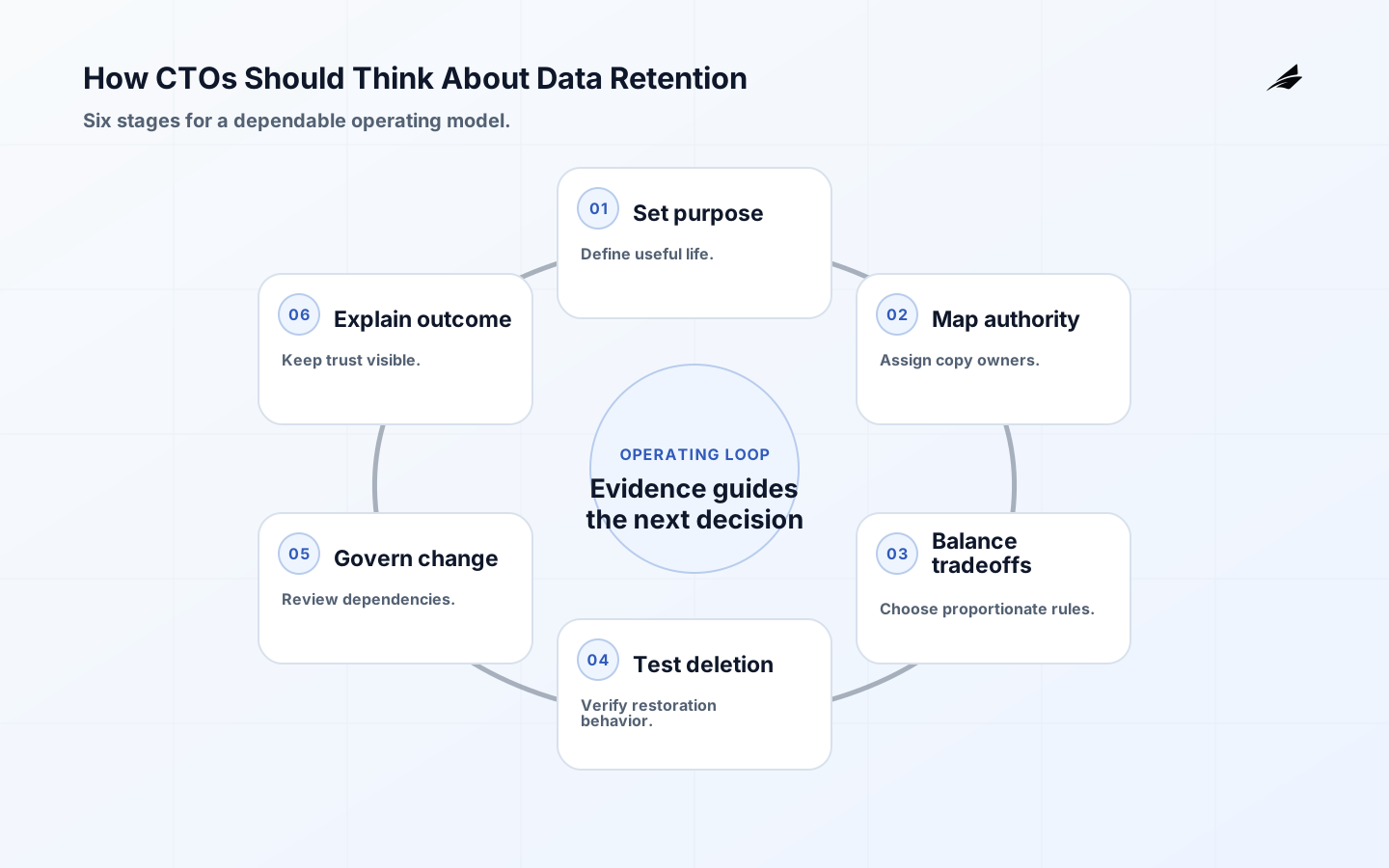
Data retention is the set of rules and technical capabilities that decide how long information is kept, when it becomes restricted or archived, and how it is deleted or anonymized. CTOs should treat it as a system-design concern rather than a line in a policy. Event logs, backups, analytics warehouses, customer records, support tools, and vendor platforms can each preserve a different copy. Keeping data indefinitely expands breach impact and operational cost; deleting it too soon can defeat legal obligations, investigations, customer commitments, or product reliability work.
Set the data retention scope

Start with purpose, data class, and system of record. Ask why the organization collects each class, who uses it, what obligation or business need supports its retention, and what happens at the end of the period. Do not assume one company-wide number is sensible. Security logs may need a different period from payment records, account deletion requests, and transient telemetry. NIST’s framework emphasizes governance and asset understanding; applied here, that means retention decisions need named owners and an inventory that reaches beyond the primary application database.
| Decision area | Question to answer | Accountable evidence |
|---|---|---|
| Data class | Retention question | Typical owner |
| Authentication events | How long supports detection and investigation? | Security operations |
| Customer account data | What purpose remains after account closure? | Product and privacy owner |
| Backups | When does expiry make deleted data unrecoverable? | Infrastructure owner |
Design controls that fit the workflow — retention strategy
Translate the schedule into data lifecycle states: active, restricted, archived, deleted, or de-identified. Build system behavior for those states instead of relying on manual cleanup. A deletion request may need to propagate through primary storage, search indexes, derived datasets, queues, and processor systems, while backups follow a separate expiry cycle. Be candid about those differences in internal procedures and customer-facing commitments. For immutable audit evidence, restrict access and define expiration rather than pretending it can be erased on demand.
Build and test the failure paths — retention strategy
Choose one high-value data class and trace it from collection through derived stores and backup restoration. Implement retention jobs with idempotent behavior, completion logs, alerting for failed deletions, and a way to prevent a deleted record from being recreated by an old integration. Test restore procedures: a backup process that reintroduces expired data is a lifecycle defect. Product and legal owners should approve both the schedule and any exception, especially where a hold pauses routine deletion.
| Scenario | Expected response | Review evidence |
|---|---|---|
| Lifecycle state | Technical behavior | Evidence |
| Active | Available to approved product workflows | Access and classification record |
| Archived | Restricted, lower-cost storage | Archive location and access policy |
| Deleted | Removed from live systems and queued copies | Job completion and exception log |
Make operations accountable — retention strategy
Create a lightweight retention register that lists data category, purpose, systems, owner, retention rule, deletion mechanism, and review date. Connect it to data retention implementation guidance and session security because identity and session logs often include high-value, time-sensitive records. Vendor contracts and configuration must be checked separately; a local delete job cannot erase copies held by a processor with an independent schedule.
Use authoritative guidance with local evidence — retention strategy
Use primary guidance to anchor technical choices: NIST Cybersecurity Framework 2.0 describes a governance-oriented risk framework; CISA Cybersecurity Performance Goals supplies practical baseline outcomes; the OWASP Logging Cheat Sheet offers implementation-oriented guidance; and RFC 9700 records current OAuth security practice. These references inform the controls here, but the accountable owner must still apply them to data retention in the organization’s actual architecture and threat model.
Measure the operating outcome — retention strategy
Track coverage of classified systems, success and failure rate of lifecycle jobs, age of data beyond its approved period, exceptions nearing expiry, and time to satisfy approved deletion requests. Avoid a vanity metric such as total terabytes removed without knowing whether the right records were removed. The useful evidence is that a data owner can explain the rule, an engineer can show the mechanism, and an auditor can trace a result.
Address architecture and dependency tradeoffs — retention strategy
Designing deletion requires an honest data map. A record can be copied into event streams, caches, object storage, customer-support exports, analytics transformations, and partner systems. Some copies may be necessary for resilience or fraud investigation, but each one should have a documented purpose and lifecycle. Classify derived data as carefully as source data; a hashed identifier, usage trace, or free-text ticket can still be personal or sensitive in context. The map should show both data flow and the owner able to change each storage rule.
Legal holds and investigations require a controlled pause, not an informal request to stop a scheduled job. Identify who may place a hold, which records and systems it covers, how access is restricted, how the hold is reviewed, and how normal deletion resumes. A hold should not silently become indefinite retention. Likewise, an incident may justify temporarily preserving logs, but the decision, scope, and end date need evidence. These controls protect the organization from both premature deletion and unnecessary accumulation.
Review change without losing the operating model — retention strategy
Retention decisions should be surfaced in product design. A user who closes an account, an administrator who exports a report, and a customer who configures audit logging may have different expectations about availability and deletion. Build interfaces and support procedures that state the actual lifecycle without making claims the infrastructure cannot meet. When a retention change affects analytics or debugging, give teams a replacement measurement path instead of encouraging undeclared copies outside the managed lifecycle.
Turn the design into durable governance — retention strategy
Storage architecture should make it possible to demonstrate lifecycle behavior without exposing the records themselves. Retention jobs can emit counts, category identifiers, policy version, execution time, and failure reasons while keeping sensitive content out of routine logs. Encryption keys and access controls require their own lifecycle review: destroying a key may render a dataset inaccessible, but it is not a substitute for deletion when copies remain available elsewhere. Conversely, deleting an application record while retaining a linked search index or diagnostic export is incomplete. Treat each mechanism as evidence to reconcile. Cost optimization can be a valid reason to archive or delete, but it should not quietly redefine the approved purpose of data. When analytics teams need longer-lived trends, consider aggregation or de-identification designed for the use case and test whether reidentification remains possible through joins. A retention program works when product, privacy, security, finance, and infrastructure can all read the same schedule and see how it is enforced in the systems they operate.
Run a practical review — retention strategy
A practical audit asks for one record that should be gone and follows it through the documented lifecycle. Check the primary store, search system, derived dataset, vendor application, and the most recent backup restoration process according to the stated policy. Differences should be recorded as engineering work, not explained away as an edge case. This end-to-end test grounds a retention schedule in observable behavior and exposes copies that a system inventory has missed.
Keep verification close to the work — retention strategy
Version retention rules like other production behavior. A change in purpose, law, vendor capability, or product feature should create a reviewed schedule change with a rollout and evidence plan. That history helps the organization explain why a record existed at a particular time and prevents silent configuration drift.
Review retention evidence with the owner who understands the data purpose, not only the storage operator. Technical completion and policy intent must agree for a lifecycle control to be meaningful.
Leadership decisions should be checked against NIST SP 800-188, the ICO data-protection principles, the UK data-protection guidance, and the EDPB SME resources. Connect that governance view to the retention cybersecurity guide, session-security leadership guide, and retention operations playbook.
Key takeaways
- Define data retention around a real high-consequence workflow, not a generic tool setting.
- Give every exception an owner, compensating control, and expiry date.
- Test the denial, change, recovery, and evidence paths before calling the control complete.
- Use measurement to remove operational blockers and revise the control deliberately.
Frequently asked questions
Is retention only a privacy issue? No. It affects breach exposure, incident investigation, product operations, contracts, and cost. Can backups be ignored? No. They may have a different feasible deletion timeline, but that timeline must be designed and documented. What is a reasonable first project? Map one sensitive record type across its production, analytics, and backup paths, then automate a defensible lifecycle.
Conclusion
Data retention is credible when policy, product behavior, and infrastructure agree on what happens over time. Classify by purpose, automate lifecycle states, and test deletion through restore and integration paths. That reduces unnecessary exposure while preserving the records the organization truly needs.
Leadership checks before retention expansion
Treat retention as architecture, cost, privacy, incident response, and trust. Make purpose, copy ownership, hold semantics, deletion, restoration, and vendor commitments explicit, then review the trade-offs when the business or system changes. Record the decision with its owner, acceptance evidence, exception rule, and review date so another team can operate it without private context.
| Decision | Evidence before release | Review signal |
|---|---|---|
| Scope and owner | Named boundary, accountable role, and expected outcome | Unowned or ambiguous work |
| Failure path | Rehearsed fallback, retry, and escalation | Aged or repeated exceptions |
| Change control | Versioned policy and rollback condition | Unexpected outcome after change |
| Recovery | Test result and correction authority | Time to restore and unresolved impact |
Pair the leadership view with the data retention checklist and the data retention operations playbook. This makes it easier to move from a strategic trade-off to a queue, test, and owner.
The leadership test is simple: ask a team to explain what happens to one record after its purpose ends, including replicas, logs, backups, vendors, legal holds, and a restore. If the answer requires several undocumented assumptions, the organization has a governance gap even if its policy is well written. Fund the missing ownership and evidence as product reliability work; retention is part of the system’s promise, not an afterthought owned only by legal.
Frequently asked questions
What should be decided first? Balance purpose, exposure, cost, and recovery for one high-value data class. Which failure deserves an early rehearsal? A restore that reintroduces data or a hold that never expires. What proves the strategy is useful? A team can follow one record through every copy and decision.