A Field Guide to Zero Trust for Growing Teams
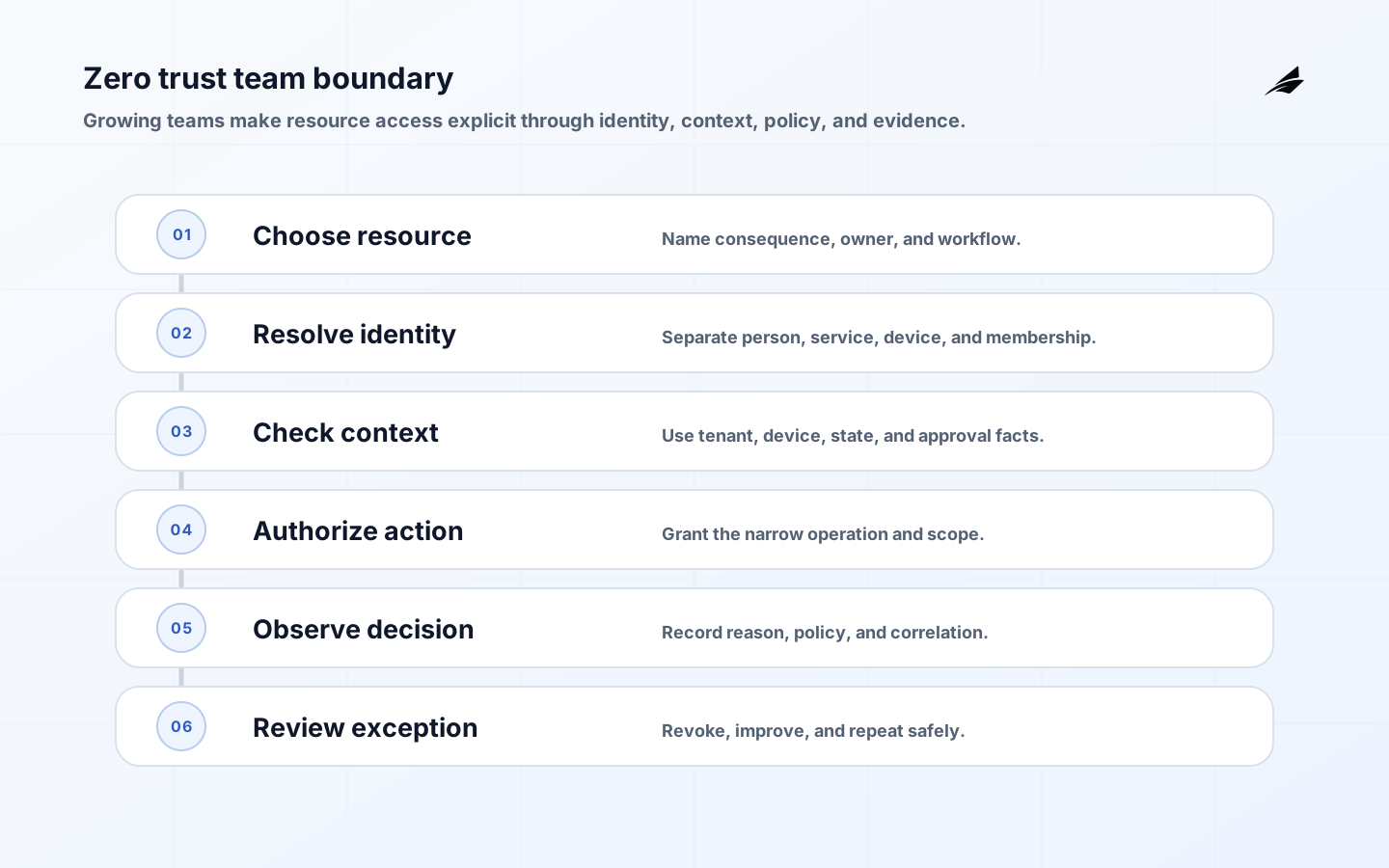
Zero trust is not a product category or a demand to distrust every employee. It is a way to make access decisions explicit when users, devices, services, and data no longer sit behind one dependable perimeter. NIST SP 800-207 describes a resource-focused architecture in which network location does not grant implicit trust. For a growing team, that means replacing broad assumptions with a small number of repeatable questions: who is acting, what is the target resource, what context matters, what is the minimum action, and what evidence remains?
Start with one important resource
Choose a resource whose misuse would be costly: a production console, customer export, deployment system, or administrator function. Map the people, services, devices, data, and workflows that touch it. Do not begin with a slogan or a network diagram. Begin with an action and its consequence. A support agent viewing a ticket, an engineer deploying code, and a finance manager exporting invoices are different decisions even when the same person can perform them in different contexts.

Write the resource contract in plain language. Name the owner, allowed actions, sensitive fields, approval requirement, session conditions, and recovery path. This gives a small team a bounded place to improve instead of attempting to redesign every identity system at once. CISA's maturity model is useful here because it treats identity, devices, networks, applications, and data as connected dimensions rather than a single perimeter replacement.
| Question | Example answer | Evidence |
|---|---|---|
| Who | Named employee or service identity | Provider record and actor ID |
| What | Read customer ticket, not export all tickets | Action and resource scope |
| Context | Managed device and current support case | Device and workflow state |
| Why | Resolve an assigned customer issue | Case reference and audit event |
Separate identity from entitlement
Authentication answers which identity is presenting credentials. Authorization answers what that identity may do here and now. Membership, role, device posture, tenant, project, approval, and resource state can all affect the second decision. Keep those facts separate in the model so a user who authenticated successfully does not inherit a broad entitlement by accident. NIST's cloud-native guidance makes the same point for services: application and service identities matter alongside human identities.
Use an identity provider for sign-in where practical, then make the application the authority for resource scope and workflow state. Require phishing-resistant or strong multi-factor authentication for administrators and sensitive actions. Treat service accounts as named actors with owners, narrow scopes, rotation, and an expiry or review date. A shared credential is not a zero-trust identity because it cannot provide accountable attribution.
Make policy small enough to review
A policy should describe subjects, resources, actions, conditions, and decisions. Avoid a role named ‘power user’ when the real need is ‘may approve refunds for assigned accounts below a threshold’. Start with a deny-by-default rule, allow the smallest tested action, and make exceptions visible. OWASP's Authorization Cheat Sheet recommends server-side enforcement and testing both allowed and denied cases; use those recommendations as acceptance criteria rather than as a late audit activity.
| Control | Weak pattern | Reviewable pattern |
|---|---|---|
| Admin access | Permanent global administrator | Time-bound role for named task |
| Support | Search every customer | Assigned tenant and case scope |
| Service | One token for all jobs | Separate identity and least-privilege token |
| Exception | Manual database change | Approved action with reason and expiry |
Use device and session context carefully
A managed device signal can reduce risk, but it should not become another unexamined perimeter. Define what the signal means, how fresh it must be, and what happens when it is unavailable. A laptop that was compliant yesterday may be unpatched today; a corporate network may contain a compromised endpoint. Require fresh checks for sensitive actions, shorten sessions after risk events, and make the fallback explicit. Never make a device label a substitute for resource authorization.
Deliver in a vertical slice
Treat identity lifecycle as part of the boundary
A zero-trust design is only as current as its identity lifecycle. Establish who owns joiner, mover, and leaver events; how group membership is approved; how quickly removal reaches applications; and what happens when the identity provider is unavailable. Do not assume that disabling an account instantly ends every session or service token. Map the propagation path and test it with a departing employee, a contractor whose assignment ends, and a user who changes teams while a workflow is in progress.
Treat non-human identities with the same seriousness as people. A deployment service, support integration, or scheduled export needs a named owner, a purpose, a narrow audience, a rotation mechanism, and a way to distinguish one workload from another. Shared service credentials hide the boundary that zero trust is meant to make visible. If a legacy integration cannot rotate yet, isolate it, reduce its scope, monitor its use, and give the exception a replacement date.
Use the network as a signal, not a verdict
Network segmentation can reduce blast radius, but it does not answer whether a user or service may perform a particular operation. NIST SP 800-207 shifts attention toward users, assets, and resources for that reason. Keep network controls where they are useful for containment and availability, then pair them with application identity, resource authorization, and meaningful telemetry. A request from an internal subnet should still fail when the actor lacks the tenant, action, approval, or current resource state required by policy.
| Maturity signal | Weak evidence | Stronger evidence |
|---|---|---|
| Identity | A directory account exists | Owner, factor, lifecycle, and revocation are tested |
| Device | Device is on a corporate network | Fresh posture signal changes the decision |
| Policy | A role name appears in a token | Server checks resource, action, scope, and state |
| Operations | A dashboard shows sign-ins | Denials, exceptions, and response owners are visible |
Make exceptions temporary and legible
Growing teams will have exceptions: an old device, a vendor integration, a break-glass account, or a customer workflow that cannot yet use the preferred factor. Record the resource, actor, additional control, owner, expiry, and evidence that justifies the exception. Review exceptions by consequence, not by convenience. If the same exception is renewed repeatedly, treat that pattern as roadmap evidence that the normal boundary is incomplete.
The goal is not to make every request slow or to collect every possible signal. It is to make high-consequence decisions deliberate and low-consequence decisions proportionate. A read-only action may need identity and tenant scope; a destructive or cross-customer export may also need a fresh factor, managed device, approval, and an audit record. Explain those differences in the product so secure behavior remains usable.
A practical first slice might protect production deployment: a named engineer, approved repository, managed device, change ticket, two-person review, short-lived credential, and recorded result. Test a normal deploy, a wrong repository, an expired approval, a stolen session, and a service outage. Then expand the same decision pattern to customer exports or administrative support. This produces reusable controls without pretending that every resource has identical risk.
Make denials useful
Log the decision inputs that an operator needs without copying secrets: actor, resource, action, tenant, policy version, device signal, decision, reason, correlation ID, and time. Review denied attempts, repeated exceptions, stale memberships, unused privileges, and emergency access. A denial that only says ‘forbidden’ frustrates a legitimate user; a log that explains the policy condition helps an owner correct the boundary. Measure known-state coverage and time to revoke as well as successful sign-ins.
Key takeaways
Review architecture by resource and consequence
A useful architecture review walks one request from a human or service identity to a resource and back. Show the identity source, device signal, policy inputs, data lookup, enforcement point, audit event, and recovery action. Then vary one fact at a time: the same user from an unmanaged device, the same device in another tenant, the same role after approval expires, and the same service after its credential is rotated. This exposes whether the design evaluates current context or simply trusts a value copied from an earlier step.
Keep the first implementation narrow enough to observe. A team that protects one deployment system end to end can learn how quickly revocation propagates, how operators investigate denials, and where policy data becomes stale. Those lessons are more valuable than a broad programme that labels every internal network zero trust without proving a single high-consequence decision.
- Protect one consequential resource first and describe its actions precisely.
- Keep authentication, membership, authorization, device context, and workflow approval distinct.
- Use deny-by-default, least privilege, server-side enforcement, and negative tests.
- Give service identities owners, rotation, narrow scope, and review dates.
- Treat device posture as a signal with freshness and fallback, not as a permanent perimeter.
- Use denials and exceptions as evidence for improving policy.
Frequently asked questions
Use a bounded first resource, keep its policy understandable, and make the decision observable before expanding the programme.
Start with the resource where an incorrect decision would matter most, then expand only after the team can show identity freshness, narrow scope, useful denials, and timely revocation. That sequence keeps zero trust concrete for a growing team.
Does zero trust mean removing the VPN?
No. A VPN can remain useful for transport or administration. Zero trust changes the assumption that being on the VPN is enough to authorize access to every resource.
Can a small team adopt zero trust?
Yes. Start with one high-consequence resource, one explicit policy, strong identity, narrow service access, and evidence of both approvals and denials. Expand after the first slice is understood.
What should a growing team protect first?
Choose the resource where an incorrect decision would have the greatest consequence, such as production deployment or a customer export. Define its actions, owner, conditions, and revocation evidence before expanding to lower-risk resources.
Conclusion
For a growing team, zero trust is disciplined clarity. Protect resources rather than relying on location, make access decisions explainable, and give every exception an owner and an end date. The architecture matures as the team learns where trust was previously assumed.
Continue with Edilec's RBAC checklist, plain-language RBAC guide, and session security checklist. Microsoft's zero-trust overview explains explicit verification and least privilege; Microsoft's zero-trust strategy connects controls to risk; the UK NCSC's zero-trust architecture guidance covers architecture decisions; and Google Cloud's zero-trust implementation guidance grounds the model in identity-aware access.