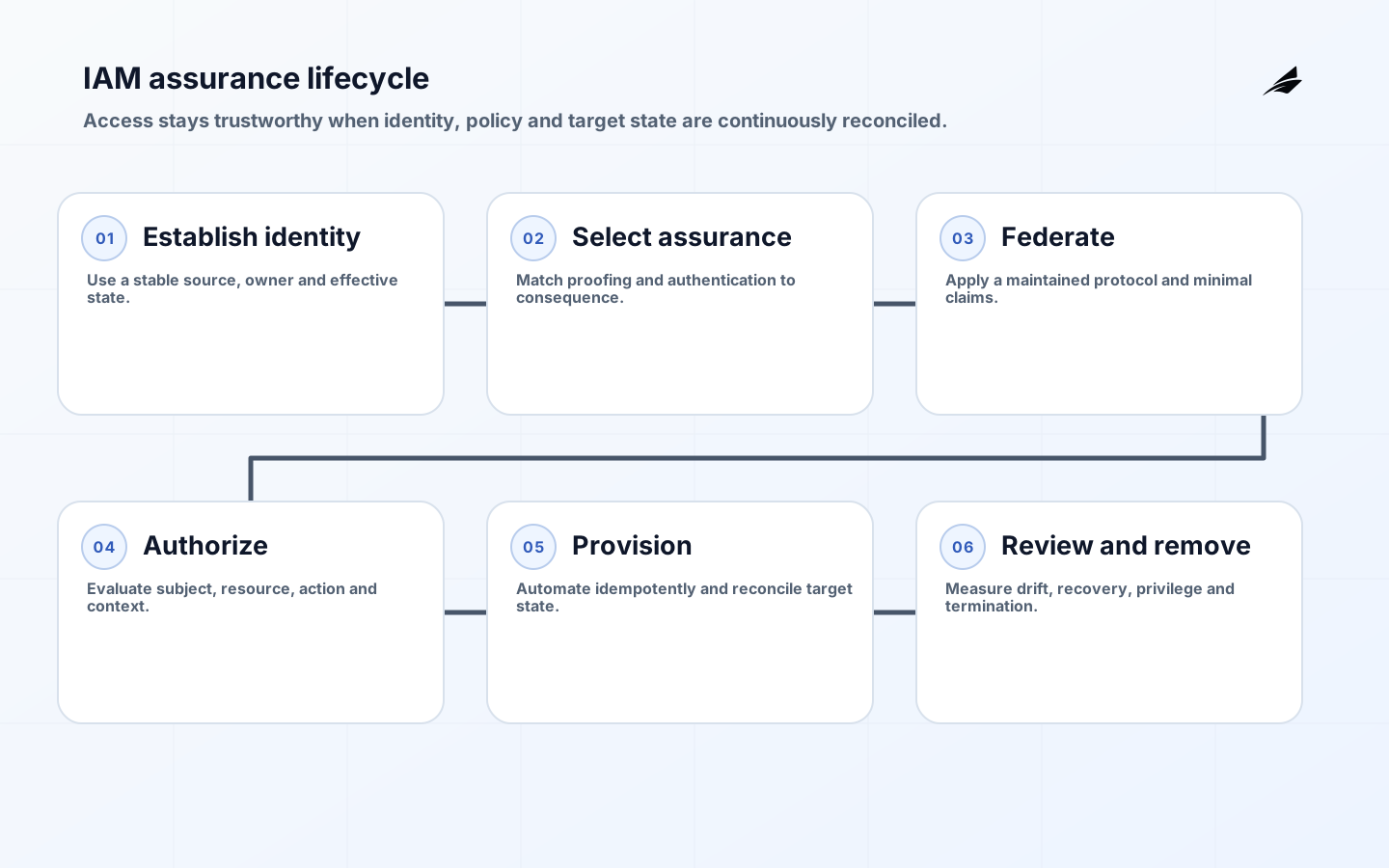
Identity and access management implementation is the work of making access decisions accurate throughout a person's relationship with an organization. It begins before sign-in, with authoritative identity data and proofing, and continues through role changes, federation, privileged work, recovery and termination. Buying an identity provider can improve authentication, but it does not resolve who should have access, which source is authoritative or how exceptions are removed.
NIST finalized Revision 4 of the SP 800-63 Digital Identity Guidelines in 2025. It separates identity proofing, authentication and federation assurance, expands fraud and customer-experience considerations and recommends continuous evaluation. NIST zero-trust guidance also emphasizes decisions based on subjects, resources and context rather than network location. This checklist turns those principles into an enterprise rollout that can be tested and governed.
1. Scope identities, resources and access decisions
List workforce, contractor, partner, customer, service and device identities separately. Identify the applications, APIs, infrastructure, data and administrative functions they may reach. Name business and technical owners for each resource. Classify decisions by consequence: viewing a public account page differs from releasing funds, changing payroll or administering production. The target architecture should support these differences rather than forcing one authentication and approval pattern onto every service.
Map current identity stores, directories, local accounts, role models, federation links and emergency paths. Record joiner, mover and leaver events, average delay, manual steps and recurring exceptions. Include non-human credentials, shared accounts and dormant integrations. Establish success measures such as timely removal, phishing-resistant coverage, privileged-account review and failed provisioning reconciliation. A project measured only by applications connected can automate poor policy faster.
| Identity function | Authoritative input | Required evidence |
|---|---|---|
| Employment or relationship | HR, partner or customer record | Source identifier, status and effective dates |
| Proofing | Risk-based evidence and validation | Method, assurance result and exception |
| Authentication | Registered authenticators and policy | Binding, use, recovery and revocation events |
| Authorization | Role, attribute, resource and context | Decision, policy version and approver |
| Provisioning | Approved account and entitlement change | Target result and reconciliation |
| Termination | Relationship end and retained obligations | Revocation completion and residual access |
2. Define authoritative identity and ownership
Choose one authoritative identifier that survives name, email and organizational changes. Define which system owns legal name, manager, employment state, customer organization and other attributes. Do not copy every attribute to every application. Minimize data, state purpose and protect sensitive fields. Establish correction and dispute processes. Identity data can be wrong, and access automation will amplify errors unless people can obtain redress and owners can reconcile sources.

For external users, decide whether real-world identity proofing is needed. Many services can use pseudonymous accounts; collecting documents without a risk need increases privacy and fraud exposure. Where proofing matters, select an Identity Assurance Level and controls through risk assessment using SP 800-63A-4. Measure success, failure, abandonment and fraud across user groups. Provide accessible alternatives for legitimate users who cannot complete the primary method.
3. Select authentication and recovery by risk
Choose Authentication Assurance Level by transaction and impact. Prefer phishing-resistant authenticators for administrators and high-value access. Passkeys can improve resistance and usability when implemented with clear account and device lifecycle behavior. Passwords, when retained, need secure handling and breached-password controls rather than arbitrary complexity rituals. Step-up authentication should be tied to a consequential action or material context change and should not become constant user friction.
Recovery is an authentication path and often the weakest one. Define who may initiate it, what evidence is required, how changes are notified and how suspicious recovery is delayed or reviewed. Support staff should not bypass strong authentication using easily obtained personal facts. Test lost devices, replaced phone numbers, inaccessible email, employee absence and suspected compromise. Record authenticator binding, replacement and revocation as auditable lifecycle events.
4. Standardize federation and application onboarding
Use maintained OpenID Connect or SAML implementations appropriate to the application and establish approved profiles. Validate issuer, audience, signature, time and redirect behavior. Minimize claims and define their semantics. Avoid authorization based solely on mutable display attributes. Federation reduces password sprawl, but a compromised identity provider or misconfigured relying party can have broad effect. Protect signing keys, administration and metadata change.
Create an application onboarding contract with owner, data class, user population, assurance need, protocol, roles, provisioning, logs, recovery and decommissioning. Test session termination and role change, not only initial sign-in. Local emergency access must be restricted, monitored and reviewed. Maintain an inventory of federation clients, secrets, certificates, redirect URIs and owners. Remove unused integrations promptly.
5. Automate lifecycle and reconcile outcomes
Use event-driven or scheduled provisioning based on approved source changes. SCIM can standardize user and group management, but each target still needs mapping, error handling and reconciliation. Make requests idempotent and preserve source, effective time and approval. Queue and alert failed deprovisioning. A success response from an API is not enough; compare expected and actual accounts and entitlements and investigate drift.
Model movers carefully. Role or location changes can require immediate removal before new access is added. Do not accumulate entitlements because each transfer is treated only as an addition. Use birthright access sparingly and time-bound project access. Give resource owners understandable reviews that show why access exists and when it was last used. Certification without context encourages approval of everything and creates weak evidence.
6. Control privileged and machine access
Separate daily and administrative identities. Require stronger authentication, narrow roles, just-in-time elevation where feasible and attributable sessions. Protect emergency accounts offline or through strongly controlled paths, monitor use and rotate after exercise. Administrative APIs and automation identities need the same inventory and ownership discipline. Prefer short-lived workload identity over embedded long-lived secrets. Bind service permissions to a workload and environment, not a developer's personal account.
Review privilege by capability and resource. A broad administrator label hides whether the subject can read secrets, change policy, deploy code or delete logs. Record approval, activation and consequential actions. Alert on unusual elevation, new federation trust, authenticator reset and access from unexpected context. Behavioral signals can inform decisions, but users need predictable policy and privacy controls; opaque risk scoring should not become unreviewable denial.
| Rollout gate | Test | Stop condition |
|---|---|---|
| Identity source | Create, change, correct and terminate representative users | Conflicting authoritative status |
| Authentication | Enroll, use, recover and revoke each approved method | Support can bypass assurance |
| Federation | Validate tokens, sessions and metadata changes | Mutable claim grants privilege |
| Provisioning | Replay, partial failure and reconciliation | Terminated access remains |
| Privilege | Elevate, monitor and revoke emergency access | Shared or unattributed administration |
| Operations | Detect and investigate identity events | Logs cannot explain access |
7. Pilot, measure and expand by risk cohort
Start with a representative application cohort and user group. Include a modern application, a difficult legacy target and one privileged path. Run shadow reconciliation before automated removal where source quality is uncertain, then move to enforced policy with a rollback plan. Communicate enrollment, alternatives and support. Measure completion and failure by user group so security improvements do not silently exclude legitimate users.
Operate identity as a product. Track stale access, deprovisioning time, authenticator strength, recovery outcomes, federation errors, provisioning drift and privileged activation. Review fraud and help-desk trends alongside security events. Maintain policy and integration versions, rehearse identity-provider outage and emergency access, and test restore. Each expansion cohort should close known exceptions or document their owner and expiry.
Key takeaways
- Separate proofing, authentication, federation and authorization assurance.
- Use stable authoritative identities and provide correction and redress.
- Treat recovery, privilege and machine identities as first-class access paths.
- Reconcile target state instead of trusting provisioning responses.
- Expand by risk cohort with usability, fraud and operations evidence.
Frequently asked questions
Does single sign-on complete IAM?
No. SSO centralizes authentication and federation. IAM also needs identity source, authorization, provisioning, reviews, recovery, privileged access, monitoring and termination.
Should every user be identity-proofed?
No. Proof only to the level justified by risk and service need. Unnecessary proofing increases cost, privacy exposure and exclusion without improving every access decision.
How often should access be reviewed?
Set frequency by consequence and change rate. Use event-driven removal and monitoring continuously; use periodic certification for residual decisions, with more frequent review of privileged and high-risk access.
Plan migration from legacy directories and local accounts as a service transition. Reconcile users and entitlements before federation, preserve a tested rollback, and avoid running two uncontrolled authorities indefinitely. Applications that cannot support modern federation may use a broker or access proxy temporarily, but the exception needs an owner and retirement date. Test contractor expiry, extended leave, merger records and rehire because these cases expose identity matching errors. For customer IAM, include organization transfer, delegated administration and account recovery disputes. These lifecycle scenarios are more revealing than a successful new-user demonstration.
Document operational dependencies on the identity provider, directory, messaging, HR source and certificate services. Set service objectives, monitor synchronization and rehearse an identity-provider outage. Decide which applications can use an existing session, which must fail closed and how administrators regain controlled access. Keep emergency procedures short, protected and tested. Review audit-log delivery and time synchronization so investigations can reconstruct a sequence across federation and target applications. Identity availability is a business-service concern, but bypassing assurance during an outage can create a larger incident than the outage itself.
Conclusion
A dependable IAM implementation makes each access decision traceable to a trusted relationship, appropriate assurance, explicit policy and current resource need. Use NIST Revision 4 to frame identity risk, automate lifecycle only after sources and ownership are clear, and prove recovery and removal as rigorously as sign-in. The result is not just fewer passwords; it is an access system that remains accurate as people, applications and threats change.