The Plain-Language Guide to RBAC
RBAC means role-based access control: a system assigns permissions through roles that represent recognizable responsibilities. Plain language RBAC makes that model reviewable. A role is not a job title, a trust score, or a shortcut to administrator. It is a named answer to a practical question: which actions may this actor perform on which resources, under which conditions? Explaining RBAC this way helps product, operations, and security teams find gaps before code makes them expensive.
The five parts of an access decision
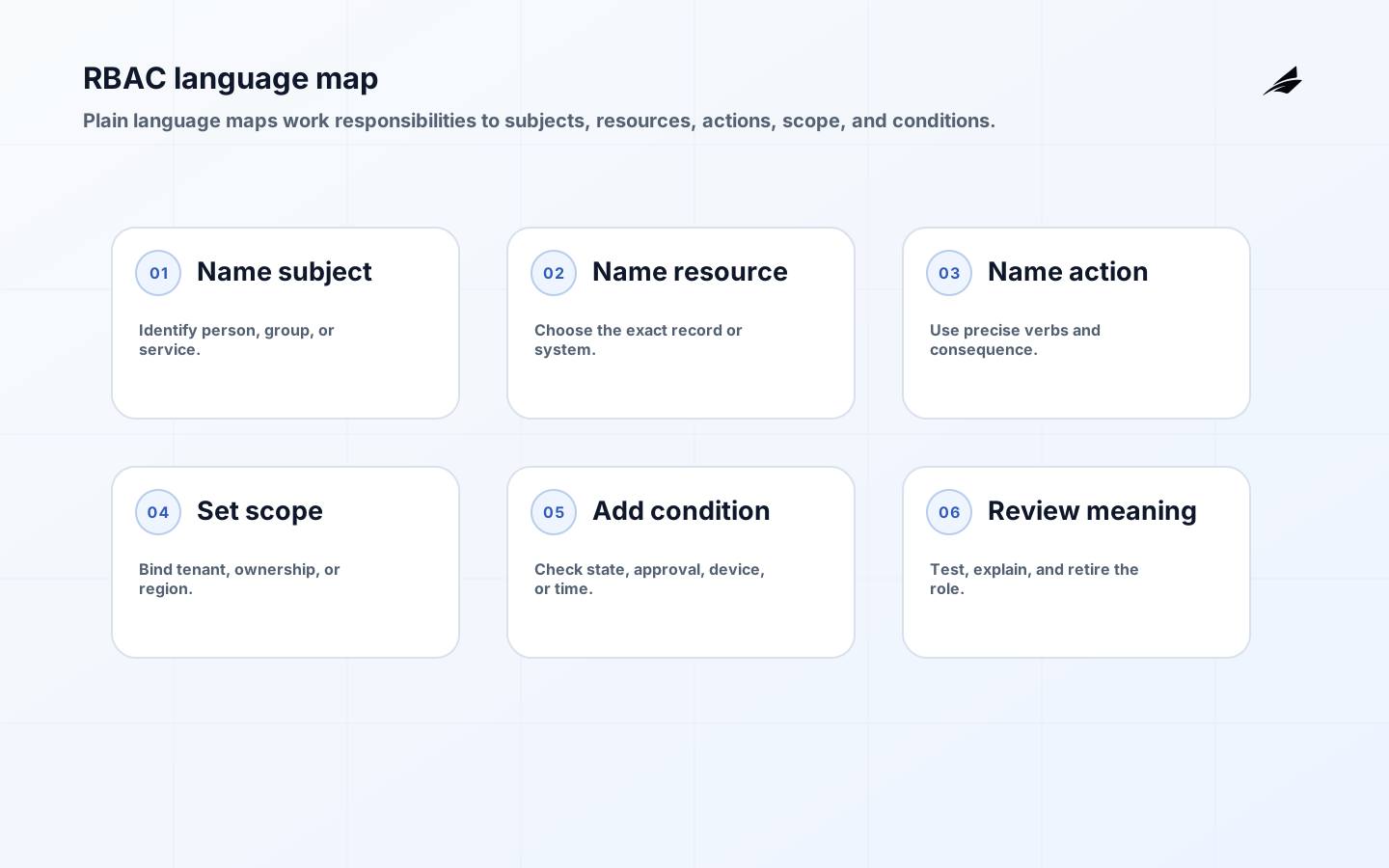
Every useful decision has a subject, resource, action, scope, and condition. The subject may be a person, group, or service. The resource may be a ticket, account, deployment, or export. The action should be exact: view, edit, approve, publish, delete, or restore. Scope says which tenant or record is in bounds. Conditions capture facts such as ownership, approval, device state, or workflow status. Leave one part vague and the policy becomes harder to test.
| Part | Plain-language question | Example |
|---|---|---|
| Subject | Who is acting? | Assigned support agent |
| Resource | What is being touched? | Customer ticket |
| Action | What may happen? | Add internal note |
| Scope | Which records count? | Agent's assigned queue |
| Condition | What else must be true? | Ticket is open |
What a role is—and is not
‘Billing approver’ is a role because it names a responsibility. ‘Senior user’ is a poor role because it mixes status with authority. ‘Can manage everything’ is not a useful permission because it hides consequences. Keep roles understandable to a manager and precise enough for a developer to implement. OWASP recommends least privilege and deny-by-default; both are easier when the role contains only the actions the responsibility needs.
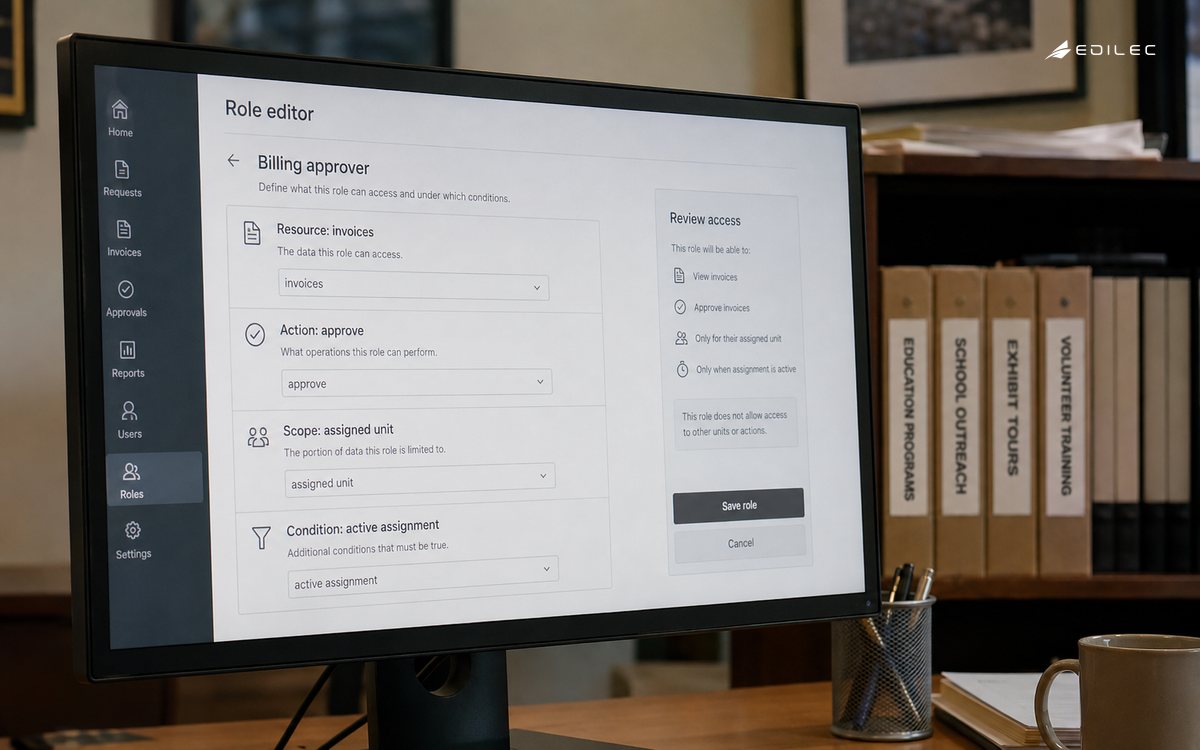
RBAC does not eliminate context. A billing approver may approve invoices for one business unit, below a threshold, during an active assignment. NIST SP 800-162 explains why attributes and policy conditions become useful when a role alone cannot express the decision. Add context deliberately rather than creating dozens of nearly identical roles.
A concrete example
Imagine a repair platform. A dispatcher may view jobs in assigned regions, change a schedule, and send a customer update. A technician may view assigned jobs and add completion evidence but cannot change price. A supervisor may approve a price adjustment within a threshold. A support specialist may investigate a job but needs a time-limited, recorded escalation to change it. These are four different responsibilities, not four levels of importance.
| Role | May do | Must not do |
|---|---|---|
| Dispatcher | Assign and reschedule regional jobs | Approve price changes |
| Technician | Update assigned work and evidence | Read unrelated customer history |
| Supervisor | Approve bounded adjustments | Export all customer data |
| Support | Investigate and explain | Use permanent impersonation |
Where RBAC must be enforced
The server must enforce the decision at every path that can change or disclose data. Frontend buttons improve usability but do not protect an API. Check direct object requests, bulk actions, file downloads, search, background jobs, reports, webhooks, and internal support tools. The resource's tenant and state must be resolved from authoritative data, not trusted from a client-supplied label. Test a permitted action and the same action from the wrong role, tenant, object, and lifecycle state.
Roles have a lifecycle
Ask five questions before granting access
Before granting a role, ask: what work is blocked without it, which exact records are involved, what is the worst outcome of misuse, who is accountable for the decision, and when will the grant be reviewed? These questions turn a request such as ‘make me an admin’ into a smaller conversation. Someone who needs to edit a customer's address may not need to export the customer list; someone who needs to approve a refund may not need to change the payment method.
The same questions help with service identities. Name the job, the data it reads or changes, the external side effect it can cause, and the owner who can rotate or disable it. Give separate services separate identities even when they run in the same cluster. If a role is granted to a group, explain how membership is approved and how removal reaches the application. A role without an owner is a permission nobody can safely review.
Let resource state change the decision
The same actor may be allowed to edit a draft but not a published record, propose a change but not approve it, or restore an archived item only after a second person confirms. State is not decoration; it is often the fact that prevents an otherwise valid permission from creating an unsafe transition. Put the check beside the action on the server and return a useful reason when the state has changed since the page was opened.
| Work question | Permission meaning | Boundary to keep |
|---|---|---|
| Can I see it? | Read the fields needed for the job | Sensitive fields and tenant |
| Can I change it? | Perform a named mutation | Resource state and ownership |
| Can I approve it? | Move a workflow across a control point | Separation of duties |
| Can I recover it? | Restore or override a protected state | Fresh auth, reason, and audit |
Explain a denial without exposing policy secrets
A useful denial tells the person what safe next step is possible: request membership, ask the owner, complete approval, switch to the assigned tenant, or wait for a state transition. It should not reveal another customer's existence or disclose internal policy details that help an attacker map the system. Keep the detailed reason in the audit event and show the user a concise, actionable explanation. Good denial language reduces unsafe workarounds and makes support conversations shorter.
Assign roles from an authoritative source, review them when responsibilities change, remove them when work ends, and record exceptions. Emergency access needs a reason, approver, scope, expiry, and after-action review. A role that no longer maps to real work is a liability even if nobody has abused it. Review unused permissions and repeated denials; they reveal either an over-broad role or a workflow the model does not understand.
Key takeaways
Explain the boundary to the whole team
Product managers should be able to describe a permission as a customer-facing capability; engineers should be able to point to the server decision; operators should know who owns a denial; and reviewers should know when the grant ends. Use the same words in documentation, UI, audit events, and tests. When a product calls something an owner in one place and an administrator in another, people begin to infer authority from language instead of from a policy that can be checked.
Plain language is not a substitute for precision. It is the way precision becomes shared. Write examples that include a permitted action, a denied action, a wrong-scope action, and a state transition. These examples help a new teammate understand why a role is narrow and give reviewers something concrete to challenge before the policy reaches production.
- Describe roles as responsibilities, not seniority labels.
- Name the subject, resource, action, scope, and condition in every decision.
- Use contextual attributes when a stable role is not enough.
- Enforce on the server across APIs, jobs, search, exports, and support.
- Time-limit exceptions and remove roles that no longer map to work.
- Test the wrong tenant, object, role, and lifecycle state.
Frequently asked questions
Use the same vocabulary in policy names, UI copy, audit events, and tests. Consistent words keep a small permission understandable as the product grows.
Examples should include the allowed action, the denied action, and the reason the boundary exists. That contrast makes a role memorable for reviewers and gives developers a concrete test for the server decision.
When a role is explained with a real work example, reviewers can challenge the boundary before implementation and support can explain the result after implementation. That shared vocabulary is one of RBAC's most useful controls.
When a role spans several products, keep the business responsibility consistent but let each product enforce its own resource boundary. A person may be a billing approver in the account system and only a read-only analyst in the support system. Federation of role names without shared scope is a common source of accidental authority. Document the mapping, test it at each resource server, and make a change in one product visible to the owner of the others.
The language should stay stable as the implementation evolves. If a team renames a role, changes a resource hierarchy, or introduces a new workflow state, update the examples and negative tests together. Stable language is a practical control because it keeps product decisions, code review, and access review aligned.
A good example should name both the allowed and disallowed action: a technician may update evidence on an assigned job but may not change its price or read an unrelated customer's history. Contrasts like this make the boundary memorable and testable.
Plain language also helps incident response: an operator can say which responsibility, resource, action, or condition prevented the request and what safe next step remains.
How can a team explain a permission boundary?
Name the responsibility, resource, allowed action, disallowed action, and changing condition in one concrete work example. That format gives reviewers something to challenge and developers a clear positive and negative test.
If people cannot describe a role without using words such as everything, full, or manage, stop and split the responsibility into concrete actions. The clearer the examples, the easier it is to review the boundary and to explain a denial without exposing internal policy details.
Is RBAC the same as ABAC?
No. RBAC grants through roles; attribute-based access control evaluates facts such as ownership, tenant, time, device, or resource state. Real systems often combine stable roles with contextual conditions.
Are groups and roles the same?
No. A group is commonly an assignment mechanism; a role is a permission meaning. Keeping them distinct makes membership changes less likely to alter policy accidentally.
Conclusion
RBAC is understandable when it speaks in the language of responsibility and consequence. Make each role narrow, contextual, server-enforced, and reviewable, and the model can grow without becoming a maze.
Read the companion RBAC checklist, RBAC mistakes and fixes, and RBAC production guide. The Cloud IAM hierarchy guidance explains inherited scope; Microsoft's custom RBAC guidance covers application roles; CISA's identity and access management recommendations address administration; and NIST's RBAC FAQ clarifies the model.