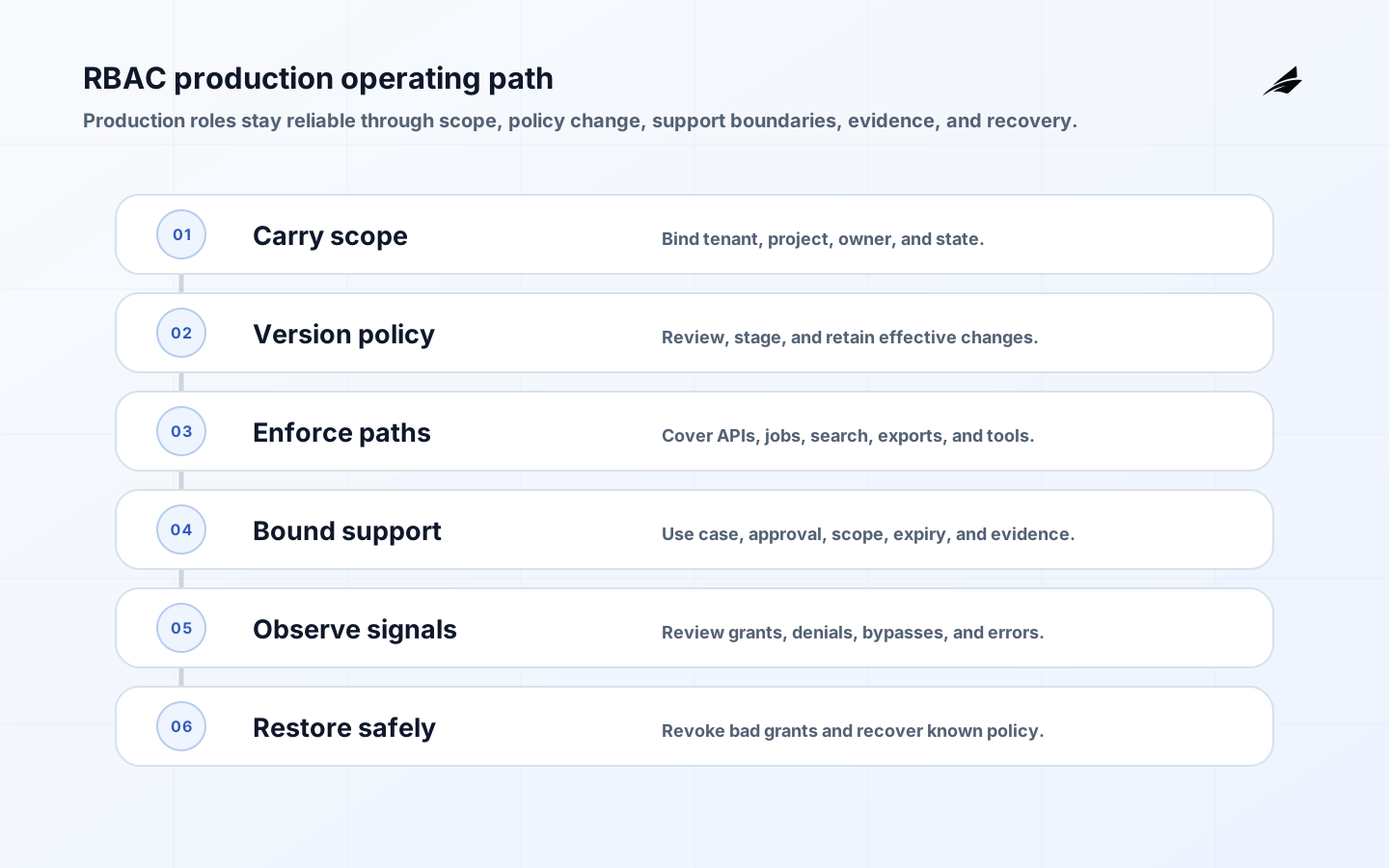
What Changes When RBAC Moves into Production
RBAC in production is a living operating boundary. Real tenants, asynchronous jobs, support actions, stale caches, organizational changes, and emergency access expose assumptions hidden by a test environment. Keep the role model explicit, but also carry scope through every path and record the policy decision that was effective at the time.

Carry scope through every path
Resolve tenant, project, ownership, and resource state from authoritative records. Do not trust a client label or a queue message that contains only an object identifier. Test APIs, workers, search, exports, file downloads, and support tools with a neighboring tenant and a removed membership. A UI filter is not an authorization boundary.
| Concern | Question | Evidence |
|---|---|---|
| Assignment | Who may grant the role? | Approval and owner |
| Propagation | When does removal apply? | Revocation test |
| Scope | Which records are in bounds? | Negative fixtures |
| Recovery | How is a bad grant undone? | Versioned policy and runbook |
Version and stage policy changes
Make assignment and removal observable
Production role assignment is a workflow, not a database insert. Record who requested the grant, who approved it, which source made it effective, what scope it carries, and when the application observed it. Do the same for removal. Joiner, mover, and leaver events can arrive late or out of order, so the system should reconcile current membership from an authoritative source and alert when a local assignment disagrees. Do not report access as removed until the relevant session, cache, queue, and resource paths have reached their defined state.
For a multi-tenant service, test the awkward cases: a manager belongs to two organizations, a contractor's project ends while a job is running, a user is transferred while a report is queued, and a support employee has a temporary customer grant when the case is closed. These are not exotic edge cases in production. They are where a simple role label meets changing scope and exposes whether the system models authority as current state or as an old decision copied everywhere.
Set freshness rules for caches and workers
Caching an authorization decision can reduce latency, but the cache must carry the subject, resource, action, scope, policy version, and expiry that make the decision meaningful. A cache key containing only user ID is unsafe when tenant or record scope matters. Invalidate high-risk grants and removals deliberately, and choose shorter freshness for destructive or cross-customer actions. Workers need the same discipline: recheck authority at execution time when the queued action can create a lasting side effect.
| Production case | Decision to document | Proof |
|---|---|---|
| Policy service outage | Fail closed, queue, or bounded read-only mode | Game-day result |
| Stale membership | Maximum allowed decision age | Revocation latency test |
| Role migration | Compatibility window and exit | Old-role usage report |
| Support emergency | Scope, approval, and expiry | Case-linked audit event |
Prepare an authorization incident runbook
The first response to an over-broad role should be specific: disable the assignment source or policy version, revoke affected sessions and service tokens, identify resources accessed during the exposure window, preserve logs, and name the customer or internal owners who must be informed. Then restore a known-good policy and run the negative tests that failed. The incident is not closed when the grant is removed; it is closed when the team can explain the blast radius and show that the repair holds across every data path.
Policy changes are production changes. Review diffs, test representative workflows, stage high-consequence grants, and retain the effective policy version with the access event. Define behavior when the policy service is unavailable. A safe degraded mode may preserve a narrow read path; it should not silently grant broad write access.
Bound support and emergency access
Separate read-only investigation from customer action. Require a case reference, named operator, target resource, narrow scope, expiry, and after-action review for impersonation or emergency access. Record the customer and object affected, not only the employee identity. Reconcile assignments when a user changes team, a vendor ends work, or a project closes.
| Signal | Meaning | Response |
|---|---|---|
| Grant spike | Automation or compromise | Pause source and review |
| Cross-scope success | Authorization bypass | Revoke and investigate |
| Policy timeout | Dependency failure | Use defined fallback |
| Repeated exception | Model gap | Create safe normal path |
Key takeaways
- Carry scope through APIs, jobs, exports, search, and support.
- Version, review, stage, and observe policy changes.
- Time-limit emergency access and preserve evidence.
- Define dependency failure and recovery behavior.
- Rehearse bad grants, delayed removal, and policy restoration.
Frequently asked questions
Production readiness also depends on the team that owns the surrounding data. A role may be correct while a search index, export job, cached file, or notification still exposes a record outside its scope. Include those paths in the release review and retain a fixture with two tenants, overlapping identifiers, a membership transfer, a deleted resource, and a delayed queue message. The result should be a clear decision: allowed, denied, queued for review, or safely degraded. Make the review repeatable by exposing the grant source, last use, policy version, scope, expiry, and emergency history to the role owner without exposing customer payloads. Operations should be able to disable a bad assignment and confirm propagation. Those capabilities turn production RBAC into a system that can be operated under pressure rather than a role list that looks correct only on paper.
A mature production role model also supports customer communication. When a permission changes, the product should be able to identify which workflows are affected and whether a user needs to request a new role or simply wait for propagation. When an access incident occurs, the evidence should show which tenants, resources, and actions were in scope without forcing the team to inspect raw customer content. This is why policy version, scope, resource state, and correlation IDs belong in the decision event. They let security, support, and engineering tell the same story. Review the role catalogue after each incident and after major organizational changes. Remove roles that no longer represent work, split roles that mix incompatible duties, and promote repeated emergency use into a safer normal workflow. Production RBAC earns trust through this feedback loop: define the responsibility, enforce the boundary, observe the result, recover from mistakes, and improve the next release.
Operational readiness also depends on the team that owns the surrounding data. A role may be technically correct while a search index, export job, cached file, or notification still exposes a record outside its scope. Include those paths in the release review and retain a fixture that contains two tenants with similar names and overlapping object identifiers. Test a membership transfer, a deleted resource, a delayed queue message, and a support escalation after the role changes. The result should be a clear decision: the action is allowed, denied, queued for review, or made safe through a documented degraded mode. Treat that review as a release gate, not a post-incident exercise.
Finally, make the review repeatable. A role owner should be able to see the grant source, last use, policy version, scope, expiry, and emergency history without asking engineering to reconstruct it. Security should be able to sample decisions without collecting customer content. Operations should be able to disable a bad assignment and verify propagation. Together, these practices make production RBAC operable under pressure rather than a role list that looks correct only on paper.
How should RBAC changes be released?
Treat them like code and data migrations: stage by consequence, observe allowed and denied workflows, retain policy-version evidence, and define rollback and compatibility expiry before enabling the change broadly.
Release roles like code and data
A role release changes what people and services can do, so it needs the same discipline as a schema or API release. Describe the intent, affected assignments, scope, expected decision changes, migration sequence, rollback condition, and owner. Use a policy version that can be referenced in logs and support conversations. Run the decision matrix against realistic tenants, resources, states, and actors before enabling the change for everyone. Include a case where the role should be denied even though the actor is otherwise valid.
Stage changes by consequence rather than by employee count. A role assigned to two people may be more dangerous than a read role assigned to two thousand. Start with a representative customer or internal group, observe successful and denied workflows, and check whether support can explain the change. If a migration needs a compatibility role, name it clearly, alert on its use, and set a removal date. Never let a compatibility grant become a silent second permanent role.
Keep evidence that supports customer trust
A production access record should answer who acted, through which role or policy, on which tenant and resource, with which action, under which state, and with what result. Do not store unnecessary customer payloads or secrets, but retain enough context to reconstruct the decision. Correlate an approval, the authorization event, the resulting state transition, and any external side effect. This evidence supports security investigation, customer support, and ordinary debugging without asking an operator to guess from a login log.
Review the evidence for blind spots. If a report is generated by a job, can the team identify the initiating actor and the effective scope? If a support action uses an emergency grant, can it be linked to the case and the customer? If a policy dependency failed, can the team show which fallback was used? These questions turn production RBAC from a static role catalogue into a defensible operating capability.
| Readiness area | Pass condition | Owner |
|---|---|---|
| Policy | Effective version and review are recorded | Security and resource owner |
| Assignment | Grant and removal are attributable | Identity operations |
| Enforcement | All data paths apply scope | Application team |
| Support | Temporary action is bounded and evidenced | Support lead |
| Recovery | Bad grant can be contained and explained | Incident owner |
What evidence supports customer trust in production RBAC?
Keep grant source, scope, policy version, last use, expiry, emergency history, and decision outcomes without exposing customer payloads. Correlate approvals, authorization events, and resulting state changes so an incident can be explained from evidence.
When is production RBAC ready?
When allowed and denied decisions are tested across paths, assignments and removals have owners, support access is bounded, changes are observable, and recovery has been rehearsed.
Conclusion
Production RBAC combines precise roles with durable scope, lifecycle ownership, evidence, and recovery. Use the RBAC checklist, plain-language guide, and mistakes and fixes. AWS's IAM policy examples illustrate scoped decisions; Kubernetes' logging guidance supports operational evidence; AWS's IAM role documentation clarifies role assumptions; and Microsoft's audit-log guidance supports reviewable changes.