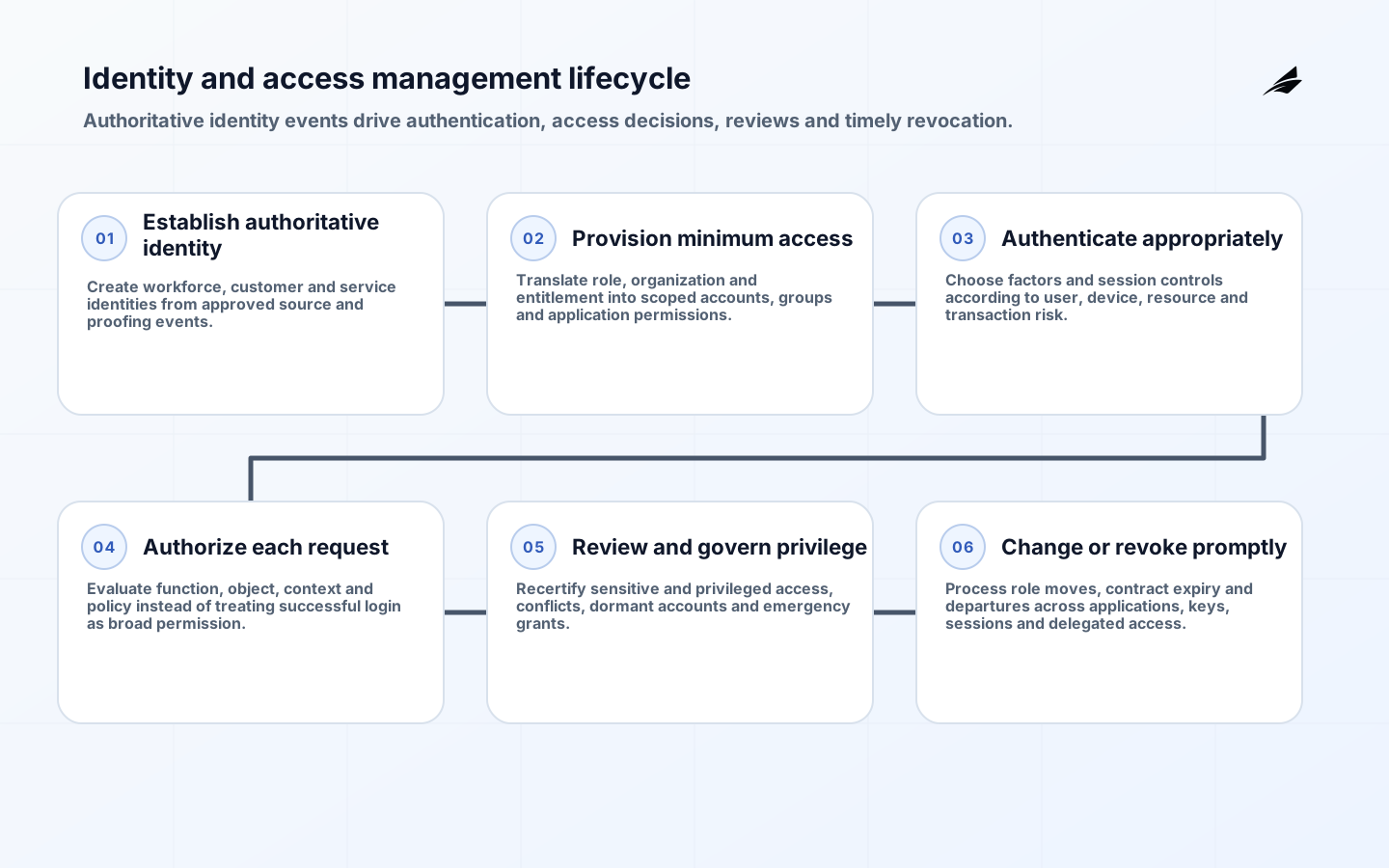
Identity and access management determines who or what may use a system, under which conditions, and with what evidence. It spans identity proofing, account lifecycle, authentication, federation, authorization, privileged access, workload credentials, recovery and review. Buying single sign-on software addresses only part of that operating system.
A dependable IAM program connects business ownership with technical enforcement. It reduces standing privilege, removes access when relationships change and makes sensitive decisions explainable. This guide answers common implementation questions while showing how modern standards such as OpenID Connect, OAuth and SCIM fit into a complete lifecycle.
Separate workforce, customer and workload identities
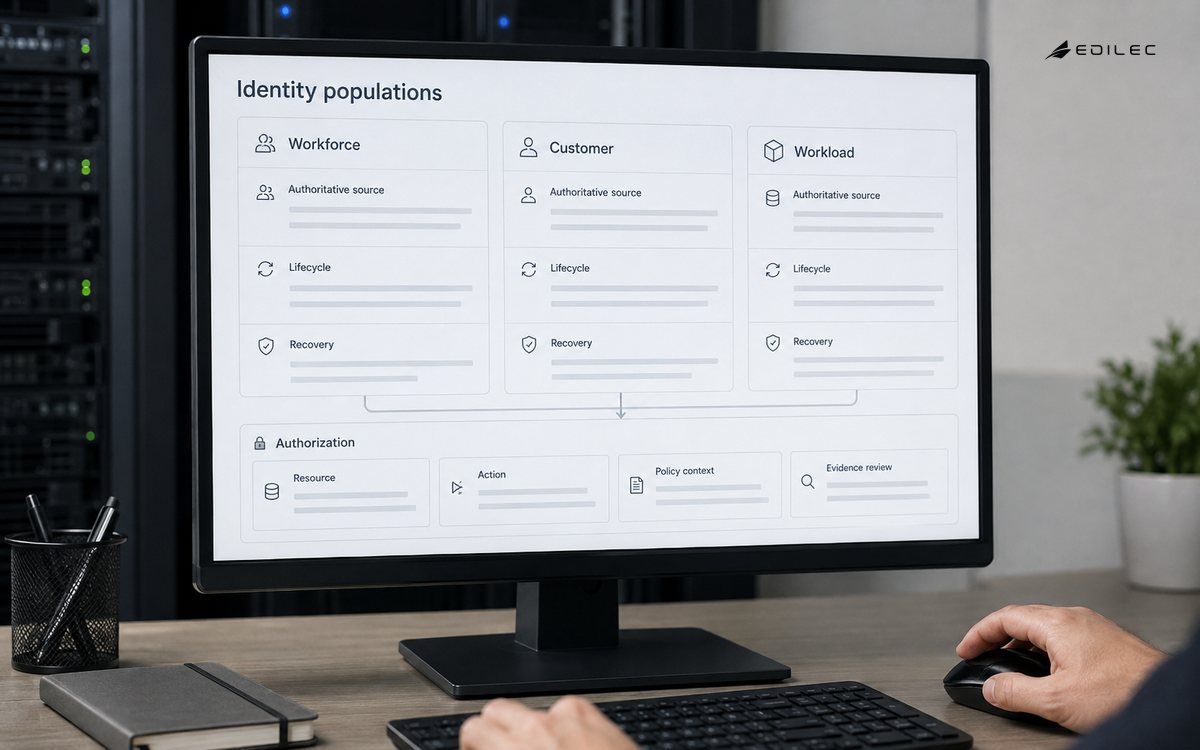
Workforce identity represents employees, contractors and partners; customer identity supports external users at different assurance and scale; workload identity authenticates services, jobs and devices. They can share protocols but need different proofing, recovery, privacy and lifecycle rules. Do not force service accounts into a human joiner-mover-leaver process or treat consumer recovery like employee help-desk reset.
Name an authoritative source for each identity population and relationship. HR may establish employment but not application entitlement. A CRM may hold a customer profile but not authentication truth. Workload identity should bind to a deployment or platform control rather than a long-lived shared secret. Stable subject identifiers prevent email or display-name changes from breaking ownership.
| Domain | Authoritative signal | Primary control | Failure to avoid |
|---|---|---|---|
| Workforce | Employment or contract relationship | Lifecycle and role approval | Orphaned access |
| Customer | Account registration and assurance | Secure authentication and recovery | Account takeover |
| Privileged | Named administrative duty | Time-bound elevation and audit | Standing broad privilege |
| Workload | Approved runtime identity | Short-lived credentials and policy | Shared embedded secrets |
| Partner | Federated business relationship | Sponsor, scope and expiry | Unowned external account |
Choose assurance from risk
NIST SP 800-63-4 separates identity proofing, authentication and federation assurance. Use a risk assessment to decide how strongly an identity must be established and authenticated. Reading public documentation is different from changing payroll or releasing funds. Apply stronger, phishing-resistant authentication to administrators and high-impact transactions.
MFA quality matters. Factors should be independent, enrolled through a verified process and recoverable without creating an easier bypass. Protect new-factor registration and reset as privileged events. Offer usable alternatives for accessibility and loss. Monitor repeated prompts, suspicious enrollment and recovery patterns rather than measuring only enrollment percentage.
Use federation without confusing protocols
OpenID Connect provides authentication information on top of OAuth 2.0; OAuth authorizes scoped API access. An ID token is not a general API credential, and an access token is not proof that the current browser session is the named user. Validate issuer, audience, signature, time and nonce or state where required. Keep redirect URIs exact and use current OAuth security guidance.
Federation moves authentication to an identity provider but does not eliminate application authorization. The relying service still owns session, entitlement, transaction and logout behavior. Establish metadata and key-rotation procedures. Test provider outage and account disablement. A valid token should not grant more access than current policy allows.
Automate the identity lifecycle
Provision from an authoritative event, assign baseline access through governed rules and route exceptions to accountable owners. SCIM standardizes user and group lifecycle exchange, but connector behavior still needs testing for rename, suspension, rehire, duplicate identity and partial failure. Deprovisioning should revoke sessions and downstream credentials where risk requires it.
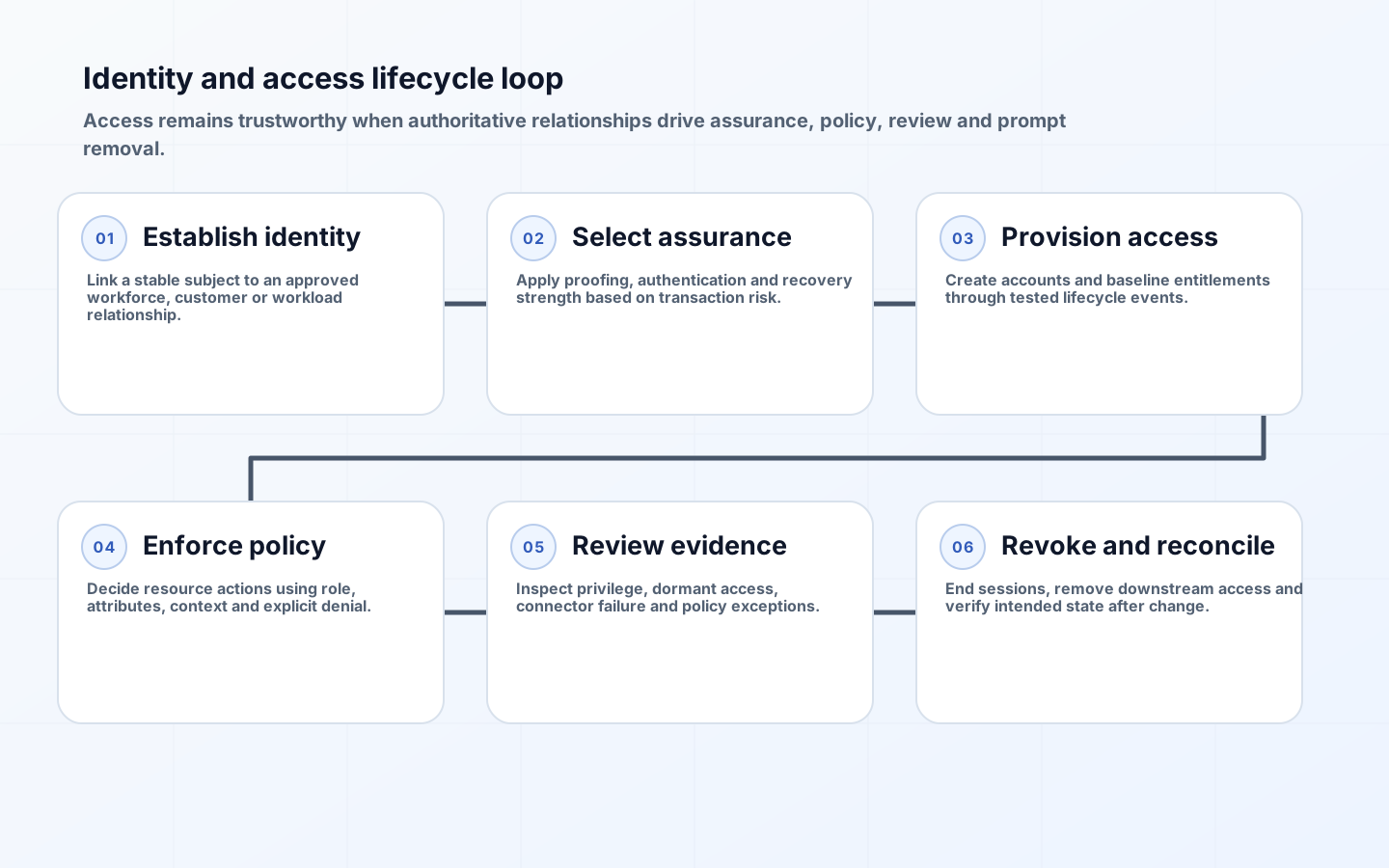
Keep a durable link between person, account and entitlement. Reconcile target systems against intended state, because event delivery can fail. Expire contractor and temporary access by default. Review dormant accounts, unowned groups and exceptions. Lifecycle service levels should reflect the risk of delayed removal, not only provisioning speed.
Design authorization around resources and actions
Roles are useful when they correspond to stable job responsibilities, but role names alone rarely express resource ownership, transaction value or environment. Combine role-based access with attributes and policy where needed. Define resources, actions, conditions and explicit deny behavior. Enforce authorization in the service that owns the resource, not only in navigation.
Prevent toxic combinations such as creating and approving the same payment. Where staffing makes separation difficult, use compensating review and limits. Policy changes need version control, test cases and approval. Log the subject, action, resource, decision and relevant policy without exposing secrets or excessive personal data.
| Control | Design evidence | Operating evidence |
|---|---|---|
| Joiner/mover/leaver | Source and lifecycle mapping | Provision and removal latency |
| Authentication | Assurance and recovery policy | Factor and recovery events |
| Authorization | Resource-action policy tests | Allow and deny decisions |
| Privilege | Elevation and emergency procedure | Approval, duration and session log |
| Review | Owner and risk cadence | Revocation and exception closure |
Treat privileged and machine access separately
Administrators should use named accounts, strong authentication and time-bound elevation. Separate routine work from privileged sessions. Record approvals, commands or material actions where lawful and appropriate. Emergency access must be available during provider failure, protected offline or independently, tested and reviewed immediately after use.
For workloads, prefer platform-issued short-lived credentials and workload identity federation. Bind permission to service, environment and deployment context. Rotate residual secrets automatically and scan for exposure. A machine identity needs an owner, purpose and retirement condition just as a human account does.
Apply zero trust as continuous policy
NIST zero trust architecture removes implicit trust based on network location. Access decisions should consider subject, device, resource and context, and enforcement should be close to the resource. This does not mean prompting for MFA on every click. It means validating the conditions relevant to each request and re-evaluating when risk or session state changes.
CISA's maturity model highlights identity alongside devices, networks, applications, workloads and data. Progress should be measurable: stronger authenticators, device signals, shorter privilege, better policy coverage and faster revocation. Avoid a large “zero trust” purchase without a resource inventory and decision model.
Roll out IAM through controlled migration
Inventory applications, protocols, identity stores, privileged paths and recovery dependencies. Prioritize high-impact access and systems that can support modern federation. Pilot with a representative cohort, monitor lockouts and entitlement differences, and preserve a tested rollback. Communicate enrollment and recovery before enforcement.
Measure coverage and outcomes: phishing-resistant MFA for privileged users, time to remove access, standing privilege, failed provisioning, recovery abuse, dormant accounts and policy exceptions. Do not celebrate login consolidation while authorization remains unmanaged. Incident exercises should include identity-provider outage and administrator compromise.
Prepare evidence and identity incident response
Retain enough evidence to investigate account takeover, privilege misuse and provisioning failure: authoritative lifecycle events, factor enrollment and recovery, federation identifiers, session and token events, policy decisions, privilege elevation and target-system changes. Protect logs from alteration and restrict access. Define retention from security, privacy and legal needs rather than collecting every attribute indefinitely.
Identity incidents often require actions across several systems. Prepare playbooks for compromised administrator, stolen session, malicious OAuth client, identity-provider outage and erroneous mass deprovisioning. Response may include revoking sessions, disabling clients, rotating credentials, isolating administrative paths and preserving emergency access. Test communications because forced reauthentication can affect the entire workforce or customer base.
After containment, reconcile intended and actual access. A restored directory does not prove downstream accounts and permissions are correct. Query high-risk targets, compare entitlements and review actions taken during the incident. Feed the failure into policy tests, lifecycle controls and recovery design. Measure full access restoration separately from identity-provider availability.
Governance reporting should combine coverage and exceptions: identities linked to an owner, modern federation, strong authenticators, time-bound privilege, removal latency, failed connectors, unowned accounts and overdue access decisions. Trends are more useful than a single compliance percentage. Each exception needs a risk owner, compensating control and expiry.
Application onboarding should use a repeatable acceptance checklist. Confirm protocol and token handling, lifecycle support, resource-level authorization, administrative roles, log fields, recovery dependencies and an accountable business owner. Test disablement and tenant separation before broad rollout. Legacy applications that cannot support federation or timely removal should be isolated, monitored and placed on a modernization plan rather than silently exempted. This creates a risk-based sequence for IAM improvement and prevents the newest applications from becoming the only well-governed part of the estate.
User experience is a security control. Measure sign-in success, recovery completion and lockout by user population while protecting against abuse. Clear consent, session and device notices help people recognize unexpected activity. Support staff need diagnostic evidence without the power to bypass policy casually. When a control creates repeated workarounds, investigate the design and accessibility instead of assuming every failure is user resistance.
Related reading
Continue with Identity Governance for Teams, SSO and MFA Rollout Planning, and RBAC Design for Internal Tools for deeper implementation patterns.
Frequently asked questions
What is the difference between authentication and authorization? Authentication establishes which subject is present. Authorization decides whether that subject may perform a specific action on a resource under current conditions. Both decisions need independent enforcement and evidence.
Is single sign-on the same as IAM? No. SSO centralizes authentication, while IAM also covers identity lifecycle, resource authorization, privileged access, workload credentials, recovery, review and incident evidence.
Should every account use MFA? Use MFA broadly and prioritize phishing-resistant methods for administrators and high-impact access. Protect enrollment and recovery with comparable assurance so reset does not become the easiest bypass.
How often should access be reviewed? Use risk-based frequency plus event-driven review. High privilege and temporary access deserve closer attention, while authoritative lifecycle automation should remove access promptly without waiting for a campaign.
Key takeaways
- Govern identity from authoritative relationship through removal.
- Choose proofing and authentication assurance from transaction risk.
- Use federation for authentication while keeping authorization at the resource.
- Protect recovery, privilege and workload credentials as distinct control problems.
- Measure access removal, policy coverage and exceptions, not login count alone.
Conclusion
IAM is the control plane for digital responsibility. Its quality depends on authoritative identity, explicit authorization, secure recovery, short-lived privilege and evidence across the full lifecycle. Standards make integration safer, but they do not decide business ownership. Organizations that join protocol correctness with accountable policy can improve user experience while reducing standing access and making every sensitive decision easier to explain.