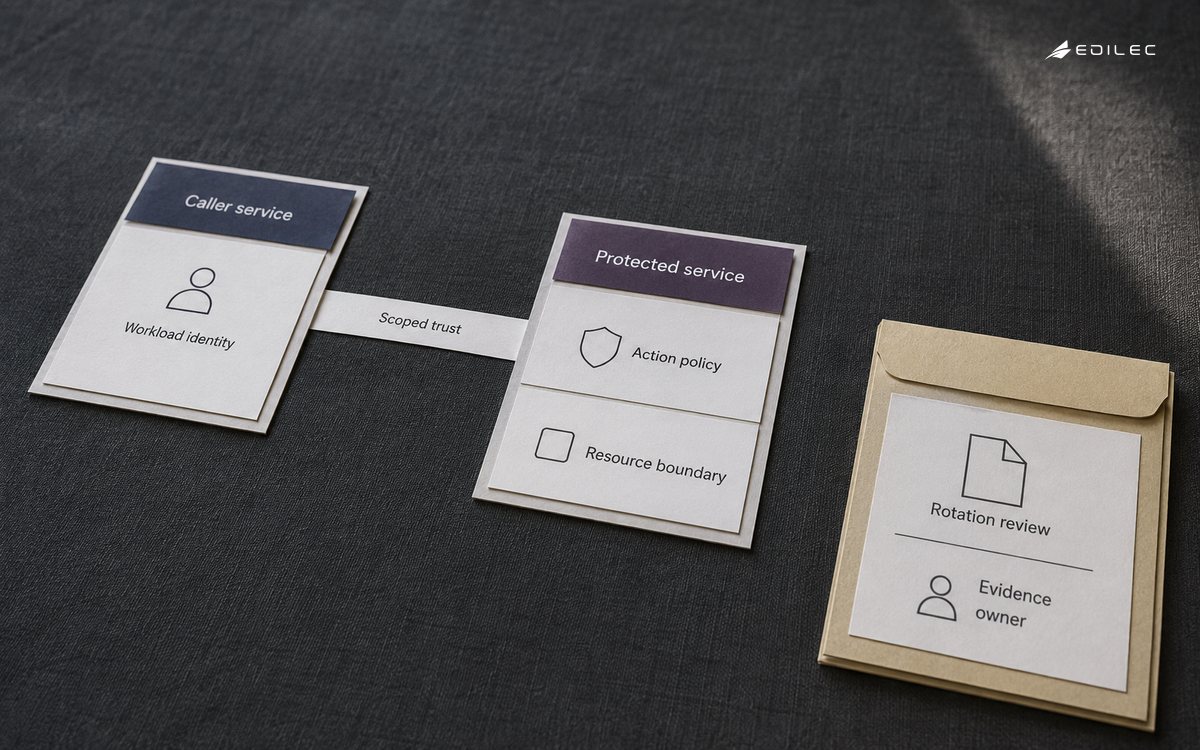
Multi-cloud zero trust service access treats every workload call as a request from a named software principal to a specific protected service, independent of cluster, account or provider location. Private addressing, peering and service-mesh membership can protect transport but do not establish business authority. The implementation needs verifiable workload identity, explicit trust relationships, policy at meaningful enforcement points, short-lived credentials and telemetry that survives boundaries.
The design is easiest when tied to one service flow. Name the caller, callee, action, data class and failure consequence. The NIST Zero Trust Architecture establishes the resource-centered principle, and Edilec's zero trust for business applications translates it into product decisions. This article applies that principle to workloads that cross clouds and managed services, where IP allowlists and provider-native identity formats often fail to express the same principal consistently.
Inventory service identities and protected calls
Create a service catalog with owner, deployment identities, environments, inbound APIs, outbound dependencies, data handled and lifecycle state. Distinguish a logical service from its replicas, jobs and deployment versions. Remove shared credentials that make several services indistinguishable. Record non-HTTP paths such as queues, databases and object stores because service-to-service access includes asynchronous and managed-resource calls, not only mesh traffic.
NIST SP 800-207A describes an application-level access-control model for cloud-native applications in multi-cloud environments, including API gateways, sidecar proxies and application identity infrastructure. Use that model to locate policy enforcement near protected services. A central gateway can govern north-south traffic, but calls inside and across clusters need equivalent identity and policy rather than presumed trust after entry.
| Identity option | Useful boundary | Main risk | Required control |
|---|---|---|---|
| Cloud workload identity | Resources in one provider trust domain | Provider-specific semantics across clouds | Federated mapping and audience restriction |
| SPIFFE ID and SVID | Portable workload identity across runtime domains | Overbroad trust-domain federation | Registration and selector governance |
| Kubernetes service account token | Cluster workload to compatible audience | Long-lived or broadly accepted token | Projected short-lived audience-bound token |
| Static API credential | Legacy managed service | Copying, weak attribution and rotation | Vaulting, narrow scope and replacement plan |
| mTLS certificate only | Service channel authentication | Identity mistaken for business authorization | Callee policy on action and resource |
Issue short-lived workload identity from runtime evidence
A workload identity system should attest runtime facts, map them to a registered service identity and issue a short-lived credential. The SPIFFE overview defines SPIFFE IDs and verifiable identity documents called SVIDs, with SPIRE as one implementation. Regardless of technology, govern registration selectors and deployment ownership. If any namespace label can claim a payments identity, short credential lifetime will not prevent impersonation.
Keep production, test and partner trust domains separate. Automate issuance and rotation without exporting private keys to build pipelines or developer laptops. Bind tokens to target audiences; bind certificates to recognized trust bundles and service identifiers. Define behavior when the identity agent or control plane is unavailable: existing short-lived credentials may continue within a bounded window, while new workloads fail visibly rather than falling back to a shared secret.
Federate trust narrowly across cloud boundaries
Federation means one domain accepts evidence from another under explicit constraints. Register issuer, subject namespace, audience, algorithms, key-discovery method and permitted service mappings. Avoid a rule that trusts every identity from a partner cloud. Translate external principals into local policy subjects through allowlisted mappings and retain the original issuer-qualified identity for evidence. Review federation when organizations, accounts or cluster ownership change.
Protect metadata and trust-bundle distribution as critical configuration. Cache with bounded freshness, overlap keys during rotation and alert on stale bundles or unexpected issuers. Test compromise containment: if one cluster's issuer is breached, determine which services and actions it can reach. Separate trust domains and narrow audiences should limit impact. Emergency distrust needs a rehearsed path that can propagate faster than ordinary configuration release.
Enforce service and object policy at the right layers
Transport policy answers whether service A may connect to service B on a protocol. API policy answers whether A may invoke an operation. Domain policy answers whether that operation is allowed on this tenant, account or record now. Use gateways, sidecars and application middleware for common checks, but keep business invariants in the service that owns the resource. A mesh allow must not become permission to update every object behind the endpoint.
Policy inputs can include workload identity, deployment environment, target, operation, tenant, data class, time, risk and delegation context. Version decisions and deny by default for unknown identities. Be cautious with mutable labels from caller-controlled headers; derive trusted context at the enforcement point. Edilec's secure API access control guide explains server-side object checks that complement infrastructure policy.
| Test | Expected outcome | Evidence | Recovery |
|---|---|---|---|
| Test workload calls production | Deny environment mismatch | Issuer, subject and policy reason | Correct deployment mapping |
| Valid service uses wrong audience | Deny token validation | Expected and received audience | Request target-specific token |
| Federated issuer key rotates | Continue through planned overlap | Bundle version and key ID | Rollback within bounded overlap |
| Sidecar unavailable | Fail according to documented service policy | Enforcement health signal | Restore without bypass route |
| Caller accesses another tenant | Deny domain authorization | Tenant and object policy result | Investigate caller behavior |
Correlate evidence and design resilient failure modes
Propagate a trace identifier while recording authenticated caller, issuer, target, policy version, operation and result at each enforcement point. Do not log full tokens or private keys. Join infrastructure allow decisions with application outcomes so an investigator can distinguish connection denial, token failure and domain rejection. The audit log guide provides a useful event model for authoritative effects.
Set availability expectations by service class. Identity issuance, policy distribution, DNS, gateways, proxies and cloud interconnects each fail differently. Use circuit breakers and bounded retries; never retry non-idempotent effects merely because a cross-cloud connection timed out. Predefine which read operations may use recently cached policy and which writes fail closed when fresh identity or policy is unavailable. Exercise regional isolation and trust-bundle rollback.
Use the six-stage Edilec multi-cloud workload path
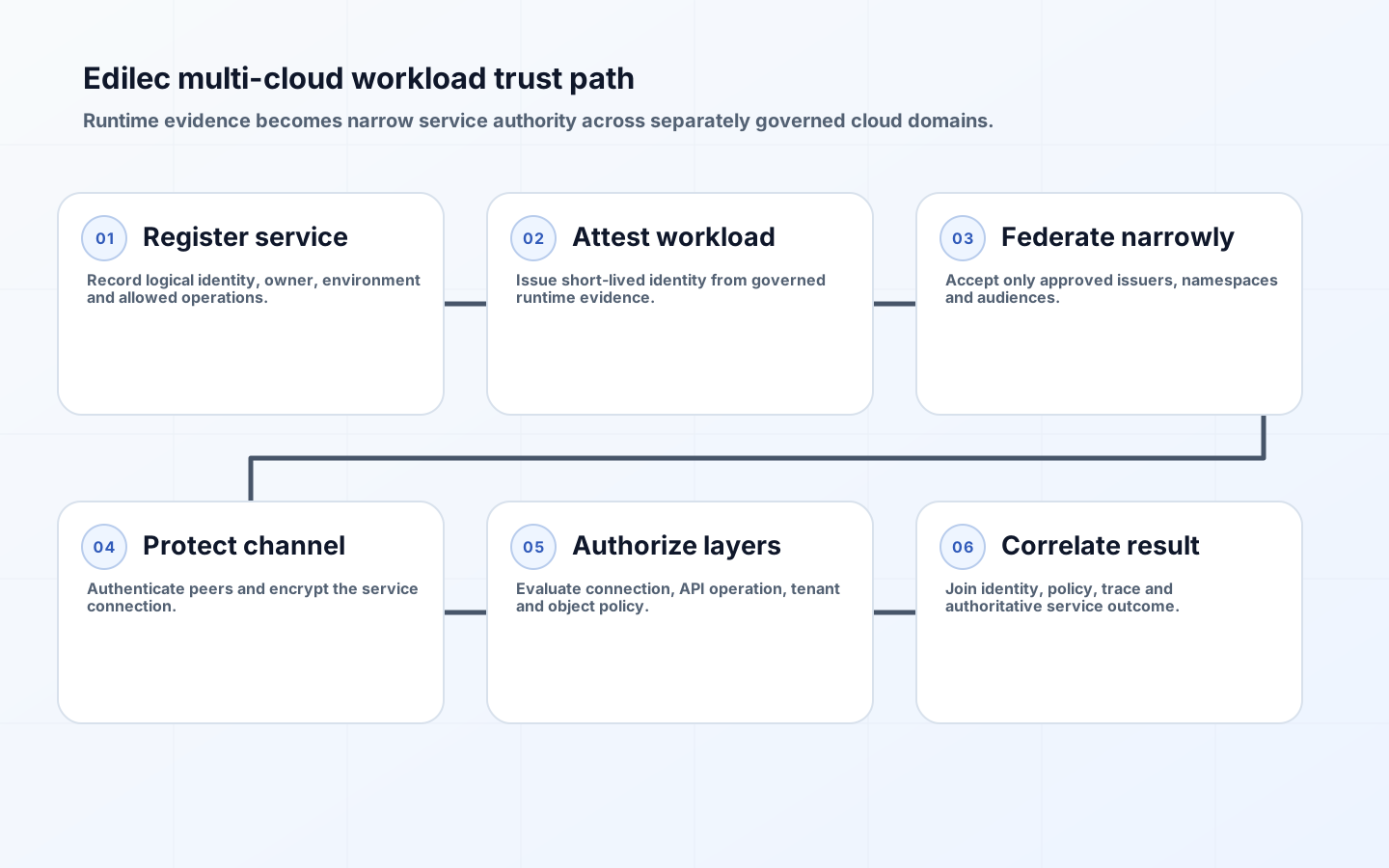
The Edilec path registers service ownership, attests runtime identity, federates only the needed trust, establishes an encrypted channel, evaluates layered authorization and records the authoritative result. Apply all six stages to one cross-cloud call and assign component owners. The sequence prevents teams from beginning with mesh installation while service names and permitted operations remain undefined.
Pilot a read and a consequential write between two clouds. Attempt calls from a sibling namespace, test environment, expired credential, wrong audience and untrusted issuer. Rotate the source issuer and disconnect policy distribution. Confirm that operators can identify the stage that failed and that no emergency procedure introduces a broad static credential. Verify queue consumers and scheduled jobs as well as synchronous APIs, because asynchronous paths often retain older credentials and weaker attribution. Use the CISA Zero Trust Maturity Model to coordinate identity, network, application and data owners around measured improvements. Then expand by service pair, not by opening an entire peered network.
Govern service onboarding and policy ownership
Offer a paved onboarding path that creates the service catalog entry, workload identity registration, environment-specific trust, default-deny policy, telemetry fields and rotation tests together. Require the service owner to declare inbound operations and outbound dependencies in machine-readable configuration under review. Platform teams can provide templates and validation, while domain owners approve business access. This division avoids a central security team guessing which service may modify an invoice or release a shipment.
Detect drift between registered identity and runtime deployment. Alert when a workload appears under an unexpected account, namespace, image provenance or region, and decide whether that evidence should prevent identity issuance. Remove identities and trust mappings when services retire. A dormant service principal with valid federation is an attack path even when no pods currently run. Review external trust relationships more frequently than low-risk internal service pairs because organizational control can change outside the platform's deployment system.
Use policy simulation before broad changes. Replay representative request attributes against the proposed version and inspect new allows and denies by service pair, operation and tenant class. Deploy to a small enforcement cohort, watch both policy decisions and business errors, then expand. Maintain a rapid policy rollback, but never roll back identity validation or audience checks as a generic availability fix. Separate policy distribution health from decision content so operators choose the right recovery action.
Key takeaways
- Give every logical workload an owned identity and eliminate shared credentials that erase attribution.
- Federate issuers, namespaces and audiences narrowly instead of trusting an entire cloud or cluster.
- Layer connection, API and domain authorization, keeping object invariants with the resource owner.
- Use short-lived credentials and rehearse identity, key and trust-bundle rotation under failure.
- Trace policy decisions through to authoritative service outcomes without logging reusable secrets.
Frequently asked questions
Does a service mesh provide multi-cloud zero trust by itself?
No. A mesh can issue identities, encrypt connections and enforce service policy, but identity registration, cross-domain trust, business authorization, managed-service access and evidence still require design. Mesh membership should not imply unrestricted authority.
Should IP allowlists be removed immediately?
They can remain a defense layer during migration, but should not be the primary identity or authorization mechanism. Document their purpose, keep ranges narrow and remove obsolete rules after workload identity and policy are proven.
Is SPIFFE required for this architecture?
No. SPIFFE supplies a portable standard and useful model, but provider-native federation or another workload identity system can satisfy the goals. Evaluate identity uniqueness, attestation, lifetime, federation, audience binding, rotation and enforcement interoperability.
Conclusion
Multi-cloud service access becomes zero trust when location stops being authority. Each caller presents a verifiable workload identity, each trust domain accepts only defined peers, and each protected service authorizes the requested operation with current context. Encryption is necessary, but policy and evidence make the channel accountable.
Start with one important cross-cloud dependency and prove identity, federation, denial, rotation and recovery end to end. Align the operating model with Edilec's zero trust field guide. Scaling from proven service pairs produces a controlled trust graph instead of a new multi-cloud perimeter.