What Changes When Multi-tenant Architecture Moves into Production
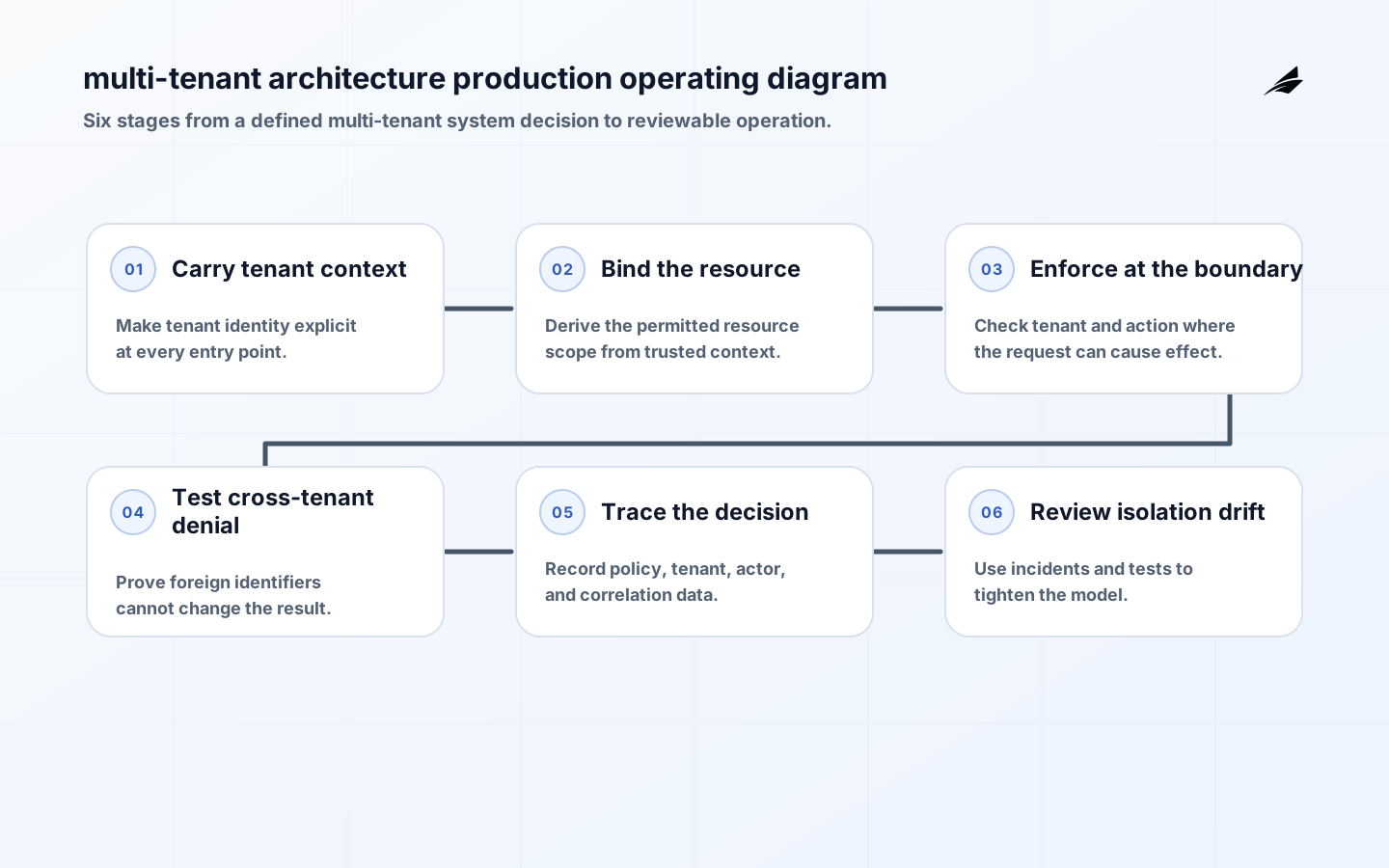
Production changes the meaning of multi-tenant architecture because tenant context must survive more paths than the browser request that first created it. A production system has background workers, exports, support tooling, retries, caches, webhooks, and staff actions. Each path can accidentally reintroduce a resource identifier without its tenant constraint. The useful question is therefore not whether the database has a tenant column. It is whether every consequential read, write, queue message, and administrative action derives scope from a trusted tenant context. AWS distinguishes tenant isolation from ordinary authentication and authorization: a signed-in, permitted user can still be pointed at another tenant’s resource unless the application enforces that boundary.
Set the multi-tenant architecture production boundary
Start by writing an inventory of resources that can expose or change customer state: records, blobs, search indexes, analytics exports, queues, and operational consoles. For each, name the tenant key, the trusted producer of that key, and the layer that rejects a mismatch. A route parameter is an input, not proof. In pooled storage, make the tenant predicate part of repository methods and policies so it cannot be casually omitted. In siloed components, still validate the mapping between request tenant and allocated resource. This is a product decision as much as a security decision: support staff need a deliberate, auditable way to switch context rather than an invisible superuser shortcut.
| Decision | Question to answer | Evidence to retain |
|---|---|---|
| Scope | What account, role, resource, or period does this multi-tenant system govern? | Stable identifier, effective time, and accountable owner. |
| Authority | Which service provides the fact used by the multi-tenant system? | Source version, freshness, and reconciliation status. |
| Failure | What happens when the deciding fact is late or disputed? | Safe state, user explanation, and escalation route. |
| Exception | Who can override the ordinary multi-tenant system result? | Purpose, approver, narrow scope, and expiry. |
Write an explicit multi-tenant architecture contract
The contract should express both data ownership and request ownership. A command such as “export invoices” needs an actor, tenant, target scope, authorization decision, policy version, and a correlation identifier. Jobs should carry a signed or server-derived tenant envelope rather than trust a customer-supplied payload. When a cross-tenant operation is legitimate, such as a platform-wide reliability aggregate, make it a separately named workflow with minimised fields and a named owner. The AWS authorization guidance is useful here because it treats API access control as a repeated pattern, not a one-off check in each endpoint.
- Name an accountable owner for the multi-tenant system decision and its data contract.
- Version the rule or state transition that changes the multi-tenant system outcome.
- Keep the user-facing explanation tied to a reason the system can reproduce.
- Define an expiry and review point for every manual exception.
Build controls around the multi-tenant architecture decision
Use negative tests as a release requirement. For every resource family, attempt reads, writes, search, bulk export, retry, and cache retrieval with a valid actor from the wrong tenant. Test asynchronous paths after deployment changes, because worker code often has different dependency injection and observability than request handlers. Keep tenant ID in structured logs and traces, but do not put secrets or raw personal data into telemetry. The OWASP logging guidance explains why event evidence must be useful without becoming a second data leak. A small set of invariant tests across services is more durable than hoping reviewers notice a missing predicate.
| Failure mode | Preventive control | Operating signal |
|---|---|---|
| Stale or absent context | Derive scope from a trusted server-side fact. | Decision failures by reason and source. |
| Duplicated work | Use durable identifiers and idempotent processing. | Duplicate suppression and retry outcomes. |
| Unexplained change | Record version, actor, target, and correlation. | Audit completeness and investigation time. |
| Unsafe override | Use narrow, expiring, reviewable exceptions. | Override age and post-expiry activity. |
Implementation decisions for multi-tenant architecture
Put tenant isolation tests beside every resource adapter, not only the HTTP layer. Repository methods should require tenant scope; queue consumers should reject messages without a verified envelope; search and export paths should prove that their filters cannot be broadened by a caller. The important review artefact is a map from each data store and side effect to the enforcement mechanism. This exposes the places where an otherwise sound request policy stops at a cache, object store, event stream, or support utility.
Decide which identifiers are safe to expose in URLs, logs, and customer support references, and which must remain internal. Tenant IDs, account IDs, and resource IDs have different collision, guessing, and migration risks. Treat mappings as production data with change history. When a tenant is merged, split, or renamed, preserve the historical relationship so an old job cannot resolve to a newly reused identifier.
Schedule periodic isolation drills using synthetic tenants. The drill should attempt a foreign-resource read, a bulk operation, a delayed retry, and a staff-assisted correction, then record the expected denial. This is stronger than an annual checklist because it exercises deployed dependencies and proves that observability still carries the context responders need.
Release multi-tenant architecture with observable limits
Release the boundary in slices that preserve recovery. First observe decision results without blocking only where doing so cannot expose data; then enforce on low-risk paths; then widen after deny rates, support cases, and trace coverage are understood. Treat a sudden increase in denied requests as a signal to examine an integration or stale membership, not automatic proof that the policy is wrong. Dashboards should separate policy denials, malformed context, mapping failures, and downstream errors. OpenTelemetry provides the vocabulary for linking a request, job, and dependency call through a correlation trail.
Recover without obscuring the multi-tenant architecture history
When isolation evidence is incomplete, fail closed for tenant-scoped data and give the user a stable explanation and support reference. Do not silently substitute a default tenant or retry a job after stripping its context. An incident runbook should identify how to stop affected jobs, scope potential exposure, preserve logs, notify the response owner, and prove the fix with the same negative tests used before release. The improvement loop is concrete: every exception should reveal an unmodelled entry point, ambiguous ownership relation, or insufficiently enforced boundary.
- Keep a support-ready view of the facts behind an affected multi-tenant system.
- Stop or narrow automated effects before a disputed decision spreads.
- Use a corrective action that references the original outcome rather than overwriting it.
- For adjacent planning, see the related tenant isolation for SaaS product engineering: a practical guide.
Preflight review for multi-tenant architecture
A useful preflight review for multi-tenant architecture walks through data stores, queues, caches, and exports. The reviewers should name the authoritative record for each part, the moment at which it becomes effective, and the person or team allowed to correct it. This is where ambiguous language is worth resolving: “current”, “active”, “available”, and “complete” often mean different things to product, operations, and customers. Turn those words into observable states before a release makes them contractual.
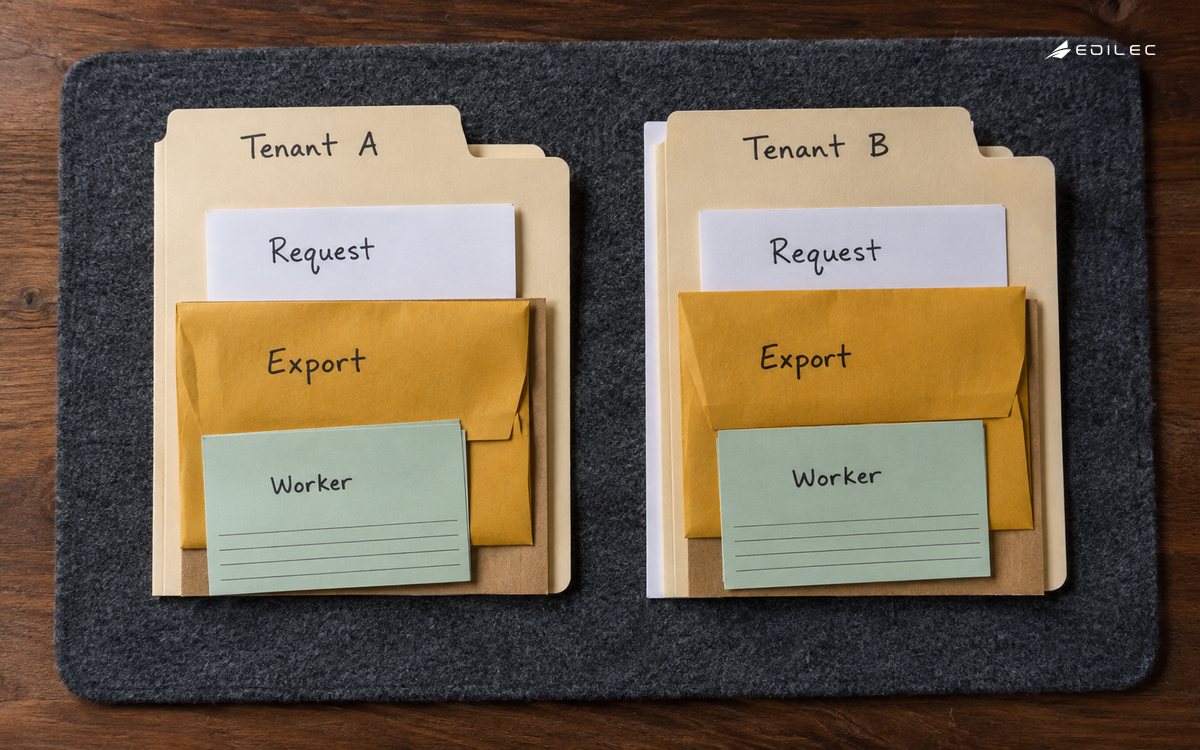
Use a scenario table built around a request from Tenant A pointing at a Tenant B resource. Ask what the customer sees, which server-side decision is made, what is stored for later explanation, and who receives the first alert when the outcome cannot be trusted. The scenario should be executable in a non-production environment and recognisable in production telemetry. That creates a bridge between acceptance testing and incident response instead of leaving recovery to a generic escalation note.
The minimum review evidence for this workflow is policy decision, predicate coverage, and cross-tenant test result. It should be available without reconstructing events from several unrelated dashboards. A concise operator view with timestamps, source references, and reason codes is more valuable than a large collection of metrics with no documented decision use. Decide which fields are sensitive, who can inspect them, and how long the evidence must remain useful.
Plan now for tenant migration and service-to-service access. These are ordinary production changes, not exceptional edge cases. A service that can explain its state before the change, during the transition, and after reconciliation will be easier to support and less likely to surprise customers. Include that transition in the rollout checklist, and retain a named owner until the new behaviour has been observed under real traffic.
Key takeaways
- Multi-tenant architecture must be owned as a production decision, not left as interface behavior.
- A versioned contract and evidence trail make changes explainable to customers and operators.
- Release signals should measure both technical correctness and the user outcome the workflow serves.
- Recovery is stronger when exceptions are narrow, attributable, and reconciled.
Frequently asked questions
For multi-tenant architecture, What is the first production test for multi-tenant architecture? Exercise one normal path and one hostile or interrupted path with the same identifiers, then confirm that the result, audit evidence, and user explanation agree.
Who should own multi-tenant architecture? Product owns the customer decision and success measure; engineering owns the dependable implementation; operations, security, finance, or support own the specialised controls that apply to their part of the workflow.
When is a manual override acceptable for multi-tenant architecture? Only when its scope, purpose, approver, expiry, and reconciliation action are visible. A permanent informal bypass is a missing multi-tenant architecture rule, not a reliable operating practice.
Conclusion
A production-ready multi-tenant architecture makes tenant scope a property of the whole execution path, not a convention in application code. The most valuable output is evidence: tests that demonstrate isolation, traces that explain a decision, and a recovery path that keeps a malformed request from becoming a broad data event. For adjacent planning, see This companion article on multi-tenant architecture for saas product engineering: a practical guide.