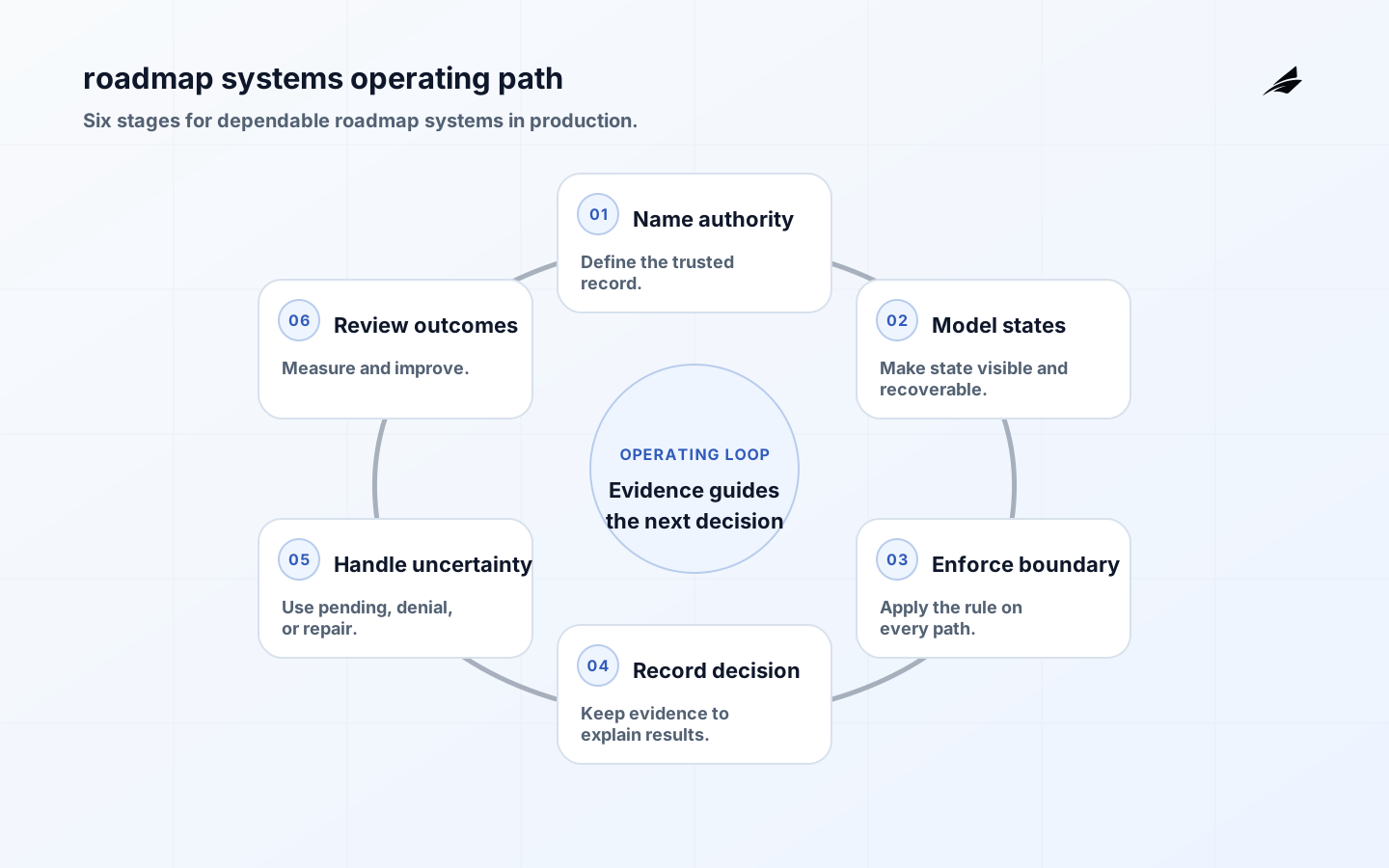
A roadmap system becomes consequential when teams, customers, and executives use it to make commitments. At that point, a card is not just a note about an idea. Its status can influence sales conversations, staffing, investment, and customer expectations. Production operation requires a distinction between aspiration, discovery, approved work, active delivery, and a promise made to a particular audience. The system must show what is known, what is uncertain, who can change it, and how the record evolved.
Validate roadmap systems through a complete operating case
Use this production transition guide to validate roadmap systems with one complete operating case before widening the scope. Delivery teams should trace one customer journey from first intent through an authorized state change, durable value, support visibility, and a measurable product outcome. Begin with the customer job, tenant and user identity, entitlement, workflow state, support history, and release decision, cross each policy and dependency boundary, and finish in a durable state that a customer or operator can recognize. Record the expected state at every handoff, who may change it, and which evidence proves that the next step was justified. This walkthrough gives product, engineering, security, and support a shared acceptance case instead of allowing each team to assume that another layer owns the transition. Use representative roles, realistic timing, and the constraints that exist during an ordinary operating day.
The production transition guide should also test a second roadmap systems case that deliberately challenges the design. Include a missing entitlement, repeated action, delayed integration, incomplete onboarding step, or support intervention. The purpose is not to demonstrate that every dependency always succeeds; it is to prove that the service can stop safely, preserve useful evidence, and expose the next responsible action. Review completion state, time to value, exception reason, support action, release cohort, and recurring product use together so the team can distinguish a policy refusal from bad input, a software defect, a delayed dependency, or an operator decision. A useful result is specific enough for a support or incident owner to act without reconstructing the entire journey from unrelated logs and messages.
Turn both cases into release evidence for roadmap systems. Keep the input conditions, expected states, observed result, decision owner, and unresolved exceptions in one reviewable record. Define the recovery action in advance: return the tenant to a clear state, preserve the customer record, route the right support action, and confirm that normal work can resume. Re-run the same cases after a material policy, interface, data, model, infrastructure, or entitlement change so that improvements do not silently weaken an earlier control. For this production transition guide, readiness means that the normal path is usable, the failure path is understandable, and ownership remains visible after launch rather than ending when implementation work is declared complete.
- Choose one representative roadmap systems journey and state the customer or operator result in plain language.
- Capture the customer job, tenant and user identity, entitlement, workflow state, support history, and release decision as evidence, with a named owner for each consequential handoff.
- Exercise a missing entitlement, repeated action, delayed integration, incomplete onboarding step, or support intervention before broader exposure and verify that the safe state is visible.
- Review completion state, time to value, exception reason, support action, release cohort, and recurring product use after release and assign every unresolved exception to a person and date.
Key takeaways
- Use explicit states for ideas, commitments, delivery, and retirement.
- Separate internal planning detail from customer-facing promises.
- Attach owners, evidence, assumptions, and review dates to important items.
- Prevent stale integrations from silently changing priority or delivery signals.
- Keep history so a changed decision can be explained rather than guessed.
- Measure decision quality and learning, not the number of cards moved.
Define what each roadmap state means
State names only help when they change behavior. Define entry criteria, exit criteria, owner, permitted edits, and audience for each state. An idea can be recorded without a delivery commitment. An approved initiative should have a problem statement, accountable lead, and decision date. An active item needs evidence from delivery work, while a completed item needs a reference to the shipped capability. A canceled item should retain the reason and any assumption that changed.
| State | Minimum evidence | Permitted promise | Review question |
|---|---|---|---|
| Idea | Problem, source, affected audience. | No delivery date. | Is this worth learning about? |
| Candidate | Owner, assumptions, discovery plan. | Possible future direction. | What evidence would change priority? |
| Committed | Scope, decision owner, dependencies. | A bounded planning commitment. | Can the team support this promise? |
| Shipped | Release reference and observed result. | Describe available behavior. | Did the change solve the intended problem? |
Govern decisions and visibility
A roadmap needs different permissions for proposing, prioritizing, committing, publishing, and retiring work. The browser should present those permissions, but the server must enforce them. The OWASP Authorization Cheat Sheet is a useful foundation for explicit checks and failure behavior. The NIST Secure Software Development Framework also supports treating decision controls as part of the product's delivery and operating practice. Record why a priority changed, who approved the change, which audience can see it, and when the decision should be revisited.
Separate planning from promises
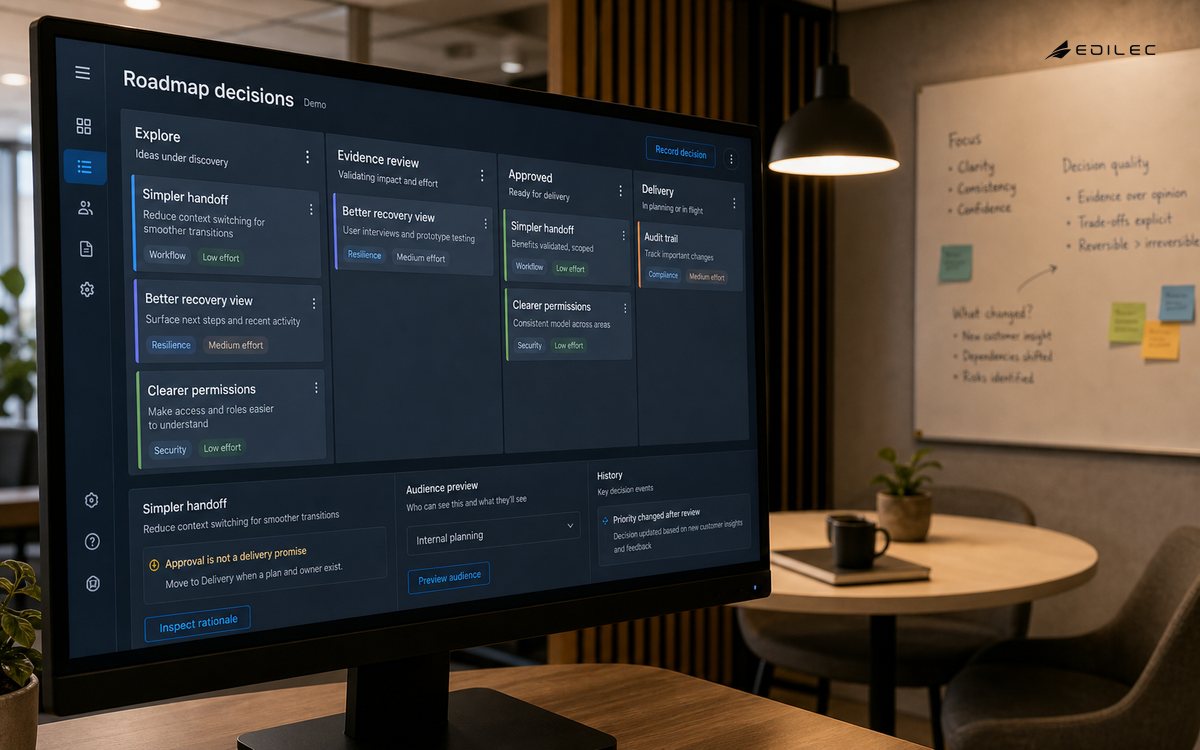
Internal roadmaps can contain staffing assumptions, unresolved dependencies, competitive concerns, or ideas that are not ready for public discussion. A customer-facing view should be a deliberate projection, not a raw feed from an internal board. Define which fields are safe for each audience and how a public commitment can be withdrawn or softened. Make dates meaningful: distinguish a target quarter, a discovery window, an active rollout, and general availability. Ambiguity is acceptable when it is named; false precision creates avoidable trust debt.
Make integrations explainable
Roadmap systems often ingest work items, delivery status, customer requests, and research notes from other tools. Store the source identifier, synchronization time, source version, and mapping rule. A failed sync should be visible rather than turning yesterday's delivery state into today's apparent truth. Decide which system owns each field and prevent two-way updates from creating loops. When a source disagrees with a local decision, route the conflict for review instead of silently choosing the most recent message.
Make tradeoffs visible at portfolio level
Roadmap decisions compete for people, technical capacity, customer attention, and operational tolerance. A production system should show the assumptions behind a priority without pretending that a score is an objective answer. Record the problem being addressed, affected audience, dependencies, confidence, opportunity cost, and next decision date. When an initiative moves up, identify what moved down or what capacity changed. This gives leaders a way to discuss tradeoffs directly instead of reading intent into an ordered list.
Do not let a numerical ranking outrun its evidence. A high-priority item with an unresolved dependency may need discovery before delivery. A lower-ranked reliability improvement may be necessary to protect a committed workflow. Let the system hold these distinctions and show the decision owner. The result is a roadmap that supports judgment rather than hiding judgment behind a calculated position.
| Decision detail | Useful record |
|---|---|
| Value | Customer problem, affected group, and intended outcome. |
| Cost | People, dependency, maintenance, and opportunity cost. |
| Confidence | Evidence quality, open questions, and next learning step. |
| Tradeoff | Deferred work, changed promise, or capacity released. |
Preserve the reasoning behind change
A current priority without history invites mythology. Keep old state, new state, actor, effective time, reason, supporting evidence, and related decision. Let a team distinguish a deliberate reprioritization from an accidental drag-and-drop. History should be searchable by initiative, owner, audience, and decision period. It should also be protected from casual edits, because the record is valuable precisely when the team is under pressure to explain a difficult tradeoff.
Measure learning and decision quality
Count the outcomes the roadmap is meant to improve: decisions made with evidence, commitments kept or revised early, customer questions resolved, dependencies found before delivery, and time spent recovering from stale information. Avoid treating card movement as progress by itself. The OWASP Logging Cheat Sheet offers guidance for recording meaningful events without over-collecting sensitive details. OpenTelemetry documentation can connect a roadmap decision to project work, publication, and customer interaction when that chain crosses services.
Operate the roadmap as a living system
Assign an owner for stale items, failed synchronizations, broken audience projections, and overdue decisions. Review items that have sat in the same state without evidence, but do not turn the review into a mechanical cleanup exercise. Ask whether the underlying problem remains important and whether the next decision is clear. Provide a safe recovery path for an accidental publication, duplicate integration update, or incorrectly assigned owner.
Test the promises people remember
Test a customer-visible item whose internal status changes, a failed source sync, two owners editing the same priority, a deleted dependency, a target date that passes, and a public commitment that must be withdrawn. Check that readers can tell what is planned, active, available, or no longer pursued. Verify that operators can recover the public view without erasing the decision history. The most damaging failure is often not a wrong status; it is an unexplained status that causes someone else to make a consequential decision.
Give important decisions a review cadence
A roadmap item should not remain important merely because nobody revisited it. Assign a review date when an item enters discovery or becomes a commitment, and ask the owner to bring the evidence that justifies the next state. The review may confirm the direction, narrow the scope, pause the work, or retire the idea. Store the outcome and the assumption that changed. This is different from clearing old cards; it is a deliberate check that the decision still serves the intended customer and business problem.
Make the cadence visible to the people who depend on the view. Sales should know when a public statement will be reconsidered. Delivery teams should see which dependency can block a commitment. Leaders should be able to distinguish an item waiting for evidence from one waiting for capacity. A roadmap that exposes these conditions helps teams make smaller, earlier decisions and gives customers a more honest account of what is known.
Make stale information visible to the reader instead of hiding it behind a polished card. Show the last meaningful update, source freshness, owner, and next review when those details affect a commitment. A reader can then decide whether to rely on the item, ask a question, or wait for evidence. This small amount of context is especially valuable when several teams consume the same roadmap view.
The same record should support a planning conversation, a customer question, and a later explanation of why the team changed course. Keep the language concrete enough that each audience can see what is certain and what remains conditional.
Frequently asked questions
Should every internal item appear on a public roadmap?
No. Publish a deliberate view with audience-safe language and a promise the team can maintain. An internal candidate may be useful for learning without being suitable for an external commitment.
What should be measured first?
Start with the quality of the decisions the roadmap supports: evidence attached, assumptions revisited, dependencies found, and customer promises corrected early. Then examine the recovery effort caused by stale or conflicting information.
For delivery teams working on roadmap systems, this operating signal should connect customer outcomes, tenant state, entitlements, release controls, support actions, and operating cost to evidence an accountable owner can inspect. For adjacent decisions, continue with Edilec's Multi-tenant SaaS Architecture: Production Boundaries That Hold and Feature Flags in Production: Safe Release and Rollback. In this production review, move beyond the operating signal only after the owner can show the accepted result, the exception path, and the signal for another review.
Conclusion
A production roadmap system is a decision record with carefully controlled views. Explicit states, accountable authority, audience boundaries, integration evidence, and preserved history let teams change direction without pretending the old direction never existed. That honesty makes planning more useful to delivery teams and more trustworthy to customers.