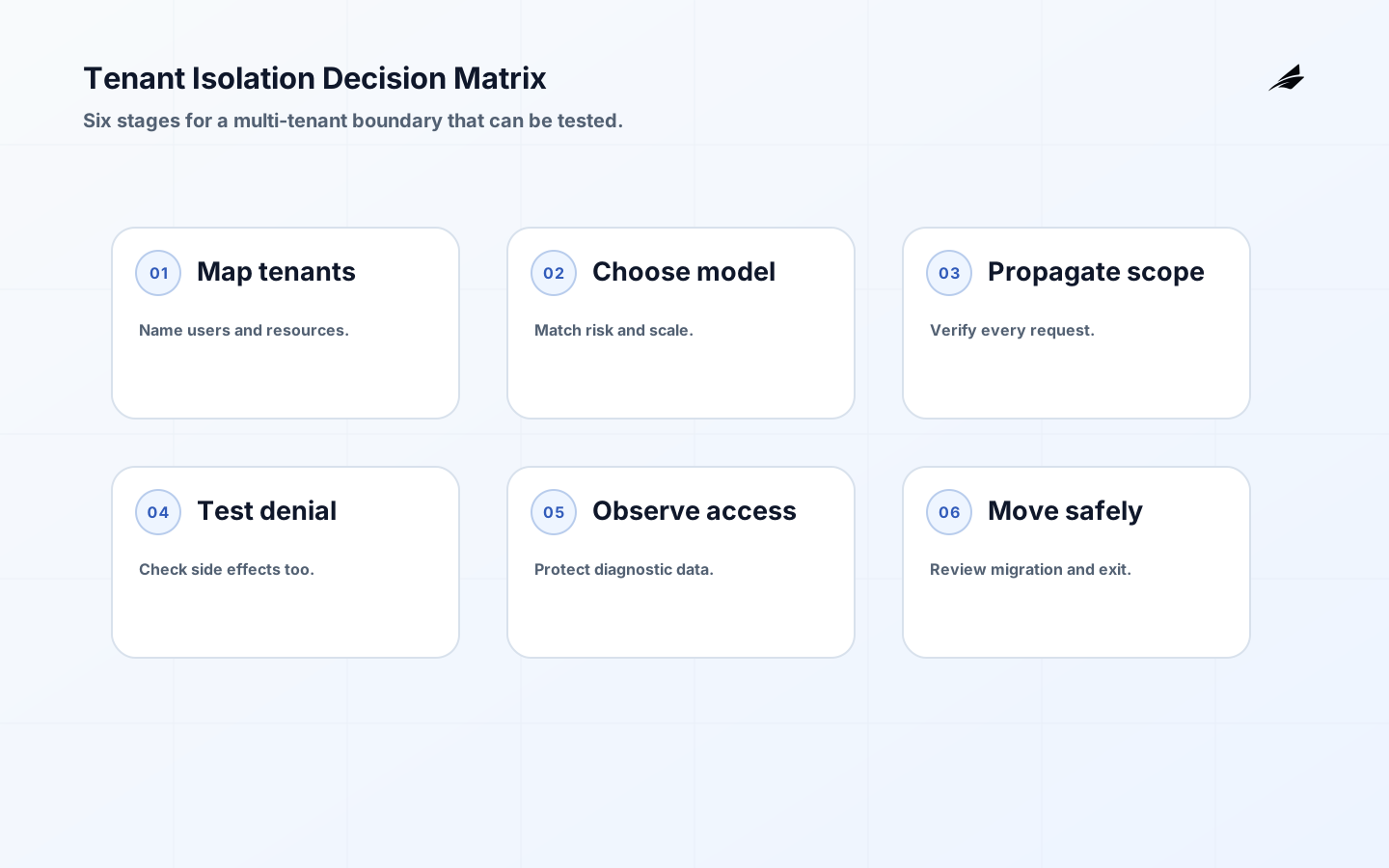
Tenant isolation decisions determine how one customer’s users, data, jobs, files, metrics, and support actions from crossing into another customer’s scope. It is not solved by adding a tenant_id column or by hiding a customer selector in the interface. The decision reaches identity, API authorization, database queries, caches, queues, search indexes, object storage, analytics, background workers, exports, logs, and administrative tooling. Before the first build, choose the isolation model and write the failure behavior. AWS guidance presents multiple authorization and isolation options because the correct trade-off depends on scale, risk, performance, and operating capability. The team must still prove its chosen boundary with adversarial tests.
Define the tenant boundary
Name the tenant, user, workspace, resource, role, and relationship that determine access. Decide whether a user can belong to several tenants, whether a resource can be shared, whether support staff may impersonate, and which services may act across tenants. Put those decisions in an authorization model before designing endpoints. A tenant boundary should be enforced from trusted identity and server-side state, not from a client-supplied parameter. Write examples for normal access, cross-tenant access, a suspended account, a support request, and a background job. If the team cannot explain why each request is allowed, the boundary is still a sketch.
| Boundary | Decision | Evidence |
|---|---|---|
| Identity | How is tenant scope established? | Claims, membership, and server lookup |
| Resource | Can it be shared or moved? | Relationship and audit history |
| Support | What exceptional access exists? | Approval, scope, expiry, and record |
| Automation | Which worker may act? | Service identity and tenant binding |
Compare isolation models deliberately
Shared tables with enforced row policies can be efficient and consistent, but one missing predicate or privileged database path can create a serious breach. Separate schemas or databases can make boundaries more visible and support stronger blast-radius controls, but they increase migration, monitoring, and operational work. A hybrid model may isolate high-risk tenants while sharing lower-risk workloads. PostgreSQL row security policies provide a database-level mechanism, yet the application must understand policy owners, bypass roles, connection pooling, migrations, and administrative access. Choose the model against consequence, tenant count, support capability, and recovery requirements. Do not call a database layout an isolation strategy until every downstream store is included.
| Model | Strength | Cost or risk to test |
|---|---|---|
| Shared tables | Simple operational footprint | Predicate, cache, and admin bypass |
| Separate schemas | Clearer namespace boundary | Migration and connection routing |
| Separate databases | Strong blast-radius separation | Provisioning, cost, and fleet operations |
| Hybrid | Matches varied risk and scale | Complexity of policy and placement |
Authorize every layer
Enforce authorization at the API and service boundary, then carry tenant scope into database, storage, cache, queue, search, and export operations. Do not trust a hidden form field or a path segment without checking it against the authenticated membership and resource relationship. OWASP recommends server-side authorization and least privilege; apply that to human and machine identities. A worker processing a job should receive an explicit tenant-scoped context and reject a payload whose tenant does not match the job. Review privileged roles, support tools, migrations, and reporting paths separately because they often bypass normal request code.
Test cross-tenant failure before launch
Create at least two tenants with similar identifiers, overlapping resource names, different roles, and separate files. Test read, write, delete, search, export, notification, cache, background job, and audit paths. Alter IDs, omit tenant context, reuse a token, replay a job, switch a host, and call an administrative endpoint. Check both response and side effect: a denied request must not enqueue work, mutate a cache, leak an error message, or create an audit record visible to the wrong tenant. Use automated authorization tests and a release gate. NIST SSDF’s secure development framing supports treating these tests as repeatable engineering work rather than a one-time audit.
Include data products and observability
Analytics, logs, traces, backups, support exports, and search indexes can leak tenant information even when the primary API is correct. Decide whether telemetry is tenant-scoped, aggregated, redacted, or restricted. Do not put customer content in exception messages or unprotected trace attributes. Retain enough context to investigate a failure without making every operator a reader of every tenant. Review backups and restore tooling: a database dump, staging environment, or debug export needs the same boundary discipline. The source of truth for tenant membership and the audit record of exceptional access should be protected as high-value data.
Operate changes, moves, and offboarding
Tenant isolation must survive migration, resource transfer, plan changes, suspension, deletion, and support intervention. Model a resource move with an explicit owner, approval, and history; do not update a tenant column without checking related files, jobs, indexes, and caches. When a tenant is suspended, define which reads, writes, exports, and background actions stop. When data is deleted, identify replicas and retention obligations. A change runbook should include preflight counts, an idempotent operation, a rollback boundary, post-change verification, and a customer communication owner.
Key takeaways
- Treat tenant isolation as an authorization and data-flow property across the whole system.
- Choose an isolation model against consequence, scale, and operating capability.
- Carry trusted tenant scope into stores, caches, queues, exports, and workers.
- Test denied access and side effects with similar tenants and adversarial inputs.
- Design migrations, support access, backup recovery, and offboarding as boundary changes.
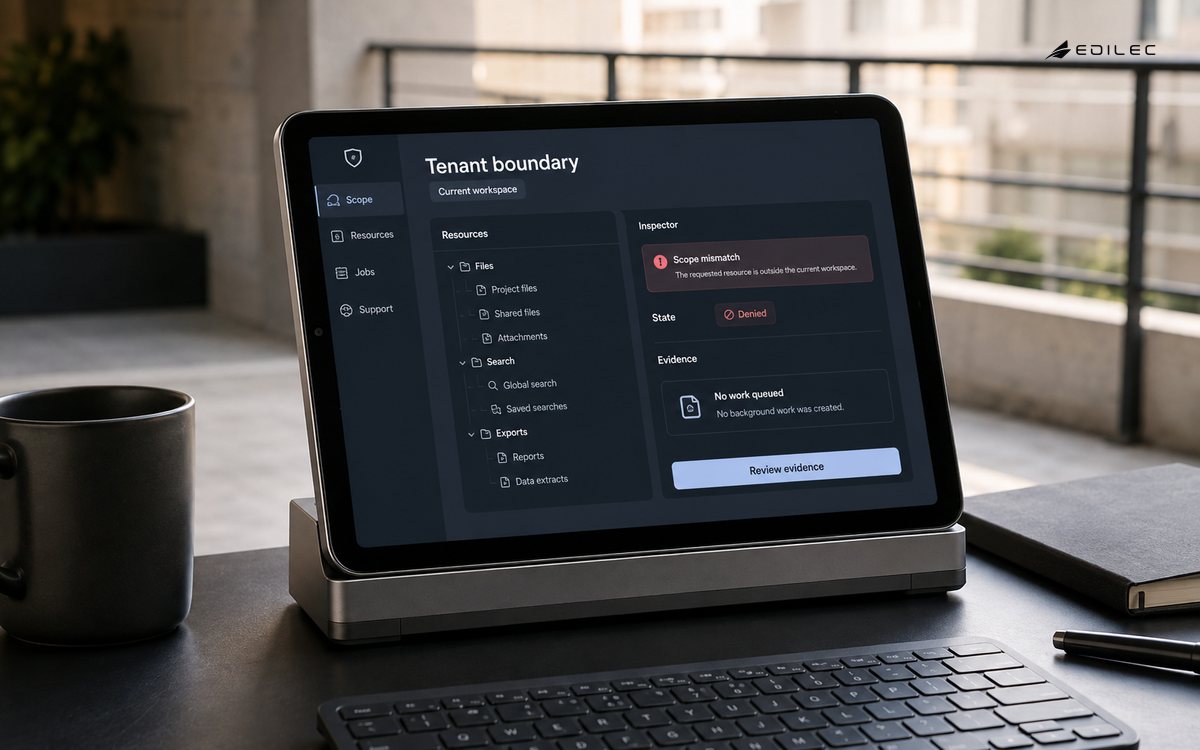
The AWS SaaS Lens treats tenant isolation as an architectural and operational concern, while PostgreSQL’s row security policies show how database enforcement participates in the boundary. Use the NIST Secure Software Development Framework and OWASP Authorization Cheat Sheet to make authorization and verification explicit, and review the AWS tenant-isolation guidance when choosing service-layer controls.
Frequently asked questions
Is a tenant_id column enough?
No. It can support a design, but authorization must be enforced across APIs, queries, workers, caches, files, search, exports, logs, and administrative paths.
Should every tenant have a separate database?
Not always. Separate databases may reduce blast radius, while shared models may be more operable. Choose using risk, scale, support capability, and tested recovery.
What is the most useful isolation test?
Use similar tenants and try altered IDs, missing context, replayed jobs, exports, caches, search, and support tools. Verify denied responses and absence of side effects.
Conclusion
Tenant isolation is a promise about who may see, change, or cause effects for a customer. Before choosing a database pattern, describe the tenant boundary in terms of users, organizations, resources, jobs, files, events, support actions, and derived data. Identify the consequence of a cross-tenant mistake and the safe behavior when context is missing. This gives architecture, authorization, testing, and operations one shared risk statement. Map relationships rather than relying on a tenant column. A resource may inherit scope from an organization, belong to a project, appear in a queue, feed a search index, or be copied into an export and a cache. Write down the authoritative owner and the permitted relationship for each path. Distinguish authenticated identity from tenant membership and from resource authorization. A request that contains a tenant identifier is not trustworthy merely because the value has the expected shape. Choose an isolation model against the real operating envelope. Shared tables with row-level controls, separate schemas, separate databases, or separate deployments each change cost, blast radius, migration effort, support workflow, and recovery. The important question is whether the team can enforce and verify the selected boundary across APIs, workers, scheduled jobs, analytics, files, caches, search, billing, and administration. Document exceptions and make the model legible to the people who will operate it. Test denial as thoroughly as success. Use similar tenants, altered identifiers, missing context, stale memberships, replayed jobs, bulk exports, cache hits, search results, and support tools. Verify both the response and the absence of side effects. Test background work after a membership change, a tenant move, a suspension, a restore, and a deletion request. A clean API response is insufficient if a queue, notification, index, or log still carries the wrong customer’s data. Observability must help an authorized person investigate without becoming a leak. Record the scope decision, actor, resource, policy version, result, and correlation context, but minimize payload and restrict access to diagnostic evidence. Give support a purpose-bound, time-limited route with approval and expiry instead of a permanent impersonation privilege. Make it possible to prove which tenant a job was intended for and which tenant it actually touched, without copying customer content into every log line. Migrations deserve a boundary plan. Define how a resource changes owners, how identifiers remain stable, how caches and search update, and how in-flight work is handled. Use cohorts, reconciliation, rollback evidence, and a clear finalization step. During a move, show whether the old and new owners may read, write, or only observe. Offboarding should revoke access, clean derived copies, preserve required records, and leave an auditable disposition. The first build is ready when the team can demonstrate a normal workflow, a denied request, an indirect path, a recovery path, and an exceptional support action. Review the evidence with engineering, security, support, and the product owner. If a boundary depends on a convention that a new service could easily bypass, tighten the control or narrow the scope. Tenant isolation becomes credible when architecture and operations can prove both the access granted and the access refused. Compare the boundary model with tenant isolation for growing teams, product analytics before the first build, and product analytics in production. The related material is useful because tenant scope often travels through analytics, logs, exports, and support workflows even when the primary data model looks sound. Use it to ask where context is copied, who can join it, and how deletion or migration is proven. The first-build review should require a denied request, an indirect data path, an approved support action, and a tenant move. Retain the evidence and the rollback decision before adding more storage or more administrative convenience.
Tenant isolation is a product promise backed by architecture, authorization, data handling, and operations. Choose the boundary early, test it across every path, and keep migrations and exceptional access visible. Trust grows when the system can prove what it allowed and what it prevented.