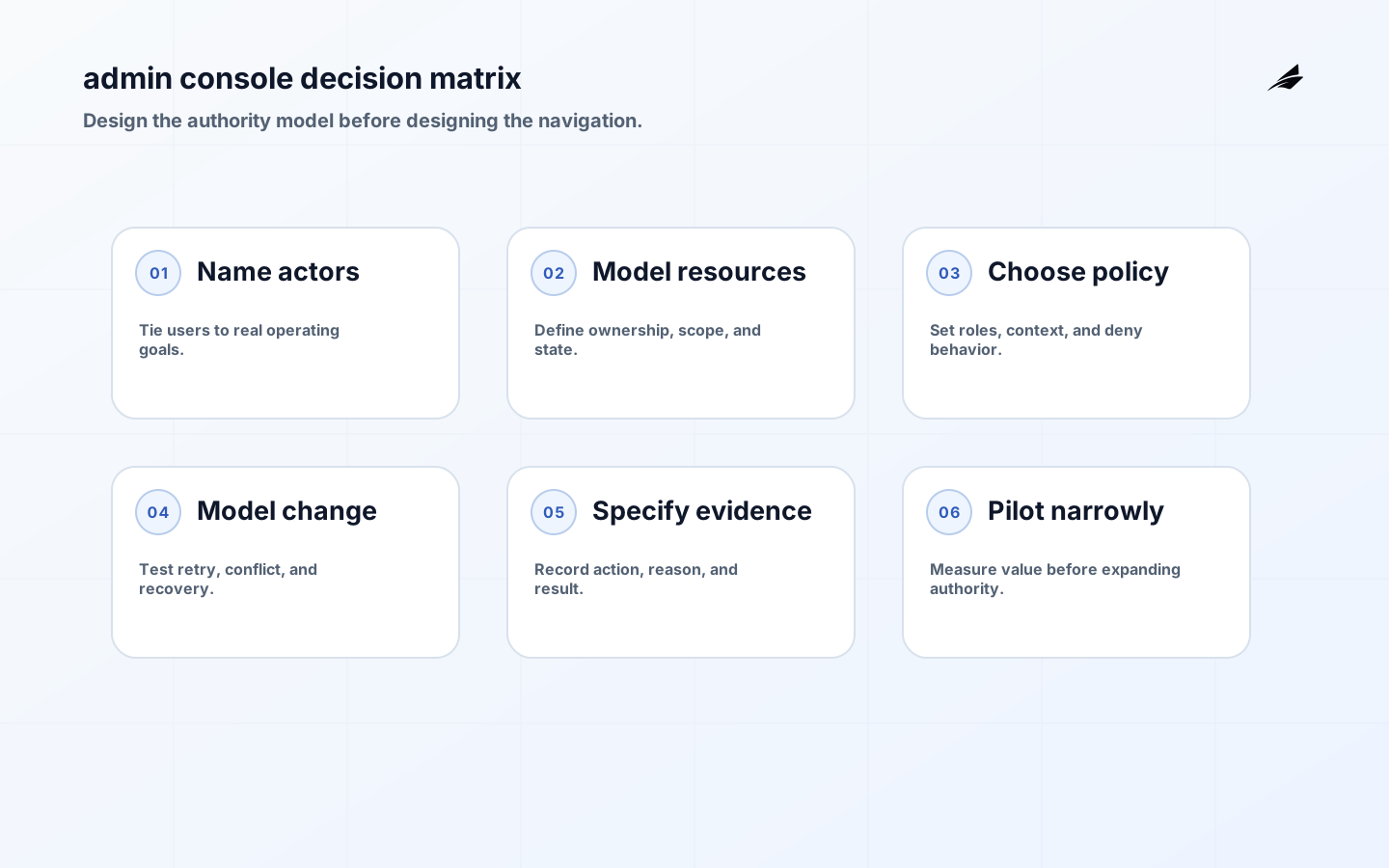
Admin Console Planning: Define Authority First
An admin console is often designed from a list of screens: users, accounts, settings, reports, and support tools. That is the wrong starting point for a system that can alter real customer or operational state. Before the first build, define the actors, objects, actions, consequences, approvals, evidence, and recovery path. A useful console is not merely a faster database editor; it is a bounded authority surface that helps a named team make a decision without hiding the impact. The OWASP Authorization Cheat Sheet gives a strong starting principle: authorization should be explicit, least-privilege, and enforced where the resource is protected.
Name actors and operating goals
Write down each user group and the work they need to complete. A support agent may need to explain an account state; a billing specialist may need to correct an invoice; a security administrator may need to revoke access; an engineer may need to inspect a failed job. These are different goals with different authority and data exposure. Observe the current workflow, including approvals, handoffs, spreadsheets, and manual checks. Link to what changes when admin consoles move into production for the later operational standard. If a role cannot be described with a real decision and boundary, do not create a broad role for it yet.
| Design decision | Why it matters | Artifact before build |
|---|---|---|
| Who acts? | Role, skill, and support context shape the workflow. | Actor map and accountable owner. |
| What is the object? | Object scope prevents accidental cross-tenant access. | Resource model and ownership rule. |
| What may change? | Action consequence determines controls and approval. | Action inventory and risk tier. |
| What proves it? | Evidence enables support, audit, and recovery. | Event record and retention decision. |
Model resources before pages
Define the resources the console will expose: tenant, organization, user, subscription, invoice, job, device, or configuration. For each, specify owner, parent scope, lifecycle state, sensitive fields, and relationships. Decide whether an action operates on one resource, a set, or a derived view. Make cross-tenant and cross-organization boundaries explicit. A page can display a friendly name, but the backend must act on a stable identifier and verify its scope. Include deleted, suspended, archived, and pending states so the design does not treat every record as active and editable.
Choose an authorization model
Choose the smallest model that expresses the real policy: role-based, attribute-based, relationship-based, or a combination. NIST SP 800-207 is useful for thinking about the user, resource, policy, and context as separate inputs to an access decision. OWASP ASVS can help turn the model into verification cases. Define deny behavior, conflict resolution, delegated access, break-glass authority, and revocation. Do not begin by copying a super-admin role into every workflow because it is convenient; broad authority is difficult to test and harder to explain after an incident.
Design state transitions and failure
For every write action, describe starting state, validation, approval, side effect, resulting state, and recovery. Decide how the system handles duplicate submissions, stale pages, concurrent edits, downstream timeout, and partial batch completion. Include idempotency and version checks in the API contract, not as a UI afterthought. Show users whether an action is proposed, accepted, completed, rejected, or unknown. If the record changes elsewhere during the workflow, present a conflict with enough context to choose a safe next step. A design that has only a happy-path confirmation is not ready for production authority.
| State or event | Product question | Acceptance evidence |
|---|---|---|
| Before change | Can the user see scope, impact, and required approval? | Preview with correct object and permission. |
| During change | Can a retry or timeout be distinguished? | Idempotency and failure simulation. |
| After change | Is the result durable and inspectable? | Readback, event, and audit record. |
| Recovery | Can a wrong or partial change be reconciled? | Rollback or compensating procedure. |
Specify the evidence contract
Decide which actions need durable evidence and what it must contain. OWASP’s Logging Cheat Sheet distinguishes useful event data from sensitive data that should not be recorded casually. Capture actor, scope, action, target, time, reason, approval, old and new state when appropriate, and outcome. Define retention, access, integrity, correlation, and disposal. Give support a way to find the event without granting broad access to the underlying audit store. Evidence should answer both “what happened?” and “what should we do now?”
Make the workflow accessible and understandable
Use WCAG 2.2 before the component library is chosen. Decide how a user reaches controls with a keyboard, sees focus, understands labels, reads validation, distinguishes errors without color, and recovers after a timeout. High-consequence actions need clear scope, plain language, and a stable confirmation sequence. Do not rely on hover-only explanations or icon-only buttons. Test the entire workflow at zoom, with keyboard-only navigation, with a screen reader, and under slow network. Accessibility is not a later polish pass when the screen controls customer or operational outcomes.
Example: design an account access review
A company wants an admin console for reviewing account access. The initial decision is not “manage users”; it is “let an authorized security administrator remove a stale grant while preserving evidence and avoiding a lockout.” The design names user, account, grant, source system, and current session as resources. It requires scope checks, step-up authentication, a reason, a preview of affected applications, and a durable result. If the directory is unavailable, the console does not claim success. A review view distinguishes assigned, inherited, effective, pending, and revoked access. The pilot tests wrong-tenant identifiers, concurrent changes, session expiry, bulk removal, and recovery for a mistaken revocation.

Choose a small pilot and success measures
Select one actor group, one resource boundary, and a small action set. Measure time to complete the decision, correction rate, denied legitimate requests, unsafe attempts blocked, reconciliation backlog, support contacts, and audit completeness. Review the pilot with the people who own the business outcome, not only the developers who built the screen. Version the authorization policy, API contract, copy, and evidence schema. Define who can approve expansion, who handles incidents, and how to disable the feature without leaving an orphaned path. A narrow pilot produces evidence that a broad console plan cannot.
Key takeaways
- Actors, operating goals, resources, ownership, and data sensitivity.
- Actions, consequence, reversibility, approval, and server-side policy.
- State transitions for retry, timeout, conflict, partial success, and recovery.
- Evidence fields, retention, integrity, access, and correlation.
- Accessible labels, focus, error handling, scope preview, and confirmation.
- Pilot boundary, success measures, owner, expansion gate, and disable path.
Frequently asked questions
Should every internal tool start with a super-admin role?
No. Start with the smallest actor and action scope that supports the decision. A temporary break-glass role may be necessary, but it needs stronger controls, visibility, expiry, and review.
Can the UI define the access boundary?
The UI can explain and guide authority, but only the server can enforce it reliably. Test direct requests and changed object identifiers as part of the design acceptance criteria.
Turn the authority model into testable work
A useful pre-build package contains more than wireframes. Include an actor-to-action matrix, resource and tenant model, state-transition map, decision table for authorization, error and recovery catalogue, audit schema, accessibility acceptance criteria, and a pilot plan. Give every action a stable name that can appear in the API, audit record, support guide, and test. This shared vocabulary prevents a page called “Users” from hiding several unrelated authorities such as view profile, reset factor, change role, suspend account, and export data. Each should be reviewed on its own consequence and recovery path.
Use examples that force the boundary to show itself. Consider a user who belongs to two organizations, an account whose parent is suspended, a record changed by another operator, and an action that is valid only during a maintenance window. Ask what the actor sees, what the server checks, what event is recorded, and how a mistake is reversed. Link to admin consoles in production to carry these design decisions through release. If a scenario cannot be explained without a super-admin exception, the underlying policy probably needs more work.
Choose an initial API shape that preserves scope and intent. Pass stable object identifiers, explicit action names, idempotency keys, expected versions, and reason or approval references where required. Return structured outcome states rather than a generic success or error. Make bulk operations a separate contract with caps, preview, per-item outcomes, and reconciliation. Do not let the browser submit arbitrary field patches that bypass business rules. A clear action contract is easier to secure and easier to evolve than a generic update endpoint wrapped in a polished form.
Set the review order before implementation begins. The business owner confirms the decision and acceptable consequence; the security owner confirms actor, resource, and revocation; the data owner confirms scope and retention; the operator confirms wording and fallback; and engineering confirms testability and observability. Use RBAC design for internal tools when choosing role boundaries and audit logs for SaaS platforms when specifying evidence. This sequence keeps a screen review from becoming the first time the team discovers a policy disagreement.
The most valuable pre-build decision is often an explicit refusal. Decide which actions will remain in the primary product, which belong in an admin console, which require a separate security tool, and which should not be automated at all. This keeps the console from becoming the place where every unresolved product policy is hidden behind a privileged button. Use admin dashboard architecture to separate observation from administration, and secure admin panel design to review the interaction and control boundary. Record the reason for each placement, its owner, and the evidence needed to revisit it. A smaller console with a clear boundary is easier to secure, easier to train, and more useful during an incident than a broad surface whose authority no one can explain.
Use the planning artifact during implementation review. Ask whether each visible control maps to a named server action, whether each action has a scope and state check, and whether the result can be reconciled. If a designer adds a convenience shortcut, update the action inventory and risk decision rather than letting the shortcut escape review. Admin console architecture can help separate administrative workflows from ordinary dashboards, while the authority matrix remains the source for permissions.
A planning workshop should end with decisions that can be challenged. Ask which actor is accountable, which data is authoritative, which action is reversible, and what evidence proves the result. If the group cannot answer, record the uncertainty as a design constraint rather than hiding it in a generic role or an “advanced settings” page. The next workshop can then resolve one boundary at a time. This pace may feel slower at the beginning, but it gives implementation teams fewer ambiguous requirements and gives operators a clearer tool to use when the product is under stress.
Conclusion: design the authority before the screen
The best admin console plans begin with decisions and boundaries, not navigation. Define actors, resources, actions, state, evidence, accessibility, and recovery before building components. That preparation lets the team create a focused tool whose speed comes from clarity and whose authority remains accountable.