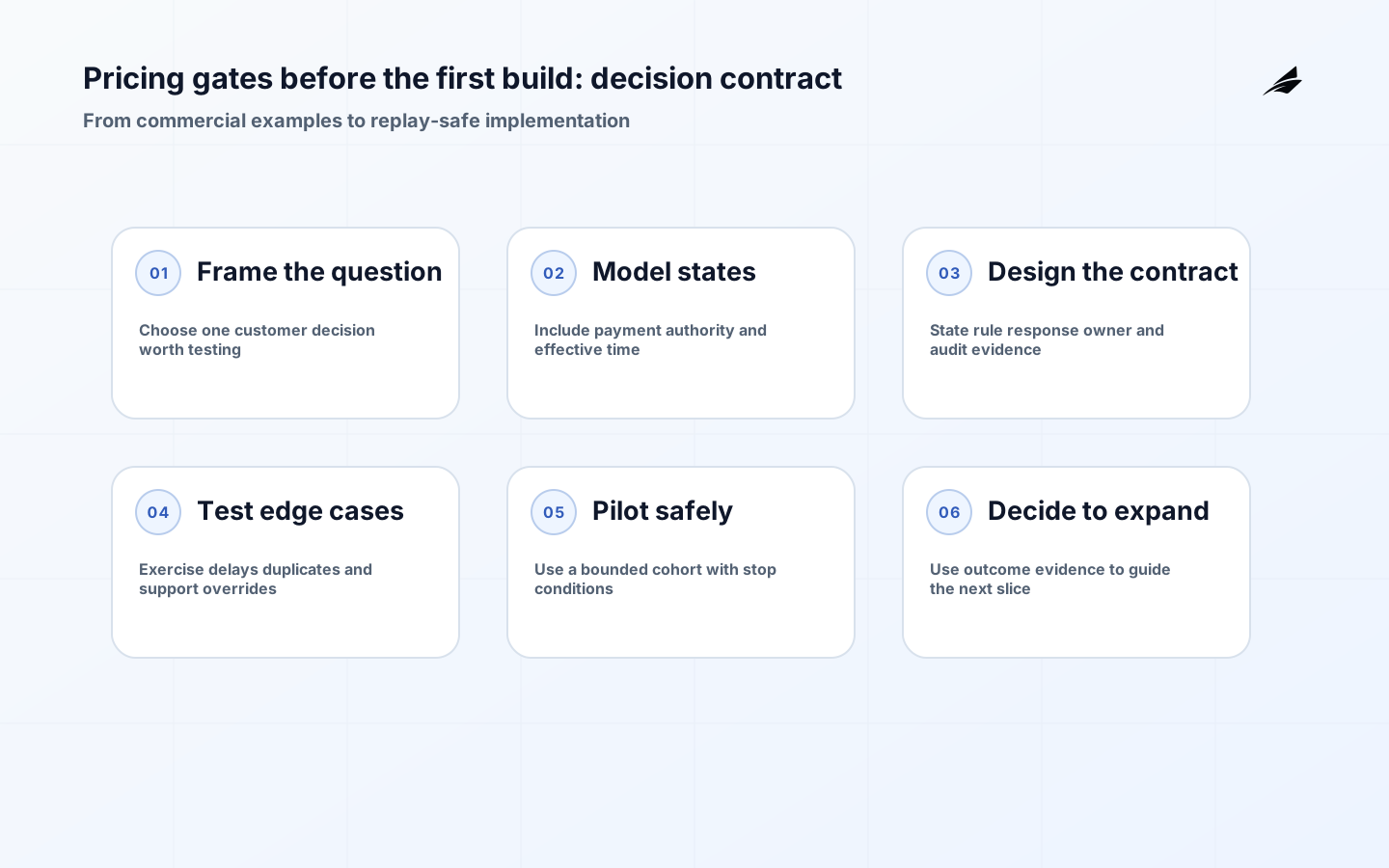
Pricing gates is a production concern because it decides whether a customer may use a capability under the current plan, usage, contract, and temporary exception. Before the first build, define one server-side entitlement record, its owner, its effective time, and the customer-safe result for allow, deny, pending, or review. A collaboration service might evaluate an export entitlement from plan, contract add-on, current usage, and an expiring exception, then return a precise next action when access is denied. Stripe Billing subscriptions overview provides commercial-lifecycle context, while the OWASP Authorization Cheat Sheet reinforces server-side enforcement. Keep launch rollback tied to a fixture that proves the state, explanation, and recovery action remain consistent.
Pre-build pricing gates — Define the decision before the mechanism
For pricing gates, write a one-page decision contract that names the subject, capability, qualifying facts, protected operation, effective time, policy version, denied result, and exception owner. Decide what happens when a required fact is late or unavailable; pending and review are states that need an owner, not vague error messages. The contract should also state how a correction is approved and how the customer-facing explanation is derived from durable evidence. NIST Secure Software Development Framework offers a useful anchor for treating these decisions as planned, testable development work.
| Decision question | Concrete rule | Evidence to retain |
|---|---|---|
| Who or what is affected | Use a stable subject and scope. | Identifier and effective time. |
| Which fact decides | Read one declared authority. | Source version and correlation ID. |
| What happens when unsure | Choose pending, deny, or review deliberately. | Reason code and next action. |
| Who can repair it | Use a scoped, auditable path. | Approver, expiry, and outcome. |
Pre-build pricing gates — Model state, ownership, and time
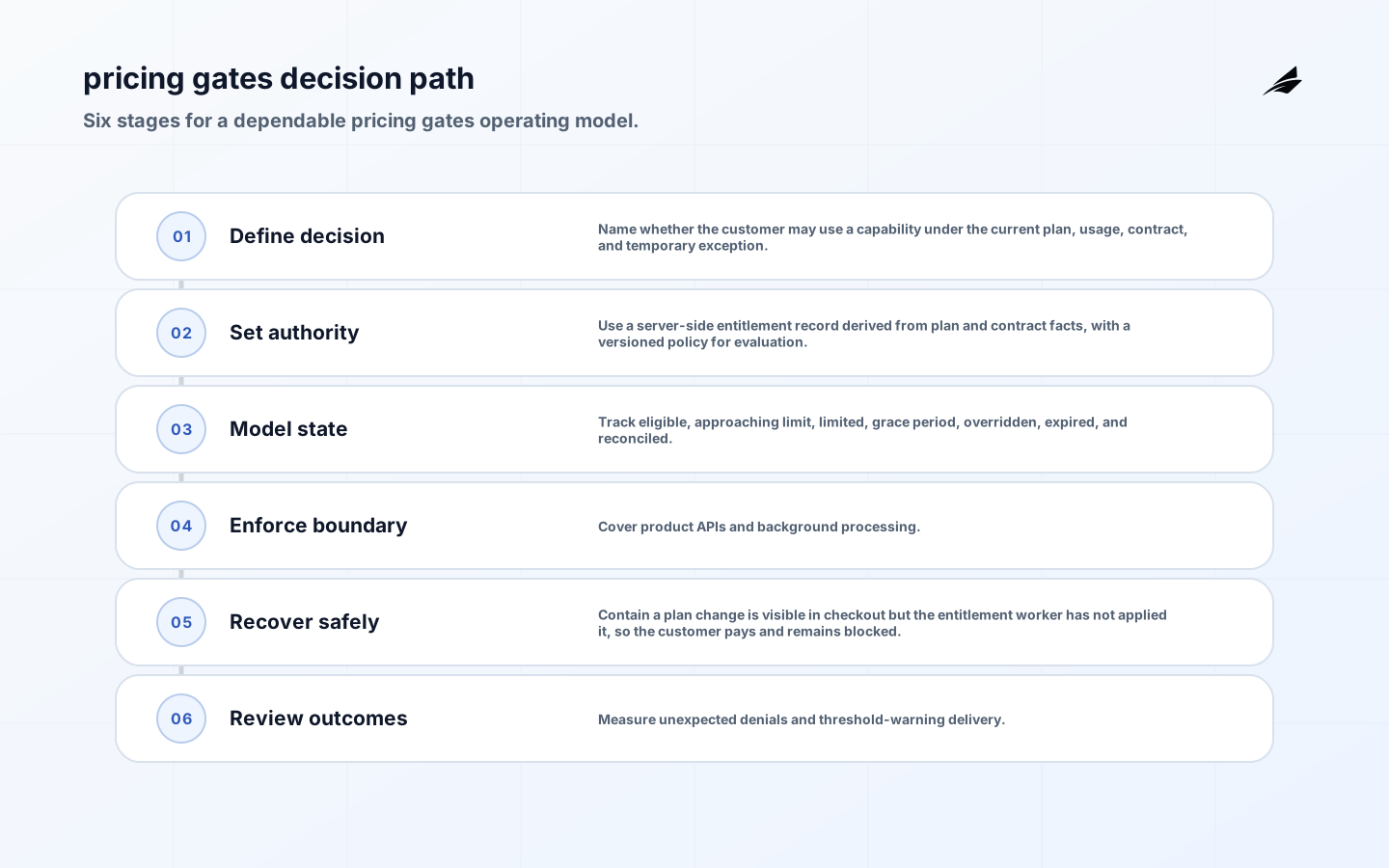
Pricing gates becomes brittle when state exists only in presentation code or an external vendor's latest response. Model the lifecycle explicitly: eligible, approaching limit, limited, grace period, overridden, expired, and reconciled. Record transition source, actor where relevant, event time, processing time, idempotency or correlation identifier, and policy version. Make stale facts unable to overwrite newer facts, and make duplicate delivery harmless. OpenFeature concepts can help separate evaluation from the service that delivers the result.

Pre-build pricing gates — Build the trusted delivery path
Implement pricing gates at every boundary that can create an irreversible outcome: product APIs, background processing, upgrades, invoice changes, cancellation, migration, and support repair. Evaluate authority on the server, persist inbound facts before mutation, deduplicate by a durable key, and carry scope and policy version into worker paths. A repair route should be narrow, expiring, attributable, and separate from ordinary entitlement evaluation. Acceptance tests should compare the protected operation, the customer-facing explanation, and the evidence record rather than checking only a response code.
| Path | Implementation choice | Failure contained |
|---|---|---|
| Interactive request | Evaluate authority on the server. | Stale or forged client context. |
| Inbound event | Persist and deduplicate before mutation. | Replay or duplicate delivery. |
| Background work | Carry explicit scope and policy version. | Unbounded worker action. |
| Operator repair | Require narrow, expiring approval. | Permanent undocumented override. |
Pre-build pricing gates — Test the uncomfortable cases
A happy-path demonstration does not prove pricing gates. Build a fixture in which checkout records an upgrade but the entitlement worker has not applied it, so the customer has paid and remains blocked. Add cases for a duplicate webhook, a late cancellation, an expired exception, a retry after partial work, and a repair that needs approval. Each fixture should assert the state transition, protected-action result, customer-safe message, durable evidence, and recovery authority. The OWASP Authorization Cheat Sheet is a useful reminder that the enforcement boundary must remain on the server.
Pre-build pricing gates — Instrument outcomes, not just errors
Treat pricing gates as an operating system with named signals. Record entitlement-calculated, threshold-crossed, gate-denied, override-approved, and entitlement-reconciled events with owners and response rules. Useful measures include unexpected denials, threshold-warning delivery, override volume, upgrade conversion, policy evaluation errors, and time to reconcile a disputed result. Review the measures with product, engineering, support, and finance so a dashboard change leads to an accountable action. NIST Secure Software Development Framework and the OWASP Authorization Cheat Sheet support treating these controls as part of delivery and operation.
Pre-build pricing gates — Practical takeaways
- Name the pricing gates decision, authority, scope, and safe uncertain outcome before implementation.
- Preserve state transitions and their evidence so a customer result can be explained.
- Enforce the rule across product APIs, background processing, upgrades, invoice changes, cancellation, migration, and support repairs, including workers and operator tooling.
- Exercise retries, late facts, conflicting changes, and scoped recovery before exposure expands.
- Measure unexpected denials, threshold-warning delivery, override volume, upgrade conversion, and policy evaluation errors with an owner who can act on the signal.
Frequently asked questions
Pre-build pricing gates — What is the first deliverable for pricing gates?
The first deliverable is a decision contract that product, engineering, support, and finance can read the same way. It should identify the authoritative entitlement record, policy version, effective time, uncertain-input behavior, and repair owner. Write examples for an ordinary grant, denial, pending result, late event, and approved correction. A small fixture set is more valuable than a broad mechanism when it proves that state, customer messaging, and evidence stay aligned.
Pre-build pricing gates — When should pricing gates expand beyond a pilot?
Expand when the team can reconcile the pilot's outcomes and explain exceptions from durable records. Confirm that the normal path, the failure path, and the operator path all enforce the same policy. Check that alerts lead to a named action and that a customer can receive a useful response if the system is waiting or denies a request. Do not use a healthy average as proof: inspect affected cohorts and unusual states. A measured rollout can reveal whether pricing gates is changing the intended behavior rather than merely generating more activity. The durable test is simple: can the team explain a recent success, denial, retry, and correction without relying on memory?
Conclusion
Pricing gates rewards precision more than complexity. Before selecting a mechanism, write examples for allow, deny, pending, retry, late fact, and repair. For each example, name the customer or workspace, the capability, the authoritative plan and contract facts, the effective time, the policy version, and the explanation a user should receive. Define how an unknown fact changes the result; a bounded pending state is often safer than guessing or silently granting access. Treat feature flags as exposure controls, not as substitutes for entitlement, authorization, billing, or audit policy. Build a fixture set that covers upgrades, downgrades, cancellation, grace periods, duplicate events, delayed webhooks, expired exceptions, and operator correction. The first implementation is ready to widen when the team can replay those cases, compare the result with the customer-visible state, and repair a discrepancy without editing primary records by hand. Record the decision, evidence, and approver for each fixture so the examples remain useful after the initial build. This discipline keeps the first release small while making its commercial boundary explicit, testable, and supportable.
Before selecting a mechanism, write pricing examples for allow, deny, pending, retry, late fact, and repair. Define the authoritative record, state precedence, effective time, idempotency key, customer explanation, and safe behavior when a required fact is unknown. A feature flag may control exposure, but it is not the entitlement, authorization, billing, or audit policy. Build one replay-safe path first and apply it consistently to APIs, background work, upgrades, cancellation, migrations, and support repair. The first implementation is ready to widen when the team can reconcile its outcomes and explain a disputed result from durable evidence.
Related reading: Related guide 1, Related guide 2, Related guide 3.
Use the examples as acceptance tests, not as documentation left behind after implementation. Each case should assert the state transition, customer-facing result, durable evidence, and repair authority. This gives a small team a shared way to reject a mechanism that works on the happy path but cannot explain commercial edge cases.
A useful pre-build review also names the people who will operate the decision after launch. Product should state the commercial promise and the unacceptable customer outcome. Engineering should own evaluation, idempotency, state precedence, and the path that turns a late fact into a visible pending result. Support should have a customer-safe explanation and a route for escalating a false denial without asking an operator to edit a database row. Finance should be able to reconcile the entitlement result with subscription, invoice, usage, and credit evidence. These roles do not require separate systems, but they do require one shared record of authority, time, reason, and outcome. Before implementation, walk one example through checkout, webhook delivery, entitlement evaluation, protected action, message, support view, and repair. Mark every handoff where a stale value could replace a newer fact or where a duplicate event could create a second side effect. Then turn those handoffs into fixtures that run in continuous integration and into a short launch runbook. The first build is ready when a new team member can follow the record without private context and when the rollback or disablement action preserves the history that explains why the decision changed.
Keep the initial contract deliberately narrow. One capability, one subject boundary, one policy version, and one recovery route are enough to expose whether the organization can keep commercial meaning stable while code and billing events move at different speeds. Do not hide unresolved questions inside a generic flag or a provider status. Write them down as explicit states with owners, review times, and customer-safe outcomes. A pilot that is small in scope but rich in evidence can reveal a broken assumption earlier than a broad launch with impressive traffic. When the pilot produces a disputed result, preserve the original facts, attach the correction, and record who approved the change. This lets the team learn from an exception without turning the exception into a second source of truth. That record should remain understandable after the original builders leave. Include a plain-language decision summary, the current policy version, the source facts, the expected customer message, the owner of an exception, the allowed repair, and the time when the result should be reviewed. A compact runbook makes that contract operational for support teams.