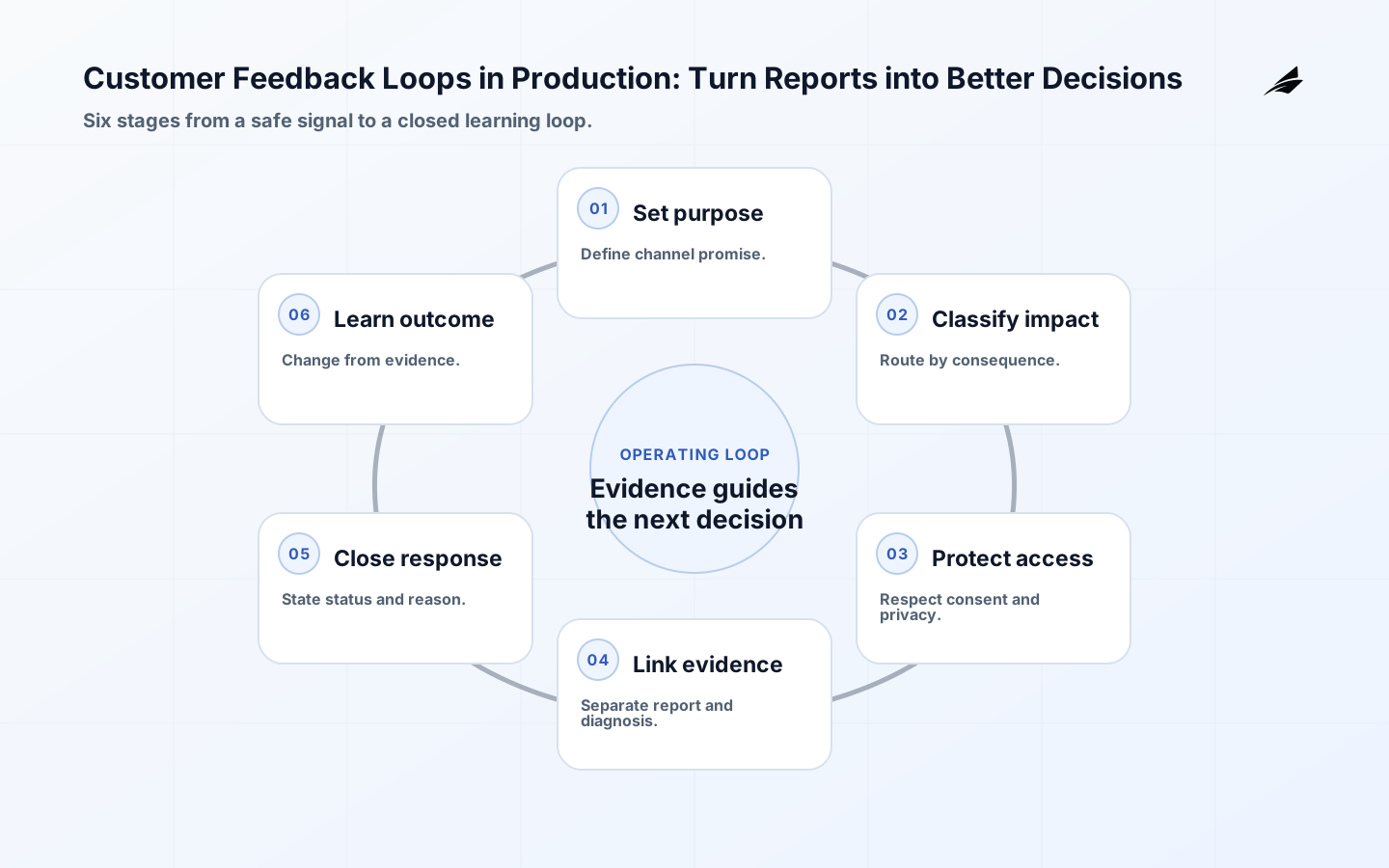
Customer feedback loops become production systems when a report can change what a team builds, how support responds, what an incident means, or what a customer expects next. A form is only the intake point. The loop needs a purpose, channel, consent and retention boundary, classification, owner, evidence path, response expectation, and a way to learn whether a change helped. The GOV.UK Service Manual's measurement guidance is a useful public example of connecting measures to service improvement rather than collecting numbers for their own sake. Compare this with customer feedback loops for SaaS product engineering and product analytics in production.
Set the customer feedback loops production boundary
Separate channels by the decision they support. In-product task feedback can identify friction at a known moment; a support case may contain private account context; a research interview needs a different consent and retention model; an outage or security report needs urgent routing. Define what each channel is for, what it must not be used to infer, who can inspect it, and how a reporter will know what happens next. Keep free text available when it is valuable, but do not make it broadly searchable by default. A feedback loop is trustworthy when the customer can tell its purpose and the team can tell its limits.

| Channel | Best for | First control |
|---|---|---|
| In-product prompt | Task friction at a known state | Timing, accessibility, and context |
| Support case | Account-specific help or harm | Access scope and response owner |
| Research conversation | Understanding motivation and unmet need | Consent and retention |
| Incident report | Reliability, security, or accessibility risk | Priority route and acknowledgement |
Use a taxonomy that supports action
Classify defects, usability obstacles, feature requests, billing concerns, accessibility barriers, account support, abuse or security concerns, and praise or confirmation separately. Let an item be reclassified with a reason because the first label may be incomplete. Define severity and urgency in customer terms: can the person complete the task, has data or money been affected, is there a workaround, and does the issue indicate broader harm? Keep a channel for uncertain reports so triage does not force a false category. The taxonomy should determine routing and evidence, not become a decorative set of tags no one reviews.
Make feedback channels accessible and respectful
WCAG 2.2 applies to web content across devices and includes testable criteria for labels, keyboard access, focus, status messages, error identification, and accessible authentication. A feedback form that cannot be completed by keyboard or whose error is communicated only by colour excludes the very people who may need to report a barrier. Ask only for information required to route or understand the issue, state whether a response is expected, and provide an alternative channel when the product path is unavailable. Do not make a customer repeat context the system already has unless the privacy or consent boundary requires it.
Connect reports to evidence without pretending they are diagnoses
A customer's description is valuable evidence about an experience, but it may not identify the technical cause. OpenTelemetry documentation provides a vocabulary for traces, metrics, logs, and context that can help an engineer compare the report with a request or release. Link a report to a correlation key, product version, workflow state, and relevant incident when permitted. Keep the reporter's words and the technical interpretation distinct. This preserves trust: the team can say what was observed, what was inferred, and what remains unknown instead of rewriting a customer account into an overconfident label.
| Evidence layer | Question | Retention decision |
|---|---|---|
| Customer report | What did the person experience? | Keep original text and consent state |
| Product context | Which account, role, version, or workflow? | Minimise to routing need |
| Technical signal | What request, error, or trace is related? | Use correlation and access controls |
| Decision record | What changed or was declined, and why? | Retain for accountability and learning |
Route urgency before popularity
A high-volume request is not automatically more urgent than one report of an accessibility barrier, account loss, security concern, or financial harm. Set routing rules that combine impact, affected scope, reproducibility, and time sensitivity. A suspected security issue should reach the responsible team without being exposed in a broad product backlog. A critical support report needs an acknowledgement and a named owner even when a fix is not immediate. Keep routing decisions attributable and provide an escalation path when the classifier is uncertain. This prevents the feedback queue from rewarding the loudest channel while serious low-volume signals disappear.
Protect the context people give you
Feedback can contain personal data, account identifiers, screenshots, logs, or information about other people. Define who may view raw content, who may see a redacted summary, how long each form is retained, and how access or deletion requests affect the record. OWASP's Logging Cheat Sheet reinforces minimisation, consistent structure, and controlled access for diagnostic records; apply the same care to free-form feedback. Do not copy a private report into an unrestricted roadmap or analytics table. Derived themes can be useful, but they should retain the source boundary and avoid making a person identifiable when identity is not needed.
Close the individual and organisational loops
The individual loop answers what happened to this report: acknowledged, investigating, workaround available, changed, declined, or no further action with a reason. The organisational loop asks which themes recur, which decisions changed, what hypotheses were rejected, and whether the observed customer outcome improved. Keep the two levels connected but do not send internal debate or another customer's information to the reporter. A status update is not a promise of a fix; it is an honest account of the current decision and next review. This distinction lets teams close cases without erasing learning.
Measure whether feedback improves the service
Measure response acknowledgement, triage age, time to a decision, recurrence after a change, accessibility of the channel, share of reports with usable context, and customer outcome after the intervention. Compare feedback with task completion, support contact, reliability, and release events. A spike may mean a regression, a clearer report path, a changed customer population, or a new interpretation; the loop should help distinguish those possibilities. The GOV.UK service guidance is a helpful reminder to choose measures that inform decisions and to review them alongside the service rather than treating a target as success by itself.
Roll out changes with a response and recovery plan
Before widening a feedback channel or changing its taxonomy, exercise normal submissions, duplicates, sensitive reports, accessibility paths, provider failure, backlog spikes, and a report that should be reclassified. Provide an alternate route when the main channel is unavailable. Preserve the original context, give operators a way to stop unsafe automated effects, and review the first cohort with real examples. A feedback loop should make the product more responsive without turning every anecdote into automatic policy. The release is ready when the team can explain how it will hear, decide, communicate, and learn.
Walk one report from experience to learning
Consider an accessibility report submitted through an in-product form after a user cannot complete a keyboard-only workflow. The first response should acknowledge the report and route it to an owner who can assess urgency. Preserve the original wording, relevant product version, and consent boundary; add a technical trace only if it is available and appropriate. The team can then reproduce the journey, decide whether a release or workaround is needed, communicate status without overpromising, and check the outcome after the change. At the organisational level, aggregate the report with similar barriers without exposing the person's identity. This complete example demonstrates why feedback is not just a backlog item: it is an interaction with a customer, a service signal, a product decision, and a responsibility to verify whether the experience improved.
A feedback review should end with a decision record, not only a theme count. State what the team learned, which evidence supported it, which reports were not comparable, what changed in the product or support process, and when the result will be checked. This preserves the contribution of customers whose reports did not lead to immediate work. It also prevents a backlog from becoming a substitute for judgement. Over time, the decision record becomes a map of how the service listens and improves.
Key takeaways
- Define each channel by purpose, audience, consent, retention, and response expectation.
- Use an action-oriented taxonomy with an uncertain path and priority based on impact, not popularity.
- Make forms accessible, brief, and honest about whether someone will receive a reply.
- Keep customer evidence, technical interpretation, and product decision distinct but linked.
- Close the individual loop without promising what has not been decided, then synthesise themes for the organisation.
- For related operating detail, See Roadmap Systems for SaaS Product Engineering: A Practical Guide and in-app guidance.
Frequently asked questions
Should every feature request enter the roadmap?
Every request should be captured or acknowledged according to the channel's promise, but not every request should become a roadmap item. Use evidence, customer outcome, strategy, cost, risk, and recurrence to make the decision visible to the right audience.
Can feedback be used for product analytics?
Only within a stated purpose and access boundary. Aggregate themes can inform product learning, but raw free text, account context, and research material should not silently inherit a broad analytics audience or retention period.
How can a team close a report with no fix?
State the decision, evidence considered, current workaround or limitation, and whether a future review is planned. A respectful explanation is better than leaving the customer in an ambiguous status or claiming that silence means resolution.
Conclusion: make listening an accountable system
Customer feedback loops improve a product when they protect the effort of reporting, route the right signal, connect experience to evidence, and turn decisions back into communication and learning. Build the channel, taxonomy, privacy boundary, measurement, and recovery path together. Then let real outcomes—not volume, sentiment, or a backlog count alone—decide whether the product is becoming easier, safer, and more useful for the people who rely on it.
The measurement plan for customer feedback loops in production should pair an outcome with a reason to investigate it. Test customer feedback loops in production with normal, delayed, denied, and corrected workflow cases.
A durable operating note for customer feedback loops in production records the assumptions that made the decision safe: the authoritative source, effective time, permitted actor, protected resource, and recovery route. Explain customer feedback loops in production pending and denied states before expansion.
For customer feedback loops in production, a good handoff ends with observable evidence rather than a verbal promise. Review production evidence with product, engineering, and support before the move is complete.
The smallest useful improvement to customer feedback loops in production is often a sharper boundary, not another feature. Measure customer feedback loops in production outcomes alongside correction effort.
This decision also connects to Roadmap Systems for SaaS Product Engineering: A Practical Guide, When Product Analytics Moves into Production, In-app Guidance for SaaS Product Engineering: Help at the Right Moment. Review those boundaries together when customer feedback loops in production shares identity, data, billing, or support evidence with another workflow.
For customer feedback loops in production, the measurement reference defines scope; WCAG 2.2 supports the control; OpenTelemetry clarifies evidence; the Logging Cheat Sheet guides recovery. Treat exceptions as evidence for the next decision.
Evidence for “Customer Feedback Loops in Production” is grounded in Measuring success, Web Content Accessibility Guidelines (WCAG) 2.2, OpenTelemetry Observability Primer, Logging Cheat Sheet, Customer feedback loops primary reference; each source informs a specific decision, test, or operating trade-off described in this guide.