Feature flags are a production concern because it decides whether a named capability is available for a particular subject in a particular context. For pre-build feature flags, the useful question is not whether a team can add a screen, query, or provider integration. For pre-build feature flags, it is whether the resulting decision remains correct when a request retries, a person changes role, an upstream event arrives late, or an operator must explain a customer outcome. A reporting feature may be shown to a pilot cohort, but the server must independently evaluate the cohort rule before returning the report or scheduling its export. OpenFeature concepts frames the topic in operational terms, while OWASP Authorization Cheat Sheet is a useful reminder that important permissions and effects belong at trusted boundaries. For pre-build feature flags, build the smallest decision that is observable, repairable, and understandable before widening scope.
Name the capability decision before choosing a flag
For feature flags, write a one-page decision contract. For pre-build feature flags, state the subject, resource or record, action, authority, effective time, result, and behavior for unknown facts. The decision here is whether a named capability is available for a particular subject in a particular context; the authority is a versioned flag definition with named owners, approved targeting attributes, and an expiry expectation. For pre-build feature flags, this separates product policy from an incidental implementation detail. For pre-build feature flags, it also exposes disagreements early: a commercial promise may differ from the system that can enforce it, and a customer-facing message may require more context than an internal reason code. The secure-development practices in NIST Secure Software Development Framework support treating these choices as delivery work rather than a final review. For pre-build feature flags, give every rule an owner and version so a later incident can be investigated without reconstructing intent from chat messages.
| Decision question | Concrete rule | Evidence to retain |
|---|---|---|
| Who or what is affected | Use a stable subject and scope. | Identifier and effective time. |
| Which fact decides | Read one declared authority. | Source version and correlation ID. |
| What happens when unsure | Choose pending, deny, or review deliberately. | Reason code and next action. |
| Who can repair it | Use a scoped, auditable path. | Approver, expiry, and outcome. |
Specify flag lifecycle, ownership, and expiry
Feature flag state becomes brittle when state exists only in presentation code or an external vendor's latest response. Model the lifecycle explicitly: draft, reviewed, enabled for cohort, fully enabled, disabled, and archived. For pre-build feature flags, store the transition reason, actor, effective time, idempotency identifier, and policy version alongside the current state. For pre-build feature flags, then specify ordering: decide whether an older fact may change a newer state, and what evidence wins when sources disagree. Google SRE Workbook: Configuration Specifics gives a concrete reference point for the kind of explicit semantics that prevent invisible access or data mistakes. For pre-build feature flags, a support colleague should be able to see why the system chose its current state, and an engineer should be able to replay a transition without guessing which message arrived first.
Make evaluation safe when dependencies fail
Implement feature flags at the points where the product can create an irreversible outcome. The relevant boundaries are server decisions, client rendering, asynchronous work, data migrations, and emergency controls. For pre-build feature flags, resolve context once at the trusted boundary, pass it deliberately, and enforce the same decision for interactive and asynchronous work. For pre-build feature flags, persist inbound events before processing; deduplicate on durable keys; make mutations idempotent; and avoid granting capability solely because a client claims it is entitled. For pre-build feature flags, this is particularly important when a UI is quick but background processors, exports, and integrations continue to act after the browser closes. For pre-build feature flags, use a customer-safe response with an internal reason code. For pre-build feature flags, the result should tell the person what can happen next without exposing secrets or policy details.
| Path | Implementation choice | Failure contained |
|---|---|---|
| Interactive request | Evaluate authority on the server. | Stale or forged client context. |
| Inbound event | Persist and deduplicate before mutation. | Replay or duplicate delivery. |
| Background work | Carry explicit scope and policy version. | Unbounded worker action. |
| Operator repair | Require narrow, expiring approval. | Permanent undocumented override. |
Test stale rules, retries, and wrong audiences
A happy-path demonstration does not prove feature flags. Build examples around the failure that would change customer trust: a client-side flag exposes a privileged endpoint even though the visible control is hidden. For pre-build feature flags, test timeout followed by retry, duplicate delivery, out-of-order facts, a permission or plan change during a request, partial dependency outage, and a human repair that expires. For pre-build feature flags, assert both the resulting state and the evidence created. For pre-build feature flags, the test should show which record won, why it won, and what the customer sees. For pre-build feature flags, keep fixtures representative but free of real customer data. Where access, identity, or sensitive records are involved, OWASP Authorization Cheat Sheet provides sound principles for server-side checks and least privilege. For pre-build feature flags, a release is credible when these cases run automatically and the repair path has been rehearsed.
Measure evaluations against customer outcomes
Treat feature flags as an operating system with named signals. Record flag-created, targeting-changed, evaluation-failed, rollback-used, and flag-expired. For pre-build feature flags, the first dashboard should answer: did the decision happen, did it take too long, did it affect the intended scope, and can someone recover? Useful measures include evaluation errors, stale-flag count, rollback duration, cohort outcome, and configuration change review time. For pre-build feature flags, pair a technical signal with a customer or operator signal so an apparently healthy service cannot hide an unusable workflow. Avoid putting secrets, raw tokens, or unnecessary personal information into logs; NIST Secure Software Development Framework and OWASP Authorization Cheat Sheet both reinforce that evidence needs protection. For pre-build feature flags, review unusual denials, long-lived pending states, and manual corrections as product evidence. For pre-build feature flags, they often reveal unclear policy, a missing integration contract, or a default that no longer matches the business.
Write the feature flags decision before selecting a tool
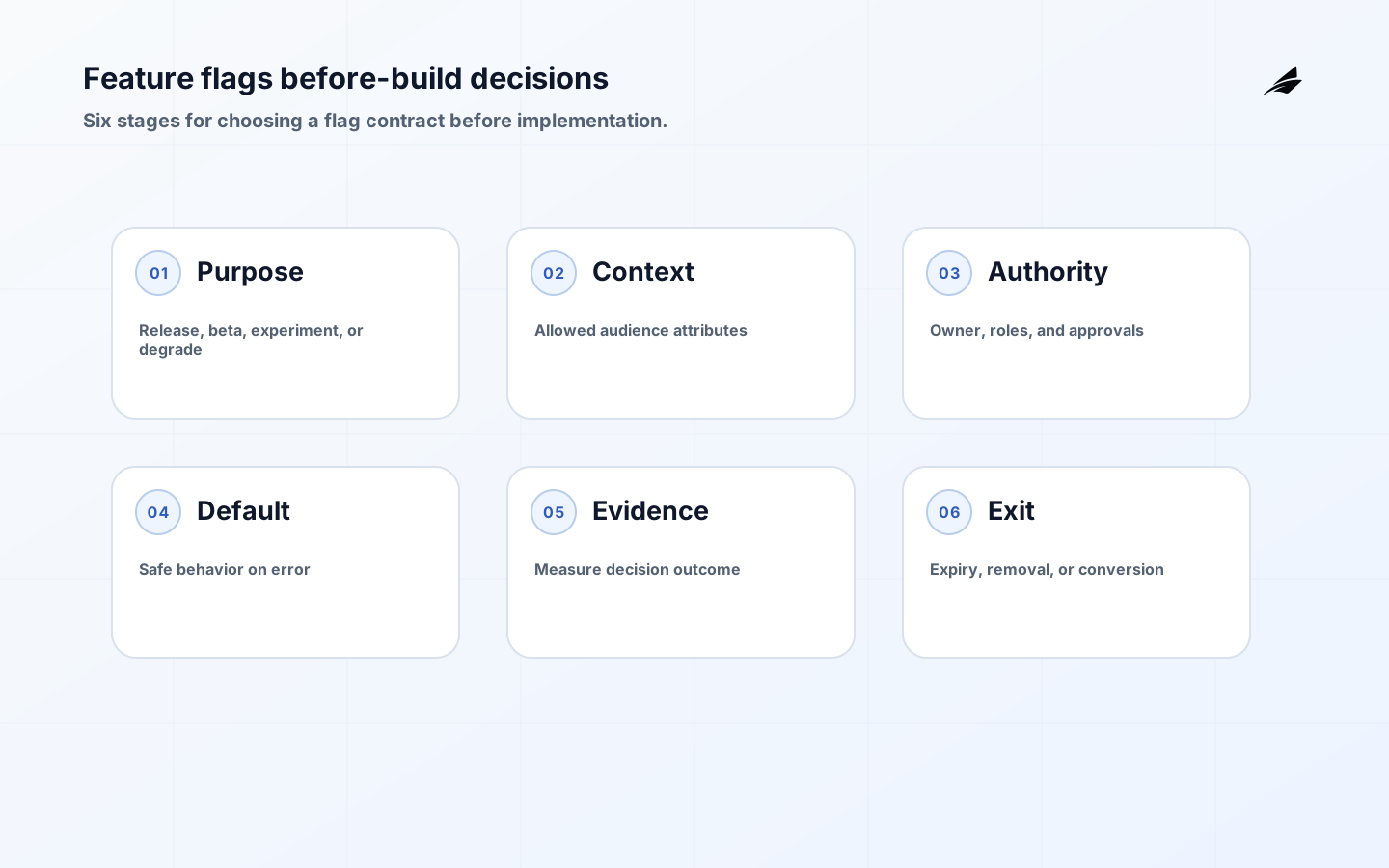
Before the first build, decide which uncertainty feature flags must help you manage. Is the purpose release safety, internal testing, pricing eligibility, experimentation, or emergency degradation? Each purpose needs different ownership, context, evidence, and expiry. OpenFeature concepts separates the evaluation API, provider, context, hooks, and events; that is a useful architecture boundary even if a team starts with a small local implementation. Google’s SRE guidance on configuration reinforces the need to treat runtime configuration as a controlled change with validation and rollback.
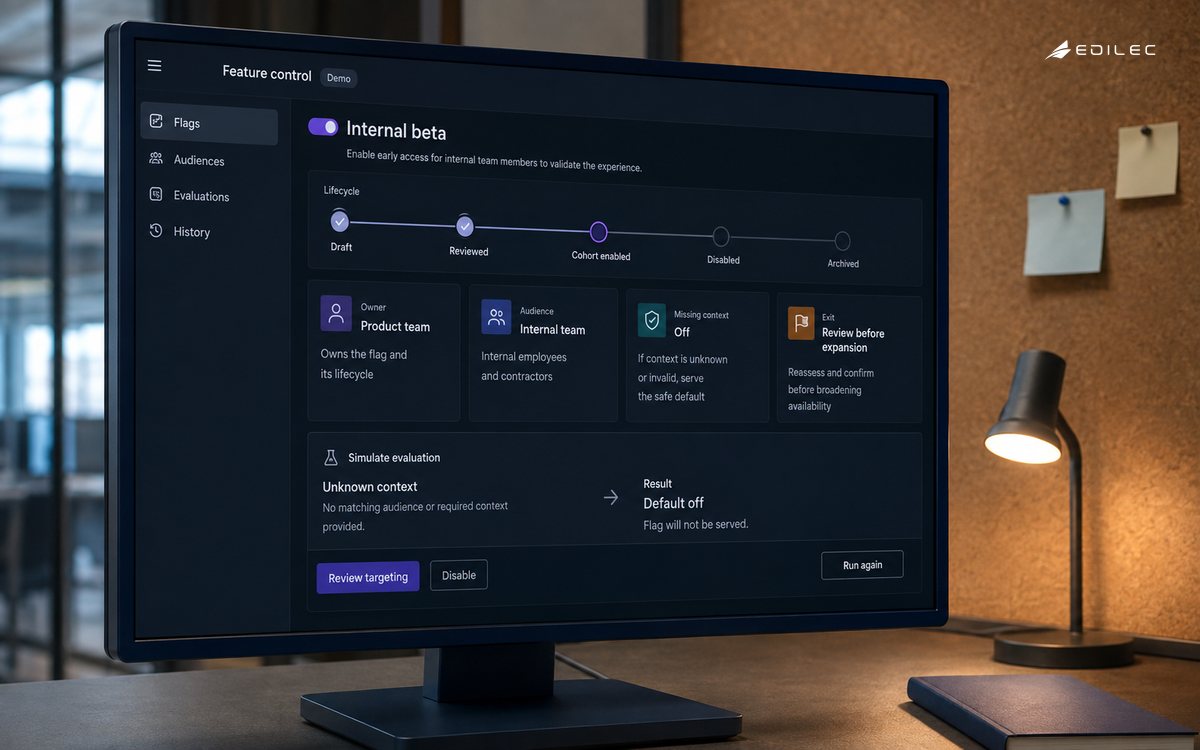
Example: an internal beta with a safe default
For an internal beta, define the audience by a stable team or account attribute, not a hand-maintained list in application code. Specify what non-members see, how the evaluation behaves when context is missing, and who removes the flag after the beta. If the flag can grant access to data or an operation, apply the OWASP Authorization Cheat Sheet distinction between authentication and authorization: a positive flag evaluation is not a substitute for checking the actor’s permission.
| Before build | Question | Evidence of a sound answer |
|---|---|---|
| Purpose | Which decision does the flag change? | One sentence and one named owner. |
| Context | Which attributes are required and safe? | Schema, fallback, and privacy boundary. |
| Authority | Who can create, target, or retire it? | Roles, approvals, and audit trail. |
| Exit | What ends the flag’s useful life? | Expiry date, removal issue, or permanent decision. |
Continue with What Changes When Product Analytics Moves into Production for analytics implications, Billing Workflows Decisions That Matter before the First Build for billing-sensitive controls, and How Operations Leaders Should Think About Customer Feedback Loops for feedback loops. These adjacent guides help decide whether a proposed flag is the right mechanism or merely hiding an unresolved product decision.
The OpenFeature provider guidance makes the provider boundary explicit: a team can change the flag backend without rewriting every evaluation call, while still defining defaults and provider failure behavior.
Feature-flag design takeaways
- Name the feature flags decision, authority, scope, and safe uncertain outcome before implementation.
- For pre-build feature-flag architecture, keep lifecycle state and transition evidence durable enough to explain a customer result.
- Enforce the rule across server decisions, client rendering, asynchronous work, data migrations, and emergency controls, including workers and operator tooling.
- For pre-build feature-flag architecture, test retries, late facts, conflicting changes, and scoped recovery before broad exposure.
- Measure evaluation errors, stale-flag count, rollback duration, cohort outcome, and configuration change review time with an owner who can act on the signal.
Feature flag questions before implementation
What is the first deliverable for feature flags?
For pre-build feature flags, produce the decision contract and a small set of concrete examples before selecting a framework or vendor. For pre-build feature flags, include one allowed path, one denial, one pending or degraded case, and one correction. For feature flags, the authority should be a versioned flag definition with named owners, approved targeting attributes, and an expiry expectation. For pre-build feature flags, this gives design, engineering, support, security, and finance a shared object to review. For pre-build feature flags, it also stops a team from equating a data field, a browser control, or a third-party status with the decision itself. For pre-build feature flags, the first implementation can then focus on a narrow path with clear acceptance tests instead of attempting a complete platform at once.
When should feature flags expand beyond a pilot?
For pre-build feature flags, expand when the team can reconcile the pilot's outcomes and explain exceptions from durable records. For pre-build feature flags, confirm that the normal path, the failure path, and the operator path all enforce the same policy. For pre-build feature flags, check that alerts lead to a named action and that a customer can receive a useful response if the system is waiting or denies a request. For pre-build feature flags, do not use a healthy average as proof: inspect affected cohorts and unusual states. A measured rollout can reveal whether feature flags are changing the intended behavior rather than merely generating more activity. For pre-build feature flags, the durable test is simple: can the team explain a recent success, denial, retry, and correction without relying on memory?
Conclusion: give feature flags a durable contract
A feature-flag system rewards precision more than complexity. Start with whether a named capability is available for a particular subject in a particular context, anchor it in a versioned flag definition with named owners, approved targeting attributes, and an expiry expectation, and make the lifecycle draft, reviewed, enabled for cohort, fully enabled, disabled, and archived visible to the people who operate it. For pre-build feature flags, implement the rule at every consequential boundary, record evidence that is useful but protected, and practise recovery before customers need it. For pre-build feature flags, that approach keeps a product decision connected to operational reality. For pre-build feature flags, it also makes later changes safer: when pricing, policy, integrations, or team ownership changes, the system has a clear place to express the new rule and a traceable way to show what happened. For pre-build feature flags, before each planned change, review one recent decision with the people who build, sell, support, and operate the service. For pre-build feature flags, compare the policy version, source facts, observed result, and customer explanation. For pre-build feature flags, ask whether an older event, missing dependency, or corrected record would change the answer. For feature flags, this short review turns incidents and near misses into concrete updates to contracts, tests, dashboards, and guidance. For pre-build feature flags, it also prevents a temporary exception from quietly becoming permanent product behavior.