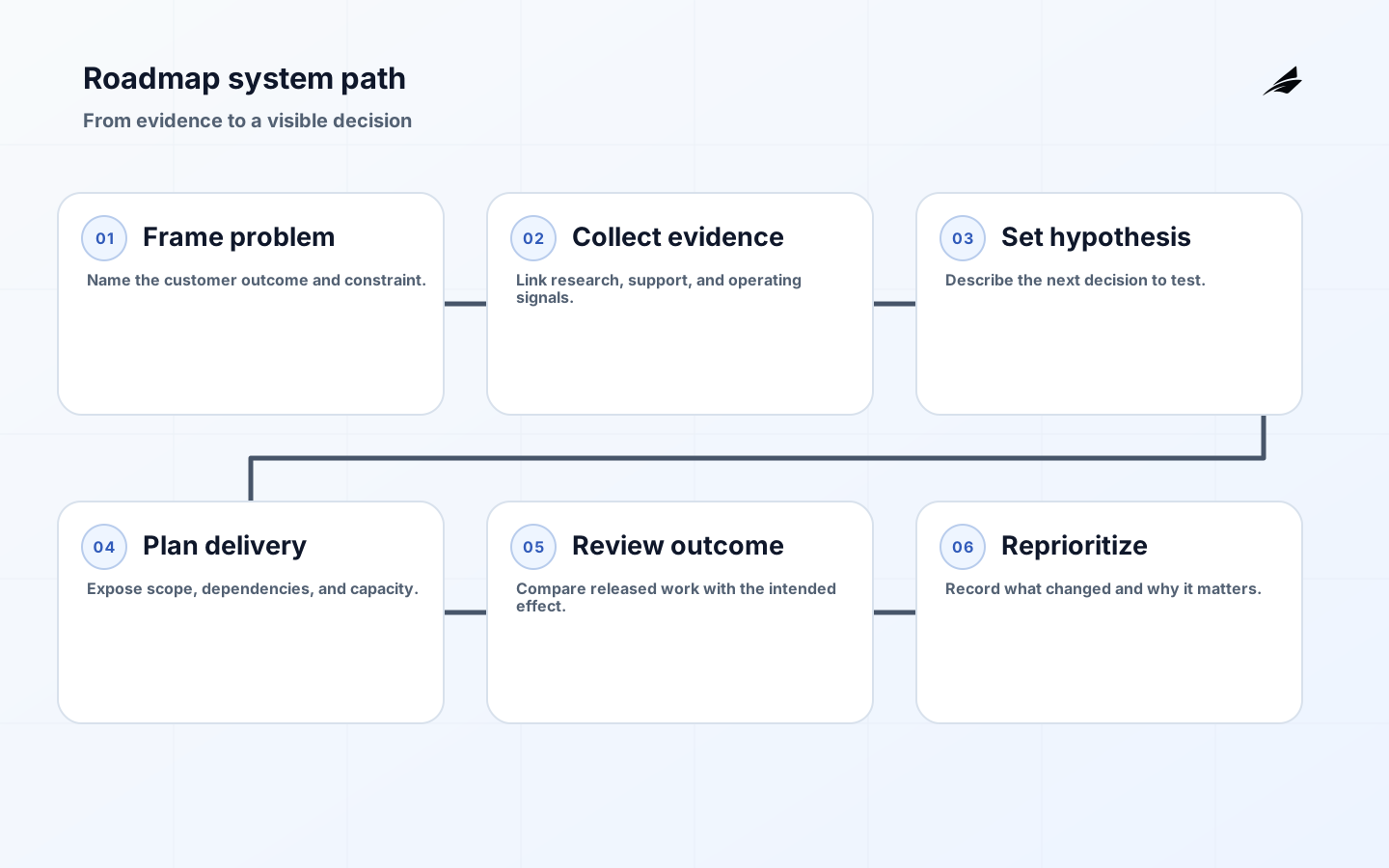
Roadmap systems are a product-engineering concern because they shape what a customer can trust in the product, what an operator can explain, and what a delivery team can change safely. For product teams, the work is not to collect more tooling or policy language. It is to make one important decision visible: what state is authoritative, who owns it, which controls enforce it, and how the team learns when reality differs from the plan.
Why Roadmap systems Matters
A roadmap becomes misleading when it represents hope as a promise. A row of features and dates may look decisive while hiding discovery risk, dependency uncertainty, reliability work, or a decision that no customer has actually asked the team to make. Product teams then spend their planning cycle arguing about dates instead of learning what outcome is worth pursuing. The system should expose confidence and evidence, not make uncertainty disappear behind a polished timeline.
Use the roadmap as a decision system with separate views for strategy, delivery, and commitments. Strategy connects a problem, target customer outcome, and measure of change. Delivery tracks validated scope, dependencies, and sequencing. Commitments record the few dates or obligations that truly require coordination. Keeping those views distinct stops a discovery item from being treated like a release promise and stops an operational obligation from competing invisibly with optional feature work.
Build the Operating Model
Every roadmap item should be traceable to a decision record: the user or business problem, evidence, desired outcome, owner, current hypothesis, constraints, and next learning step. Add delivery fields only when the item has earned them. A useful roadmap can show a short-term execution horizon in detail and a longer horizon as themes or options. That is not less rigorous. It is a more honest representation of what the team knows at each point.

| Roadmap view | Primary question | Evidence needed |
|---|---|---|
| Strategy | Which customer outcome deserves investment? | Problem evidence, target segment, and expected measure. |
| Delivery | What must happen to release safely? | Validated scope, dependency, capacity, and readiness. |
| Commitments | What has the organization promised or must coordinate? | Owner, date, scope boundary, and escalation path. |
| Learning | What must be true before investment grows? | Hypothesis, experiment, and decision threshold. |
Define a small shared vocabulary. A problem is not a solution. An outcome is not an output. A target date is not a delivery commitment unless a named owner has accepted it. A dependency is not a vague mention of another team; it has an interface, condition, and due decision. This vocabulary matters because a roadmap system is social infrastructure. When its labels are interpreted differently by product, engineering, sales, and operations, the board becomes an argument amplifier.
Design the Architecture and Controls
Choose a system that keeps roadmap fields close to the underlying work and evidence. A planning record should link to customer research, incident or support evidence, technical decision notes, and delivery work without requiring someone to copy status between tools. Permissions should let contributors add evidence while keeping final commitment fields governed. Automated status can be useful, but only when it reflects actual state. Avoid dashboards that turn a stale estimate into a confident-looking percentage.
Beware of date theater, priority churn, and hidden capacity. A team that changes priority weekly without recording why cannot learn from its decisions. A roadmap that excludes reliability, security, and maintenance work implicitly treats them as free. A portfolio view that rolls every item up to green or red loses the nuance that executives need. Preserve a short explanation for movement: what changed, which assumption failed, and what decision follows from the new evidence.
Roll Out with Evidence
Pilot the system with one product area and a limited set of outcomes. Create a weekly review where item owners update evidence, confidence, dependencies, and the next decision, rather than merely reciting status. After a month, compare planned outcomes with what users actually experienced and review items that changed shape. Expand only when the fields are helping people make faster, clearer decisions. A heavy taxonomy is not maturity if nobody can maintain it.
| Signal | What it can reveal | First response |
|---|---|---|
| Frequent priority changes | Decision criteria are unclear | Record the evidence and tradeoff behind each change. |
| Old unresolved dependency | A plan assumes someone else's work | Name the interface owner and deadline for a decision. |
| Work starts without an outcome | The backlog is replacing strategy | Require a problem and measure before commitment. |
| Missed dates with stable scope | Capacity or risk was hidden | Re-estimate with operational work and dependencies visible. |
Operate and Measure
Measure decision latency, proportion of items with current evidence, age of unresolved dependencies, unplanned work ratio, outcome movement after release, and the share of commitments met without last-minute scope distortion. These measures are prompts for conversation, not targets to game. A roadmap system is healthy when leadership can see where risk lives, teams can explain why work moved, and customer signals influence plans before a quarter has already been spent.
- Keep strategy, delivery, commitments, and learning visible as different states.
- Link plans to evidence and explicit decisions.
- Show reliability and maintenance work alongside feature work.
- Record why priorities move.
- Use dates only at the level of confidence they deserve.
Implementation Detail
Suppose a team is considering a new reporting capability. The strategic record might say that finance operators cannot reconcile monthly exceptions and that success means a reviewed exception list can be produced in one business day. The delivery view can then expose the data dependency, permission decision, and first release slice. It should not invent a final launch date before those unknowns are resolved. When the data dependency slips, the roadmap should show the changed assumption and the next decision, rather than silently turning yellow.
Use confidence as an explanation, not as a decorative percentage. A discovery item can be high confidence about the problem and low confidence about the solution. A delivery item can be high confidence about scope but low confidence about an external dependency. Record the evidence behind each assessment and the event that would change it. This gives leadership a reasoned view of risk and helps teams avoid pretending that all uncertainty can be compressed into a single status color.
Review Before Scaling
Before quarterly planning, reconcile roadmap capacity with the work required to operate the existing product. Include incident follow-up, accessibility debt, security findings, data quality fixes, and migration obligations. If those items are absent, feature plans are simply borrowing capacity from future reliability. Make the tradeoff explicit and ask which customer outcome is most harmed by deferral. This is a more productive conversation than promising every initiative and treating operational work as a surprise later in the quarter.
Roadmap reviews should end in decisions. For each item, keep, change, pause, or stop it, and write the evidence and owner. A review that only collects updates turns the system into a reporting ceremony. Encourage teams to stop work when evidence no longer supports the original hypothesis; a visible stop decision protects capacity for better opportunities. The roadmap earns trust when it explains change clearly, not when it maintains the illusion that every earlier plan was correct.
For portfolio decisions, compare items against the same scarce resources: customer attention, engineering capacity, operational risk, and dependency time. A roadmap system need not calculate a perfect score, but it should prevent a highly visible request from bypassing the tradeoffs applied to quieter reliability or research work. That comparability is what makes prioritization explainable when stakeholders disagree. Review this evidence with the owner of roadmap systems, the people who operate the surrounding workflow, and the team responsible for customer communication. Agree on one change, one measure, and one follow-up date. That closed loop keeps local fixes from becoming unexamined policy and makes the next decision easier to defend.
Key Takeaways
- Make roadmap systems a named operating decision rather than an implicit implementation detail.
- Keep customer impact, evidence, and recovery visible to the team that owns the workflow.
- Start with a narrow path, learn from real outcomes, and expand only after the controls hold.
Frequently Asked Questions
Where should a team start with roadmap systems? Start where an incorrect decision would create meaningful customer, commercial, or operational harm. Map the current state, the owner, the boundary, and the evidence available during failure. How much process is enough? Use the smallest process that makes the decision repeatable, reviewable, and recoverable. Add rigor when the data, action, or customer consequence makes a shortcut unsafe.
Conclusion
Strong roadmap systems work is not a one-time project. It is a durable agreement between product, engineering, and operations about how the system behaves under ordinary and difficult conditions. When the contract, controls, telemetry, and recovery path agree, product teams can improve the product without turning each release or customer exception into a new source of uncertainty.
The practical continuity test for roadmap systems is whether a qualified teammate who did not design the workflow can inspect the current state, understand the relevant decision and its limits, and take the next safe action without improvised access or tribal knowledge. Keep the owner, evidence location, escalation route, and recovery rule visible. That discipline makes routine operations calmer and gives the organization a reliable starting point when a customer, release, or incident exposes a new edge case.
Sources
The implementation advice in this roadmap systems guide is grounded in GitHub Projects documentation, Manifesto for Agile Software Development, Google SRE service-level objectives, OpenTelemetry documentation. These references are useful for checking platform-specific controls and terminology during delivery; the decisions here still need to be applied to the product's data, risk, and customer context.