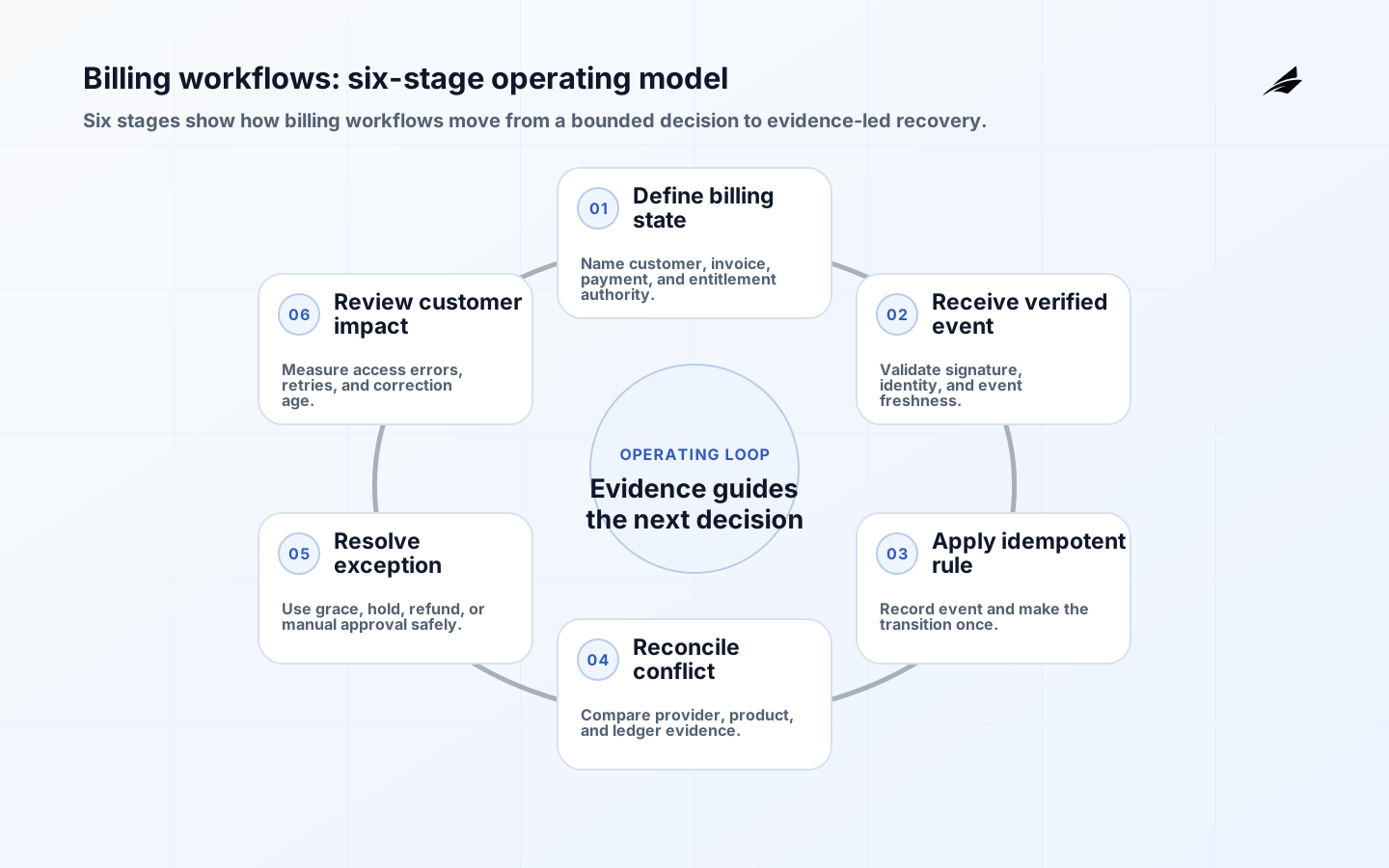
Billing workflows become production-grade when a retry, late webhook, refund, plan change, or permission change can be handled without charging twice or granting access on an unverified assumption. Billing workflow changes character when it reaches production. It is no longer a design choice discussed in a planning meeting; it becomes a sequence of runtime decisions that customers, operators, and adjacent systems rely on. The practical boundary is the commercial record and the product state. Teams need to define customer, account, invoice, payment event, entitlement, and ledger entry, decide which facts are authoritative, and make the same decision wherever a charge, refund, retry, plan change, or payment-provider callback changes customer access or money due. A convincing implementation does not merely work in a demonstration. It remains understandable when a request is retried, a dependency responds late, a person changes roles, or a customer asks why the system acted as it did. That is why the work belongs to product engineering as much as infrastructure: the product promise, the operating control, and the recovery route must agree.
Key takeaways
- Treat billing workflows as a customer-facing contract, not a background implementation detail.
- Write the trusted inputs and the authoritative state before choosing components or screens.
- Make retries, delayed events, and partial work explicit in the state model.
- Apply the same decision to every execution path, including jobs and administrative tools.
- Keep evidence that lets an operator explain a material outcome without reconstructing it from memory.
- Review the exceptions; they reveal whether the model matches real customer work.
Define the customer effect and financial authority
Begin by writing one sentence that describes the decision billing workflows must make: who or what is affected, what qualifies, which condition blocks progress, and who owns an exception. Then inventory the facts behind it. In this case, the important facts include invoice status, payment attempt, provider event, credit, tax treatment, and entitlement period. Do not let a display label, a cached browser value, or an undocumented convention become the source of truth by accident. Each billing fact needs a source, event identifier, effective period, correction rule, and accountable owner. Derived views are useful, but a derived view should say when it was computed and how it is repaired when it disagrees with the source. This discipline also prevents a local interface shortcut from becoming an unreviewed product policy.
| Decision area | Question to settle | Evidence worth retaining |
|---|---|---|
| Scope | Which ${t.unit} are inside this decision? | Stable identifiers and the resolved context. |
| Authority | Which service or record may change the fact? | Source, version, effective time, and actor. |
| Failure posture | What happens when required information is late or missing? | Reason code, customer state, and named owner. |
| Review | How will a team know the rule stopped matching reality? | Sampled outcomes, exceptions, and operating signals. |
Make entitlement changes idempotent
The durable design starts with a small state machine rather than a collection of boolean fields. Name the valid states, the event that moves the record, the preconditions for that move, and the behavior when the event is replayed. For billing workflows, model invoice status, payment attempt, provider event, credit, tax treatment, and entitlement period with stable IDs and effective times. Separate an observed event from the business decision derived from it; a received callback, click, or request can be valid evidence without being permission to change the product state immediately. Make transitions idempotent so repeated delivery produces the same durable result. Where a person must decide, preserve a pending state with a deadline and owner instead of manufacturing a success response that later becomes a support problem.
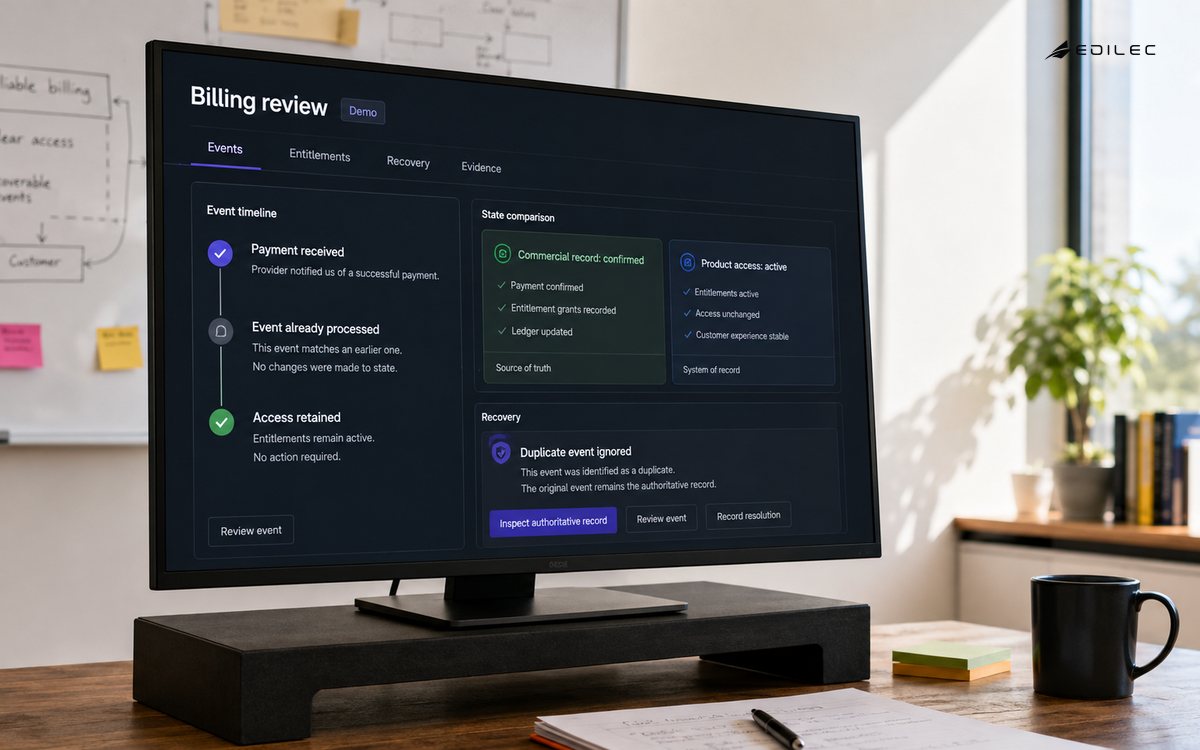
A payment succeeds at the provider, its webhook is delivered twice, and the customer refreshes the confirmation page. The workflow should record the provider event once, project the same ledger result on replay, and show one truthful customer state. This is the sort of ordinary, awkward case that should shape the architecture. It crosses a time boundary and a system boundary, so it exposes assumptions that a happy path conceals. Replay that billing edge case before increasing its customer reach. The expected result should include the user-visible state, server-side record, event trail, and recovery action, not only an HTTP response.
Verify event intake before access changes
Implement billing workflows at the operation where the product effect occurs. Resolve trusted context on the server, validate inputs, load the relevant authoritative state, apply a versioned rule, perform the change, and record the outcome with a correlation identifier. This sequence is deliberately less clever than a broad client-side shortcut, but it protects background work and integrations from drifting into a different policy. For asynchronous work, persist intent before dispatching work, make consumers replay-safe, and write a clear result state after processing. Use least-privilege credentials for each component, and avoid giving a reporting or support integration more authority than the action needs. The security review should cover the recovery route too, because an emergency bypass is still a production feature.
| Failure mode | Design response | Customer-safe result |
|---|---|---|
| Repeated request | Use a stable operation or event identifier and an idempotent transition. | One explainable result, not duplicate work. |
| Late dependency | Persist the request and expose a pending state with a review time. | Progress is visible without a false completion. |
| Invalid scope | Resolve trusted context and authorize at the protected operation. | The request is denied without leaking another customer’s information. |
| Partial completion | Record completed work and route compensation or repair to an owner. | The next safe action is clear to the customer and operator. |
Reconcile access, money, and event history
Production quality depends on whether the team can inspect a real outcome. For billing workflows, retain a compact record of the input identity, relevant state version, policy or configuration version, decision reason, actor or service, correlation ID, and final result. Be deliberate about sensitive values: store references or redacted fields where full payloads are not necessary. Alert on conditions that change an owned action, not every transient error. The important operational signals are event-to-ledger delay, duplicate-event rate, reconciliation exceptions, failed-payment recovery, entitlement mismatch count, and manual adjustment volume. A rising denial rate or growing correction queue is not automatically a customer problem; it may indicate a new release, an upstream contract change, or a rule whose boundary was never stated.
Review normal, denied, pending, and manually corrected billing workflows outcomes on a regular rhythm. Ask whether a new operator can explain why the result occurred, inspect the relevant evidence, and choose the next action. When that is not possible, repair the model, audit record, or customer explanation before adding automation. Durable product work advances through small, owned improvements instead of a ceremonial review that leaves the awkward cases untouched.
Expand after replaying payment edge cases
Release billing workflows to a narrow cohort with a reversible rule. Publish the decision owner, expected behavior, measurable guardrails, and stop condition before exposure increases. Exercise the failure posture with an isolated or internal case, including a retry and a delayed dependency. Observe both customer-facing and operator-facing signals; a release can look healthy in aggregate while creating a hard-to-see support burden for a small segment. Keep a previous behavior or compensating procedure available until the new state is demonstrably stable. After reconciliation, remove temporary billing logic that no longer earns its place.
Billing events FAQ
Do we need a new platform before improving billing workflows? Usually not. Begin with the critical decision, the authoritative record, a stable identifier, and a visible recovery route. A platform may help when several products need the same control, but it cannot substitute for a clear definition of the decision or ownership of exceptions.
How much audit detail is enough for billing workflows? Keep enough information to explain a material outcome, reproduce the relevant rule evaluation, and identify the actor or automated identity that acted. Retain only the billing evidence needed to reconcile and support the customer outcome. Set retention and access with the people responsible for risk, operations, and customer commitments.
What should trigger a redesign of billing workflows? Repeated manual overrides, customer confusion about status, inconsistent results across entry points, unbounded queues, or an inability to explain sampled outcomes are strong signals. Treat these as evidence about the product model, not merely as tickets to close.
Rehearse provider delays and customer repair
Billing correctness benefits from an explicit separation between money movement and customer messaging. A provider can confirm a payment while an internal reconciliation check is still pending; the product should not promise irreversible access or a receipt until its own durable record supports that claim. Conversely, a temporary processing state needs a review route and deadline. This distinction keeps accounting, entitlement, and customer communication from racing each other during retries and delayed provider events.
Billing workflows connects to billing workflows before the first build, billing workflows for growing teams, and release notes before the first build. These billing references connect event delivery, entitlement policy, and release communication so customer impact can be reconciled rather than guessed.
Make billing state transitions explicit
For implementation context, compare Stripe: Using webhooks with subscriptions, Stripe: Receive events in your webhook endpoint, RFC 9110: HTTP Semantics, and OWASP Logging Cheat Sheet when choosing the boundary and its evidence.
Model the commercial record as a sequence of state transitions: customer, subscription, invoice, payment attempt, entitlement, refund, and ledger or reporting entry. Decide which system is authoritative for each fact and which events are merely notifications. A payment provider can report an event, but the product still needs a durable mapping from that event to its own customer and entitlement state. This boundary is where many “works in test mode” integrations fail after retries, disputes, migrations, or manual adjustments.
Design for duplicate, delayed, and conflicting events
Store provider event identifiers and make handlers idempotent. A successful response should not mean the business action was forgotten; it should mean the event is safely recorded and the next state is known. When events arrive out of order, retrieve the current authoritative object or place the transition in a review queue rather than applying a stale downgrade. Keep a trace from invoice or subscription to customer, product plan, entitlement, and internal actor.
Separate money authority from access authority
A paid invoice, a successful payment, and an active entitlement may be related without being identical. Write the rule for each access change, including grace periods, failed payments, refunds, chargebacks, and cancellations. Restrict manual overrides, show their expiry, and log the reason. The safest customer experience is often a visible pending state while the team reconciles evidence, rather than a silent grant or revocation that later surprises support.
| Production concern | Decision to record | Useful evidence |
|---|---|---|
| Event identity | How is a provider event deduplicated? | Provider event ID, received time, handler result |
| State authority | Which system wins when records disagree? | Object version, retrieval time, reconciliation status |
| Entitlement | What grants or removes access? | Rule version, customer, plan, status, effective time |
| Manual action | Who may override and for how long? | Actor, reason, approval, expiry, and reversal |
Choose the safe billing response for each state
Use a response matrix for the states that affect customer access or money. The exact grace period is a product decision; the important part is that it is explicit and observable.
| Condition | Default product state | Next action |
|---|---|---|
| Payment confirmed and mapped | Apply the declared entitlement | Record evidence and notify downstream systems |
| Webhook delayed or duplicated | Keep current state and mark reconciliation pending | Retry safely and compare the authoritative object |
| Payment failed or action required | Apply documented grace or limited access | Notify customer and route recovery |
| Refund, dispute, or cancellation | Evaluate entitlement and reporting impact | Create an auditable transition and customer message |
Production billing practices to carry forward
- Make billing entities, authorities, event identities, and state transitions explicit.
- Use idempotency and reconciliation for every asynchronous payment path.
- Keep money status, entitlement status, and manual overrides separately observable.
Reconcile billing events before widening scope
Replay a provider timeout after acceptance, duplicated subscription event, out-of-order cancellation, refund, entitlement mismatch, and manual correction with product, finance, and support. Reconcile customer access, provider state, invoice records, and internal evidence before expanding the workflow.
Billing production questions
Can a webhook alone grant access? Only after the event is verified, mapped to the correct customer, and interpreted under the product’s entitlement rule. Keep a durable event record and make retries harmless.
What should happen when the payment provider is unavailable? Do not invent a new financial state. Keep the last known state with a visible freshness condition, queue safe work, and use a documented customer-support path.
How do we test billing production readiness? Replay duplicate, delayed, out-of-order, failed, refunded, and manually corrected events, then reconcile customer access, invoices, and internal reporting.
Conclusion
Billing workflows become dependable when their boundary, state, authority, and recovery path are explicit. Build the decision where the product effect happens, preserve evidence for real outcomes, and use exceptions to improve the rule. That turns a fragile production convenience into a product capability that customers and operators can trust.