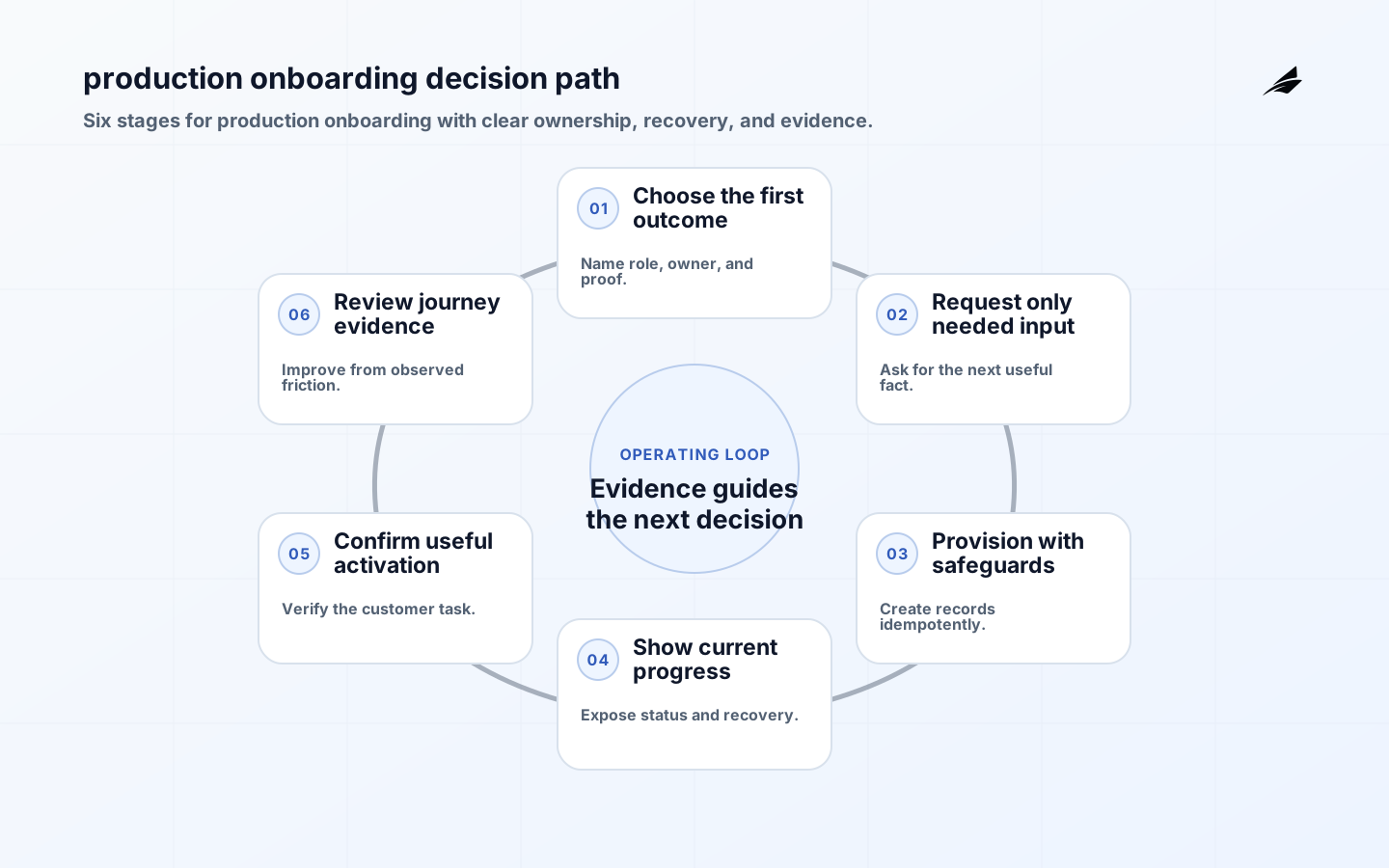
Self-serve onboarding is a production workflow for creating a working account, not a polished sequence of welcome screens. A customer can arrive with incomplete information, an existing identity, a company security policy, a delayed integration, or a teammate who should complete the next step. The journey earns trust when it makes progress visible, avoids asking for information twice, and leaves a recoverable record when a dependency fails. The engineering task is to make the path understandable for people and controllable for operations. This guide gives operations leaders a practical way to set the boundary, design the controls, release safely, and keep improving from evidence in the self-serve onboarding context.
Set the self-serve onboarding boundary before implementation — self-serve onboarding

Begin with a role-specific first outcome. An administrator may need to create a workspace and invite a colleague; an individual contributor may only need to connect data and complete a first task. Map the required inputs, external dependencies, and permissions for each outcome. Store setup state as explicit milestones rather than inferring it from a collection of UI events. That record supports resume, handoff, support, and measurement. It also lets the product distinguish a voluntary pause from an error that needs intervention. Before solution design, write down the outcome, the records involved, the actor who is accountable, and the evidence that proves a safe result in the self-serve onboarding context. This narrow statement makes tradeoffs visible: some work must be synchronous and confirmed immediately, while other work can be durable and asynchronous for this self-serve onboarding context. Treat the distinction as a product promise. A person should never have to infer whether a request completed, is pending, or requires another action within self-serve onboarding context.
| Decision area | Question to settle | Evidence to retain |
|---|---|---|
| Scope | Which self-serve onboarding outcome is being protected or improved? | Named owner and success condition |
| Authority | Which system or role may make the state change? | Policy version and decision record |
| Failure | What happens when a dependency or input is incomplete? | Visible status, retry rule, and responder |
| Review | Which signal changes the next product decision? | Threshold, cadence, and accountable team |
Design self-serve onboarding as an explicit operational contract — self-serve onboarding
Use progressive disclosure to request information at the point it changes the next action. WCAG 2.2 requires errors to be identified in text when detected, and its input-assistance guidance is a useful baseline for labels, corrections, and confirmation around consequential changes. Do not hide a required administrator decision behind a generic completion bar. Explain why access is needed, preserve entered values after a failure, and route the user to a specific remedy. For automated provisioning, make requests idempotent and expose a durable status instead of repeatedly creating partial accounts. Write acceptance criteria that include the unhappy path: a missing field, a duplicate action, a late response, an unavailable dependency, and a valid but unusual request in the self-serve onboarding context. The intent is not to predict every incident. It is to make the normal rules and safe fallback visible enough that a colleague can reason about a new case without relying on private knowledge for this self-serve onboarding context.
- Name the user-visible outcome and the state that confirms self-serve onboarding is complete.
- Assign authority for each important record, transition, and exception.
- Keep a durable identifier for requests, events, and corrections that may be repeated in the self-serve onboarding context.
- Expose pending, failed, and completed states in language a customer can act on in the self-serve onboarding context.
- Test denied or invalid paths as carefully as the intended successful path in the self-serve onboarding context.
- Give every manual exception queue an owner, response expectation, and correction route in the self-serve onboarding context.
Release self-serve onboarding with recovery and observability — self-serve onboarding
Treat the onboarding flow as a small integration product. Test a new account, an invited member, a returning user, a blocked domain, a failed connector, a slow background task, and a workspace that changes owner midway through setup. Release observability with the flow: a correlation identifier should connect the UI session, provisioning request, external response, and support record. A manual fallback can be appropriate, but it must show who owns the next action and how the user will be informed. Use a limited audience when the behavior or operating assumptions are new, but do not make the control itself contingent on a vague experiment in the self-serve onboarding context. Capture correlation identifiers at boundaries so support and engineering can trace one real item from input to outcome for this self-serve onboarding context. Confirm that a rollback preserves the ability to explain and correct records created during the release within self-serve onboarding context. in-app guidance in production is a useful adjacent decision when planning the customer-facing implications.
| Production risk | Practical control | Signal for review |
|---|---|---|
| Ambiguous state | Use an explicit lifecycle and durable identifiers | Conflicting or aged records |
| Unsafe retry | Make commands and event processing idempotent | Duplicate effects or corrections |
| Invisible exception | Create an owned queue and customer-facing status | Age of unresolved work |
| Uncontrolled change | Stage exposure and retain a rollback route | Unexpected outcome after release |
Operate self-serve onboarding from decision-ready signals — self-serve onboarding
Activation deserves a definition stronger than completion of a tour. Measure the share of accounts that reach the stated first outcome, time to it, abandonment by step, recovery after validation error, and the age of pending provisioning work. Review completion by role and device because a single aggregate can conceal a journey that works only for the team that designed it. Watch qualitative evidence too: repeated support questions often identify an unclear prerequisite before analytics does. Choose measures that lead to a named action: investigate a specific backlog, pause a rollout, contact affected customers, correct a record, or change a policy in the self-serve onboarding context. Review the oldest unresolved cases alongside aggregate rates. Averages are useful for trend, but they can make a single consequential failure disappear for this self-serve onboarding context. Keep event history proportionate to the need to reconstruct a decision and protect it with the same care as the workflow itself within self-serve onboarding context.
Keep self-serve onboarding changes reviewable — self-serve onboarding
Onboarding captures identities, organization details, permissions, and sometimes data connections. Keep a decision record for each required field, the system that owns it, retention expectations, and the person who may change it. Review a new step when it introduces a legal, security, or billing consequence. Product and operations should agree on the escalation rule for stuck accounts, otherwise the phrase self-serve becomes a reason for a customer to wait without an accountable responder. Keep the record short enough to use: purpose, affected users and records, accountable owner, release condition, recovery method, and review date in the self-serve onboarding context. This is not ceremony for its own sake. It lets product, engineering, support, and operations distinguish a change in presentation from a change in authority, cost, or customer commitment for this self-serve onboarding context. Retire old exceptions and temporary rules deliberately; they are part of the production behavior even when no longer visible in the interface within self-serve onboarding context.
Use authoritative guidance to check the design — self-serve onboarding
The recommendations here are informed by Web Content Accessibility Guidelines (WCAG) 2.2, Understanding Error Identification, How the alpha phase works, Using webhooks with subscriptions. These sources provide durable reference points for access decisions, accessible interaction, asynchronous integration behavior, reliable operation, or controlled delivery, depending on the problem at hand in the self-serve onboarding context. For self-serve onboarding, apply them to accessible data collection, provision-status recovery, and the first role-specific outcome. They do not replace customer research, contractual obligations, or domain-specific review for this self-serve onboarding context. Use them to challenge assumptions, then record the product-specific rule your team adopts and the evidence that will show whether it is working within self-serve onboarding context.
Key self-serve onboarding takeaways
- Define self-serve onboarding around a bounded customer outcome, not a feature inventory.
- Make ownership, state transitions, and exceptions explicit before expanding scope.
- Release with representative failure tests, traceable evidence, and a correction path.
- Use signals that trigger a concrete operational or product decision.
- Keep policy and change records understandable to the people who support the service in the self-serve onboarding context.
- Remove temporary controls once their decision has been made and verified.
Self-serve onboarding FAQ
How many steps should self-serve onboarding have? As many as the first successful outcome requires, and no more. Combine only steps with the same owner and dependency. Can a progress bar represent estimated time? It can, but never use it to imply success while the account is still provisioning. What happens when setup needs another person? Save the state, make the pending owner clear, and send a specific invitation or reminder. How do we handle a connector failure? Preserve the user’s work, report the actual problem in text, and offer retry or an owned support path.
Conclusion: make self-serve onboarding dependable in production
Self-serve onboarding works when the product respects incomplete information and interrupted work. Make each milestone explicit, accessible, and recoverable, then learn from the accounts that do not reach the promised first outcome.
Prove the first successful setup — self-serve onboarding
For production onboarding, review one complete setup from invitation through the first useful action. Record which role supplied each input, which service created each record, and how a person resumes after a delayed connector or an abandoned step.
Make recovery visible to customers — self-serve onboarding
Recovery is part of the experience: preserve entered values, show whether provisioning is pending or failed, and give support a traceable handoff. A rollback should explain what happened to invitations, workspace state, and downstream jobs.
Review onboarding evidence at the right cadence — self-serve onboarding
Use completion time, recovery time, duplicate-account rate, abandonment by step, and assisted-completion rate as separate signals. A healthy average can hide a blocked administrator, so segment the review by role, integration, and failure reason.
Questions for the production onboarding review — self-serve onboarding
Which onboarding proof is durable? — self-serve onboarding
Retain the inputs, decision, owner, outcome, and recovery record that matter for production onboarding. Make the record useful to the next operator, not just to the person who designed the control in the self-serve onboarding context.
How should setup friction be segmented? — self-serve onboarding
Choose one outcome measure for production onboarding and pair it with failure, exception, and recovery measures. Review segments that expose a blocked role, dependency, or workload.
When should the onboarding path change? — self-serve onboarding
For onboarding, change the path when recovery evidence shows a blocked role or unsafe handoff; record the reason and retest the affected step.
Conclusion: operate production onboarding with evidence
Reliable production onboarding is a maintained operating practice. Keep the boundary explicit, make the difficult path recoverable, and give every material exception an owner and a review date in the self-serve onboarding context.
For adjacent Edilec guidance on self-serve onboarding, compare API rate limiting engineering notes, the zero-trust operations checklist, and the production secrets-rotation guide. This comparison is selected for What Changes When Self-serve Onboarding Moves into Production.
Source context: Web Content Accessibility Guidelines (WCAG) 2.2; Understanding Error Identification; How the alpha phase works; Using webhooks with subscriptions; Service Standard.