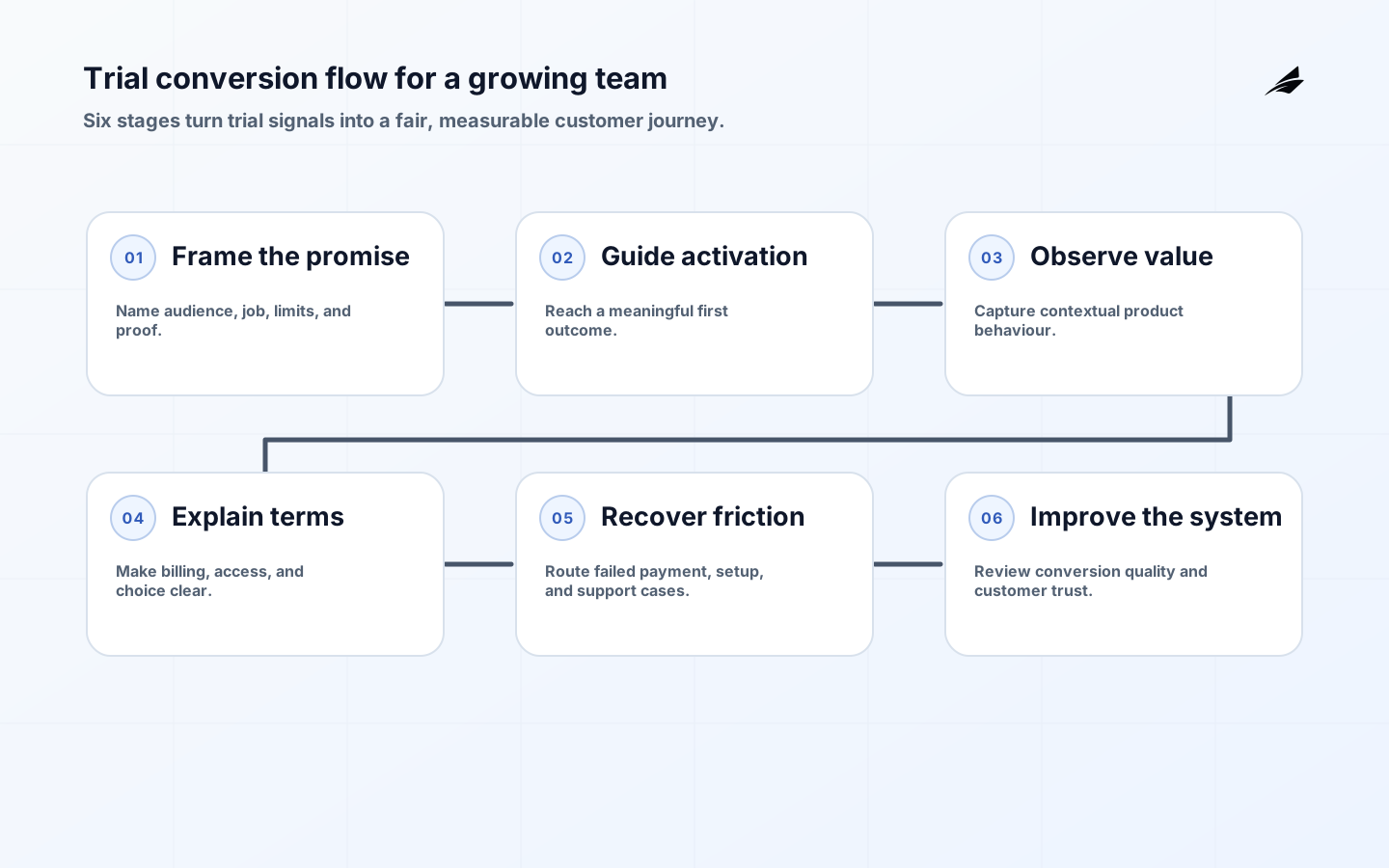
As a team grows, trial conversion becomes a coordination problem. Marketing promises a result, product guides activation, engineering records events, finance owns billing, support handles friction, and leadership asks for a rate. If those teams do not share the same definition of value and state, the business can optimize a number that customers experience as confusion. A field guide should keep the whole path visible: promise, activation, product evidence, billing terms, access, recovery, and learning. OpenTelemetry’s observability primer offers a useful principle for the product side too: reliability is whether the service does what users expect, not merely whether the system is up. Trial conversion is healthy when people reach value, understand their choice, and continue because the product earns it.
Frame the promise around a job
Write the promise in the customer’s language and pair it with the job the trial should make possible. A promise such as “get control of your operations” is hard to test; “review yesterday’s exceptions and assign the next action” is concrete. Identify the audience, prerequisite data, time to first result, and evidence of success. Keep marketing, onboarding, in-product help, and sales language aligned. If different segments need different first jobs, define separate paths and measures rather than averaging them into one activation event. The trial conversion decisions guide is a useful companion for establishing the contract before a growing team adds more plans or experiments.
Guide activation to meaningful value
A trial should help a customer reach the first valuable result with enough context to know whether it matters. Remove optional work from the critical path, but do not hide requirements that will block the job later. Use role-specific prompts, sample data where appropriate, and visible progress. Make every field and control accessible; W3C guidance applies to pricing and cancellation as much as to setup. Show what has been saved and what remains. If an integration or collaborator is needed, explain why and provide a safe alternative for exploring the product. Activation should be an outcome that a customer can recognize, not a state the company infers from a click.
| Stage | Customer question | Team evidence |
|---|---|---|
| Promise | Is this for my problem? | Audience, job, and expected result |
| Activation | What should I do first? | Completed first valuable workflow |
| Value | Did this help? | Result viewed, shared, or acted on |
| Choice | What happens if I continue or stop? | Terms, plan, payment, cancellation state |
| Recovery | Can I fix this? | Owned route for setup, payment, or support friction |
Observe value with context
Instrument the events that connect product behaviour to the promised job. Capture account or tenant scope, plan, trial timing, role, product version, source, event time, outcome, and reason when a step fails. Keep event names stable enough for longitudinal analysis and avoid treating all clicks as intent. OpenTelemetry’s concepts help distinguish metrics, logs, and traces: a rate can show a trend, an event can record a discrete choice, and a trace can explain a multi-service operation. Use the least sensitive data that answers the question. A support view should show what value was reached and what blocked continuation without exposing unnecessary customer content.
Explain terms and access
Keep trial start, end, limits, plan, payment method, renewal, cancellation, pause, downgrade, and data retention visible at the decision point. Do not bury a material term in a separate help page. Make pricing and billing controls keyboard accessible, labelled, and understandable. On the system side, model entitlements explicitly and enforce them on the server. OWASP authorization guidance supports least privilege, deny-by-default, and checking access close to the protected resource. If a customer adds a teammate, decide whether that person shares the trial, receives a role-limited view, or starts a separate entitlement. A clear access model prevents both accidental overexposure and support confusion.
Recover the friction that blocks conversion
Group friction into setup, product value, billing, access, performance, and trust categories. Give each category a route and owner. A failed integration may need a retry or sample data; a payment failure needs billing recovery; a missing feature may need an honest explanation rather than another email. Preserve the customer’s progress and show whether the operation is pending, failed, or completed. Reconcile product and billing state after webhooks, retries, and support changes. A growing team should avoid granting open-ended extensions to hide a broken path; when an extension is necessary, record reason, scope, duration, and outcome. Recovery should improve the system, not only rescue one account.
| Friction | Helpful customer response | Operating measure |
|---|---|---|
| Setup blocked | Explain missing prerequisite and offer safe next step | Time to resolved activation |
| No value yet | Return to the job with guided example | First-value completion |
| Payment failed | Show status, retry, and contact route | Recovery and involuntary churn |
| Access denied | Explain scope without leaking data | Denied action and support resolution |
| Cancellation | Make choice clear and preserve policy | Cancellation success and surprise reports |
Build the conversion operating model
Give product ownership of the value definition, finance ownership of billing authority, engineering ownership of state and integration reliability, support ownership of recovery, and security ownership of access and data boundaries. These are responsibilities, not silos. Maintain one glossary for trial, activation, conversion, active, past due, cancelled, and retained. Review the same cohort with product, finance, support, and engineering so a billing conversion is not mistaken for a successful customer outcome. Google’s SRE monitoring guidance is a useful prompt to connect signals to user impact and actionable response. A dashboard is not an operating model when it reports thousands of events but cannot identify customers or next actions.

Measure durable outcomes
Track trial-to-paid conversion with eligibility and cohort definitions, then pair it with first-value completion, time to value, usage of the promised workflow, support contacts, payment recovery, cancellation, refund, and early retention. Segment by plan, role, source, integration path, and customer maturity. Review qualitative evidence for confusion and trust. A conversion rate can rise because more customers were charged before understanding the product; that is not a durable improvement. Define a review window long enough to see whether customers continue the job they were promised. Record the hypothesis, change, observed result, and decision to expand, revise, or roll back.
A practical field sequence
- Write the promise, audience, first job, and evidence of value.
- Align trial, billing, access, data retention, cancellation, and support states.
- Guide activation with accessible content and role-appropriate next steps.
- Instrument meaningful outcomes with account, plan, timing, version, and reason context.
- Test setup, integration, payment, access, cancellation, retry, and recovery paths.
- Review durable outcomes with product, finance, support, engineering, and security.
Review the conversion system, not only the rate
Use one shared customer story to align the team. Follow a new account from the promise through first value, payment or cancellation choice, entitlement change, and early retention. At each point ask what the customer sees, what the product records, what finance considers authoritative, and what support can repair. Include accessibility checks for pricing and cancellation, tenant and role checks for entitlements, and event checks for delayed or duplicated billing notifications. The trial conversion decisions guide helps keep definitions stable while the team experiments. When the outcome differs by segment, expose the difference and choose a focused response rather than hiding it in a blended rate. The review should end with one owned change or an explicit decision to keep the current behaviour.
Run a recurring review with product, finance, support, engineering, and security. Follow one customer from promise to first value, payment or cancellation choice, entitlement change, and early retention. Compare the customer-facing language with product events, billing records, and access state. Test an integration failure, failed payment, late webhook, duplicate notification, and support extension. The trial conversion decisions guide can anchor the contract while this field guide focuses on the team rhythm. When a dashboard says conversion improved, ask whether the intended job improved, whether customers understood the charge, and whether support burden moved elsewhere.
Keep experiments reversible and name the risk before release. A pricing copy test may alter comprehension; an activation prompt may alter data collection; a billing change may alter entitlement timing. Define the cohort, event version, outcome window, support escalation, and rollback signal. Review by segment and role rather than hiding variation in an average. If customers convert but do not repeat the workflow, change the value path before asking for more conversion. A growing team can move quickly when the shared model makes evidence comparable and when every change has an owner who can explain the customer consequence.
Key takeaways
Use the takeaways to connect conversion reporting to customer trust. Define the eligible cohort and value event, then review billing, entitlement, product evidence, cancellation, support burden, refunds, and early retention together. Segment results by plan, role, acquisition path, and integration so a blended rate does not hide a broken promise. Inspect whether customers understood the charge and could recover from setup or payment friction. If the number improves while durable use falls, pause expansion and investigate the value path. Record one owner, one customer consequence, one measure, and one rollback signal for the next change. That review rhythm lets a growing team learn without turning experimentation into silent risk or hidden harm.
Keep the customer’s choice legible after conversion as well. A paid customer may change plan, add a teammate, pause, downgrade, or cancel. Review whether product access, invoices, emails, and support views converge after each change. Use a clear authority for payment and a clear authority for product access, with reconciliation when they differ. If a customer cannot tell why a feature is unavailable or how to stop a renewal, the system has failed even if the trial converted. A growing team earns durable conversion by making the whole lifecycle understandable.
Keep onboarding and trial states distinct but connected. A customer may activate before conversion, convert before retention, or need support after payment. The onboarding flows guide helps keep identity, first value, and recovery decisions explicit at the start of the journey.
Keep the handoff from onboarding to trial explicit. The onboarding production guide is useful when support must distinguish incomplete setup from a billing or entitlement problem.
The OpenTelemetry observability primer grounds user-impact signals; the W3C WCAG overview supports accessible pricing and cancellation; the OWASP Authorization Cheat Sheet supports entitlement checks; and Google’s SRE monitoring workbook helps keep measures actionable.
- Conversion is the result of value, clarity, access, and customer choice.
- Keep promise, activation, product evidence, billing, and entitlement states aligned.
- Make pricing and cancellation interactions accessible and understandable.
- Treat friction as owned recovery work and feed patterns back into the product.
- Judge improvements by durable value and trust, not a single rate.
Frequently asked questions
What is a good trial conversion rate?
There is no useful universal number. Define the eligible cohort, trial terms, value event, billing window, and retention period, then compare changes against customer outcomes and trust. A lower rate can be healthier if it reflects better qualification and durable use.
How should a growing team define activation?
Use the first valuable job a customer can recognize and complete. It should be tied to the product promise and durable enough to predict continued use, rather than a shallow visit or click.
Should support offer trial extensions?
Extensions can be appropriate for a documented service failure or evaluation need, but they should be scoped, authorized, visible to billing and product, and reviewed. An extension should not conceal a recurring activation or payment problem.
Conclusion
A growing team improves trial conversion by making the whole customer journey legible. Frame a real promise, guide the first useful job, observe value with context, explain terms, recover friction, and review durable outcomes. That discipline turns conversion from a volatile funnel number into a shared measure of customer trust and product usefulness.