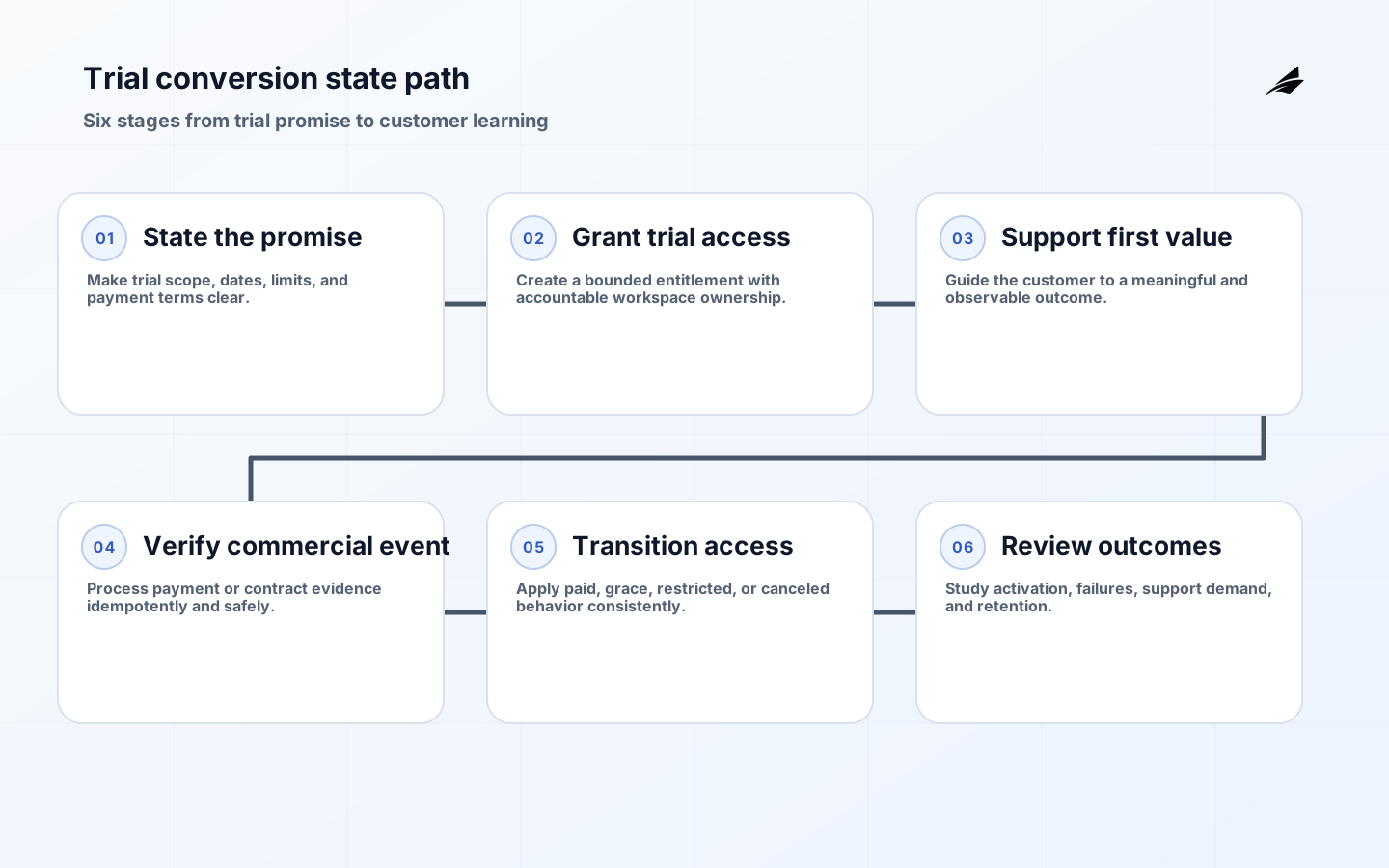
Trial conversion is often discussed as a funnel metric, but the product experience is a stateful engineering system. A person creates an account, joins or creates a workspace, receives a trial entitlement, reaches an outcome, may invite colleagues, may add payment details, and eventually either becomes a paying customer, downgrades, pauses, or leaves. Each transition affects access, communications, consent, and support. The engineering goal is not to maximize a chart by making expiry ambiguous or obstructing cancellation. It is to make the trial promise clear, help the right customer experience a meaningful result, and convert commercial state into correct product access. When teams model this honestly, they can distinguish a weak value proposition from a broken verification step, a pricing mismatch, or an avoidable onboarding failure.
Define the trial promise and the first valuable outcome
Start with a precise statement of what the trial includes, how long it lasts, whether payment information is required, what happens at expiry, and which roles may use it. Put that information where a reasonable buyer can see it before committing. Then choose one observable outcome that signals real value, such as importing a first dataset, publishing a report, completing an approval flow, or inviting a teammate who successfully finishes a task. Avoid measuring superficial clicks as if they were customer progress. The product should help a new user reach that outcome with relevant defaults, sample data only when it is clearly labelled, and an escape route when the setup does not match their situation. A useful trial is not a smaller version of every feature; it is a coherent path to a decision about continued use.

| Trial decision | What to make explicit | Engineering consequence |
|---|---|---|
| Start condition | Identity, workspace ownership, and eligibility. | Prevent duplicate or inappropriate trial grants. |
| Access scope | Features, limits, users, and integrations. | Issue a bounded entitlement rather than ad hoc flags. |
| Expiry policy | Date, timezone, grace period, and data retention. | Schedule a tested state transition and customer notice. |
| Conversion trigger | Verified payment or approved contract event. | Provision paid access from durable commercial evidence. |
Model trial and paid states as an explicit lifecycle
Create a small state model that product, billing, support, and analytics can all understand. For example: eligible, trialing, payment pending, active, grace, restricted, canceled, and reactivated. Define allowed transitions, owner, triggering event, effective time, and customer communication for each. Do not infer a paid state from a successful page redirect; verify the provider event and handle retries, out-of-order delivery, and payment methods with delayed confirmation. When a trial ends, decide whether the account becomes read-only, loses selected capabilities, or is scheduled for deletion after a clear retention period. Preserve enough data for a returning customer where that is promised, but do not retain more personal or customer data than necessary. A single authoritative entitlement record prevents the familiar bug where an email says “trial ended” while the API still permits paid actions.
Reduce friction without removing consent or control
Every extra field, verification task, or setup choice can slow a legitimate customer, yet removing all friction can create abuse, unusable accounts, or a security problem. Choose the smallest identity and configuration step that protects the service and supports the promised outcome. Keep calls to action descriptive, keyboard accessible, and honest about the result. If a card is required for renewal, say so before it is requested. If a user can invite others, clarify whether the workspace owner will be billed for additional seats. Use progressive setup rather than a wall of preferences, but do not defer decisions that change the customer’s commercial obligation. Instrument where people stop, while respecting consent and minimising event data. Pair quantitative signals with session reviews and support feedback; a drop-off after “connect data source” may reveal a technical prerequisite, not a copywriting issue.
| Friction point | Healthy response | Unhelpful shortcut |
|---|---|---|
| Email verification | Explain why it protects the account and retry safely. | Silently creating duplicate accounts after a delayed email. |
| Payment collection | State amount, renewal terms, and confirmation result. | Calling a subscription active before payment is verified. |
| Team invitation | Show role and seat effect before sending. | Allowing unlimited seats with no entitlement check. |
| Trial end | Offer clear next steps and data policy. | Removing access with no retained explanation or support route. |
Measure learning, not manipulation
A conversion rate alone cannot tell a team whether the trial is healthy. Measure time to the first valuable outcome, completion by account type, invitation success, verification failures, payment confirmation delay, expiry-related contacts, reactivation, and retention after conversion. Make segments meaningful and protect identities; do not turn behavioral data into unrestricted surveillance. Review false starts: accounts that converted but immediately needed support, accounts that reached value but did not buy, and accounts whose access was wrongly restricted. These samples reveal problems in packaging, onboarding, or state management that aggregate metrics conceal. Before changing a trial rule, write the hypothesis, affected population, expected benefit, and guardrails. The SaaS MVP implementation checklist can keep that experiment disciplined as the product evolves.
- State the trial scope, end date, and payment behavior before sign-up.
- Design one meaningful customer outcome rather than an unfocused product tour.
- Translate verified commercial events into explicit access states.
- Keep conversion controls accessible, honest, and reversible where appropriate.
- Study activation, errors, support demand, and post-conversion retention together.
Prepare customer communication and recovery paths
Map every automated trial message to the state that authorizes it. A welcome message, value reminder, payment prompt, expiry notice, cancellation confirmation, and reactivation note should be triggered from durable facts and should link to the action the reader can take. Test the sequence for a user who changes timezones, joins a workspace late, receives a payment failure, or has opted out of non-essential communications. Transactional messages must still be understandable when the customer cannot immediately sign in. Support should see which message was sent and why, but should not be able to resend a payment request or extend a trial without an authorized route and an audit record.
Build a recovery queue for state mismatches rather than relying on ad hoc fixes. It should include commercial event, entitlement state, customer impact, owner, and resolution evidence. Reconcile it on a schedule and use recurring mismatches to improve the adapter or decision rules. Make cancellation and data export routes as reliable as upgrade routes; a customer who can begin self-service should be able to understand how to leave it. This is both a trust issue and an engineering signal. Systems that only optimize the happy conversion path tend to accumulate the most painful support cases at expiry and renewal.
Keep trial behavior consistent across every customer surface. The account page, invoices, transactional emails, API responses, support console, and product controls should agree about the current state and the next change. Give the content team a versioned source for plan descriptions so an old message does not describe a retired limit. For a global service, document timezone handling and local payment-method differences. Finally, test a user whose organization purchases through a sales-assisted contract after they began self-service. Their personal trial history, workspace ownership, and commercial entitlement need a controlled merge path rather than an improvised transfer between systems.
Coordinate the trial policy with product-led sales rather than treating the paths as rivals. A sales-assisted customer may need a longer evaluation, additional seats, or a proof-of-value configuration that differs from a public trial. Model those cases as explicit, reviewable entitlement variants with start and end dates, not as untracked flag changes. Give account teams a request route that shows the commercial reason and expected customer impact, while preserving product ownership of the technical decision. Review whether special trials reach the same meaningful outcome as self-serve trials; otherwise, the team may be comparing incomparable conversion data. Clear variants let a business support real customer needs without eroding the consistency of the underlying lifecycle.
- Make trial duration, limits, and payment terms visible before enrollment.
- Record the account owner and trial entitlement as durable product facts.
- Use a meaningful completed task as the activation signal.
- Verify provider events before granting a paid entitlement.
- Test expiry, renewal failure, cancellation, and reactivation as first-class journeys.
- Compare conversion metrics with retention and support load, not in isolation.
Key takeaways
- Trial conversion is a product lifecycle, not just a growth metric.
- An explicit state model prevents contradictory access and messaging.
- The first valuable outcome is more useful than a long feature tour.
- Transparent terms and accessible controls build better long-term trust.
- Support and payment failures are product signals worth reviewing.
Frequently asked questions
Should a trial require a credit card?
That depends on the service risk, sales model, and customer expectation. If it is required, disclose the renewal and cancellation terms early. If it is not, add proportionate abuse controls and ensure trial eligibility is still enforced consistently.
What should happen when a trial expires?
Choose a behavior that matches the promise: read-only access, restricted capabilities, or a scheduled deletion route. Communicate the date and data policy, preserve a clear entitlement record, and give support a way to explain or safely correct a mistake.
Conclusion: make conversion a trustworthy transition
A sound trial helps a customer make an informed decision because the experience, commercial terms, and technical access states agree. Define the value milestone, model the lifecycle, verify payment before provisioning, and make expiry understandable. That discipline produces cleaner data and a more respectful path to growth than a conversion system built on ambiguity.